Lia Buarque de Macedo Guimarãesa (2022). Civil Defense Volunteers Calling for Helping in Disasters Situation. In: Advances in Ergonomics In Design, Usability & Special Populations: Part III. AHFE Open Access, vol. 20. https://doi.org/10.54941/ahfe1001351
This article presents a study on the volunteers calling system for helping the Civil Defense group from the city of Curitiba, Brazil. Traditional calling is done using computer and telephone, what takes a time officials cannot spare. Therefore, volunteers are seldom called. A new calling system based on smartphone and geolocation technology was prototyped and compared with the traditional system. Simulation of the two systems showed that, in the traditional system, it takes 1h45min for two officials to call 96 volunteers. Only one official using the new technology can perform the same task in 7min36s. The results show that the introduction of new and affordable technology can improve the work performed by Civil Defense.
The frequency and intensity of natural disasters have been rising sharply worldwide in recent decades (Thomas, 2010) and although countries are strengthening risk governance capacities and reducing vulnerability, this is not happening quickly or effectively enough (GAR, 2011). The last Brazilian report on natural disasters (CEPED-UFSC, 2012) shows that they increased by 73% from 1991 to 2010. Droughts (mainly in the Northeast region) account for 50.34% of these disasters, but flooding (29.56%) generates more deaths (43.19%) mainly in the South and Southeast regions. The Brazilian 2009-2011 HFA report (PreventionWeb, 2012) states that disasters are a contributing factor for increasing the social debt and inequality, affecting the country’s sustainable development. However, the Brazilian Civil Defense does not have the information and technology needed to efficiently act during a crisis, and there is no structured plan for disaster risk reduction.
Brazilian Civil Defense may count on the help of volunteers in case of disasters. However, they are seldom engaged in the process because emergency situations are often chaotic, and the calling of volunteers takes a time that the Civil Defense (CD) team cannot spare. During a crisis, officials have to look for infrastructure on health, shelter, transportation and social support by contacting many secretaries and officials, set an action plan and monitor actions that involve different technical and human resources. Although time is crucial, officials agree that trained volunteers would be of great help in most situations. They would be engaged in the rescue group if they could be more easily contacted. For the officials, the current calling system is ineffective, because it takes a long time for searching (in a computer file), locating and contacting them (through telephone). However, advances in mobile technology and application development might change this reality. Nowadays, people might be easily located and contacted by means of satellite navigation and GPS tracking technology. Smartphones with built-in transceivers that broadcast a target position has been developed for rescuing avalanche victims (Technology Org, 2014). Another advantage of cell phone technology is that it is usually the only communication system that does not collapse under adverse situations. Therefore, American Red Cross (2014), US-based Substance Abuse and Mental Health Services Administration (SAMHSA, 2014), for example, have developed smartphone apps to support users in crisis situation. Smartphone technology is getting better and cheaper, what justifies its use by most people worldwide. 69.1% of the Brazilian population uses this technology (IBGE, 2013) and the rate is increasing in all regions of the country.
In order to improve the current volunteers calling task, a research was done on the CD system adopted in the city of Curitiba, Brazil. An alternative solution was developed based on smartphone and geolocation technology. This paper presents the comparative results, based on computational simulations, of the volunteers calling task under the traditional system and the proposed smartphone technology.
METHOD
Research followed 4 steps:
1) appraisal for understanding the volunteers calling process, based on interviews with: the head office of the municipal CD Council (3 officials); the regional CD Council (2 officials) and; Bairro Alto volunteers CD group (3 people). The interviews generated 3 procedures maps, which were then validated by each group.
2) brainstorming session with 2 CD Council officials for evaluating the profile and quantity of volunteers that could be engaged in a real event. In 20-26 June 2013, 2346 houses (8 thousand people) were affected by flooding in Curitiba. Although CD had not enough personnel to cope with the situation, volunteers were not called. Based on data from the brainstorming, the 2 officials were asked to simulate calling volunteers from the 4 most affected districts, where 258 people were dislodged. The 2 officials simulate the calls simultaneously: their times and actions were recorded, generating a human/machine map. A total of 96 callings to the 4 districts were simulated.
3) developing an alternative system for volunteers calling using smartphone and geolocation technology. The system displays the volunteers available in the emergency area, who (the profile) and how many they are. The official can select the volunteers, and send one single call message to all. Volunteers than send back a message confirming their availability. The system displays an estimate of the time participants will arrive to the local. Therefore, the task of the official is to start the calling program and confirm the volunteers’ engagement in the action plan.
4) comparing the calling based on the traditional and new technology using Promodel computer simulation. To obtain a 99% level of confidence, simulation was run 21 times for the traditional and 4 times for the new technology condition. The reason is that variability of work using the new technology is lower than of work with the traditional technology.
RESULTS
Appraisal of the volunteers calling task showed that, traditionally, the calling is done using computer (which keeps the volunteers records) and telephone. DC officials search for volunteers on a restricted access computer file, named SISDC. They may search for people filtering data by state and district, but no other important information (such as who is available in the neighborhood and the profile of the volunteers) is retrievable. Officials have to select people from the file, get their phone number, make the call and talk to each possible volunteer in order to set a volunteers group. Because this task is time consuming and officials are under pressure for attending the community in need, volunteers are seldom engaged in the rescue team.
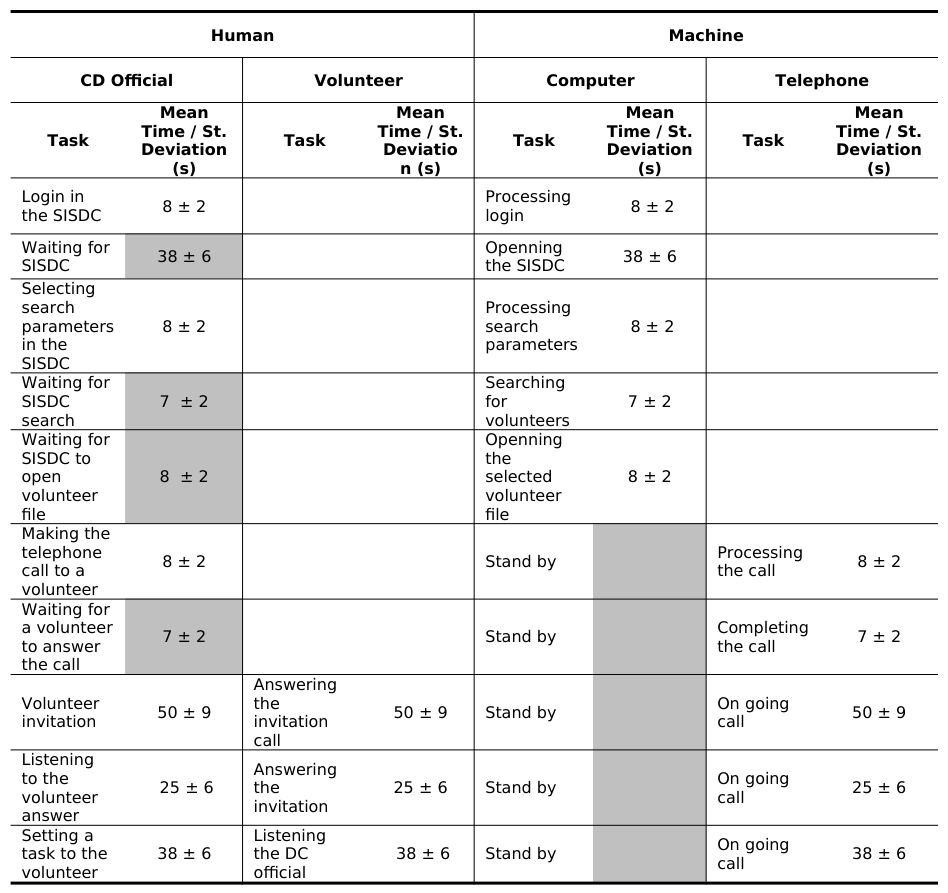
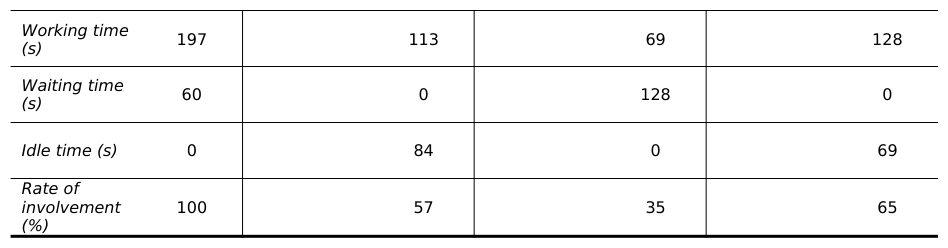
In step 2, the two CD officials agreed that a team of 96 volunteers would be needed for helping 258 dislodged people from four districts affected by the June 2013 flooding. Each official simulated calling 48 volunteers in the traditional system using computer and telephone. The task lasted about 1hour 45min and required each official to be involved 100% of the time.
In the prototyped new system (step 4), volunteers who are close to the sites in need (located by geolocation technology) are automatically invited by DC through smartphone. Just one message can reach many people, simultaneously, therefore reducing the time officials would spend for locating and calling them.
Traditional and new systems were than simulated using Promodel and the results were compared (step 4). Table 1 shows the simulated results for calling 96 volunteers under the traditional system (involving 2 officials) and Table 2 shows the results for calling 96 volunteers under the new system (involving one official).
Table 1: Allocation of tasks and time spent in the traditional human-machine system for a volunteer calling using computer and telephone
Traditional Calling System Human Machine
Table 2: Allocation of tasks and time spent in the proposed human-machine system for volunteers calling. One DC official uses a smartphone app and geolocation technology to call all necessary volunteers
Proposed Calling System Human Machine
With the smartphone and geolocation technology (Table 2), only one DC official called 96 volunteers in 7 min 36 s. Mean times in Table 2 were assumed as normal distribution for Promodel simulation. Simulation considered only once the two first tasks of the cycle (“Opening smartphone app and “Selecting Menu option for sending SMS invitation to volunteers”. Most of the time of 7min 36s is used for “Sending SMS invitation to volunteers”, a task done by the machine sequentially to 96 people. Because machine does most part of the work, human involvement is reduced. The time one official spent in the calling is only 21 s, i.e., 4,52% of the total calling time of 7min 36 s. This means that officials can call volunteers without wasting the time that should be used in his/her major tasks. Besides, by saving time, officials can act faster, what is crucial in any critical situation.
CONCLUSIONS
This article presented the results of a study on volunteers calling for helping the Brazilian Civil Defense (CD) in case of an adverse event. In the traditional calling system, CD officials look for volunteers in a computer file and make telephone calls to invite them. Because this task is time consuming, volunteers are seldom engaged in the rescue. In order to optimize the calling task, a new proposal using smartphone and geolocation technology was prototyped and tested. The idea behind the new system is that volunteers who are close to the sites in need (geolocation technology can be used for locating people) would be automatically invited by DC officials through smartphone. Just one message can reach many people, simultaneously, reducing the time officials would spend for locating and calling the volunteers.
Results from the two simulations showed that under the traditional system, two officials spent about 1hour 45min calling 48 volunteers (totaling 96 calls). The task requires each official to be involved in the task 100% of the time. With the new technology, only one DC official called 96 volunteers in 7min 36 s. Because technology does most part of the work, human involvement is reduced. The time one official spent in the calling is only 21 s, i.e., 4,52% of the total calling time of 7min 36 s. By reducing time spent on locating and calling people, and by revising its procedures, Brazilian Civil Defense might easily engage in its workforce the valuable and available contribution of volunteers. Besides, the use of smartphone technology should not be restricted to CD officials and volunteers; citizens in crisis situations would profit from getting easy communication and information, therefore apps should also be developed for supporting them.
REFERENCES
American Red Cross (2014), “Red Cross mobile apps”: http://www.redcross.org/prepare/mobile-apps CEPED-UFSC (2012), “Brazilian map of natural disasters, 1991 to 2011”: http://www.integracao.gov.br/c/document_library/get_file?uuid=9910176b-5173-4fb5-9a39- dc16e2faa0ed&groupId=10157. GAR (2011), “Global assessment report on disaster risk reduction - revealing risks, redefining development”: http://www.preventionweb.net/english/hyogo/gar/2011/en/home/executive.html IBGE (2013), Brazilian Institute for Geography and Statistics. “National research by sample, 2011: Access to Internet and use of personal cell phones”: ftp://ftp.ibge.gov.br/Acesso_a_internet_e_posse_celular/2011/PNAD_Inter_2011.pdf. PreventionWeb (2012), “Brazil: National progress report on the implementation of the Hyogo Framework for Action (2009-
2011)”: http://www.preventionweb.net/english/hyogo/progress/reports/v.php?id=16862&pid:223. SAMHSA (2014), “Access critical, disaster-related behavioral health resources right from your phone with the SAMHSA Disaster App”: http://store.samhsa.gov/apps/disaster/ Technology Org (2014), “How smartphones help find avalanche victims”: http://www.technology.org/2014/02/07/smartphones-
help-find-avalanche-victims/ Thomas, V. (2010), “Why aren't we ready for natural disasters?”: http://www.huffingtonpost.com/vinod-thomas/not-ready-fornatural-disasters_b_698799.html.
LISTED IN THE AHFE DIGITAL BOOKSTORE CATALOGUE
Explore the complete digital volume
Advances in Ergonomics In Design, Usability & Special Populations: Part III
Read this individual research paper free through the original publisher, or explore the full digital proceedings book.
ISBN 978-1-4951-2108-1
Explore this ISBN in the AHFE Bookstore ↗Listed in the July 2026 bookstore catalogue; search by ISBN to confirm current availability · Digital book purchase optional