Shuichi Fukuda (2021). Emotional Engineering and PLM. In: Advances in Affective and Pleasurable Design. AHFE Open Access, vol. 14. https://doi.org/10.54941/ahfe100569
Quickly increasing diversification and frequent and extensive changes in our environments and situations call for new frameworks for Product Lifecycle Management (PLM) and Mass Customization and Personalization (MCP) and their effective integration.\This paper points out that if we introduce modular design and manufacturing and if we divide modules into functional ones and emotionally appealing ones, we can reduce time, cost and energy considerably, because we can substantially minimize modular diversifications and at the same time can increase emotional satisfaction of our customers.
This paper points out that if we divide products into functional modules and emotionally appealing modules, we can reduce time, cost and energy considerably and at the same time, we can increase the emotional satisfaction of our customers. And we can integrate PLM (Product Lifecycle Management) and MCP (Mass Customization and Personalization) and can accommodate the preference and the needs of our customers in a much better way.
PLM (PRODUCT LIFECYCLE MANAGEMENT) PLM (Product Lifecycle Management) (PLM-Conference.Org, 2014 and Product_lifecycle_management, Wikipedia, 2014 ) is well known today, although it is not yet clearly defined. But to the author’s knowledge, all arguments relating to PLM are focused on product functions. And there are very few, if ever, which discuss PLM in connection with emotional satisfaction. This is because the current framework of PLM is developed mainly from the standpoint of the producer.
But if we consider that diversification comes from the diversifying requirements from the customer to customize and personalize their products, we should focus more on the customer. Indeed, why PLM is getting more and more attention these days is because the product lifecycles are getting shorter and shorter with diversification. The producer is developing products in increasingly wider variations to respond to the diversification of customers’ requirements. But the increasing number of variations does not truly satisfy our customers, because it is very difficult for producers to develop products which are very much unique and are different from the current ones. So although the product variations are increasing, their differences are getting smaller and smaller and customers feel more disappointed than satisfied because what they would like to have is a very much new and unique product. This is very much natural because for the producer, it is very difficult to develop a completely different product from their current products because they have to re-innovate their design and production and they need sometimes larger or completely new resources (human, money, time, etc) .
MASS CUSTOMIZATION AND PERSONALIZATION (MCP) Mass customization and personalization (MCP) (Pillar and Tseng, 2009) is one of the solutions to this issue. It is proposed because if producers attempt to develop products in smaller numbers to increase variability, the cost, time and energy for production will become exceeding large and in fact they cannot introduce such a system. So its main idea is to produce products in mass but still maintains variability. This idea is very good and many proposals are made to realize it. But they do not discuss the problem in connection with PLM and most of them focus their attention to daily goods and not to industrial products.
MCP OF INDUSTRIAL PRODUCTS - LEARNING FROM TRUCK INDUSTRY On the other hand, PLM researchers are focusing their primary attention on industrial products. It is dubious, however, if current discussion of MCP can be applied in a straightforward manner to such industrial products. But if we recall how trucks have been designed and produced in order to respond to the diverse requirements of their customers, we can mass customize and personalize our industrial products much easier. In fact, this practice has been developed in truck industry far earlier than the time the concept of MCP was proposed.
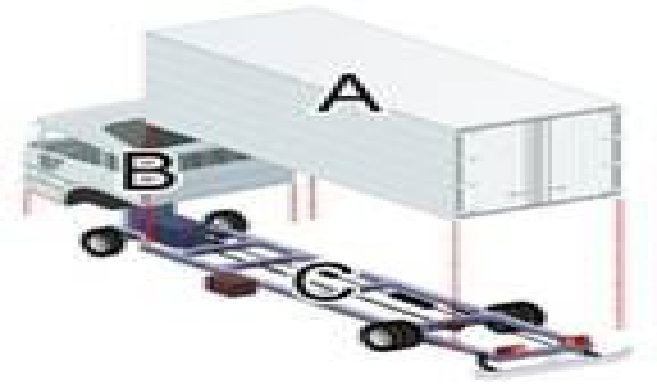
As trucks are used for a very wide variety of purposes, they divided design and manufacturing of a truck into a chassis and a body. As a chassis does not change appreciably from truck to truck, they introduced a common chassis. But what cargo body a user needs differs extensively from user to user. So they introduced another group who specialized in design and manufacturing of cargo bodies. See Figure 1.
Figure 1. Truck Design Affective and Pleasurable Design (2021)
Thus truck companies were divided into two groups; one specializing in chassis and the other in cargo bodies, brought a great reduction of energy, time, cost and human resources. The chassis companies can produce their products truly in mass. Cargo body companies cannot produce their products in such mass, but they still can produce their products with great efficiency by clustering the users needs, because although cargo bodies are very much diversified, there are not small number of customers who need the same or similar bodies. Thus, they can secure their profits if they can classify them properly. The design and production for chassis and cargo bodies are very different, but if we can modularize a whole truck into such fit-for-mass production modules and fit-for- customization modules, then we can resolve the challenging conflict between mass production and customization.
MCP IN AUTOMOTIVE INDUSTRY - PASSENGER CARS The same idea is being introduced today in other areas of automotive industry as well. Passenger cars are now introducing the same idea. They are now sharing common platforms across different models of passenger cars to reduce cost, time and energy. Their focus is still limited on the chassis and they do not discuss much about the other parts. Trucks are easier than passenger cars because they are used for industry applications so truck cargo body makers can have a clear idea about what groups need what type of cargo bodies. Thus they can discriminate a whole truck into proper modules easily. But in the case of passenger cars, such division or categorization is not straightforward. Each customer has his o her preference and the operating conditions differ from driver to driver or from user to user. Thus the degree of variability or diversification is much far greater in passenger cars than in trucks.
BIG DATA Big Data is getting wide attention these days. What Big Data brought us is a paradigm shift. Change of views from producer-centric to customer-centric.
Open Loop System The traditional producer-centric view is one way from the producer to the customer. This system was an open loop system as shown in Figure 2.
Plan
Figure 2. Open Loop System
Figure available in the original PDF paper.
Closed Loop System with Feedback But the remarkable progress of Information Technology has made it possible to process enormous amount of user data. Thus the system now emerging is a closed loop system with feedback loop from the customer as shown in Figure 3.
Study
Study
Figure 3. Closed Loop System with Feedback
Figure available in the original PDF paper.
But no matter how much progress IT has made, it is a great waste of time, energy and cost to observe how each customer is using their products and to extract their preferences or their needs for feeding back their information for updating design and production. Thus, in the case of automotive industry, especially in the case of passenger cars, further modularization beyond functional requirements still remains an open problem.
WHAT WEDDING DRESS MAKERS TEACH US This is why most MCP research works discuss only daily goods and do not discuss much about industry applications. But interestingly enough, wedding dress design provides a hint to solve this issue.
Every lady would like to wear a wedding dress just for her alone. But not every lady can afford to order a wedding dress. So most of them rent one. But wedding dress companies which produce rental dresses cannot afford to develop and produce one-of-a-kind dresses.
To solve this problem, they observed where ladies pay their attention to during shows, etc using such technologies as eye cameras, etc. They found out that there are feature parts which attract their attentions and if these feature parts are well taken care of and differ from dress to dress, ladies think that it is unique. Thus, if these feature parts appeal emotionally to them, they think that the dress is just made for her, although the other majority parts are same. Such feature based design and modularization brings emotionally satisfaction to ladies.
This is another example of modularization which separates characterizing modules from common modules. The example described here is a wedding dress, but many designers told me that other clothing designs as a whole have developed along the same line. Therefore, if we separate the emotionally appealing modules from modules that are not relevant to emotion, we could develop a truly MCP design and development for passenger cars. This idea is not restricted to automotive industries, but we can extend it across many different products and across many different industries.
MCP AND PLM Coming back to PLM, we not only can divide products into common functional modules and emotionally appealing ones, but we can further divide functional modules into several groups. those which can be used for much longer time and those which need shorter term replacements. Emotionally appealing modules can be used interchangeably from product to product and can be designed for shorter lifecycles because the cost, time and energy are in most cases far less than the functional modules.
Such division and combination of long life and short life modules is very important to respond not only to increasing diversification but also to adapt to the quick and extensive changes which often take place in these days. The current PLM certainly discusses how we can combine long life and short life modules, but their focus is limited to functions. We have to remember what brought forth diversification.
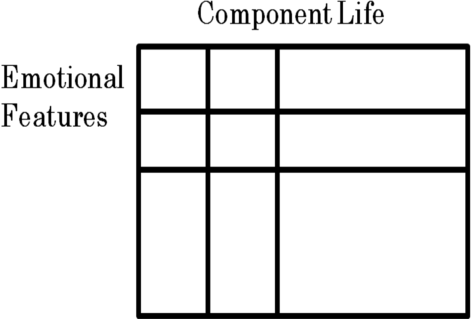
EMOTIONAL DESIGN STRUCTURE MATRIX Then, we can apply a design structure matrix (Eppinger and Browning, 2012) for such a modular emotional design and manufacturing. We can develop an emotional design structure matrix by placing emotional features in a row and component life in a column as shown in Figure 4. This allows us to combine them in an optimum way to respond to the needs and preferences of customers. Such a MCP oriented design structure matrix will reduce a great reduction of energy, time and cost, and we can minimize human resources. But it also should be stressed that it will provide a great amount of emotional satisfaction to customers.
Figure 4. Emotional Design Structure Matrix
SUMMARY Modular design and production is getting wide attention these days as a very effective approach to reduce time, cost and energy and to cope with the increasing diversification. But most of them are carried out on the basis of functions. Products are divided into modules based on functional or manufacturing such as assembly requirements. Thus the current modularization is being carried out primarily from the standpoint of the producer.
But if we look back why products are getting more and more diversified, we immediately realize that the needs and preferences of our customers are quickly diversifying and in addition they change very frequently and extensively. Therefore, if we can modularize our products based upon the needs and preferences of our customers, we will be able to develop a better and more effective modularization and we can reduce time, cost and energy. The needs are primarily associated with functions so the current modularization based on functions will be effective. But the problem of responding to the preferences of our customers is not well answered yet.
If we divide products into functional modules and emotionally appealing modules, we can solve this problem. And further we can adapt to the frequent and extensive changes of our customers’ preferences because we only have to replace the modules with other ones that best respond to the preferences of our customers when needed.
REFERENCES
Eppinger. S.D., Browning, T.R. (2012, “Design structure matrix: methods and applications (engineering systems)”, The MIT Press Http://www.plm-conference.org Http://en.wikipedia.org/wiki/Product_lifecyle_management. Pillar, F.T., Tseng, M.M. (2009), “Handbook of research in mass customization and personalization”, World Scientific
Publishing Company
LISTED IN THE AHFE DIGITAL BOOKSTORE CATALOGUE
Explore the complete digital volume
Advances in Affective and Pleasurable Design
Read this individual research paper free through the original publisher, or explore the full digital proceedings book.
ISBN 978-1-4951-2109-8
Explore this ISBN in the AHFE Bookstore ↗Listed in the July 2026 bookstore catalogue; search by ISBN to confirm current availability · Digital book purchase optional