Jacek Klich (2020). Demographic Shifts and Higher Education: Responses and Strategies. In: Advances in Science, Technology, Higher Education and Society in the Conceptual Age: STHESCA. AHFE Open Access, vol. 10. https://doi.org/10.54941/ahfe100380
Demographic shifts in a vast majority of EU countries affect universities in a rather negative way. The aim of the paper is to identify universities’ responses to these demographic challenges. Desk-top analysis of available literature combined with the analysis of responses of fourteen top European and American universities to demographic changes is presented here. The paper starts from a review of the literature on the university’s strategies in the context of demographic shifts (based on ScienceDirect and EBSCO databases). Then strategies of the fourteen universities at hand are presented. It is shown here that these strategies have not acknowledged demographic changes as strategic factors. Universities at hand as global players (with the exception of Charles University and Eötvös Loránd University) do not consider ageing as a phenomenon which could jeopardize their future. They consider further international expansion and lifelong education as adequate responses to demographic shifts. It is suggested in this paper that ageing populations can be perceived by universities as an opportunity in respect both to research and teaching.
We live in an increasingly changing world. Rapid changes and developments in the world of higher education involve increased cross border education, enlargement in higher education, an increase in the number of international students, a more diversified body of students, multiculturalism, marketization, decreasing state funding, increased expectations for quality and higher competition for better students and researchers, among others (Gül et al. 2010, p.1879).
In the twenty-first century universities are subject to the pressures of society more than ever, largely because of their importance to knowledge-based economies1, and because more and more of the college-age population attends postsecondary institutions in the USA (Altbach, 2011) and in the European Union2, including in Poland (Białynicki- Birula, 2011). Influences from external forces come from two basic directions. The first constitutes broad societal factors, such as economic trends and demographic factors, which affect the directions and realities of higher education, and the second comes from the specific requirements of funding sources, government agencies, and others to account for, and sometimes control, the expenditure of funds, the nature and scope of research, and other university activities (Altbach, 2011).
1 An assumption being that the concept of knowledge-based economy is the leading one, addressing vast majority of the societal needs of the XXI century. 2 According to Eurostat data, the number of tertiary education graduates in the EU 27 countries rose form 130,8 thousand in 2000 to 145,2 thousand in 2011, available from http://appsso.eurostat.ec.europa.eu/nui/submitViewTableAction.do;jsessionid=9ea7d07d30d97e1cd11902c344c78196b1267b108 72f.e34MbxeSaxaSc40LbNiMbxeNb38Ke0 Technology, Higher Education and Society (2020)
Having acknowledged the significance of economic, organizational and other societal determinants, this paper focuses on demographic changes and their influence on university education3.
Demographic changes themselves possess several dimensions, however, it aging which attracts the attention of many professionals and researchers partly because the aging population has a profound impact on all generations and on most economic, social and politic activities: employment, social protection, education, culture, and politics. Demographic changes challenge these institutions and political strategies, which were put into operation at a time when demographic trends were different. These trends influence the daily lives of citizens and the strategies adopted by governments, which are confronted with a number of problems including but not limited to the cost of pensions, changing strategies related to education and training, housing, transportation, healthcare, public infrastructure, tax reforms, structural reforms, public expenditure, etc. (Rogojanu and Badea, 2012).
Aging is an … increasing problem in EU countries. The age structure of population in the EU-27 is becoming older, due to increasing life expectancy and low levels of fertility sustained for decades. The share of the population aged 65 or over is projected to increase from 17.4 % in 2010 to 30.0 % in 2060 (European Commission, 2011, p.65). Over the next 50 years, the age grouping of 65 and over will increase in the EU-27 from 17.4 % to 30.0 %. Most of this increase is projected to occur between 2020 and 2040.
Aging population is the result of at least two processes: diminishing fertility rates in a vast majority of developed countries4 and increasing longevity. Aging influences the higher education sector in a negative way, leading to a diminishing number of graduates. To illustrate this, one may point to the U.S.A. where the number of high-school graduates peaked in the 2010-2011 academic year with about 3.4 million graduates. The number is predicted to decline until 2013-2014, before stabilizing between 3.2 and 3.3 million until 2020-2021. Each state in the northeast US (except New York) is predicted to have fewer high-school graduates by 2028 than they have today (Lane, 2013). A similar trend is predicted in the UK (Wolff, 2013).
In respect to universities demographic changes can be grouped as affecting students, teachers and society as a whole (OECD, 2008). The key areas of demographic shift’s impact on higher education are on student enrollment, the budget for higher education, student-teacher ratios, teacher recruitment requirements, and the percentage of higher education graduates in the population (Vincent-Lancrin, 2008). There are new lifestyles and new patterns of migration and all of this affects higher education systems all over Europe (Rogojanu and Badea, 2012).
The goal of this paper is to identify top American and European universities’ responses to demographic changes and challenges. The paper is organized as follows: in the first part there is a brief review of the literature available in ScienceDirect and EBSCO and then methods are introduced, followed by the results and a brief discussion. Conclusions complete the paper.
REVIEW OF THE LITERATURE Despite the fact that demographic shifts are considered as having serious consequences for higher education sector (Keller 2001; Wolff, 2013), the number of publications analyzing these processes remains moderate. This can be perceived as strange since, for example, population aging in Europe has occupied the attention of policy makers and demographers for over a decade (Ceobanu and Koropeckyj-Cox, 2013). It is significant that in a book published by a respected publishing house and aimed at the analysis of the higher education system in the U.S., virtually no attention is paid to demography as an important factor influencing the future of the system (Waldavsky et all, 2011). Indirectly such an inclination to underestimate the influence of demographic changes on the American higher education sector is acknowledged by Patricia McGuire5 (2013). There are also other anecdotal evidences that top
3 For editorial reasons in this paper terms: universities, tertiary education, and higher education are used interchangeably while acknowledging all the differences in meanings. 4Which is combined with such trends as: the reduction in the number of marriages; the increase in the average age at which people marry; and an increase in the number of divorces (Rogojanu and Badea, 2012, p. 4556). 5 President, Trinity Washington University. Technology, Higher Education and Society (2020)
American universities6 are inclined to underestimate the potential threat of demographic shifts on student enrollment (Hoover, 2013) . Due to space limitations only a few selected issues are presented below7. Publications dealing with demographic changes influencing the higher education sector can be grouped into two broad categories: those focusing on expected (and unexpected) consequences of demographic changes, and those aimed at recommended/suggested responses/answers to these consequences.
An OECD report from 2008 fits in with the first category of publications since it identifies demographic trends affecting the higher education system, and classifies them as related to students, teachers and society.
As regards to students one could expect the following: -student participation will continue to expand and will in most cases be evident from the growth in the size of higher education systems. Contraction will affect only a small number of countries; -women will be the majority in the student population; -the mix of the student population will be more varied, with greater numbers of international students, older students and those studying part-time, etc. -the social base in higher education will probably continue to broaden, along with an uncertainty about how this will affect inequalities of educational opportunity between social groups; -novel attitudes and assumptions regarding access to higher education will emerge and be more concerned with real student attainment, reflecting trends in access policies for students with disabilities; -changes will occur in issues and policies relating to access and the fight to reduce inequality, as well as some broadening and changes among the groups concerned, depending on the particular country
As regards to teachers: -the academic profession will be more internationally oriented and mobile, but still structured in accordance with national circumstances; -the activities of the profession will be more diversified and specialised, and subject to varied employment contracts; -the profession will move gradually away from the traditional concept of a self-regulated community of professionals, and towards a model and consensus to be based on fresh principles.
As regards society: -the population will contain a greater proportion of graduates with positive implications for social well-being and economic growth; -women graduates will be the majority, while the inequalities they experience in remunerative terms will be reduced but still present; -half or almost half of all people in the youngest age cohorts in many countries will be graduates; -the gap between the absolute number of graduates (but not the relative number) in the OECD area and in the major emerging countries, in particular China and India, will become smaller; -demographic trends seem likely to have little effect on higher education expenditure as a percentage of national wealth; -challenges will arise linked to the possible social exclusion of groups not involved in higher education (OECD, 2008, p.13-14).
Another example of publications belonging to the first group is Morrison’s paper (2003) identifying four demographic changes affecting higher education in the U.S.:
6 An interview with Mr. Fitzsimmons, dean of admissions and financial aid at Harvard University, cited after Hoover (2013). 7 The literature review is limited to sources published over the last decade. ScienceDirect (Elseviere) and EBSCO were searched using the following key words: demography, demographic shifts, demographic trends and tertiary education, universities, and higher education ( in various combinations). The search was limited to: abstract, title and keywords field (in ScienceDirect) and abstract ( in EBSCO).The selection process had three stages. At the first stage all of 245 in ScienceDirect and 341 in EBSCO (the latter after few consecutive attempts to narrow the scope of search) articles were looked through and those not fitting with the research topic were rejected. At the next step each summary of all which left (119) was red. Then based on the summary content at 58 papers were identified for in extenso reading. In References only the most relevant sources are indicated. Technology, Higher Education and Society (2020)
-the ethnic identification mix of the general population is changing both in the US and in the world, although the changes vary by geographical area. This change is reflected worldwide, in that the proportion of the population that is white is decreasing and is projected to continue to decrease. To be effective in this environment, colleges and universities must ensure that their curriculums provide opportunities for students to learn how to function effectively in an increasingly diverse, multi-cultural global environment. -the demand for access to some form of postsecondary education is increasing dramatically The demand for education is exacerbated by a general shortage of postsecondary faculty members. -the age demographic within the US and other industrialized countries is changing. -within the first decade of twenty first century, more than 20 percent of college and university faculty members will retire.
In the U.S. the tertiary education demographic shifts are considered by private universities as one of the top ten trends for 20138. The most recent report by The Lawlor Group (2013) indicates that changing demographics results in the U.S. higher education market in: -producing more first-generation students and students from socioeconomic backgrounds that not only make paying for college a challenge, but also leave them underprepared for college-level study, -more people age 25 and older have returned to college, but that bump reached its peak in 2010. Non-traditional students are also more likely to drop out in their first year, so they seek convenient course scheduling, assistance in the financial aid process, tutoring and counseling services, and centers for veterans services, -from 2012 to 2019, the number of white college students is expected to increase 5%, while the number of Hispanic students will increase 27%. (College Board cited after The Lawlor Group 2013) -compared to a decade ago, 31% more international students were studying at U.S. colleges and universities in 2011- 12.
According to some forecasts all higher education institutions, including the market-leading elites, are going to be facing significant fiscal pressures in the coming decade due to the fact that demographic changes are lowering student demand for higher education, while at the same time a weak economy has exacerbated parents’ and students’ concerns about the cost versus value of a college degree (Lane, 2013).
The second category of publications is built on papers and books offering suggestions and recommendations on how to countervail the negative consequences of demographic shifts. This group is heterogeneous and can be further divided according to different criteria. For example, they can be classified as dealing with macro level issues, thus appropriate recommendations are addressed to governments and politicians and those dealing with micro level offering recommendations for universities. Due to the topic and the goal of this paper, attention is paid only to the micro level9.
Another possible criterion is the level of generalization of recommendations given. One may find here publications offering very general recommendations such as focus on quality education, restructuring in order to become more competitive, internationalize and globalize campuses and curriculum, emphasize technology, produce knowledge, develop and retain intellectual assets, and assert the importance of moral leadership (Mauch, 1998) which can be applied to virtually any business entity.
There are also publications offering more practical, university-focused recommendations. A good example here are various measures aimed at solving (or softening) the problem of diminishing enrollment caused by demographic shifts identified by Vincent-Lancrin (2008):
- diversification of student enrollment and provision since “new” kinds of students can be identified, - closures and mergers of higher education institutions, - diversifying the higher education sector, - public funding and cost-sharing, - the attainment, quality and number of graduates, 8 This may in turn lead to the question about differences in attitude between public and private universities. 9 One may quote Marcus (2011) who maintains, that the higher education system in the USA lacks the capacity for reshaping itself and creating an environment of innovation and creativity. Technology, Higher Education and Society (2020)
- quality assurance and the recognition of qualifications, - e-learning, - numerical impact, geographical distribution and variations over time.
In respect to the diversification of student enrollment acknowledgement of the existence of “new” kinds of students:
- part-time students in countries where this kind of participation remains uncommon, - international students - their numbers have grown rapidly in the last ten years and institutions (and countries) are increasingly attempting to develop strategies for boosting their recruitment, - older less “traditional” students - in many countries, higher education institutions are offering easier access to courses for students with some professional experience or a family, seeking to retrain or obtain qualifications enabling them to change career or further their professional development. This process may or may not involve degree courses, or may lead to certificates awarded for evening or weekend classes. -company employees - the provision of continuing education and training for people employed in firms, in such a way that the their employees are the “client”, is also expanding in some countries, even though it is not widespread in all OECD countries. -retired people - the ageing of the population, with people living longer in good health, arguably creates a fresh demand for students from among the ranks of the retired whose desire to study is unrelated to their career development and envisaged more for its own sake. This would appear all the more likely if they already have a sound basic education (Vincent-Lancrin, 2008, p. 76-77).
Since it is often hard to close higher education institutions, and especially those in the public sector, mergers and acquisitions are perceived as less controversial and more acceptable thus politically feasible. The first ones to face difficulty are often small private institutions or small public institutions with only a modest reputation located in rural or remote regions. Above all, the closure of public establishments in particular poses a political problem. The elected representatives of these regions or towns (and possibly other regions in similar circumstances) will tend to join forces to prevent these closures. While this may partly occur for reasons of form or prestige, local economic concerns are also an important issue. The fact that higher education institutions can make a major contribution to the economic vitality of their region is no less true if the latter is in economic decline.
The diversification of higher education may also be viewed in relation to demography, even though it constitutes a response to many other issues also, such as the appropriate matching of particular types of graduate to demand on the labour market, or research excellence. The division of labour between institutions or sub-sectors of higher education, or even courses within a single institution, has contributed to the expansion of higher education, and the management of that expansion. To simplify matters, the various forms of diversification (or diversity) are of two kinds, corresponding to the division between public and private institutions, or between general and professional (or long and short) higher education (Vincent-Lancrin, 2008, p. 78). Diversity may also help to satisfy more varied student demand, thereby attracting new groups of people into higher education and improving student achievement rates as long as institutions and students within the system are well matched, which also presupposes the existence of sound admissions and guidance systems. The main risk inherent in this diversity is that it can result in a hierarchy and real or perceived stratification, which may pose problems of equity (with inequality of opportunities).
From the standpoint of governments, the coexistence of private sector education has the merit of being far less costly than an entirely public system, even when private institutions are partly government dependent, and also of satisfying a social demand that governments cannot or do not wish to meet.
Transnational education, which is defined as an arrangement in which courses or programs offered by an educational institution based in one country are delivered to students located in another country (Ziguras, 2003, p. 89), is increasingly becoming popular as it provides internationally recognised education at the doorstep of students.
The reduction of government subsidies to western universities has created conditions for looking for alternative ways to generate income to offset a financial short fall. As a result, the western higher education institutions have become heavily dependent on onshore fee paying international students. However, the income from onshore fee paying international students is falling. Therefore, universities are starting to offer their education to international students in their home countries (Alam et al., 2013) . There are five popular modes widely used in transnational Technology, Higher Education and Society (2020) education. They are branch campus, franchising or partnership, articulation or twinning, distance or virtual education, and study abroad (Alam et al., 2013, p.871).
In the next section we would like to explore what particular measures were undertaken in fourteen top universities to address challenges arising from demographic changes.
MATERIAL AND METHODS
The sample Desk top analysis is supplemented by a pilot study covering 14 universities. It is a purposeful sample composed of top universities (according to Academic Ranking of World Universities 201310) from the U.S., United Kingdom, France, and Germany and of two universities from new European Union member states: Czech Republic and Hungary11. The U.S., the United Kingdom, France and Germany were selected due to their leading position in the global higher education market (Alam et al. 2013), and Czech Republic and Hungary as a kind of point of reference. The list of the universities is shown in Tab. 1.
The goal of the search The aim of this pilot study was to answer the following questions: 1. do the universities mentioned possess formal12 strategic plans? 2. are there any specialized organizational units responsible for strategy formulation? 3.are demographic shifts acknowledged in strategic plans among factors influencing the present and future of universities at hand? 4.what are universities’ responses to demographic changes?
Method
Strategic plans of the respective universities were analyzed in detail. In addition relevant university policies including admission policies, research policies, teaching policies, etc. were also assessed from the point of view of their responsiveness to demographic changes.
Data The main source of information were web pages of the universities.
Results
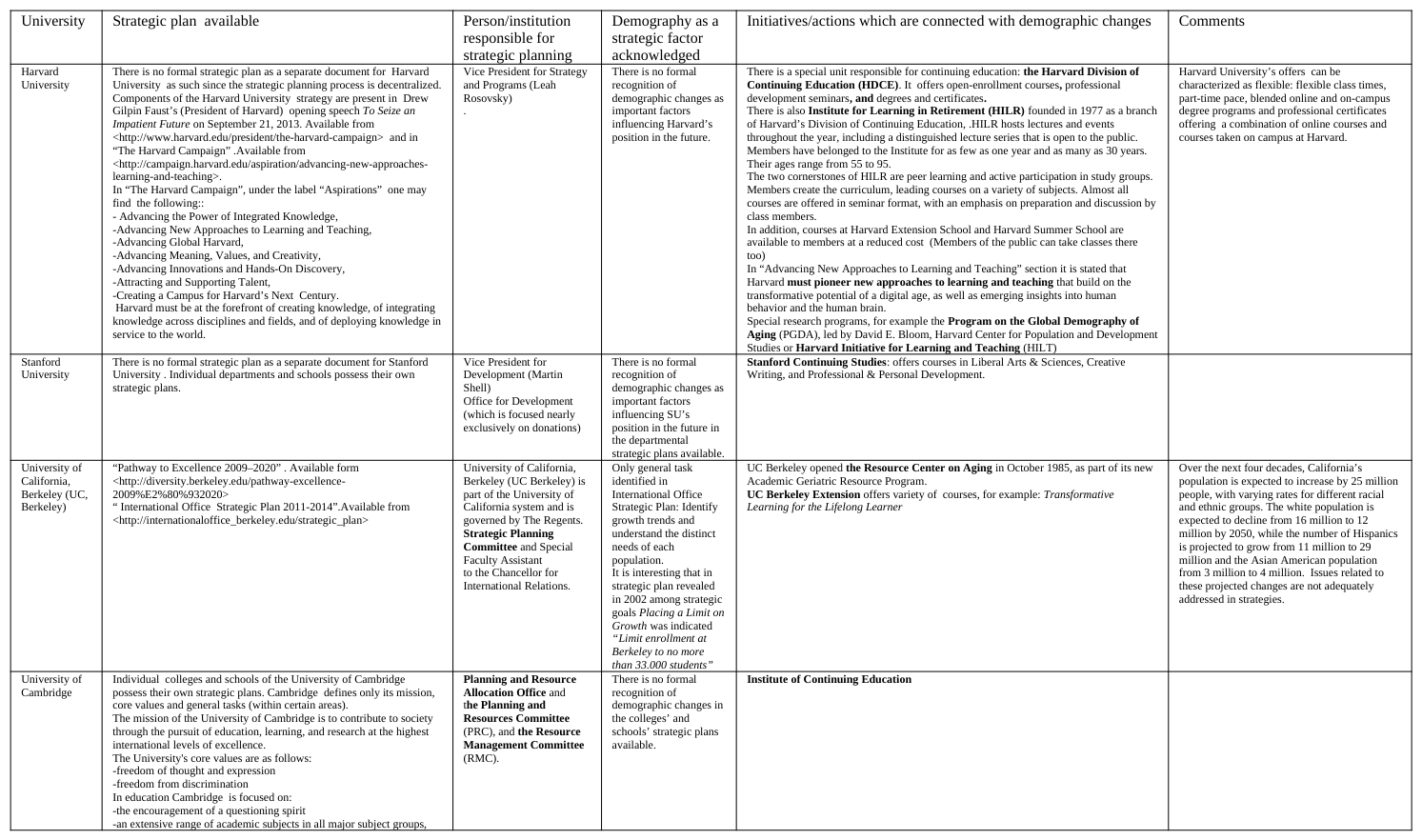
As shown in Tab. 1, in seven universities (50% of the sample) formal strategic plans are available. It can be explained partly by the organizational structure of British and American universities with considerable scopes of decentralization.
10 Avaliable from < http://www.shanghairanking.com/World-University-Rankings-2013> (3 February 2014) 11 Charles University, Prague and Eötvös Loránd University, Budapest were the highest ranked (301-400) among universities from Central and Eastern European countries. 12 It means: separate documents specifying nothing less than university’s mission, vision, and strategic goals. Technology, Higher Education and Society (2020)
As far as the problem of institutional settings for strategic formulation at the level of an entire university is concerned, special organizational units aimed at strategic development exist in five universities (36%). It is worth noting that at Harvard University, Stanford University, and Eötvös Loránd University, strategic development rests in the hands of the CEOs dedicated to strategy, e.g. Vice President for Strategy and Programs, Vice President for Development , and Vice-Rector for Strategic Affairs.
It is striking that in virtually none of the universities, demographic changes were acknowledged as strategic factors influencing the universities’ future. Here the University of California, Berkeley’s case is interesting due to the fact that – unlike in other cases - California’s population is expected to increase over the next four decades. Consequently, UC, Berkeley is not facing possible drops in enrollment. What is interesting, however, is the fact that despite big projected changes in the racial structure of students enrolled at UC, Berkeley, there is no action plan aimed at addressing this problem which is considered in the literature as important (Prescott, 2012; Swail, 2002).
Despite the fact that there is no formal recognition of demographic changes as a strategic factor, one may identify in these universities actions which are classified in the literature as ways to response to the ageing issue, namely lifelong education (Chiţba, 2012). This refers to all of the fourteen universities but three – the University of Paris Sud - Paris 11, École normale supérieure - (ENS) Paris, and Eötvös Loránd University. The most commonly used initiative is the development of various lifelong (continuous) education programs ( named as such) declared by seven universities (50%). In eight universities (57%) namely Harvard University, CU, Berkeley, Oxford University, University College London, University Pierre et Marie Curie, Technische Universität München, Universität Heidelberg, and Ludwig-Maximilians-Universität München ageing is a subject of intensive research. There are dedicated departments (Department of Psychological Ageing Research), institutes (Institute of Longevity, Institute of Population Ageing, Institute of Healthy Ageing) and research centers (Resource Center on Aging, Centre for Policy Challenges of Population Ageing, or Network Aging Research) as well as research programmes (Program on the Global Demography of Aging) aimed at the study of ageing. This shows that universities, as research institutions, want to treat demographic changes also as an opportunity. The ageing population can be combined with another function of a university, which is teaching. One may find interesting university initiatives in this respect, for example, the Institute for Learning in Retirement or various projects aimed at new special-needs teaching methods taught in Ludwig-Maximilians-Universität München.
Charles University and Eötvös Loránd University, when compared to the other twelve universities, show considerable weaknesses in respect to the ways they have responded to demographic changes. Keeping in mind that demographic projections in these two countries are negative one may conclude that the only option for these two universities is to neutralize negative demographic trends when attracting foreign students. The Eötvös Loránd University case is doubly interesting here since it leverages university strategy at the highest possible institutional and organizational level (special position has been established - Vice-Rector for Strategic Affairs), and at the same time it lacks development of a formal strategy and ignores such simple (and commonly used) action to develop and promote lifelong learning.
Discussion
Apparently due to the size of the sample one cannot generalize the findings. The fact that demographic changes (first of all ageing) are not at all perceived as strategic factors by these fourteen universities may be partly explained by the fact that these fourteen universities represent (in vast majority of cases) higher education institutions which operate internationally (if not globally)13. Since the share of international students at these universities remains high, aging population issues in a home country of a given university does not create a visible threat for this university in respect to enrollment. Here, however, one interesting issue should be noticed.
Students from Asian countries, mainly China and India, constitute an important component of foreign students around the world14 and in the universities mentioned here. In this context it is worth noticing that China intends not 13 Australia, Canada, France, Germany, the United Kingdom and the United States together receive more than 50% of all foreign students worldwide ( OECD, 2013, p. 305). 14 Asian students represent 53% of foreign students enrolled worldwide. The largest numbers of foreign students are from China, India and Korea (OECD, 2013, p. 304). Technology, Higher Education and Society (2020) only to reverse the stream of its own students currently travelling to the west for education but to attract more foreign students to Chinese universities as well. With the strong intention to identify and develop a few Chinese universities into ‘world-class’ universities, the Chinese government has implemented various reform measures such the ‘211 project’ and the ‘985 project’ to concentrate state resources on a few selected top-tier national universities to boost them to become leading universities in the world (Mok, 2005; Chou, 2008). Maybe demographic shifts constitute real threats but mainly (if not exclusively) for middling universities (Wolff, 2013) thus addressing this issue to top universities can be seen as missing the point. Such an assessment is right only in respect to enrollment of secondary school graduates. There is enough ground to expect that senior citizens may become a university’s top clients (i.e. students) too (Elmore, 1999).
Aging population issues constitute both a threat and an opportunity for universities. As the few examples in Table 1 show there is growing opportunity for universities to perform research on ageing as a multidimensional problem (engaging various specialists thus implying high value analyses by academic study which needs to be addressed without unnecessary delay.
CONCLUSIONS
Even if demographic changes/shifts are identified in the literature as factors influencing the present and the future of tertiary education institutions, there is a lack of in-depth analysis on their possible consequences. Since there is limited reflection/analysis on the consequences of demographic shifts on higher education institutions, there is an acute shortage of adequate/appropriate university responses to demographic changes Identified university strategies are aimed at exploiting the existing market through balanced or increased enrollment including attracting students from abroad. There is enough ground to maintain that the target group for the vast majority of universities are secondary schools/college graduates, i.e. people aged 16 to 25.
Technology, Higher Education and Society (2020)
Table 1. Universities’ strategic plans and responses to demographic changes
Technology, Higher Education and Society (2020) https://openaccess.cms-conferences.org/#/publications/book/978-1-4951-2110-4
Despite the fact that - due to demographic changes – there are more and more adult students (i.e. older than 25) enrolled at universities, this does not influence a university’s policy and practice strongly enough to make appropriate changes in curricula, teaching methods, ways classes are organized, etc. Senior citizens, i.e. people over 64 years of age, who are growing in numbers everywhere (but especially in developed countries) are still out of sight (and probably out of interest) of a vast majority of universities and other tertiary education institutions. It is significant, that people aged 64 and over are excluded from official statistics as students15.
Some of the universities analyzed in the paper showed growing interest in performing research on ageing issues. This can strengthen their position as research centers and – in the long run – may result in better tools and techniques aimed at addressing various economic, social and medical challenges connected to and arising from issues of ageing.
But ageing can be approached by universities from a teaching perspective too. As Harvard University’s experience shows, teaching senior citizens can be treated not exclusively as a kind of social experiment but could be an opportunity to expand teaching offerings also which in turn (but this must take time) may lead to an increase of revenues.
Consequently, ageing can be interpreted by universities as an opportunity from the point of view of two basic university functions - research and teaching.
REFERENCES
Alam, F., Alam, Q., Chowdhury, H., Steiner, T. (2013), “Transnational education: benefits, threats and challenges”, Procedia Engineering, Volume 56. pp.870-874. Altbach, P.G. (2011), “Higher Education in Context - Economic Factors, An Era of Competition, Demographic Realities,
Governmental Political and Legal Challenges, Religious Factors”, Education Encyclopedia, StateUniversity.com, retrieved on February 2, 2014 from: http://education.stateuniversity.com/pages/2041/ Higher-Education-in-Context.html#ixzz2s5Tdo99M. Andrew, S. (2013), “How to Avoid a Silent Spring”, Chronicle, November 21, retrieved on February 1, 2014 from: http://chronicle.com/blogs/headcount/how-to-avoid-a-silent-spring/37283. Barth M.C., McNaught, W., Rizzi P. (1993), “Corporations and the ageing workforce”, in: Building the competitive workforce:
investing in human capital for corporate success, Mirvis P.H. (Ed.), John Wiley and Sons. Białynicki-Birula, P. (2011), „Tendencje zmian w szkolnictwie wyższym” (Tendencies of Change in Higher Education), Wiadomości Statystyczne, January, No. 1 (596), pp.30-43. Ceobanu, A.M., Koropeckyj-Cox, T. (2013), “Should International Migration be Encouraged to Offset Population Aging? A
Cross-Country Analysis of Public Attitudes in Europe”, Population Research and Policy Review, Volume 32, Issue 2, pp 261-284. Chiţba, C.A. (2012), “Lifelong learning challenges and opportunities for traditional universities”, Procedia - Social and Behavioral Sciences, Volume 46, pp.1943-1947. Chou, P. (2008), “Taiwan higher education at the crossroads: implications for China”, Journal of Asian Public Policy, Volume
1, Issue.2, pp.148–163. Elmore, R. (1999), “Education for Older People: a moral dimension”, Education and Ageing, Volume 14, No.1, pp. 9-20. European Commission (2011), “Demography report 2010. Older, more numerous and diverse Europeans”, Publications Office of the European Union, Luxembourg 2011. Gül,H., Gül, S.S., Kaya, E., Alican, A.(2010), “Main trends in the world of higher education, internationalization and
institutional autonomy”, Procedia Social and Behavioral Sciences, Volume 9, pp. 1878–1884. Hoover, E. (2013), “Demographic Change Doesn’t Mean the Sky’s Falling”, Chronicle, June 18, 2013, retrieved on February 1, 2014 from: http://chronicle.com/blogs/headcount/demographic-change-doesnt-mean-the-skys-falling/35223. Keller, G. (2001), “The New Demographics of Higher Education”, The Review of Higher Education, Volume 24, No. 3, pp. 219-
235. Lane, J.E. (2013),”Are Colleges in the Northeast Prepared for the New Demographic Reality?”, Observations, The Nelson E.
Rockefeller Institute of Government, retrieved on February 1, 2014 from: http://www.rockinst.org/observations/lanej/2013- 02-Are_Colleges_in_the_Northeast_Prepared_for_the_New_Demographic_Reality.aspx. The Lawlor Group (2013), “Ten Trends for 2013. How Marketplace Conditions Will Influence Private Higher Education Enrollment -And How Colleges Can Respond”, retrieved on February 4, 2014 from http://www.thelawlorgroup.dreamhosters.com/pov/more-intelligence/lawlor-trends-20132013. Marcus, J. (2011), “Old School: Four-Hundred Years of Resistance to Change”, in: “Reinventing Higher Education: The
Promise of Innovation”. B. Waldavsky, A. Kelly, K.Carey (Eds.), Harvard Education Press, Cambridge, MA., pp. 61-93.
15 The most recent OECD report (OECD, 2013) does not possess data on students older than 65. Technology, Higher Education and Society (2020)
Mauch, J. (1998), “Strategies for Universities in the 21st Century”, retrieved on February 2, 2014 from: http://eric.ed.gov/?
id=ED429474 McGuire, P. (2013), “Shifting the Higher Education Paradigm”, The Huffington Post, January 15, retrieved on February 2, 2014 from: http://www.huffingtonpost.com/patricia-mcguire/college-demographics_b_2468260.html. Mok, K.-H. (2005), “Globalization and educational restructuring: university merging and changing governance in China”,
Higher Education, Volume 50, pp.57–88. Mok, K-H, Wei, I.P. (2008), “Contested Concepts, Similar Practices: The Quest for the Global University”, Higher Education Policy, Volume 21, pp.429 – 438. Morrison, J. (2003), “U.S. Higher Education in Transition”, On the Horizon, Volume 11, Issue 1, pp. 6-10. OECD (2013), “Education at a Glance 2013. OECD indicators”, retrieved on January 18, 2014 from
http://www.oecd.org/edu/eag2013%20(eng)--FINAL%2020%20June%202013.pdf. OECD (2008), “Higher Education to 2030” Volume 1: Demography” , OECD 2008. Pusser, B. (2008), “The Political Economy of Continuing Education in the 21st Century”, in: Association for Continuing Higher Education “The Next Generation: Access and Opportunity in Continuing Higher Education” 70th Annual Conference and Meeting Proceedings, November 8-11, Nashville. Prescott, B.T. (2012), “What Demographic Changes Mean for Colleges and Counselors”, Chronicle, October 4, 2012 retrieved
on February 11, 2014 from: http://chronicle.com/blogs/headcount/what-demographic-changes-mean-for-colleges-and- counselors/319581. Rogojanu, A., Badea, L.(2012), “Higher education from the perspective of demographical evolution: obstacles and solutions”, Procedia - Social and Behavioral Sciences, Volume 46, pp.4555- 4559. Swail,W.S.(2002), “Higher Education New Demographics. Questions for Policy”, Change, July/August 2002, pp.15-23. Vincent-Lancrin, S.(2008), “What is the Impact of Demography on Higher Education Systems? A Forward-looking Approach for
OECD Countries”, in: OECD, Higher Education to 2030 Volume 1: Demography, OECD 2008, pp 41-93. Waldavsky, B., Kelly, A., Carey, K. (Eds.) (2011), “Reinventing Higher Education: The Promise of Innovation”, Harvard Education Press, Cambridge, MA. Wolff, J. (2013), “Middle universities will be squeezed hard”, The Guardian, Monday 18 March 2013. World Bank (2002), “Constructing knowledge societies: new challenges for tertiary education”. Washington DC. Ziguras, C. (2003), “The impact of the GATS on transnational tertiary education: Comparing experiences of New Zealand,
Australia, Singapore and Malaysia”, Australian Education Researcher, Volume 30, Issue 3, pp. 89-109.
Technology, Higher Education and Society (2020)
LISTED IN THE AHFE DIGITAL BOOKSTORE CATALOGUE
Explore the complete digital volume
Advances in Science, Technology, Higher Education and Society in the Conceptual Age: STHESCA
Read this individual research paper free through the original publisher, or explore the full digital proceedings book.
ISBN 978-1-4951-2110-4
Explore this ISBN in the AHFE Bookstore ↗Listed in the July 2026 bookstore catalogue; search by ISBN to confirm current availability · Digital book purchase optional