Mo Zhou, Wojciech Bonenberg, Xia Wei, Ling Qi (2022). Enhancing Rural Sustainable Development and Rural Innovation through Adaptive Design Strategies. In: Human Factors in Architecture, Sustainable Urban Planning and Infrastructure. AHFE Open Access, vol. 58, pp. 140–145. https://doi.org/10.54941/ahfe1002344
Many rural areas have been facing declining during the rapid urbanization process in various different countries. How to keep rurally sustainable developing with their own characteristics in order to sustain diversification? There are plenty of strategies to boost the rural economy and improve living conditions. This paper is taking a case study from the rural areas in the Greater Poland region, the assessment of adaptive design connecting the strategies to boost the rural development and innovation solutions have been traced during the research work. Furthermore, increasing the local job opportunities and providing innovative technologies for farming and local firms are good proposals, which are beneficial to the rural sustainable revitalization. Adaptive design combing with local regional conditions can provide a guideline for improving rural life quality and preserving the environment in rural areas.
In the process of urbanization, due to the strong attraction to various resou- rces by the cities, there is a huge surplus to the city in aspects of population, resources and wealth. In contrast the villages have shown serious problems as the aging of the population (Li, 2012), rural settlement hollowization; less industrial development as well as the declining of traditional culture (Qi, 2019). In many developing countries, innovation has become the key to economic development, employment, increased education and access to international markets that improves the well-being of local livelihoods. Advanced tech- nologies in infrastructure may enhance access to markets thereby increase agricultural production. Additionally, improvements in information access and communication let people have better knowledge and access to health care services (Lee, 2020).
The study had been compared for the rural and urban innovation system, introduces a theoretical structural model of the rural innovation system,
Enhancing Rural Sustainable Development and Rural Innovation 141
including technology innovation and other methods for innovation, simi- larities and differences between rural and urban innovation systems have been compared. The research showed that a theoretical structural model of the rural innovation system could be an effective way for the case in China (Yin, 2019).
The “intervention logic”, is supposed as a key-tool of evaluation the recon- struction of the which establishes the causal chain from the financial input, via the output and the results of measures, until their impact. Thus, the intervention logic guides the consecutive assessment of a measure’s contri- bution to achieving its objectives. Tracing to improve the rural life quality. The intervention logic starts from the (perceived) needs of rural areas, which describe the socio-economic or environmental requirements should respond (Cagliero, 2011).
DEVELOPING RESULTS There are plenty of strategies to boost the rural economy and improve living conditions. The research had been emphasized on the rural revitalizing effect brought from the innovation system related to adaptive design in rural area. This paper is taking a case study from the rural areas in the Greater Poland region, the assessment of adaptive design connecting the strategies to boost the rural development and innovation solutions have been traced during the research work. Furthermore, increasing the local job opportunities and provi- ding innovative technologies for farming and local firms are good proposals, which are beneficial to the rural sustainable revitalization. Adaptive design combing with local regional conditions can provide a guideline for improving rural life quality and preserving the environment in rural areas and system component, which is essential to understand the inherent capacity.
Adaptive Design According to the Existing Thorny Problems in the Traditional Farm Rural revitalizing strategies not only focus on the economic, social impact factors in rural area but also emphasizing improving the life quality and far- ming styles as well. The enhancement of the quality of life in rural areas is one of the major strategies to be addressed.
The productivity of farms is essential for many reasons like providing more food, increasing productivity affects the farming market’s growth, labour migration, and income. Increased agricultural productivity refers to the more efficient distribution of scarce resources. How to improve production is a cru- cial aspect of productive farming. New methods and techniques have given farmers a chance to increase production and maintain their farm’s long-term sustainability. For instance, creative imagination went into creating flying mechanical drones to “solve the bee problem.
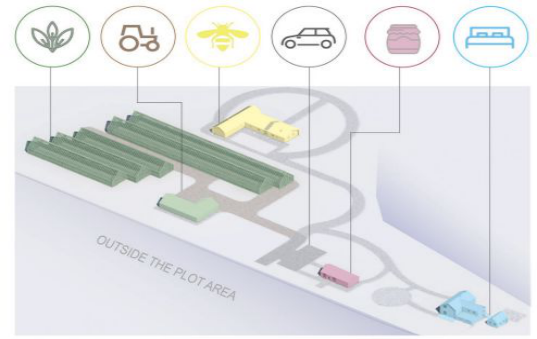
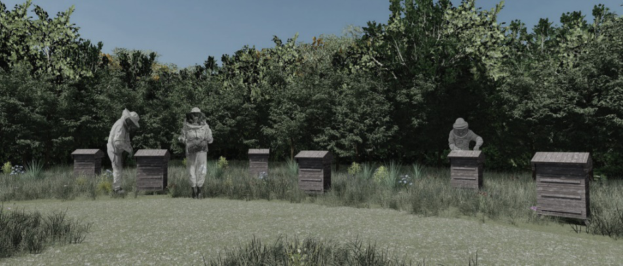
In this case study there was a struggle to find a solution to a problem that is near and dear to local beekeepers. Honeycomb is not separated in the whole farm development planning, but rather to be much closer to nature and to be convenient for beekeepers as well as in the farm layout from Fig. 1 shown us. Using the adaptive design, dividing the bee containers into horizontal
Figure 1: Diagram of adaptation a bee house from rural area designed by A. Fudala. Supervised by M. Zhou.Figure 2: Proposals of a biofarm with Winerey from rural area designed by M. Krawczynska and M. Kecman. Supervised by M. Zhou.
distanced space in order to have labor space as we can see from Figure 2. What is more, the bee containers have been adapted to be relatively scattered, which can be beneficial for the bee keepers collecting the honey and keep honeycomb service and hygiene management etc.
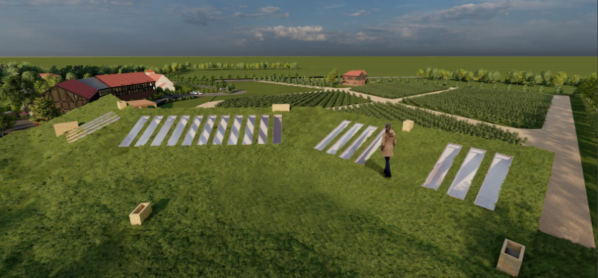
The winery house is designed on the top of the hill located in this traditio- nal farm from Mieszkowicza in Greater Poland region. This traditional farm is facing many problems with lack of labor and low productivity of farming as well as limited machinery modernization. Although with rich quality of soil of the farm, it is potential to revitalize this farm by a few strategies col- laborated with local farm keeper and positive instructions. In this research conducted by students, the local communication, sunlight analysis, comme- rcial potential, farming productivity and local architecture characteristic as well as the dwelling inhabitants have been analysis. In this project, the advan- tage of the topography and the direction of the sunlight have been taken as the main factors for the adaptive design of the vinery house. As we can see from Fig. 3, the nature sunlight can irradiate into the vinery basement through the top of the roof where is also the top of the hill in the farm. One side, it is the
Enhancing Rural Sustainable Development and Rural Innovation 143
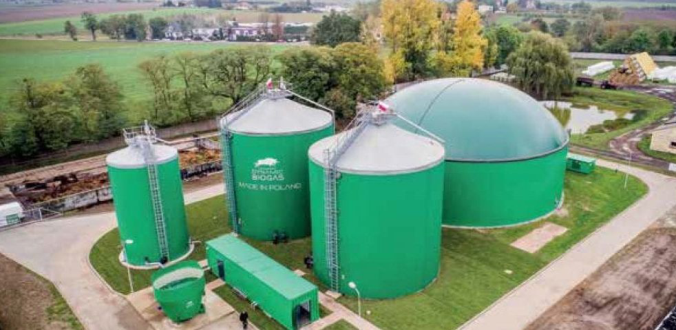
Figure 3: Domains of a biofarm with Winerey from rural area designed by M. Kraw- czynska and M. Kecman. Supervised by M. Zhou.Figure 4: Domains of biogas plant (CHP) farm from greater Poland region.
best idea to combine the nature element using and function of the building itself. The other side, it improves the ascetic effect when people pass by the buildings surroundings with cluster of grapes and rich greenery in the farm.
Providing Innovative Technologies for Traditional Farm Biogas is generated during the anaerobic fermentation of organic material after collecting and transformed by a cogeneration system in order to create both heat and power to be used locally or fed into the national power grid. It represents a clean, economical and sustainable way to provide power. In the meanwhile, the heating energy is also considered as an efficiency energy for the local farm and residential buildings around.
The agricultural biogas plant operating in Dynamic Biogas technology is the most modern global solution in the field of fermentation - because it has used the most advanced patents that greatly increase the dynamics of the process and maximize the yield of biogas with an increased methane content. This biogas plant located in Przyroda farm from Greater Poland rural region as Fig. 4 works in the Dynamic Biogas technology and has an electric power of
500 kW. The dominant substrates used for fermentation are from agriculture farm as corn silage and animal waste.
Concerning the adaptive design of the biogas plant installation, an intere- sting and very innovative solution used in biogas installations is high mobility. The installation is delivered to its destination in containers, and the direction of its construction, depending on its size, compactness and the appearance have been adapted by modern design solution based on the local climate, topography and the input substrate continence. Commissioning - due to the steel structure of the tanks, resistant to rapid heating - is also much faster than in typical concrete biogas plants. This installation is also (apart from the concrete screed under the fermenters) completely demountable, so in the event of unforeseen situations for the investor, which could be moved to another location.
CONCLUSION
There are plenty of strategies to boost the rural economy and improve living conditions. This paper is taking a case study from the rural areas in the Grea- ter Poland region, the assessment of adaptive design connecting the strategies to boost the rural development and innovation solutions have been traced during the research work. Furthermore, increasing the local job opportuni- ties and providing innovative technologies for farming and local firms are good proposals, which are beneficial to the rural sustainable revitalization. In this research, adaptive design according to the existing thorny problems in the traditional farm like improving the productivity of farming and provi- ding the renewable energy resource to the local farm combing the adaptive design have been studied. Hence, adaptive design combing with local regi- onal conditions can provide a guideline for improving rural life quality and preserving the environment in rural areas.
ACKNOWLEDGMENT
The authors would like to concern this project was supported by the Inter- national Research Cooperation Talent Introduction and Cultivation Project of Beijing University of Technology (No. 2021C10)and it was also funded by SBAD No. 0111/SBAD/0410 from Poznan University of Technology.
REFERENCES
Cagliero R., Cristiano S., Pierangeli F., Tarangioli S. (2011). Evaluating the Improvement of Quality of Life in Rural Areas Ancona-122nd Eaae seinar “Evidence- Based agriculture and rural Policy Making. Lee, S.Y., Díaz-Puente, J.M., Vidueira, P. (2020). Enhancing Rural Innovation and
Sustainability Through Impact Assessment: A Review of Methods and Tools. Sustainability 6559. Li W., (2012). Study on the development dilemma and countermeasures of Chinese contempo-rary rural culture – from the perspective of the decline of traditional culture. J. Theory Research, 10, 103–104.
Enhancing Rural Sustainable Development and Rural Innovation 145
Qi L., Zhou M., Bonenberg W., Ma Z. (2019). Smart Eco-Villages and Tourism Development Based on Rural Revitalization with Comparison Chinese and Polish Traditional Villages Experiences. Advances in Human Factors in Architecture, Sustainable Urban Planning and Infrastructure: proceedings of the AHFE 2019 International Conference on Human Factors in Architecture, Sustainable Urban Planning and Infrastructure pp. 266–278. Yin X., Chen J., Li J., Rural (2019). Innovation system: Revitalize the countryside
for a sustainable development, Journal of Rural Studies, ISSN 0743-0167.
LISTED IN THE AHFE DIGITAL BOOKSTORE CATALOGUE
Explore the complete digital volume
Human Factors in Architecture, Sustainable Urban Planning and Infrastructure
Read this individual research paper free through the original publisher, or explore the full digital proceedings book.
ISBN 978-1-958651-34-6
Explore this ISBN in the AHFE Bookstore ↗Listed in the July 2026 bookstore catalogue; search by ISBN to confirm current availability · Digital book purchase optional