Yuqi Wang, Lei Zhou (2021). Effect of Balance and Symmetry on web aesthetic: Computational modeling and experimental investigation. In: Human Systems Engineering and Design (IHSED2021): Future Trends and Applications. AHFE Open Access, vol. 21. https://doi.org/10.54941/ahfe1001204
In order to objectively evaluate the beauty of webpage colors, balance and symmetry are selected as rating indicators, using HSV color model to quanti-fy the evaluation through the principle of visual weight, and the main inter-face of the search engine is used as an example to verify the calculation model of the beauty of the color layout. In the experiment, 10 subjects eval-uate the stimulus pictures, which verified the rationality of the computation model.
Human Systems Engineering and Design (IHSED 2021) https://openaccess.cms-conferences.org/#/publications/book/978-1-7923-8987-0
INTRODUCTION
With the rapid development of the Internet, more and more people obtain information from web pages. The application of color harmony in web design is an indispensable factor for the aesthetics of visual design. Applying the rhythm of colors to web design reasonably can improve its functionality and at the same time better enhance the aesthetic of the form of web pages and satisfy people's pursuit of beauty. Balance and symmetry in design are important factors of design aesthetics. In visual design, there are three major elements of graphics, text, and color that are combined and arranged to form the rhythm of visual design. The point, line and surface of color in vision adjust the balance of visual design layout through permutation and combination. However, there is no unified standard for the evaluation of the aesthetics of webpage colors, which is very subjective, and designers cannot accurately design color schemes that meet the requirements of customers (Chien et al.,2010). Our research goal is to verify the balance and symmetry computation model on the aesthetics of webpage images. The search engine interface image will be subjectively evaluated for aesthetics. Here, two very important elements (symmetry and balance) are selected as the criteria for evaluating the aesthetics of web pages, and these two attributes are quantified on different scales. In the following sections, we first describe the balance and symmetry computation model based on segmented and pixelated images. Secondly, In the experiment subjects evaluate the given webpages to verify the proposed computation model. Finally, we studied the relationship between the evaluation results of subjective questionnaires and the computation values of balance and symmetry to verify the color computation model.
COMPUTATION MODEL The algorithm for computation aims to imitate human's cognitive representation of symmetry and balance. The model used in this study is mainly based on the concept of "visual weight" principle. The computation as a perceptual phenomenon based on balancing the visual weight of objects in a picture (Arnheim,1974). The model qualitatively reflects several main factors, such as size, position, contrast, shape and texture. These factors will affect the visual weight. One of the most important factors is size. When other factors are equal, the larger the object, the heavier it feels. Another important factor is the "distance to the central axis". Objects close to the central axis can be offset by smaller objects placed outside the central axis. Finally, the "contrast" between the object and the surrounding area will also significantly affect its visual weight. Pixels with high contrast with the background area have heavier visual weight than pixels with low contrast. Image Quantification
Image segmentation. In computer vision technology, segmentation refers to the process of segmenting a digital image into multiple regions (pixel groups), simplifying the representation to make it easier to analyze by computer. This paper
Human Systems Engineering and Design (IHSED 2021) https://openaccess.cms-conferences.org/#/publications/book/978-1-7923-8987-0 chooses the image segmentation algorithm developed (Comaniciu and Meer,1997). Because it is computationally efficient and does not require prior training and learning. When the algorithm divides the image, the largest connected area is defined as the background area. The pixels of the original image in the background area are considered to have 0 visual weight and are not used in the balance calculation. The text and images are placed in the detected background area. The goal of this research is to consist of web images covered with pictures and text. Web pages usually have obvious background areas, and the pictures and texts overlaid on them are the objects to be segmented. Since the background area usually does not attract visual attention, the original pixels in the background area are considered to have no visual weight, and are discarded when calculating the balance.
Figure. 1. Segmented webpage images Pixelations of the web page images. To make the calculation fast and efficient, this study uses a calculation model based on pixelated images with reduced resolution. Pixelation is a common image processing technology. By presenting blurred images with extremely low resolution, spatial down-sampling will reduce the image resolution while preserving the image size. As shown in the example picture in Fig. 2, an image with an original size of 1300*900 pixels is pixelated, and each "pixel block" contains 10*10 pixels. There are different ways to combine pixels to get the desired image resolution. By filling each pixel block with the average color of all the pixels in it.
Figure. 2. 10*10 Pixelated web page images
Human Systems Engineering and Design (IHSED 2021) https://openaccess.cms-conferences.org/#/publications/book/978-1-7923-8987-0
HSV Color Model HSV color space is a three-dimensional space having an approximately uniform spacing in visual judgments. The model is closer to human perception of color and provides better perceptual uniformity than RGB (Paschos,2001). In this study, the calculation of the color distance between two pixel-blocks are based on the Euclidean difference in the HSV color space.
Figure. 3. The coordinate system for the HSV color space.
Hue(H) varies from 0° to 360° while the corresponding colors vary. Saturation(S) varies from 0 (unsaturated) to 1.0 (fully saturated). Value varies from 0 to 1.0 showing the Lightness/Brightness of the color.The color difference between two colors, (H1, S1, V1) and (H2, S2, V2), is generally given as 𝛥𝐶= 1 √(𝑉1 −𝑉2)2 + (𝑉1𝑆1 𝑐𝑜𝑠𝐻1 −𝑉2𝑆2 𝑐𝑜𝑠𝐻2)2 + (𝑉1𝑆1 𝑠𝑖𝑛𝐻1 −𝑉2𝑆2 𝑠𝑖𝑛𝐻2)2 (1)
Equations and mathematical formulas are available in the original paper PDF.
Computation model Bauerly and Liu described a method to evaluate color balance and symmetry, in an attempt to imitate human's cognitive representation of symmetry and balance (Michael and Yili,2006). This article will use this method to evaluate the color beauty of the web interface, and comprehensively evaluate the beauty of the web interface by calculating the evaluation index. By using this calculation model, it has certain significance for optimizing web design. Balance calculation model. We use the following formulations for computing the normalized horizontal balance (BH) and the normalized vertical balance (BV) (Chien et al.,2010). The balance point b, is the balance point where the sum of the visual weights of all pixel blocks in each direction (horizontal or vertical) is equal, and is the Cartesian coordinate center of the visual weights of all pixel blocks in a given image. For images, the visual weight of a color pixel block is proportional to its distance from the central axis, and is proportional to the color distance of the
Human Systems Engineering and Design (IHSED 2021) https://openaccess.cms-conferences.org/#/publications/book/978-1-7923-8987-0 background area. Color blocks with a larger color distance from the background color have greater visual weight than color blocks with a smaller color distance. Given. xb as the x-coordinate of the balance point b, yb as the y-coordinate of the balance point b, w as width of image in pixel blocks, h as height of image in pixel blocks, ΔCij−B as the color difference between a block at (i, j) and the background, Wi as summation of the visual weights of all color pixel blocks in the ith column, Wj as summation of the visual weights of all color pixel blocks in the jth row.
𝑤−1|
𝑤−1|
Symmetry computation model. The model used in this study is to compare the pixel blocks in each half of the pixelated image. The symmetries of the vertical and horizontal axes are "symmetrical vertical" and "horizontal symmetry." And symmetry about the center of the image, termed “radial symmetry” (Chien et al.,2010). Two pixel blocks with a small HSV color difference are considered to be more symmetrical than two pixel blocks with a large color difference. Therefore, when comparing two corresponding pixel blocks to measure symmetry, the difference in symmetry is considered to be proportional to the HSV color difference between the two pixel blocks. In addition, pixel block comparisons far away from the reflection axis have a higher impact on the overall impression of symmetry than comparisons close to the reflection axis. The horizontal symmetry (SH), vertical symmetry (SV) and radial symmetry (SR) calculation models are as followed.
ℎ/2 𝑤
(1 −Δ𝐶𝑖𝑗−𝑖′𝑗′) (1 + (ℎ/2) −𝑗
(ℎ/2) −1)
Human Systems Engineering and Design (IHSED 2021) https://openaccess.cms-conferences.org/#/publications/book/978-1-7923-8987-0
𝑤/2 ℎ
(1 −Δ𝐶𝑖𝑗−𝑖′𝑗′) (1 + (𝑤/2) −𝑗
(𝑤/2) −1)
(1 −Δ𝐶𝑖𝑗−𝑖𝑓) (1 + ((𝑤/2) −𝑗
(𝑤/2) −1 + (ℎ/2) −𝑖
(ℎ/2) −1) /2)
(𝑤/2) −1 + 𝑖−1 −(ℎ/2)
(ℎ/2) −1 ) /2))
𝑖=(ℎ/2)+1 𝑗=1 According to the above formula, the value range of SH, SV and SR is between 0 and 1. The closer the value is to 1, the better the visual symmetry obtained in a given direction.
EXPERIMENT Ten subjects participated in Experiment. All subjects had normal or corrected-to- normal vision and normal color vision. The subject population (mean age 23 years, range 21–26, 5 male and 5 female). This experiment sample selected from the interface of mainstream search engine of Baidu, Google and a forum search engine. Open it with the Chrome browser, take a screenshot, and crop the image to a size of 1300*900 pixels.
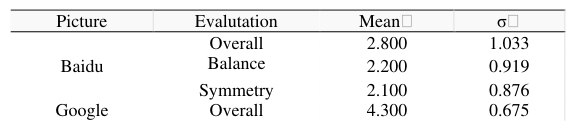
Figure. 4. All the stimuli in Experiment Procedure The three pictures were displayed to the participants separately, Subjects were instructed to rate the aesthetic appeal, balance, or symmetry on a five-point Likert scale questionnaire. Results and discussions
Table 1. Statistical results of the questionnaire Picture Evalutation Mean[Equation or mathematical symbol available in the original paper PDF] σ[Equation or mathematical symbol available in the original paper PDF]
Human Systems Engineering and Design (IHSED 2021) https://openaccess.cms-conferences.org/#/publications/book/978-1-7923-8987-0
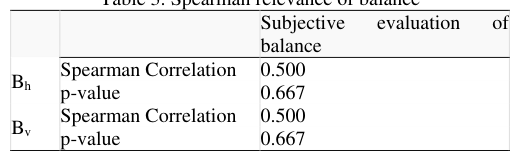
Table 2. Results of the computation model xb yb Bh Bv SH SV SR Baidu 657.1 433.5 0.989 0.963 0.895 0.913 0.595 Google 651.1 448.7 0.998 0.997 0.974 0.985 0.651 Luntan 655.3 455.9 0.991 0.986 0.761 0.805 0.495 To investigate the relationships between the subjective ratings of symmetry and balance and corresponding computational measures. we use Spearman correlation analysis. the model is verified by human perception of balance and the perception of symmetryTable 3. Spearman relevance of balance Subjective evaluation of balance
Human Systems Engineering and Design (IHSED 2021) https://openaccess.cms-conferences.org/#/publications/book/978-1-7923-8987-0
CONCLUSIONS
In order to make the designed web interface meet the aesthetic needs and pleasure of consumers, this paper establishes a balance and symmetry computation model, conduct experiments, and uses Spearman correlation to verify its rationality. The analysis shows that the balance model fit well with the subjective evaluation. The symmetry model can reflect the subjective evaluation results well, and the correlation with the comprehensive evaluation is obvious.
ACKNOWLEDGMENTS
This paper is sponsored by Science and Technology on Avionics Integration Laboratory and Aeronautical Science Fund (201913069001).
REFERENCES
Chien, Y.L., Pai, H. C., Sheng, W.S. (2010). Computational models and experimental investigations of effects of balance and symmetry on the aesthetics of text-overlaid images. International Journal of Human-Computer Studies. 68.41-56. Arnheim. R. (1974). Art and Visual Perception, University of California Press,
Berkeley Comaniciu, D., Meer, P. (1997). Robust analysis of feature spaces: color image segmentation. IEEE Computer Society Conference on Computer Vision and Pattern Recognition. Puerto Rico. Paschos, G. (2001). Perceptually uniform color spaces for color texture analysis: an
empirical evaluation. IEEE Transactions on Image Processing.pp. 932-937. Michael, B. Yili, L. (2006). Computational modeling and experimental investigation of effects compositional elements on interface and design aesthetics. International Journal of Human-Computer Studies. 64. 670-682.
Human Systems Engineering and Design (IHSED 2021) https://openaccess.cms-conferences.org/#/publications/book/978-1-7923-8987-0
LISTED IN THE AHFE DIGITAL BOOKSTORE CATALOGUE
Explore the complete digital volume
Human Systems Engineering and Design (IHSED2021): Future Trends and Applications
Read this individual research paper free through the original publisher, or explore the full digital proceedings book.
ISBN 978-1-7923-8987-0
Explore this ISBN in the AHFE Bookstore ↗Listed in the July 2026 bookstore catalogue; search by ISBN to confirm current availability · Digital book purchase optional