Yue Su, Tang Wencheng (2021). Aesthetic Influences of Different Functional Elements Layout on Shopping Website Interfaces. In: Human Systems Engineering and Design (IHSED2021): Future Trends and Applications. AHFE Open Access, vol. 21. https://doi.org/10.54941/ahfe1001106
In order to objectively evaluate the aesthetic influence of the layout of different functional elements on mobile phone client interface of shopping websites, five aesthetic indexes were extracted and quantified including balance, sequence, unity, simplicity and density. The analytic hierarchy process, questionnaire method and user interview were introduced to calculate the weight of each index in different functional elements, and a synthetic aesthetic evaluation method of layout design for different functional elements was proposed. Taking the home page interface of four popular Chinese online shopping apps as an example, this paper verifies the objectivity and accuracy of the method for measuring the impact of different func-tional elements layout on interface beauty, and reflects the influence of each index on the aesthetic of the whole interface, which will be of instructive significance for future design.
Human Systems Engineering and Design (IHSED 2021) https://openaccess.cms-conferences.org/#/publications/book/978-1-7923-8987-0
INTRODUCTION
In today's prosperous information age, e-commerce in China is booming. Online shopping ecosystem has experienced nearly 11 years of accumulation. The past decade has witnessed a dramatic increase in the number of users, from a few number in the beginning to nearly 300 million at present. In addition to the promotion and brand marketing strategy, shopping website design also plays an important role [1].
The rationality of shopping website interface layout not only affects the user's visual experience, but also affects the efficiency of user shopping and platform work [2]. With the development of the times, the aesthetic needs of users are changing. Designers should follow the development trend of the times, tap the needs of users, and constantly improve the design of online shopping page.
In their paper, NGO and others [3] elaborated an intuitive and relatively reasonable method to evaluate interface beauty, and proposed 14 indicators to quantify the aesthetic of interface layout. However, it is not easy to apply all of the indicators in practical cases. At the same time, the relative importance of aesthetic indexes is not exactly the same in different functional blocks, which may have a certain impact on the objectivity of the calculation results of interface beauty.
Through user interview and focus groups of designers, according to the characteristics of online shopping app interfaces, five of the most critical evaluation indexes were selected from the 14 aesthetic evaluation indexes proposed by NGO and his partners. Home pages of four popular Chinese online shopping apps were chosen as the samples of this study. The four home page interfaces were decolored and simplified in Photoshop, and the layout data was inputted into MATLAB to get their respective aesthetic index evaluation scores. Based on the hierarchical structure model, target users compared the importance of the five functional blocks and the five aesthetic evaluation indicators of the interface through questionnaires. After that, discriminant matrices were obtained, used to calculate the weight of each function element after passing the consistency test. The analytic hierarchy process results was used in the case analysis later.
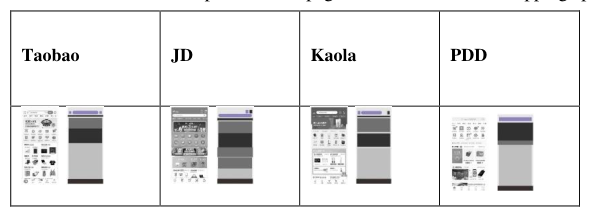
SAMPLE SELECTION The samples selected in this study are home page interfaces of four popular Chinese online shopping apps which are Taobao, JD, Kaola and PDD. In order to avoid the influence of color on interface beauty, each page was decolored first. Then, each interface was divided into five functional blocks: search bar, advertisement, category menu, product recommendation and function page selection. These areas were separately simplified as minimized rectangular blocks with different colors.
Human Systems Engineering and Design (IHSED 2021) https://openaccess.cms-conferences.org/#/publications/book/978-1-7923-8987-0
Table 1: Achromatic and simplified home page interfaces of online shopping apps
AESTHETIC EVALUATION INDEXES In order to ensure the objectivity of the evaluation results, subjective and abstract words were deleted. Through user interview and focus groups, combined with the characteristics of online shopping app interfaces, five indexes were selected.
Balance Balance measures the visual stability of each functional block in the overall layout of the interface, as well as the rationality in area and distribution, so as to avoid visual fatigue and information omission. Balance is achieved by obtaining an equal weight of elements on both horizontal and vertical axes and is given by
Equations and mathematical formulas are available in the original paper PDF.
BMvertical, BMhorizontal respectively stand for the vertical and horizontal balances with (2) BMvertical = wL - wR max(|wL|, |wR|)
nj i , j=L,R,T,B (4) where L, R, T and B represent the left, right, upper and lower regions of the interface respectively. aij represents the area of the element in region j. dij represents the distance between the midline of the element and the midline of the interface. nj represents the number of elements in region j.
Sequence Sequence measures the logical relationship between the layout of different functional
Human Systems Engineering and Design (IHSED 2021) https://openaccess.cms-conferences.org/#/publications/book/978-1-7923-8987-0 blocks. Sequence is achieved by providing users with positive visual guidance and is given by
4 wj is the maximum in w 3 wj is the second largest in w 2 wj is the third largest in w 1 wj is the minimum in w
where UL, UR, LL and LR represent the upper left, upper right, lower left and lower right areas of the interface respectively, and each area is given a visual weight. aij represents the area of interface element i in quadrant j.
Unity Unity measures the compactness and consistency of the layout of each functional block. A good sense of unity is conducive to creating the overall style of the interface and improving user familiarity. The formula is
n
UMspace measures the relationship between the space left at the margin and the space between different components with (11) UMspace = 1 - alayout - ∑ai
n i
where ai is the area of the element, alayout is the area of the design area and aframe is the area of the overall interface. n is the total number of elements.
Simplicity
Human Systems Engineering and Design (IHSED 2021) https://openaccess.cms-conferences.org/#/publications/book/978-1-7923-8987-0
Simplicity measures the brevity of the layout of each functional block, so as to avoid the burden of understanding and memory. The formula is SMM = 3 nvap + nhap + n ∈[0,1] . (12)
where nvap and nhap represent the number of alignment points in the vertical and horizontal directions respectively, and n is the number of all elements in the interface.
Density Density measures the degree of tightness of each functional block layout. A research of Zhou Lei and her partner [4] shows that when the interface element density is 50%, the interface layout makes people feel the most comfortable. The formula is
| . (13)
where ai and aframe are the area of each element and the whole interface respectively; n is the number of elements in the interface.
AESTHETIC EVELUATION MODEL AHP uses mathematical model and psychology to provide quantitative basis for analysis and decision-making. It is helpful for decision-makers to find out the best decision and have a better understanding of the problems [5].
In order to further clarify the importance relationship between the different aesthetic evaluation indexes and the influence of each functional block on the overall beauty of the interface, this paper will use analytic hierarchy process to calculate the weight of each functional block on the overall beauty of the interface and the weight of each evaluation index in every functional block. A comprehensive beauty calculation model of interface element layout is built in the end.
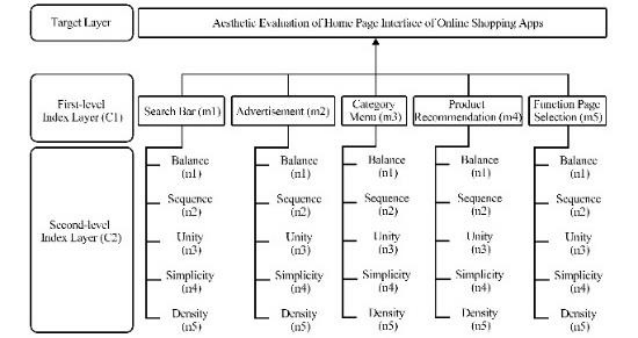
Construction of Hierarchical Structure Model The evaluation index system constructed in this study includes 1 target layer, 5 first- level index layers and 5 second-level index layers, as shown in Figure 1.
Human Systems Engineering and Design (IHSED 2021) https://openaccess.cms-conferences.org/#/publications/book/978-1-7923-8987-0
Figure 1. Hierarchical structure of aesthetic evaluation for home page interfaces of mobile client online shopping apps
Construction of Discriminant Matrix In order to increase the accuracy of importance discrimination, questionnaire survey was used to obtain the relative importance of factors. The questionnaire was distributed through social software, and the participants scaled the importance of each factor of the two indicator levels from 1 to 9. People of all ages with online shopping experience were invited. According to the questionnaire content filled in, AHP is used to calculate the weight of each point at each level. By comparing the importance of each factor in the same layer to a factor in the upper layer, a discriminant matrix is formed.
Assuming that the criterion level factor CK is related to its next level factor m1, m2, …, mn, the importance of MI and MJ to CK is compared. Then a weight matrix can be obtained with C=(cij) n×n (14)
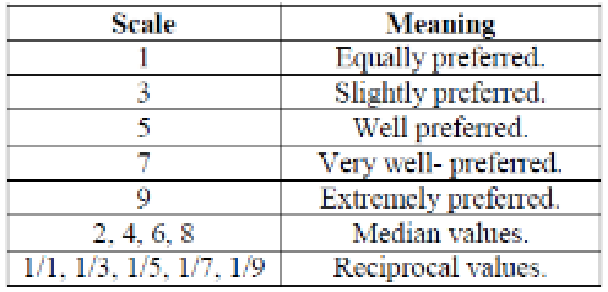
According to importance, the matrix is assigned 1-9 values. Among them, cij is the proportional scale of factor mi and mj. The meaning of each scale is shown in Table 2.
Human Systems Engineering and Design (IHSED 2021) https://openaccess.cms-conferences.org/#/publications/book/978-1-7923-8987-0
Figure 2. 1-9 scale
Consistency Test To ensure the authenticity of the data, consistency test is used to verify the validity of the questionnaire. 79 questionnaires were collected, while 57 of them were qualified in the consistency test. The proportion of valid questionnaires was 72.15%. Therefore, it is necessary to test the consistency of the discriminant matrix [6].
n-1 (15) where λmax is the largest eigenvalue of the matrix. n is the order of the discriminant matrix. RI is the average random consistency index of the matrix, which is 1.12 in this research. When CR < 0.1, it is considered that the inconsistency can be accepted and will not affect the qualitative results of ranking [6].
According to the weight value of the comparison matrix established above, the CR value of the discriminant matrix of the first level index layer is 0.0884; the CR values of the five discriminant matrices of the second level index layer are 0.0954, 0.0709, 0.0600, 0.0976 and 0.0944 respectively, which are all less than 0.1. Therefore, the consistency of the discriminant matrix is acceptable.
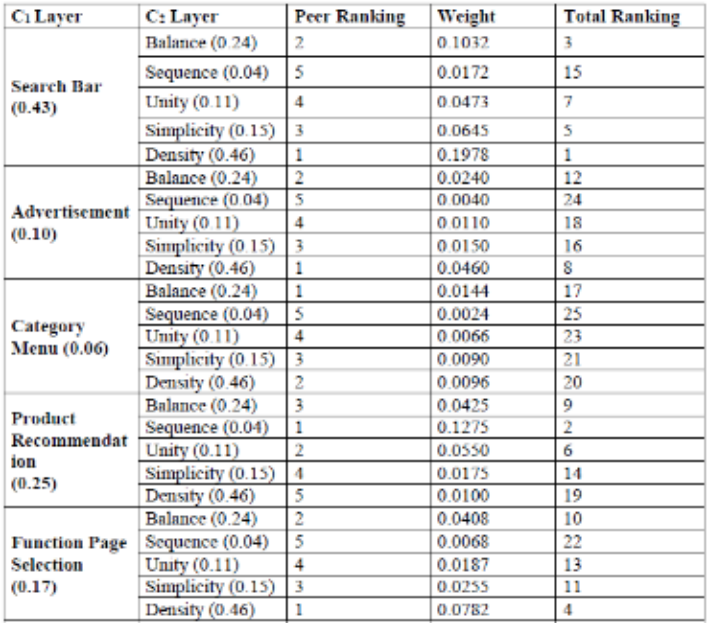
Weight Calculation The result of Analytic Hierarchy Process is shown in Figure 3.
From the perspective of functional blocks of online shopping interface, the layout of search bar has the greatest impact on aesthetic feeling of interfaces. Combined with the later user interviews, it is found that the weight ranking is related to the frequency
Human Systems Engineering and Design (IHSED 2021) https://openaccess.cms-conferences.org/#/publications/book/978-1-7923-8987-0 and demand of users for different functional blocks.
From the aesthetic evaluation index of each functional block, the same evaluation index has different influence on different functional blocks.
Figure 3. Analytic hierarchy process result CASE ANALYSIS AND CONCLUSION
The comprehensive aesthetic scores of the four samples are as follows: PDD (0.4729) > Kaola (0.4526) > Taobao (0.3979) > JD(0.3914). The search bar of PDD is the most concise and symmetrical, with only one element block. Different from the scattered layout of the other three pages, the small scanning function icon of PDD is included in the search bar, which makes it more holistic. Taobao, Kaola and PDD all have only one element in advertisement area, showing a strong sense of unity. However, JD has many scattered advertising blocks, which interferes with the overall layout logic of the page and affects the overall beauty and work performance. In addition to PDD,
Human Systems Engineering and Design (IHSED 2021) https://openaccess.cms-conferences.org/#/publications/book/978-1-7923-8987-0 the category menus of other sample interfaces are composed of two element blocks located in the top and middle of the page, which have little impact on the beauty of the interface. Product recommendation has a great impact on the work performance of online shopping home page. PDD, Taobao and Kaola relatively have a large proportion in this part, which can better provide the corresponding needs for users. However, the product recommendation area of JD is small, and the sense of unity is weak. There is little difference in the selection area of the function page of these four sample interfaces.
The research method has certain objectivity and accuracy for measuring the influence of different functional block layout on the level of interface beauty, and can reflect the influence of a single evaluation index on the comprehensive beauty in different functional blocks. However, there are still some deficiencies in this study. For different types of online shopping apps, the influence of the same aesthetic evaluation index in the same functional area is different. For different functional blocks with different requirements, the most influential aesthetic evaluation index is sometimes different. We need to do further research in the future.
REFERENCES
Liao Chan. Research on the design and user requirements of shopping website – Taking shopping website as an example [D]. Jiangnan University, 2013. (in Chinese). Nahar Singh; Samit Bhattacharya. A GA-based approach to improve web page
aesthetics. Proceedings of the 1st International Conference on Intelligent Interactive Technologies and Multimedia . 2010. Ngo D C L, Teo L S, Byrne J G. Modelling Interface Aesthetics [J]. Information Sciences, 2003, 152 (8):25-46. Zhou Lei, Xue Chengqi, Tang Wencheng, et al. Aesthetic Evaluation Method of
Interface Elements Layout Design (in Chinese) [J]. Journal of Computer- Aided Design and Computer Graphic, 2013, 25(05):758-766. (in Chinese) Solangi Yasir Ahmed,Longsheng Cheng,Shah Syed Ahsan Ali. Assessing and Overcoming the Renewable Energy Barriers for Sustainable Development in Pakistan: An Integrated AHP and Fuzzy TOPSIS Approach [J]. Renewable Energy, 2021, 173. Y.A. Solangi, Q. Tan, M.W.A. Khan, N.H. Mirjat, I. Ahmed. The selection of wind
power project location in the Southeastern Corridor of Pakistan: a factor analysis, AHP, and fuzzy-TOPSIS application. Energies (2018), 10.3390/en11081940.
Human Systems Engineering and Design (IHSED 2021) https://openaccess.cms-conferences.org/#/publications/book/978-1-7923-8987-0
LISTED IN THE AHFE DIGITAL BOOKSTORE CATALOGUE
Explore the complete digital volume
Human Systems Engineering and Design (IHSED2021): Future Trends and Applications
Read this individual research paper free through the original publisher, or explore the full digital proceedings book.
ISBN 978-1-7923-8987-0
Explore this ISBN in the AHFE Bookstore ↗Listed in the July 2026 bookstore catalogue; search by ISBN to confirm current availability · Digital book purchase optional