Renjie Dai, Xiaojun Liu (2021). Improvement and Research of Symmetry Quantization Algorithm for Abstract Black and White Images. In: Human Systems Engineering and Design (IHSED2021): Future Trends and Applications. AHFE Open Access, vol. 21. https://doi.org/10.54941/ahfe1001185
To scientifically quantify the overall symmetry of the image and assist the designer in design, the objectivity and accuracy of the algorithm for quantifying symmetry proposed by Michael Bauerly are verified through experiments, and the algorithm proposed by Michael Bauerly is improved and verified with reference to the beauty calculation formula proposed by Ngo and others. It is verified that the improved algorithm can make the value obtained from the quantized image symmetry more consistent with the judgment of human eyes, which is helpful to assist designers in the design.
Human Systems Engineering and Design (IHSED 2021) https://openaccess.cms-conferences.org/#/publications/book/978-1-7923-8987-0
INTRODUCTION
With the deepening of the research on industrial product beauty calculation, the importance of symmetry quantization algorithm is self-evident. At the same time, in terms of the algorithm principle of calculating the overall symmetry of the image, there is inevitably a big problem: whether the asymmetry close to the axis of symmetry has a greater impact on the overall image symmetry or the asymmetry far away from the axis of symmetry has a greater impact on the overall image symmetry (Bauerly & Liu, 2006). In the algorithm proposed by Michael Bauerly, he believed that the asymmetry closer to the axis of symmetry would have a greater impact on the overall image symmetry. However, in real life, most people held the opposite view, that is, the asymmetry farther away from the axis of symmetry would have a greater impact on the overall image symmetry. Exploring the answer to this question will help to more correctly grasp the overall sense of symmetry of the image under the tide of computer-aided design, and help guide designers to design and improve the interface (Bauerly & Liu, 2009).
MATHEMATICAL DEFINITION OF SYMMETRY According to the theory of geometric transformation, symmetry can be divided into mirror image symmetry, rotational symmetry and translational symmetry (Liang & Sun, 2012). Symmetry can be an attribute of objects themselves, or it can be used to compute the relationshis between ojects (Wu et al. 2001). According to the internal geometry of the object can be divided into oblique symmetry, parallel symmetry and smooth local symmetry.
What this paper explores is the popular idea of mirror symmetry (Ngo et al, 2003). Mirror symmetry is defined by assuming that the center of the image is at the origin and the image is represented by polar coordinates f (r, ζ). If there exists a line l that passes through the origin at an angle to the X-axis, such that for an Angle γ, f (r, ζ + γ) = f (r, ζ - γ), then the image about the line l is said to be mirror-like, where line l is called the axis of symmetry. This symmetry is ubiquitous in nature, such as faces and leaves. The default γ for the following discussion is 0° or 90°, that is, the axis of symmetry is the X-axis or at an Angle of 90° from the X-axis.
MICHAEL BAUERLY'S QUANTITATIVE SYMMETRY SCHEME Michael Bauerly describes a simple algorithmic scheme for quantifying symmetry in his article. The type of symmetry discussed in his paper is mirror symmetry, which analyzes whether the relative pixels on both sides of the reflection axis are the same. This is done by comparing images pixel by pixel on one side of the reflection axis. As mentioned above, only the symmetries in the vertical and horizontal directions are considered here.
Human Systems Engineering and Design (IHSED 2021) https://openaccess.cms-conferences.org/#/publications/book/978-1-7923-8987-0
Bauerly hypothesized that pixels farther away from the reflection axis had less impact on the overall symmetry of the image than pixels closer to the reflection axis (Gao et al. 2009). As shown in Figure 1 and Figure 2, the size of both images is 5 × 6 pixels, and there are a pair of asymmetric pixel pairs on both sides of the horizontal axis of symmetry. The asymmetric pixel pairs in Figure 1 (coordinates C5 and D5) are closer to the horizontal axis of symmetry than the asymmetric pixel pairs in Figure 2 (coordinates A5 and F5). According to the algorithm proposed by Michael Bauerly, as the pixel approached the reflection axis, its influence on the symmetry of the overall image became greater, which led to the conclusion that the symmetry in Figure 1 was inferior to that in Figure 2.
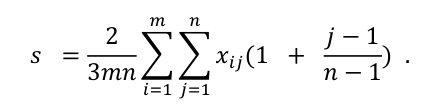
Eq. (1) below gives the calculation equation of symmetry. Variable m is the number of pixels of the image size parallel to the reflection axis. The variable n is half the number of pixels (rounded down) of the image size perpendicular to the reflection axis. The symmetry factor 𝑥𝑖𝑗 takes the value of 0 or 1, equal to 1 when the pairs of pixels are identical, and equal to 0 when the pairs of pixels are opposite. Thus, Eq. (1) gives pixel pair symmetry at the reflection axis of the image (𝑥𝑖𝑗=1), whose influence on the overall symmetry value is greater than that of pixel pair symmetry at the edge of the image. Specifically, pixel pairs at the edges of the image are considered to have half the effect of pixels at the axis of symmetry on symmetry in Bauerly’s idea.
𝑚 𝑛
. (1)
Equation reproduced from the original PDF.Figure 1: Example image1 Figure 2: Example image2 The core of the algorithm for quantifying symmetry here is that the comparison of pixels closest to the axis of symmetry has twice the impact on image symmetry while the comparison of pixels farthest from the axis of symmetry. However, through interviews with a large number of design graduate students, most of them hold the opposite view, that is, the pixel comparison farther away from the axis of symmetry has a greater impact on the overall symmetry of the image. For example, most of them believe that the symmetry of Figure 1 is greater than that of Figure 2. The following experiment will test the correctness of the algorithm.
Figure available in the original PDF paper.
Human Systems Engineering and Design (IHSED 2021) https://openaccess.cms-conferences.org/#/publications/book/978-1-7923-8987-0
TEST OF QUANTIFICATION SCHEME Experiment
Twenty industrial design graduate students aged 22-25 took part in the experiment to ensure a certain aesthetic ability. Ten men and ten women each. None of the subjects had vision problems or color blindness. Use the same design idea to develop 10 imperfectly symmetrical test diagrams for testing. The test image is shown in Figure 3. All data were recorded by the subjects. The subjects were asked to sit one meter away from the monitor in a quiet environment. The experiment was conducted on a monitor with a resolution of 1920 × 1200 pixels, and the image sizes were all 1600 pixel squares.
The chart was graded using the 7-point Likert scale. The subjects rated the horizontal symmetry and vertical symmetry of the test graph, and the higher the score was, the more symmetrical the image was. The 10 test graphs appear in random order. After scoring, the next test graph is shown.
Figure 3: The test figures Using MATLAB to reproduce Michael Bauerly's algorithm principle, the numerical values of horizontal symmetry and vertical symmetry of 10 test graphs were calculated and analyzed by combining the scores of the subjects. Results and discussion
Figure available in the original PDF paper.
The average participant symmetry score of the experiment and the values of the horizontal and vertical axis symmetry obtained by the original algorithm are shown in Figure 4 and Figure 5.
There is a linear relationship between the average score of the Likert scale and the value of Bauerly's algorithm, and the linear regression function is simulated. Eq. (2) and Eq. (3) below give the functions of the symmetry of the horizontal axis and the vertical axis respectively and calculate the value of the correlation coefficient.
Human Systems Engineering and Design (IHSED 2021) https://openaccess.cms-conferences.org/#/publications/book/978-1-7923-8987-0
The equations of horizontal symmetry equation of the correlation coefficient value is not high enough, the equation of vertical symmetry correlation coefficient value is higher, indicating that the participants of grade and Michael Bauerly algorithm to get the numerical value in the image on the level of the symmetry of the correlation is not high, but in about vertical symmetry correlation is higher. Without considering the influence of external factors such as the differences of the subjects and experimental conditions, the algorithm principle naturally remains to be discussed. In the next part, we will improve and verify the symmetry algorithm proposed by Michael Bauerly.
ALGORITHM IMPROVEMENT As mentioned above, a large number of people were interviewed. For most people, the symmetry of Figure 1 was greater than that of Figure 2, and they admitted that the pixel comparison farther away from the axis of symmetry had a greater impact on the overall symmetry of the image, which was contrary to the principle of the symmetry algorithm proposed by Michael Bauerly.
Human Systems Engineering and Design (IHSED 2021) https://openaccess.cms-conferences.org/#/publications/book/978-1-7923-8987-0
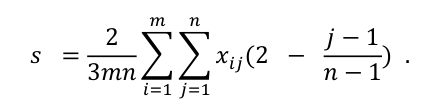
Improvement The symmetry algorithm proposed by Michael Bauerly was simply improved and adjusted to the point that pixels farther away from the axis of symmetry had a greater impact on the overall symmetry of the image, and Eq. (4) was obtained. From the perspective of understanding formula variables, we can refer to Eq. (1).
𝑚 𝑛
. (4)
Equation reproduced from the original PDF.
Matlab was also used to replicate the improved algorithm, and the quantitative values of horizontal symmetry and vertical symmetry of 10 test graphs were calculated and analyzed by combining the scores of the subjects. The symmetry scores of the average subjects in the experiment and the values of the symmetry of the horizontal axis and vertical axis obtained by the original algorithm are shown in Figure 6 and Figure 7.
There is a linear relationship between the average score of the Likert scale and the value of the improved algorithm, and the linear regression function is simulated. Eq. (5) and Eq. (6) below give the functions of the symmetry of the horizontal axis and the vertical axis respectively and calculate the value of the correlation coefficient.
Human Systems Engineering and Design (IHSED 2021) https://openaccess.cms-conferences.org/#/publications/book/978-1-7923-8987-0
From the correlation coefficient of the two formulas, it can be seen that the correlation between the values obtained by the improved algorithm and the scores of the subjects is greater than that between the values obtained by the improved algorithm and the scores of the subjects.That's up 40 percent and 10 percent, respectively.Both of the two algorithms can predict the vertical symmetry well, but the improved algorithm can greatly improve the prediction of the horizontal symmetry. Algorithms of Ngo In the exploration of the Meidu standard, Ngo et al. proposed a bottom-up method to objectively measure the aesthetic feeling of the interface, including the idea of symmetry (Ngo et al, 2003). The Eq. (7) and Eq. (8) are as follow:
(|𝑋𝑈𝐿
′ −𝑋𝑈𝑅
′ | + |𝑋𝐿𝐿
′ −𝑋𝐿𝑅
′ | + |𝑌𝑈𝐿
′ −𝑌𝑈𝑅
′ | + |𝑌𝐿𝐿
′ −𝑌𝐿𝑅 12 ⁄ . (7)
𝑆𝑌𝑀𝑣𝑒𝑟𝑡𝑖𝑐𝑎𝑙=
′ | + |𝐻𝑈𝐿
′ −𝐻𝑈𝑅
′ | + |𝐻𝐿𝐿
′ −𝐻𝐿𝑅
′ | + |𝐵𝑈𝐿
′ −𝐵𝑈𝑅
′ | + |𝐵𝐿𝐿
′ −𝐵𝐿𝑅 ′ |)
′ | + |𝜃𝑈𝐿
′ −𝜃𝑈𝑅
′ | + |𝜃𝐿𝐿
′ −𝜃𝐿𝑅
′ | + |𝑅𝑈𝐿
′ −𝑅𝑈𝑅
′ | + |𝑅𝐿𝐿
′ −𝑅𝐿𝑅
(|𝑋𝑈𝐿
′ −𝑋𝐿𝑅
′ | + |𝑋𝑈𝐿
′ −𝑋𝐿𝑅
′ | + |𝑌𝑈𝐿
′ −𝑌𝐿𝑅
′ | + |𝑌𝑈𝐿
′ −𝑌𝐿𝑅 12 ⁄ . (8)
𝑆𝑌𝑀ℎ𝑜𝑟𝑖𝑧𝑜𝑛𝑡𝑎𝑙=
′ | + |𝐻𝑈𝐿
′ −𝐻𝐿𝐿
′ | + |𝐻𝑈𝑅
′ −𝐻𝐿𝑅
′ | + |𝐵𝑈𝐿
′ −𝐵𝐿𝐿
′ | + |𝐵𝑈𝑅
′ −𝐵𝐿𝑅 ′ |)
′ | + |𝜃𝑈𝐿
′ −𝜃𝐿𝑅
′ | + |𝜃𝑈𝑅
′ −𝜃𝐿𝑅
′ | + |𝑅𝑈𝐿
′ −𝑅𝑈𝑅
′ | + |𝑅𝑈𝐿
′ −𝑅𝐿𝑅 𝑆𝑌𝑀𝑣𝑒𝑟𝑡𝑖𝑐𝑎𝑙 and 𝑆𝑌𝑀ℎ𝑜𝑟𝑖𝑧𝑜𝑛𝑡𝑎𝑙 represent the vertical and horizontal symmetry respectively. The variables are dimensionless values after normalization processing.
Where UL, UR, LL and LR, respectively, represent the upper-left, upper-right, lower-left and lower-right regions of the overall image, (𝑋𝑖𝑗, 𝑌𝑖𝑗) is the coordinate of object i in the j quadrant and (XC, YC) is the coordinate of the center of the coordinate system, 𝐵𝑖𝑗 and 𝐻𝑖𝑗 are the width and height of the object i in the j quadrant, 𝑛𝑗 is the number of elements contained in the j area.
It can be seen from the formula that the distance from the object center coordinate to the axis of symmetry is used in the calculation of 𝑋𝑗, 𝑌𝑗, 𝐻𝑗 and 𝑅𝑗, and the larger the difference between the two is, the greater the final value will be, indicating that the influence of these parameters used in the calculation of symmetry degree is proportional to the distance from the object center of symmetry. Therefore, it can be seen that the principle of Ngo symmetry calculation is consistent with the improved algorithm above.
Human Systems Engineering and Design (IHSED 2021) https://openaccess.cms-conferences.org/#/publications/book/978-1-7923-8987-0
CONCLUSION AND PROSPECT From the obtained data and analysis, the improved algorithm makes the value obtained from the quantized image symmetry more consistent with the judgment of human eyes, which is more helpful to assist designers to optimize the design. And the algorithm presented by Ngo et al. also supports this view. That is to say, it is relatively reasonable to think that the more distant the asymmetry is from the axis of symmetry, the greater the impact on the symmetry of the overall image. Objective factors can not be excluded to lead to this conclusion, such as not enough subjects and not enough test images.
At the same time, it can be seen that the quantization of horizontal symmetry of the two algorithms is not satisfactory, and the correlation coefficient is not very high. Although the improved algorithm has improved by 40%, it still fails to reach a high standard, which may be related to human eye cognition. Left and right are relatively easy to distinguish, while up and down are relatively difficult. At the same time, the representativeness of the test images can be strengthened in the future research (Li et al. 2006).
The influence of color on symmetry can be explored in the future, that is, Bauerly proposed to set different 𝑋𝑖𝑗 for comparison of pixels of different colors to calculate color symmetry. Some studies show that in the process of image recognition, the feature of the upper part of the image plays a greater role than the lower part of the image (Zou et al. 2016). Then we can try to adjust the proportion of the four partitions to improve the algorithm fit.
REFERENCES
Bauerly, M., Liu, Y. (2006) Computational modeling and experimental investigation of effects of compositional elements on interface and design aesthetics. J. International Journal of Human-Computer Studies. 64(8):670- 682 Bauerly, M., Liu, Y. (2009) Evaluation and improvement of interface aesthetics
with an Interactive Genetic Algorithm. J. International Journal of Human- Computer Interaction. 25:155-166 Gao, X., Lu, W., Tao, D., et al. (2009) Image quality assessment based on multiscale geometric analysis. J. IEEE Transaction on Image Processing. 18(7):1409-1423. Li, ZM., Hou, KP., Li, H. (2006) Continuous Symmetry Measure of Image. In:
IEEE International Conference on Information Acquisition, pp. 824--828. Liang, M., Sun, Q. (2012) An image quality assessment model based on structure feature. (in Chinese) J. Journal of Shandong University. 42(3):52-56. Ngo, D.C.L., Lian,S.T., Byrne, J.G. (2003) Modelling interface aesthetics. J.
Information Sciences. 152(8):25-46 Wu, G., Yang, J., Li, D., Zhang, H. (2001) Study on symmetry detection method of plane image. (in Chinese) J. Computer Science. 28
Human Systems Engineering and Design (IHSED 2021) https://openaccess.cms-conferences.org/#/publications/book/978-1-7923-8987-0
Zou, GF., Fu, GJ., Li, ZM. (2016) Face image quality evaluation method based on fusion of secondary evaluation indexes. (in Chinese) J. Journal of Shandong University. 46(2):6-13
Human Systems Engineering and Design (IHSED 2021) https://openaccess.cms-conferences.org/#/publications/book/978-1-7923-8987-0
LISTED IN THE AHFE DIGITAL BOOKSTORE CATALOGUE
Explore the complete digital volume
Human Systems Engineering and Design (IHSED2021): Future Trends and Applications
Read this individual research paper free through the original publisher, or explore the full digital proceedings book.
ISBN 978-1-7923-8987-0
Explore this ISBN in the AHFE Bookstore ↗Listed in the July 2026 bookstore catalogue; search by ISBN to confirm current availability · Digital book purchase optional