Zhang Yiran, Xiaojun Liu (2023). An automatic layout method of children's book covers based on design aesthetics. In: Usability and User Experience. AHFE Open Access, vol. 110, pp. 436–442. https://doi.org/10.54941/ahfe1003218
This paper focuses on children's book covers and further investigates the automatic typesetting algorithm for book covers based on the aesthetic measure algorithm. Before designing the algorithm, the element composition and relative positions of current common children's book covers were analyzed, and common types of cover elements and their identification methods were derived and their positions were quantified. The intermediate values of the positions of each type of element in the book cover in the sample were obtained, and then the initial positions of each type of element in the experimental elements were assigned according to the recognition results. And then this paper proposes an automatic displacement algorithm by generating random class objects with random seeds and then generating random numbers with the help of this object so that the objects can be displaced irregularly on the page to produce a large number of combinations with high aesthetic values. In order to verify the effectiveness of the automatic layout method given in this paper, the book cover layout is generated on the basis of the random given element size and the higher interface aesthetics values are calculated.
As an important carrier of information, books have long carried various forms of information. Books have different materials and different functions, and with the development of the times, higher requirements are put forward for the aesthetics of books, and their typesetting forms are becoming more and more diversified, giving rise to professional book typesetting workers, of which cover design is a major component of book design. As the first book element readers see, the book cover is the packaging of the book and plays an important role in the sales of the book, while having the role of beautif- ying the book and protecting the book core. The Luban AI system released by Alibaba can automate the design of product promotional images, which reduces labor costs and improves the consistency of promotional images and design efficiency as shown in Figure 1 and Figure 2.
Ngo et al. (1999) proposed a top-down, objective algorithm for measu- ring beauty, a method that combines feature elements and human perception.
An Automatic Layout Method of Children’s Book Covers Based on Design Aesthetics 437
Figure 1: Common children’s books.Figure 2: Processed cover.
The algorithm evaluates 13 aspects of aesthetic influence, including balance, proportionality, symmetry, continuity, cohesiveness, and continuity.
In this paper, we mainly use book covers as the research object and investi- gate the automatic layout algorithm for book covers based on the aesthetics algorithm proposed by Ngo et al. (1999). The study includes, determining the element size based on user input, automatically changing the position to find high beauty combinations, and extracting several different random number methods at the same time.
Element Position Initialization In order to reduce the amount of operations and improve the efficiency of the program, it is necessary to identify the elements input by the user and give them an initial position. Since book covers have special characteristics, it is possible to identify and analyze the common positions of different ele- ments in books and give the common positions to the initial positions, which can greatly reduce the amount of operations and improve the quality of the generated covers. Since there are many kinds of books with different styles of covers, and the differences between different styles of covers are large, in order to summarize the covers effectively, this paper chooses to study book covers with similar composition, so this paper chooses children’s books as the research object. Before the design of the algorithm, the current common children’s book covers were studied.
By processing the cover, it can be found that the number of elements of common children’s book covers is 3-7, which can be divided into text-based elements and image-based elements, where text-based elements include title, author, publisher and other information, and image-based elements include main picture, emblem, seal, etc. The size of text-based elements varies, but
438 Zhang and Liu
the common feature is that because the number of words is generally larger than two, their aspect ratio is relatively high. Text-based elements can be identified and simply classified into horizontal and vertical titles by aspect ratio and element size. The main image in the book cover occupies the visual center and attracts most of the attention, while its size is generally the largest, while the rest of the elements such as emblem, seal, etc. are generally smaller and located at the edge due to the size limitation of the cover, far from the visual center. In this paper, we quantify the relative position of each element with respect to the top left corner of the cover, as shown in Table 1.
Table 1. Element position statistics.
Table available in the original PDF paper.
Element Type Headline(%) Main image(%) Others(%) Book 1 (50,32.02) (50,44.76) (11.32,43.21) Book 2 (50,23.25) (50,59.43) (11.17,41.7) Book 3 (50,19.72) (50,42.35) (61.28,79.67) Book 4 (50,3.07) (50,46.71) (70.24,37.82) Book 5 (50,22.20) (50,56.22) / Book 6 (67.99,10.26) / /
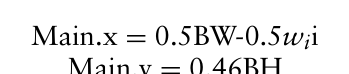
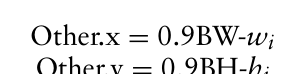
Take the median value of the title class element and the main image ele- ment, and record the width of element i as wi, the height as hi, the background width as BW and the height as BH then the initial position equation is Title type.
Equation reproduced from the original PDF.
Main image type.
Equation reproduced from the original PDF.
For the remaining elements.
Equation reproduced from the original PDF.
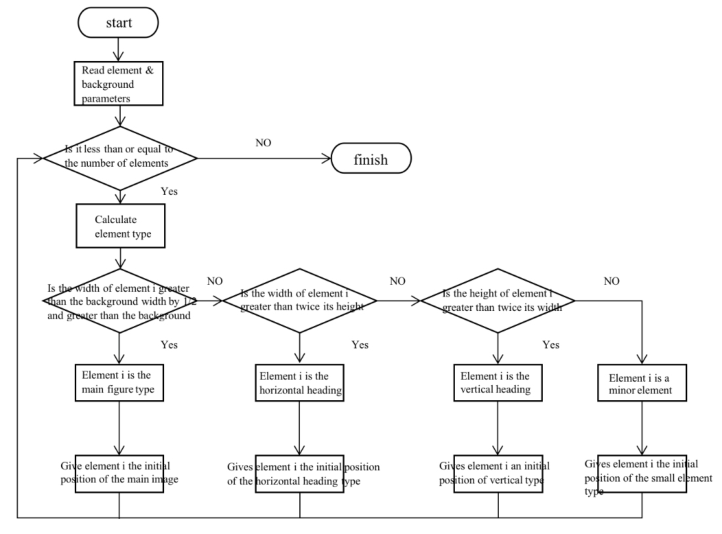
The flow of the algorithm is shown in Figure 3.
Position Change Algorithm After the initial position of the element is determined, in order to find the position of the element when the beauty is larger, the position of the element needs to be adjusted continuously and the beauty is calculated and output at high beauty. In adjusting the position, it is first necessary to obtain a set of random numbers so that the element can quickly obtain multiple combi- nations around the initial position. When generating random numbers using the Random class, since Random is a pseudo-random number generation, the pseudo-random numbers are selected from a set of numbers with the same
An Automatic Layout Method of Children’s Book Covers Based on Design Aesthetics 439
Figure 3: Location initialization flow chart.
probability, and the numbers taken are not completely random. The genera- tion of pseudo-random numbers starts from seed values, and the same seeds generate the same sequence of numbers. Generally, random uses the system clock to generate its seed values. However, because of the accuracy of the clock, creating different random objects consecutively in a short period of time will generate a random number generator with the same sequence of numbers.
One way to generate non-repeating random numbers is to specify an int argument to generate a random class object for the random seed, which can then be used to generate random numbers. First an array is created to hold the index number, the index number of the random position of the random array is taken out and the number at that position is replaced by the last number (Deepsky, 2012). After limiting the upper and lower bounds of the random numbers, the set can be changed into a set of positive and negative random numbers so that the elements can be moved randomly in different directions. Due to the limitation of the human eye’s discriminative ability, to reduce unnecessary movement, a multiplier can be added to the random number to produce a clearly perceivable movement, and the value of this multiplier is required to make each movement change perceptible and not produce a large beauty change. After a simple observation, taking 10 as a random number multiplier and a random array of values ranging from 0-14, this produces a single move step of 0–70 pixels. At the same time, because the generated typographic results need to be practically applied, although there
440 Zhang and Liu
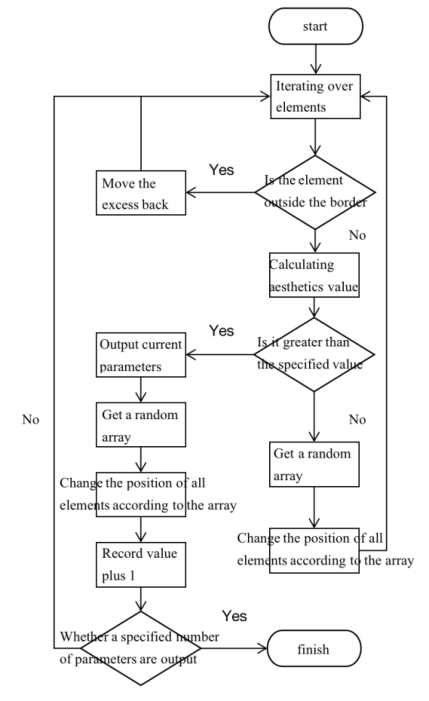
Figure 4: Location change flow chart.
already exists a part of the elements arranged beyond the layout to achieve a novel and beautiful effect, but still a few and not suitable for most layout requirements, so in the process of seeking high aesthetic combination in this paper requires the elements always within a certain range, when the detection of elements beyond the border will be repositioned to the element position within the border. The algorithm flow is shown in Fig 4.
Experimental Analysis In order to verify the effectiveness of the automatic typesetting method given in this paper, the randomly given element sizes were used as the test data, and these data sets all contained the title, the main figure and a small element, and a total of 40 sets of results were generated.
The specific experimental environment is shown in Table 2. Four groups of elements were randomly generated at 300 dpi, 2480x3508 pixels background with the following information (Table 3).
Select the combination with the highest beauty in the experimental results and generate the following typesetting results (Fig. 5).
An Automatic Layout Method of Children’s Book Covers Based on Design Aesthetics 441
Table 2. Running environment settings.
Table available in the original PDF paper.
CPU AMD Ryzen7 4800H Frequency 2.9GHz Memory 16.0GB GPU GeForce GTX 1650Ti Graphics memory 4G Operating system Win 10
Summary and Outlook Book cover design is an important part of book layout, and the book cover is the first step of contact between consumers and books, which affects con- sumers’ purchasing decisions. At present, there are both creative and artistic cover designs and moderate types of cover designs, which are mostly found in book series, children’s books, textbooks and professional books. Some of these book cover designs have the problem of insufficient aesthetics. In this paper, we propose an automatic layout algorithm for book covers based on the beauty algorithm, taking common children’s books as the research object. The main research contents of this paper include the following.
(1) Book cover elements classification research For the books on the market, this paper selects some common children’s story books as the objects, analyzes their cover element composition and relative positions, derives the common types of cover elements and their iden- tification methods, and carries out quantitative statistical analysis of their
442 Zhang and Liu
positions to obtain the middle value of the positions of each type of book cover elements in the sample, and then gives the initial positions of each type of element in the experimental elements according to the identification results.
(2) Automatic shift algorithm For the problem of how to find the high aesthetic position in automatic typesetting, an automatic shift algorithm is proposed in this paper. The first problem solved is to obtain a random array, the general method of random number generation will produce the same random number by taking conse- cutive values in a shorter period of time, this paper generates random class objects by using random seeds, and then generates random numbers with the help of this object, so that the objects can be irregularly shifted on the layout to produce a large number of combinations.
Although the automatic book cover layout algorithm in this paper has achieved some success, there are still many aspects that need further research and improvement.
(1) This paper is based on the beauty algorithm proposed by Ngo et al. (1999), but since he did not declare the weight of each aspect in the beauty in the total calculation, only the balance degree (BM) is used in this paper instead.
(2) The research objects in this paper are all relatively simple book covers, and there is no in-depth research on secondary elements, so how to per- form automatic typesetting in complex situations is also a direction for future research.
In summary, there are still many areas to be improved in this research, and I have found my own shortcomings in this research, so I will look at my own.
REFERENCE Ngo D C L, Teo L S, Byrne J G. Modelling interface aesthetics[J]. Information Sciences, 2003, 152(8): 25–46.
LISTED IN THE AHFE DIGITAL BOOKSTORE CATALOGUE
Explore the complete digital volume
Usability and User Experience
Read this individual research paper free through the original publisher, or explore the full digital proceedings book.
ISBN 978-1-958651-86-5
Explore this ISBN in the AHFE Bookstore ↗Listed in the July 2026 bookstore catalogue; search by ISBN to confirm current availability · Digital book purchase optional