Tong Li, Meng Qian Tian, Xingsong Wang (2023). Layout evaluation of interface of TV remote controls based on analytic hierarchy process. In: Intelligent Human Systems Integration (IHSI 2023): Integrating People and Intelligent Systems. AHFE Open Access, vol. 69, pp. 599–606. https://doi.org/10.54941/ahfe1002882
In order to quantitatively evaluate the beauty of the interface layout of the TV remote control, six beautification metrics are selected: balance, symmetry, continuity, cohesion, integrity, simplicity, and regularity, and quantify them separately. The analytic hierarchy process is introduced to calculate the weight of each indicator, and a comprehensive beauty calculation formula method for the layout of interface elements is proposed. Taking the interface element layout design of several TV remote controllers sold in T-mall software as an example, the objectivity and accuracy of the calculation method for evaluating the aesthetic degree of interface element layout are verified, and the weight of each aesthetic element can be reflected. The degree of influence of indicators on the comprehensive beauty of the TV remote control interface design helps guide designers to understand the importance of each indicator to the TV remote control interface design, and to improve the interface layout design of such products.
The human-machine interface is a medium for effective communication betw- een humans and machines (Su & Tang, n.d.). Therefore, the layout design of the human-machine interface affects the visual experience and operatio- nal performance of people operating the machine, and also affects the input and output efficiency of the entire system (Mitsopoulos-Rubens et al., 2011). Nowadays, commercial competition is fierce, and remote control produ- cts of the same price often have almost similar functions and performance parameters. Therefore, the layout of the man-machine interface and the cor- responding aesthetics have become an important factor in the user’s purchase behavior (Wu et al., 2016). Moreover, there has not yet been a unified and perfect calculation model and method to objectively explain the aesthetics of the interface.
This research uses the extraction of screens, buttons and other interface elements in the front view of the TV remote control, and proposes 6 cha- racteristic parameters: balance, symmetry, continuity, cohesion, integrity, simplicity, and rhythm (Moshagen & Thielsch, 2010). It is used to evaluate
the beauty of the interface layout design of several TV remote controls that are on the market and have higher sales.
METHODOLOGY
Ngo proposed a calculation model for evaluating the beauty of the user interface in his paper (Ngo et al., 2003). By classifying the beauty evalua- tion of the interface into 14 indicators and use quantitative mathematical models to evaluate. These indicators put forward an intuitive and relatively reasonable evaluation method, but the conclusion does not clarify the final comprehensive beauty calculation formula.
AESTHETIC MEASURES This article starts with the beauty of the user interface of the TV remote control (Tuch et al., 2012), selects some of the evaluation indi- cators, uses the analytic hierarchy process to calculate the overall beauty (OM) of the interface, and optimizes the interface of the existing air conditioner remote control using the derived relationship Design, this paper selects 6 indicators as factors in the final interface evaluation system.
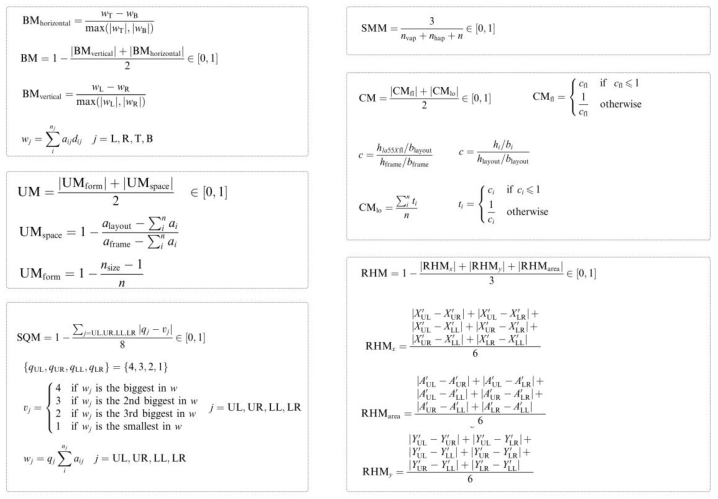
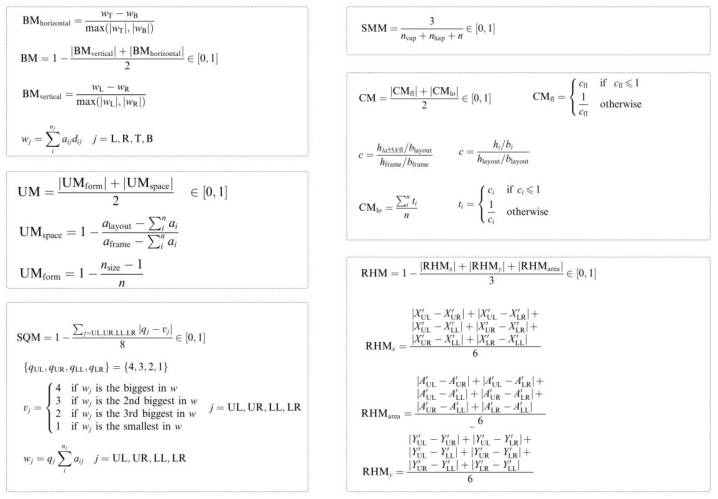
MEASURE OF BALANCE A well-balanced man-machine interface can give users a good visual perce- ption, and therefore improve the user’s operating performance and the efficiency of man-machine system communication. Different elements of the interface have different visual weights (Ben-Bassat et al., n.d.). Large objects have larger visual weights, and small objects have smaller visual weights. The visual balance dimension of the interface usually has two directions, horizon- tal and vertical. An interface with a high degree of visual balance can help users achieve better operational performance, while an interface with a low degree of visual balance will adversely affect the user’s operational performa- nce. Therefore, balance is an extremely important evaluation index, and the calculation formula is:
BMvertical
Equations and mathematical formulas are available in the original paper PDF.
BMhorizontal
2 ∈[0, 1]
MEASURE OF SEQUENCE When the user browses the interface, the user’s eye movement follows a cer- tain rule. Therefore, the arrangement of objects in the interface layout design allows the user’s eyes to move easily in the displayed information. Generally, users start from the upper left corner when reading and browsing objects, and move back and forth from the upper left corner of the interface to the lower right corner. Moreover, perceptual psychologists have found that very large objects attract readers more than small objects. Therefore, the sequence as a parameter of the evaluation system, the calculation method is given by
Layout Evaluation of Interface of TV Remote Controls Based on Analytic Hierarchy Process 601
the following formula: P
qj −vj
8 ∈[0, 1]
MEASURE OF COHESION The order in the design refers to the arrangement of objects in the layout so that the eyes can move in the displayed information. Usually, the eyes trained by reading start from the upper left corner and move back and forth on the display to the lower right corner. Perceptual psychologists find that certain things attract attention. It moves from large objects to small objects. The calculation of continuity is given by the following formula:
CMf1
CMlo
2 ∈[0, 1]
MEASURE OF UNITY Integrity is a concept arising from the rational division of interface functions. After functional division, the interface will appear very orderly. The same interface elements are grouped into one area, which creates a sense of integrity of the entire interface. This sense of integrity Make the interface layout appear relatively regular, so users can use the TV remote control efficiently. The calculation formula is:
UMform
UMspace
2 ∈[0, 1]
MEASURE OF SIMPLICITY The simpler the man-machine interface means the simpler the interaction method, which also has an impact on the user experience. Therefore, simpli- city is also used as an indicator of the evaluation system, and the calculation formula is:
MEASURE OF REGULARITY The regularity of the button layout also affects the user’s visual experience and operating experience. Therefore, regularity is also used as an indicator of the evaluation system, and the calculation formula is:
RHMy
+ |RHMarea| 3 ∈[0, 1]
ANALYTIC HIERARCHY PROCESS This article uses the Analytic Hierarchy Process to model and proceed in the following three steps: Establish the Analytic Hierarchy Model; construct
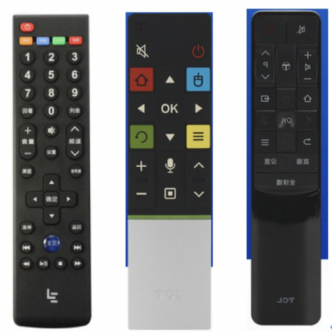
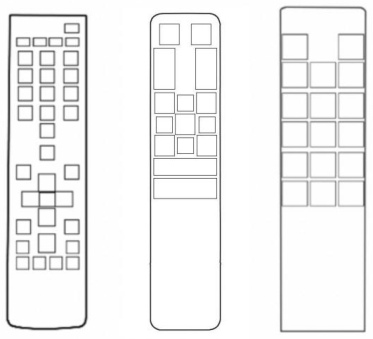
Figure 1: Samples.Figure 2: Wireframe of samples.
the judgment matrix in the criteria; rank order and check consistency (Ho & Ma, 2018).
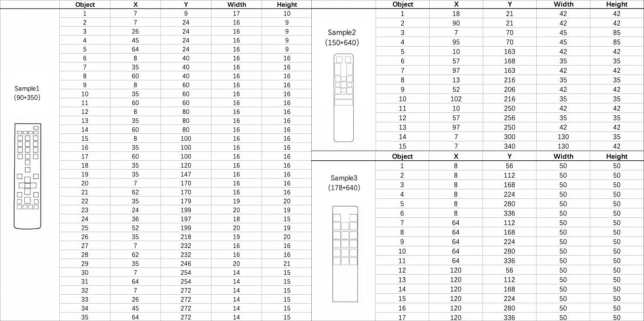
SAMPLE SELECTION The sample selection of this research refers to the top three TV remote control products in T-mall software’s comprehensive sales and positive revi- ews, and selects them as samples (see Fig. 1), and imports product images into Photoshop software and scales them. Outline the product outline in Photoshop software and then use the information in the software, including coordinates, width and height of various layout elements of each sample.
DATA PROCESSING Through the Photoshop software, the width, height and coordinate informa- tion of each TV remote control interface layout element can be accurately obtained. The data obtained is shown in the figure.
Construction of a comprehensive aesthetic evaluation system based on analytic hierarchy process.
Layout Evaluation of Interface of TV Remote Controls Based on Analytic Hierarchy Process 603
Figure 3: Sample data.Figure 4: Formula of Balance, Unity, Sequence, Simplicity, Cohesion, Rhythm (Ngo et al., 2003).Figure 5: The hierarchical structure.
Since the quantitative relationship between the evaluation indicators is not clear, this article will use the analytic hierarchy process to determine the weight relationship between the six quantitative indicators and the overall beauty of the product. The hierarchical structure is shown in the Figure 4.
The analytic hierarchy process mainly includes five steps: (1) Establish a hierarchical structure model composed of a target layer and a criterion layer;
Figure 6: RI value. (2) Construct a judgment matrix; (3) Single-level ranking; (4) Total ranking of levels; (5) Consistency check. For this article, the overall goal of the Analytic Hierarchy Process is set as the interface beauty of the TV remote control, and the selected six evaluation indicators are determined as the first indi- cator layer, which includes two layers. Since then, the hierarchical structure model is established, and the After the hierarchical index structure, the affi- liation of the index between the upper and lower levels is determined. For the experimental purpose of this article, this article is based on 10 subjects (all graduate students majoring in design) on the 6 beauty of the criterion level. The method of comparing indicators in pairs to obtain the weight of each indicator. All subjects were informed of the purpose and content of the experiment and signed a consent form. According to the subjective evaluation of the subjects, the evaluation indicators in this article constitute a six-order matrix for judging the weight ratio for pairwise comparison:
Figure available in the original PDF paper.
[Equation or mathematical symbol available in the original paper PDF]
[Equation or mathematical symbol available in the original paper PDF]
Equations and mathematical formulas are available in the original paper PDF.
This paper uses the method of solving characteristic equations to derive the weights. For the data in this paper, the largest characteristic root n’of matrix A is 6.2277, and the weight vector is [0.1801, 0.3509, 0.0292, 0.0292, 0.0596, 0.3509]. When calculating the sorting weight vector under the single criterion, the consistency test must also be carried out. Because the subje- cts are prone to judgment confusion, it has a great impact on the reliability and validity of the experiment. When the judgment matrix deviates too much from the consistency, the reliability of this approximate estimation is questi- onable. Therefore, it is necessary to check the consistency of the judgment matrix. Use n’ to represent the maximum eigenvalue with deviation, and the difference between n’ and n reflects the degree of consistency deviation. Taking into account the influence of the number of factors at the criterion level, Saaty defines CI as a consistency index. In order to determine the allo- wable range of the degree of inconsistency, Saaty defines a consistency ratio CR, CR=CI/RI. When CR<1, the inconsistency can be accepted and will not affect the qualitative results of the ranking (Saaty & Katz, 1990). The value of RI in this article is as follows Figure. For the weight value obtained from the comparison matrix established above, the CR value can be obtained. Cl value is 0.0455, CR = 0.0361.
Since the CR value is less than 1, the consistency of the judgment matrix is considered acceptable. Using the weight value obtained above, the calculation formula of OM is:
Layout Evaluation of Interface of TV Remote Controls Based on Analytic Hierarchy Process 605
Sample 1 Sample 2 Sample 3 OM 0.7473 0.6989 0.7081
OM = 0.1801*BM + 0.3509*SQM + 0.0292*CM + 0.0292*UM + 0.0596*SMM + 0.3509*RHM And the BM, UM, SQM, SMM, CM, RHM value of three samples can be computed by the formulas in Figure 5.
Substitute the values of BM, UM, SQM, SMM, CM and RHM into the calculation formula of OM, the OM values of all experimental samples can be obtained as follows: 0.7473 for sample one, 0.6989 for sample two, and 0.7081 for sample three.
CONCLUSION
According to the results of data processing, sample one has the highest com- prehensive beauty value, while sample two has the lowest comprehensive beauty value. The experiment shows that the sequence and rhythm of the remote control interface are the most important from the user’s point of view, and the cohesion and unity of the remote control interface account for the lowest overall beauty weight. Therefore, when designing a TV remote control, designers should pay more attention to the sequence and rhythm of interface elements in order to learn about consumer behavior.
This article calculates the interface beauty indicators of several TV remote controls, and uses the analytic hierarchy process to build a comprehensive beauty calculation model.
But this article has several shortcomings. The first point is that this article treats all interface elements as rectangles, and uses the corresponding coor- dinates and related lengths of the rectangles to substitute into the formula calculations. The differences between interface elements are not considered, such as the function buttons with small chamfered button elements and the shape difference between the function button elements with larger chamfers;
the second point, this article automatically ignores the effect of color on the beauty of the interface, so it may have a certain impact on the results of the experiment. The third point is that when the user uses the TV remote con- trol and intends to use a certain function button, he will hold a part of the remote control interface, so he will only focus on the interface other than the handheld part. Therefore, the width and height of the interface shall be subject to the panel interface held by the user. In future work, the concept of pixels can be introduced to further accurately calculate the beauty of each interface, and consider the impact of colors on the beauty of the comprehen- sive interface, and improve the evaluation model constructed by this analytic hierarchy process.
In this article, in order to make the designed interface meet the user’s functi- onal requirements for the TV remote control, and to meet the aesthetic needs of consumers, the analytic hierarchy process is used to construct the evalua- tion index model of the comprehensive interface beauty of the interface and is used in the TV remote control product field. Preliminary research has been carried out in the practice of interface design, and certain results have been achieved, but there is still a lot of work to be done in the future.
REFERENCES
Ben-Bassat, T., Meyer, J., & Ben, N. T. (n.d.). Economic and Subjective Measures of the Perceived Value of Aesthetics and Usability. Ho, W., & Ma, X. (2018). The state-of-the-art integrations and applications of the
analytic hierarchy process. In European Journal of Operational Research (Vol. 267, Issue 2, pp. 399–414). Elsevier B.V. https://doi.org/10.1016/j.ejor.2017.09. 007 Mitsopoulos-Rubens, E., Trotter, M. J., & Lenné, M. G. (2011). Effects on driving performance of interacting with an in-vehicle music player: A comparison of three interface layout concepts for information presentation. Applied Ergonomics, 42(4), 583–591. https://doi.org/10.1016/j.apergo.2010.08.017 Moshagen, M., & Thielsch, M. T. (2010). Facets of visual aesthetics. International
Journal of Human Computer Studies, 68(10), 689–709. https://doi.org/10.1016/ j.ijhcs.2010.05.006 Ngo, D. C. L., Teo, L. S., & Byrne, J. G. (2003). Modelling interface aesthetics. Information Sciences, 152(SUPPL), 25–46. https://doi.org/10.1016/S0020-0255(02) 00404-8 Saaty, T. L., & Katz, J. M. (1990). How to make a decision: The Analytic Hierarchy
Process. In European Journal of Operational Research (Vol. 48). Su, Y., & Tang, W. (n.d.). Aesthetic Influences of Different Functional Elements Layout on Shopping Website Interfaces. https://openaccess.cms-conferences.org /#/publications/book/978-1-7923-8987-0 Tuch, A. N., Roth, S. P., Hornbæk, K., Opwis, K., & Bargas-Avila, J. A. (2012).
Is beautiful really usable? Toward understanding the relation between usability, aesthetics, and affect in HCI. Computers in Human Behavior, 28(5), 1596–1607. https://doi.org/10.1016/j.chb.2012.03.024 Wu, L., Li, J., & Lei, T. (2016). Design entropy: A new approach for evaluating user experience in user interface design. Advances in Intelligent Systems and Computing, 485, 583–593. https://doi.org/10.1007/978-3-319-41983-1_53
LISTED IN THE AHFE DIGITAL BOOKSTORE CATALOGUE
Explore the complete digital volume
Intelligent Human Systems Integration (IHSI 2023): Integrating People and Intelligent Systems
Read this individual research paper free through the original publisher, or explore the full digital proceedings book.
ISBN 978-1-958651-45-2
Explore this ISBN in the AHFE Bookstore ↗Listed in the July 2026 bookstore catalogue; search by ISBN to confirm current availability · Digital book purchase optional