Johanna Pulkkinen, Virpi Sillanpää (2021). Workload Factors in Special Needs Education. In: Human Systems Engineering and Design (IHSED2021): Future Trends and Applications. AHFE Open Access, vol. 21. https://doi.org/10.54941/ahfe1001117
The environment of the basic education has changed during the last few years. The children's needs are more manifold than before and there are more children who need special needs education. The implementation methods of the special needs education have changed with the inclusion (one school to everybody). The changes in the environment have challenged teachers in many different ways. The special needs teachers work in the cooperation, between the units of the separate actors, such as teachers, school psychologists, school welfare officers, a psychiatric nurse, home and child protection, which for its part increases the load of the work and may cause the feeling of the inadequacy.Ensuring and maintaining the working capacity of employees is one objective of the Finnish Occupational Safety Act. According to the act, the employer has a responsibility to make sure that the work does not load worker too much. It is important to identify the work load factors, because it is the foundation of the safety work. The article is about what are the workload factors in the special needs teacher's work. The work load factors are analysed in the framework of the well-being at work. It is attempt to find factors of well-being at work, which are significant from point of view of the work load and management. The special needs teachers of one Finnish municipality participated in the study. The data for this paper was collected through well-being survey (n=35) and workshops. The process and methods will be described in the article.The results of the preliminary data analysis indicate that work of the special needs teachers is experienced to be mentally and ethically burden. According to well-being survey the working environment and conditions were not mainly considered to be the work load factors. The special needs teachers indeed experience the feeling of the inadequacy in their work which for its part adds the load of the work. Daily work needs to be done in hurry. It is not possible to do the work as well as wanted. The paper contributes to prior research by providing new information about workload factors in special needs teachers’ work. It is important to support the special needs teachers' work welfare because it has reflections in the pupils and their families, but also to other teachers and special needs assistants.
Human Systems Engineering and Design (IHSED 2021) https://openaccess.cms-conferences.org/#/publications/book/978-1-7923-8987-0
INTRODUCTION
Teaching can be a rewarding profession involving meaningful, influential, and important work. However, teaching can also be challenging due to the complex nature of the job. Special needs teachers’ wellbeing at work is challenged by various changes occurring in the context of school and education. The implementation methods of special needs education have changed with inclusion (one school for everyone). The changes in the environment have also challenged teachers in many ways. The children's needs are more varied than before, and there are more children who need special needs education. During the past ten years, the number of children in need of special support has increased considerably in Finland; in 2019, about 20% of comprehensive school students received special support, whereas in 2009 the share of students in need of special support was about 8% (OSF, 2019). The teachers' amount of work has increased during the last few years (Golnick and Ilves, 2020). In addition to the increasing number of students, the number of tasks included in special needs teachers’ job descriptions has expanded (OSF, 2019).
Workload factors are related to work or to the working environment and cause the employees either affirmative or negative load. The harmful load affects the ability to command work and its load factors. Workload factors are usually divided into physical, mental, and social load factors. (WHO, 2021). Psychosocial workload factors are related to the content of the work or the working conditions. They are usually divided into factors related to the way in which work is organized, the content of the work, and social interactions within the work community. (Occupational Safety and Health Administration, 2020) The load factors are so manifold that it is difficult to study them all in one study. Several workload factors of teachers have been discussed in previous research. In teaching, workload factors are related to many things, such as the amount of work, the work community, or cooperation with others (Occupational Safety and Health Administration, 2020: Ballet and Kelchtermans, 2009). Teachers are burdened by long working hours, rising numbers of pupils, and an increase in professional and administrative duties (Reddy et al. 2018). Stress in teaching is widely recognized in the literature Reddy et al. 2018; Morgan and Craith. 2015; Pisanti et al. 2003; Male and May, 1997; Boyle et al. 1995). Previous research indicates that violence directed against teachers is fairly common (Berlanda et al. 2019). In Finnish education provider organizations, the occupational burden generally arises from role overload, indoor air problems in the school buildings, and psychosocial work environments (Finnish Regional State Administrative Agency, 2015).
Workplace wellbeing is a multidimensional concept. It contains the quality and safety of the physical environment and how employees feel about their work, working environment, the climate at work, and the work organization (ILO, 2021). The objective of work safety is to improve the working environment and conditions to
Human Systems Engineering and Design (IHSED 2021) https://openaccess.cms-conferences.org/#/publications/book/978-1-7923-8987-0 ensure and maintain the physical and mental health and safety of employees. The measures of workplace well-being complement occupational safety and health measures to make sure employees are safe, healthy, satisfied and engaged at work.
According to the Finnish Occupational Safety Act (2002) the employer has a responsibility to make sure that workers are not overloaded. It is important to identify workload factors because they are the foundation of work safety. There is previous research related to teachers’ workload factors, but workload factors related to special needs teachers’ work have received less attention. This study aims to chart the workload factors of Finnish special needs teachers.
MATERIALS AND METHODS
The study is related to a development project, where the management, well-being at work, and productivity of the target organizations are developed with dialogical management.
The special needs teachers of one Finnish municipality participated in the study. The data for this study was collected with an online survey that was carried out in five teams. The development project started with a well-being survey sent by email to all special needs teachers and principals in the municipality in April 2019. Due to the low response rate in spring, the survey remained open until September 2019. Finally, an excellent response rate was achieved; 97% (n=35) of special needs teachers participated in the survey. Eighty percent (80%) of respondents were women.
The well-being survey was rather extensive, covering various dimensions related to working life and well-being at work at individual, team/group and work community levels. The survey was based on earlier research (Syvänen et al. 2015) and was slightly modified for use in this context. The modified survey was not publicly available. Themes of the survey included:
General features of workplace
Values and tasks in the work community
Management
General features of work
Possibilities to influence work
Operation of teams
Workload factors, including psychosocial risks of work and conflict management
Feedback and compensation
Learning, development and renewal
Job satisfaction In the online survey, respondents were asked to evaluate presented statements on a Likert scale from 1 to 5.
Human Systems Engineering and Design (IHSED 2021) https://openaccess.cms-conferences.org/#/publications/book/978-1-7923-8987-0
RESULTS
According to the results of the survey, various strengths and challenges related to well-being at work were identified. General features of the workplace are at a fairly good level. Members of the workplace share a common view about basic tasks, and operations in the workplace are regularly discussed. Distribution of work and responsibilities are clear. Of general features, only two aspects received lower estimates; only 43% of respondents considered distribution of responsibilities fair, and only 37% saw that rules of the workplace are followed well. Factors related to values and targets of organization received high estimates in the survey. The vast majority of special needs teachers (86%) believe that the values of the organization are in line with their personal values. The majority of special needs teachers know the basic tasks of their organization as well as targets set for their own work (85%). They participate in the planning of targets of their own work (70%), and targets are regarded as realistic relative to their own resources (68%). Operational management was evaluated by assessing various aspects related to supervisors’ support and availability. According to the results, supervisors (principals) support and respect special needs teachers, are available, and treat all staff members equally.
General features of special needs teachers’ work are at a high level. Work is considered responsible (98% of respondents agreed), and special needs teachers are highly committed to their work (91%). Work is considered versatile and worthwhile, and the vast majority of respondents (83%) enjoy their work. The majority of respondents (66%) believe that their abilities and knowledge meet the requirements of the work.
Special needs teachers are satisfied with the overall flow of information and communication in the organization; the organization utilizes versatile communication channels, communication is open, and the amount of communication is sufficient. Teachers are also satisfied with their ability to participate in decision making. Some respondents saw that there could be a bit more time for shared conversations, but overall satisfaction with factors related to communication was high.
Teams’ activities are considered very good. Factors related to responsibility are at a high level: Special needs teachers take responsibility for their own tasks, and responsibilities are shared well in teams. Team members help and support each other when needed, and trust between team members is high. Team members are committed to shared targets, and co-operation is fluent. Equal distribution of work was considered slightly challenging, but the overall level of teamwork was very good.
The factors listed above describe strengths related to special needs teachers’ work. However, the survey revealed some challenges as well. Based on the survey, factors that challenge special needs teachers’ well-being at work are mostly related to psychosocial risks, possibilities to influence work, and factors related to the work community. According to the survey, physical burden was considered low (14%), but psychological and ethical burden were considered high; 96% considered psychological burden and 74% considered ethical burden as high.
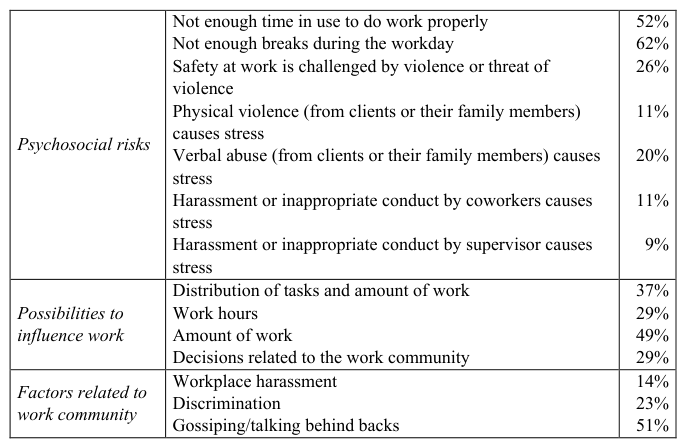
Table 1 summarizes the most important workload factors in special needs teachers’ work. Numbers (percentages) illustrate the magnitude of different workload factors.
Human Systems Engineering and Design (IHSED 2021) https://openaccess.cms-conferences.org/#/publications/book/978-1-7923-8987-0
Table 1: Workload factors in special needs teachers’ work.
Of psychosocial risks, lack of time seems to be the biggest workload factor. More than half of special needs teachers consider that they do not have enough time to do their work properly, nor do they have enough breaks during the workday. In practice, this means haste in everyday work. Also, according to the survey, special needs teachers have relatively weak possibilities to influence the distribution of tasks, working hours, and amount of work, which adds to the overall workload related to lack of time.
The survey reveals that violence, or the threat of violence, challenges the safety in the special needs teachers’ work, and verbal abuse from clients or their family members especially causes stress. Harassment in its different forms, conducted by coworkers or by supervisors, or workplace harassment in general, was identified as a workload factor. Statements related to harassment were low compared to other factors, but in the bigger picture this is notable, since in Finland the tolerance level regarding any kind of harassment is zero. Gossiping was considered quite a remarkable workload factor related to the work community. This, along with perceptions of discrimination and low possibilities to influence decisions related to the work community, are challenges related to the management of the organization and have an effect on the working atmosphere and workplace wellbeing.
DISCUSSION
The aim of this study was to identify workload factors in special needs teachers’ work. Most of the workload factors that emerged in this study were like those mentioned in
Human Systems Engineering and Design (IHSED 2021) https://openaccess.cms-conferences.org/#/publications/book/978-1-7923-8987-0 previous research. For example, like this study, workload factors have been mentioned previously regarding the amount of work, long working hours (Easthope and Easthope, 2010), and violence directed against teachers (Berlanda et al. 2019). However, some different and less discussed factors were found.
For example, some studies have highlighted the factors related to the work community to be workload factors (Occupational Safety and Health Administration, 2020; Easthope and Easthope, 2010). In this study, these factors were seen to be bracing factors. The factors related to the work community (communication, ability to participate, responsibility, co-operation, teamwork) were seen to be at a good level. However, the results indicate the presence of some workplace harassment and discrimination. The amount is not large, but they are factors with zero tolerance in the workplace. In this research, gossiping was considered a rather big workload factor related to the work community, and this is one development area in the organization.
Overall, the results of the study indicate that the work of special needs teachers is experienced to be mentally and ethically burdensome. Work was considered responsible, and the special needs teachers are highly committed to their work. The work is demanding, the number of students is high, and the students’ needs are more varied. The special needs teachers indeed experience the feeling of inadequacy in their work, which for its part adds to their perceived workload. Daily work also needs to be done in a hurry; it is not possible to do the work as well as desired. These factors partially explain why special needs teachers feel their work is mentally and ethically burdensome. However, the ethical burden is not explained by value conflict. According to the results, the values of organizations are seen to be in line with their personal values.
Workplace wellbeing is a multidimensional concept. The development of work wellbeing requires paying attention to several factors of work, work community, and working environment. This study indicates that there are many strengthening and burdensome workload factors in special needs teachers’ work. It is important to support the special needs teachers' work wellbeing because healthy teachers have a positive influence on the pupils and their families, but also on other teachers and special needs assistants. It also has links with good and effective teaching. This study identified various factors causing workload and stress for special needs teachers in Finland. Further research is needed about this topic in other countries and about development actions that could ease identified workload factors in special needs teachers’ work.
ACKNOWLEDGMENTS
The authors would like to acknowledge that this paper is part of Renewing Dialogues in Social and Health Care – Leadership, Well-being and Productivity -project. The project is funded by the European Social Fund (ESF, The Ministry of Social Affairs and Health) and the University of Tampere.
Human Systems Engineering and Design (IHSED 2021) https://openaccess.cms-conferences.org/#/publications/book/978-1-7923-8987-0
REFERENCES
Ballet, K., Kelchtermans, G. (2009) Struggling with workload: Primary teachers’ experience of intensification. Teaching and Teacher Education, vol. 25, Issue 8, pp. 1150-1157 Berlanda, S., Fraizzoli, M., de Cordova, F., Pedrazza, M. (2019) Psychosocial Risks
and Violence Against Teachers. Is It Possible to Promote Well-Being at Work?. International Journal of Environmental Research and Public Health, vol. 16(22) Boyle, G.J., Borg, M.G., Falzon, J.M., Baglioni, A.J. (1995) A structural model of the dimensions of teacher stress, British Journal of Educational Psychology, vol. 65(1), pp. 49-67 Easthope, C., Easthope, G. (2010) Intensification, Extension and Complexity of
Teachers' Workload. British journal of Sociology of Education, vol. 21, pp. 43-58 Finnish Regional State Administrative Agency: Yleiskuvaus 2015. Koulutusala (2015) (in Finnish) Golnick, T., Ilves, V. (2020) Opetusalan työolobarometri 2020. Trade Union of
Education, OAJ. (in Finnish) ILO. (2021) Workplace well-being. International Labour Organization.
https://www.ilo.org/global/topics/safety-and-health-at- work/areasofwork/workplace-health-promotion-and-well- being/WCMS_118396/lang--en/index.htm Male, D., May, D. (1997). Stress, Burnout and Workload in Teachers of Children with Special Educational Needs. British Journal of Special Education, vol. 24(3), pp. 133-140 Morgan, M., Craith, DN. (2015) Workload, stress and resilience of primary
teachers: Report of a survey of INTO members. Irish Teachers' Journal, vol. 3 (1), pp. 9-20 Occupational Safety Act. (2002) 738/2002 (in Finnish) Occupational Safety and Health Administration in Finland. (2020) Psychosocial workload factors. https://www.tyosuojelu.fi/web/en/working- conditions/psychosocial-workload/factors OSF-Official Statistics of Finland (2019) Special education.
https://tilastokeskus.fi/til/erop/2019/erop_2019_2020-06-05_tie_001_en.html Pisanti R., Garliardi MP., Razzino S, Bertini M. (2003) Occupational stress and wellness among Italian secondary school teachers. Psychology and Health, vol. 18, pp. 523-36 Reddy, L., Espelage, D., Anderman, E., Kanrich, J., McMahon, S. (2018)
Addressing violence against educators through measurement and research. Aggression and Violent Behavior, vol. 42, pp 9-28 Syvänen, S., Tikkamäki, K., Loppela, K., Tappura, S., Kasvio, A. & Toikko, T.
(2015) Dialoginen johtaminen – Avain tuloksellisuuteen, innovatiivisuuteen ja työhyvinvointiin. Tampere: Tampere University Press. WHO 82021): Constitution, World Health Organization.
https://www.who.int/about/who-we-are/constitution
Human Systems Engineering and Design (IHSED 2021) https://openaccess.cms-conferences.org/#/publications/book/978-1-7923-8987-0
LISTED IN THE AHFE DIGITAL BOOKSTORE CATALOGUE
Explore the complete digital volume
Human Systems Engineering and Design (IHSED2021): Future Trends and Applications
Read this individual research paper free through the original publisher, or explore the full digital proceedings book.
ISBN 978-1-7923-8987-0
Explore this ISBN in the AHFE Bookstore ↗Listed in the July 2026 bookstore catalogue; search by ISBN to confirm current availability · Digital book purchase optional