Tihomir Dovramadjiev, Diana Pavlova, Rusko Filchev, Rozalina Dimova (2021). Digital Visualization of Biological Processes to Depict Human Physics. In: Human Systems Engineering and Design (IHSED2021): Future Trends and Applications. AHFE Open Access, vol. 21. https://doi.org/10.54941/ahfe1001119
1 Technical University of Varna, Departments of Industrial Design and Communication Engineering and Technologies, str. Studentska N1, 9010, Varna, Bulgaria ↗
2 Dentaprime Dental Clinic, St.St. Constantine and Helena, 27th Str. Nr. 1 9006, Villa Area, Varna, Bulgaria ↗
Many chemical and physical processes take place in the human body. They have a diverse nature, which makes the study of human nature complex, time-consuming and requiring specialized technical base, which provide entry to areas and processes that are often difficult to access or invisible to the human eye. This leads to the necessity to illustrate certain processes in the human body that are significant and need their visual presentation. This report shows developed animated actions of processes important for human biological organism, which are presented to students and specialists in the fields of biology, anatomy, ergonomics, medicine, and healthcare, as well as designers working in modern cybernetics, AR and VR. The developed 3D biological models give a better understanding of their nature and serve to build a digital database.
Human Systems Engineering and Design (IHSED 2021) https://openaccess.cms-conferences.org/#/publications/book/978-1-7923-8987-0
INTRODUCTION
The development of modern computer systems has increased the possibilities for creating virtual reality in order to illustrate certain images, scenes, and details (Nunes and Costa, 2008). Studying human anatomy, specialists working and engaged in characterizing the various anthropometric parameters, properties, and characteristics of different people have encountered a number of obstacles to composing a comprehensive concept (Pensieri and Pennacchini, 2014). The needs of modern medicine and healthcare require active exchange of experience, joint national and transnational collaborations and participation in scientific and academic initiatives (Szabó et al., 2021). The various data obtained over the years have been periodically published in scientific papers, and over time additional information has been obtained gradually, which subsequently proved to be important in the development of new aids and medical devices and other important tools for human health (Bergman et al., 2015). This also applies to the development of modern technologies specializing in healthcare (Thimbleby, 2013). The present report focusses on giving a new perspective on the understanding of the vital processes taking place in the human body. The development aims to illustrate the learning content and is related to learning in detail the processes associated with cell division - Mitosis, movement of red blood cells in the veins, neuronal impulses, DNA structure. 3D visualization of the learning content of invisible to the human eye models of biological processes directly related to Education, Science, HealthCare and Medicine (Fig. 1).
Figure 1. 3D visualization of the learning content of invisible to the human eye models of biological processes in practice
Figure available in the original PDF paper.
Education Depending on the profile of the school, university specialty, institute, specialized health centers or other private schools developing activities in the fields of health and medicine, the application of teaching materials characterizing anatomical and
Human Systems Engineering and Design (IHSED 2021) https://openaccess.cms-conferences.org/#/publications/book/978-1-7923-8987-0 physiological features is basic and / or advanced (Przybylska et al., 2014). Learning and understanding of the human body is vital when building future professionals whose work will be directly or indirectly related to the protection of human health and life (Cleary, 1988). Traditional methods of understanding the anatomical structures and their connections in the human body are taught in different types of educational institutions (Makdoom et al., 2009). This includes books, textbooks, manuals, various presentations and more. A modern way to illustrate the educational content is the active inclusion of modern 3D technologies, allowing digitization of biological forms, cells, tissues and processes Llano et al., 2020). The visualization includes conventional computer graphics and animation, as well as virtual reality and augmented reality (Ma et al., 2018). This facilitates the understanding through the visualized material by the learners, as well as of all stakeholders in need of accessible and easily understandable visualization resources (Dovramadjiev et al., 2021).
Science The creation of a digital 3D database, including illustrated models of biological forms, cells, tissues and processes is essential in a number of fields of science (Zoppè et. al., 2008). They are suitable for: biomedicine, ergonomics and human factors, cybernetics, computer science, related to conventional design and creation of 3D digital and real geometry. Access to such resources optimizes the development of various applications and contributes to better design of three-dimensional models, as well as shortens design time (Sbalzarini, 2013).
Medicine For the needs of medicine, the 3D visualization of human physics aims to show in detail certain elements, geometric characteristics and entire processes occurring in the human body (Liang et al., 2011). By receiving visual information, people and specialists involved in medicine can in one way or another use the accumulated knowledge in follow-up activities.
Healthcare When it comes to protecting human health, healthcare is the unifying center of education, science and medicine (Yang and Lee, 2016). By including these units, the 3D creation of three-dimensional geometry of biological forms, cells, tissues and processes can participate in a variety of supporting ways. In this complex system, the importance of advanced visualization technologies, virtual reality and augumented reality are of particular importance, but regardless of which of them is applied, it is most important to have a set of ready-made three-dimensional digitized models (Le et al., 2018). They are subsequently used in one way or another in complete concepts.
Human Systems Engineering and Design (IHSED 2021) https://openaccess.cms-conferences.org/#/publications/book/978-1-7923-8987-0
TECHNICAL REALIZATION OF DIGITALIZATION OF THREE-DIMENSIONAL MODELS AND ANIMATION OF BIOLOGICAL PROCESSES The animation of the biological processes is done by creating in advance 3D models of the respective tissues, cells and others. In a computer environment, they are compiled in a virtual environment, where the three-dimensional objects and/or the texture itself are driven by an appropriate methodology (in accordance with the respective software). It is desirable to do this in suitable 3D computer software for graphic visualization (Simpson and Stringfellow, 2007). It is often necessary to correlate between different 3D software in order to include more technical capabilities that are provided by the respective system. Different software has some advantages or disadvantages (Bobylev, 2017). It is common practice to include additional specialized applications in the main software such as add-ons (for Blender 3D), add- ins (for SolidWorks), plug-ins (for 3DS Max) and others (Conlan, 2017). For realization of the three-dimensional geometry of the models, methods are applied in accordance with respectively:
- 3D polygonal-mesh geometry: Vertices, edges and faces (mainly constituting the polygonal-mesh models (Blender, 2021)) are built by gradually upgrading volumes based on geometric lines and curves. In certain cases, three-dimensional primitives are also used, which are further processed (Chronister, 2017).
- 3D solid geometry. 2D and 3D sketches are used, and subsequently features are applied, through which the three-dimensional geometry is built (Lombard, 2013). 3D solid models have the advantage that they are built with mathematical accuracy, they can be assigned material, as well as make a number of simulations (Dudareva and Zagayko, 2013).
When the three-dimensional geometry of the basic models is ready, specific visualization techniques are applied in accordance with the capabilities of 3D software, and in certain cases they can be combined to increase efficiency.
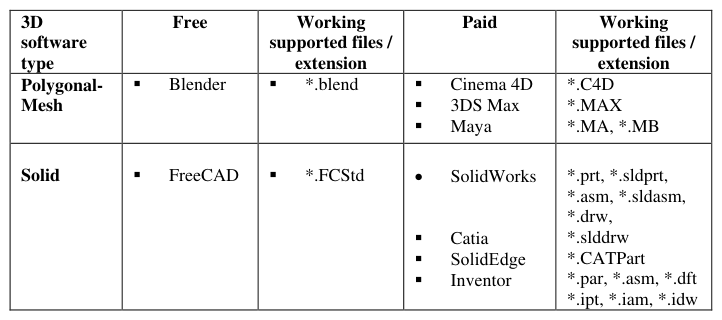
Modern Technical Means and Leading 3D Software The question of choosing the right 3D software (s) is always a dilemma for computer designers. In recent years, proven software such as SolidWorks, Cinema 4D, 3DS Max and a small number of other high-quality programs have established themselves on the international market. In principle, these software have a good reputation and they adhere to a paid license policy. These leaders have recently been joined by Blender 3D and FreeCAD, which are part of Open Source software (Junk and Kuen, 2016). Table 1 shows the leading 3D software and the corresponding main supporting file formats.
Human Systems Engineering and Design (IHSED 2021) https://openaccess.cms-conferences.org/#/publications/book/978-1-7923-8987-0
Table 1: Main 3D software for creating three-dimensional digital models of biological processes and their file extensions. https://fileinfo.com/
3D computer animated are (Figure 2):
Deoxyribonucleic acid. The structure of the DNA double helix.: https://www.youtube.com/watch?v=KLcBxLsND7A;
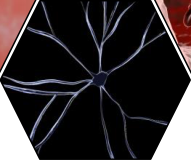
Neuron Impulse. Transmission of a signal to the nervous system of biological individuals: https://www.youtube.com/watch?v=T6_847CI8P0 ;
Vein and red blood cells. Activity and movement of the red blood cells in vein: https://www.youtube.com/watch?v=76d57tea_1w ;
Mitosis. Even division of the genetic material of the mother cell into two daughter cells: https://www.youtube.com/watch?v=4d2Xh2aJvw8 .
Figure 2. 3D visualization of the learning content by animating biological processes
Human Systems Engineering and Design (IHSED 2021) https://openaccess.cms-conferences.org/#/publications/book/978-1-7923-8987-0
CONCLUSIONS
This report presents the advantages of modern technical means that support the visual presentation of biological processes through computer animation. This modern approach optimizes the educational, scientific and medical fields directly related to healthcare. 3D models and biological processes related to human physics of DNA, Neuron Impulse, Blood Cells, Veins, and Mitosis have been developed and presented publicly. The obtained results support the learners and all stakeholders involved in the important issues of studying the biological organism and exploring opportunities for improving human health, by searching for new methods and approaches for faster presentation of the learning content.
ACKNOWLEDGMENTS
The present study is supported by Bulgarian Association of Ergonomics and Human Factors (BAEHF). The study was conducted with the support of CIII-HU-1506-01-2021 Ergonomics and Human Factors Regional Educational CEEPUS Network. This paper (result) is (partially) supported by the National Scientific Program "Information and Communication Technologies for a Single Digital Market in Science, Education and Security (ICTinSES)" (grant agreement DО1 205/23.11.18), financed by the Ministry of Education and Science.
REFERENCES
Bobylev D. (2017) Comparison of 3d modeling software. Saimaa University of Applied Sciences, Faculty of Technology, Lappeenranta, Thesis. Bergman B., Hellström A., Lifvergren S. (2015) Gustavsson S.: Emerging Science of
Improvement in Health Care. Quality Engineering, 27:17–34, 2015, Taylor & Francis Group, LLC, ISSN: 0898-2112 print / 1532-4222 online, DOI: 10.1080/08982112.2015.968042. Blender Open Source Software. (2021) Mesh Structure. https://docs.blender.org/manual/en/2.79/modeling/meshes/structure.html Chronister J. (2017) Blender Basics. Classroom tutorial book. 5-th edition. CDSchools.
https://www.cdschools.org/cms/lib04/PA09000075/Centricity/Domain/81/BlenderBasics_ 5thEdition2017.pdf Cleary H. (1988) Health education: the role and functions of the specialist and the generalist.
Rev. Saude publ., S. Paulo, 22 (1): 64-72. Conlan C. (2017). The Blender Python API: Precision 3D Modeling and Add-on Development.
APRESS. Dovramadjiev T., Stoeva M., Bozhikova V., Dimova R., Filchev R. (2021) Computer hybrid design using Python scripting and conventional 3D modeling to build (FCC) crystal
Human Systems Engineering and Design (IHSED 2021) https://openaccess.cms-conferences.org/#/publications/book/978-1-7923-8987-0 structures of precious metals and their preparing for 3D printing. Vol 64, No 1-S1 (2021), ACTA Special Issue 1, ISSN 1221-5872, pp. 213-220, Romania. Dudareva N., Zagayko S. (2011). SolidWorks by the examples 2011. “BHV”, ISBN 978-5-
9775-0690-8, UDC 681.3.06, BBK 32.973.26-018.2 St. Petersburg. Junk S., Kuen. C. (2016) Review of Open Source and Freeware CAD Systems for Use with 3D-Printing. Elsevier, Procedia CIRP 50 (2016) 430 – 435, doi: 10.1016/j.procir.2016.04.174. Le D., Le C., Tromp J., Nguyen G. (2018) Emerging Technologies for Health and Medicine.
Virtual Reality, Augmented Reality, Artifi cial Intelligence, Internet of Th ings, Robotics, Industry 4.0. WILEY, ISBN 978-1-119-50981-3, USA. Liang Y., Fang B., Wang Y., Wu L., Chen P. (2011) Design of an interactive 3D medical visualization system. Proceedings of the 2011 International Conference on Wavelet Analysis and Pattern Recognition, Guilin, pp. 60-64. Llano E., Miao H, Ahmadi Y., Wilson A., Beeby M, Viol I. (2020) Adenita: interactive 3D
modelling and visualization of DNA nanostructures. Nucleic Acids Research, doi: 10.1093/nar/gkaa593. Lombard M. (2013) Solidworks 2013 Bible. Wiley. ISBN: 978-1-118-50839-8. 1296 Pages. Ma L., Fan Z., Ning G., Zhang X., Liao H. (2018) 3D Visualization and Augmented Reality for Orthopedics. Advances in Experimental Medicine and Biology · DOI: 10.1007/978-981- 13-1396-7_16. Makdoom N., Hanafi M., Mohamed A., Mubarak I. (2009) Traditional medicine: perceptions
and experience of medical students from Egypt and Saudi Arabia, a comparative study. Bull. Alex. Fac. Med. 45 No.4, 2009., pISSN: 1110-0834, eISSN: 2090-2948, pp. 727-737. Nunes F., Costa R. (2008) The Virtual Reality challenges in the health care area: a panoramic view. Conference: Proceedings of the 2008 ACM Symposium on Applied Computing (SAC), Fortaleza, Ceara, Brazil, March 16-20, DOI: 10.1145/1363686.1363993. Pensieri C., Pennacchini M. (2014) Overview: Virtual Reality in Medicine. Journal of Virtual
Worlds Research · DOI: 10.1007/978-3-319-22041-3_14. Przybylska D., Borzęcki A., Drop B., Przybylski P., Drop K. (2014) Health education as an important tool in the healthcare system. Polish Journal of Public Health 124(3), DOI: 10.2478/pjph-2014-0032, pp 145-147. Sbalzarini I. (2013) Modeling and simulation of biological systems from image data. Bioessays
35: 482–490, 2013 WILEY Periodicals, Inc., DOI 10.1002/bies.201200051. Simpson R., Stringfellow C. (2007) 3D file formats for graphics projects. Computer Science Department, Midwestern State University. Szabó, G., Balogh, Z., Dovramadjiev, T., Draghici, A., Gajšek, B., Jurčević, lulić, T., Reiner,
M., Mrugalska, B., Zunjic, A. (2021) Introducing the Ergonomics and Human Factors Regional Educational CEEPUS Network. ACTA TECHNICA NAPOCENSIS, Series: Applied Mathematics, Mechanics, and Engineering, Vol. 64, Issue Special I, January, 2021, pp. 201-212, ISSN / eISSN: 1221-5872, Romania. Thimbleby H. (2013) Technology and the Future of Healthcare. Journal of Public Health Research, DOI: 10.4081/jphr.2013.e28, SourcePubMed, pp. 160-167. Yang H., Lee E. (2016) Healthcare Analytics. From Data to Knowledge to Healthcare
Improvement. WILEY, Identifiers: LCCN 2015047966| ISBN 9781118919392 (cloth) | ISBN 9781118919408, (online) | ISBN 9781119374664 (ePDF) | ISBN 9781119374640 (ePub), USA. Zoppè M., Porozov Y., Andrei R., Cianchetta S., Zini M., Loni T., Caudai C., Callieri M.
(2008) Using Blender for molecular animation and scientific representation. Proceedings of the Blender Conference, Zoppè et al.
Human Systems Engineering and Design (IHSED 2021) https://openaccess.cms-conferences.org/#/publications/book/978-1-7923-8987-0
LISTED IN THE AHFE DIGITAL BOOKSTORE CATALOGUE
Explore the complete digital volume
Human Systems Engineering and Design (IHSED2021): Future Trends and Applications
Read this individual research paper free through the original publisher, or explore the full digital proceedings book.
ISBN 978-1-7923-8987-0
Explore this ISBN in the AHFE Bookstore ↗Listed in the July 2026 bookstore catalogue; search by ISBN to confirm current availability · Digital book purchase optional