Chao Yang Yang, Yi Chi Fu (2021). Using prototype heuristics in reverse innovation engineering as an effective process for design-based learning. In: Human Systems Engineering and Design (IHSED2021): Future Trends and Applications. AHFE Open Access, vol. 21. https://doi.org/10.54941/ahfe1001146
Design-Based Learning (DBL) teaching can induce critical thinking and im-prove problem solving. Design is considered as a cognitive process in which we are dealing complicated message under ive problem definition. However, students are struggle as their limited experience. This research de-velops a multidisciplinary curriculum for effectively learning innovative prop-osition by reverse-engineering design thinking patterns. Totally, 36 students in the industrial design of Tatung University were the experimental subjects, 18 of whom comprised the experimental group. The design process teaching of reverse engineering and prototype-heuristics cards the research teams de-signed was used as the guide. After the project, the students in the experi-mental group were able to think more effectively, learn to change the design parameters, and focus more quickly on the knowledge that should be self-learning, and the tools allows students to synchronize their ideas with those of their teachers, whereby students can reduce their reliance on teachers’ suggestions.
Human Systems Engineering and Design (IHSED 2021) https://openaccess.cms-conferences.org/#/publications/book/978-1-7923-8987-0
INTRODUCTION
The "learner-centered learning" teaching method has received much attention in recent years. The design of such a method has focused on the process of solving problems and constructing knowledge (Perkins, 1986). It has always been an important topic for undergraduate engineering majors. Many studies have regarded it as a core subject for engineering education (Committee, 1968; Figueiredo, 2008; Mann, 1918; Spinks, Silburn, & Birchall, 2006), and it has also been regarded as fundamental for earlier education. Design-based learning is a clearer teaching method based on design and constructivism (Nelson, 2004; Strobel, Wang, Weber, & Dyehouse, 2013). The learning process focuses on interactive methods and combines design thinking and design practice to practice innovative ideas. More emphasis is placed on empathetic users in design activities. Through prototype testing and modification cycles, a stronger collaborative structure is formed, which in turn helps students perform their individual projects (楊朝陽 et al., 2018).
The design task encourages students to explore possible problems and solutions (Apedoe, Reynolds, Ellefson, & Schunn, 2008), gaining increased knowledge of their subject while also use their inherent domain knowledge and skills within the project work (Ke, 2014). This experience can help students clarify the learning theory and process because learners are required to carry out designs. The actual factors involved in the process make up for some of the problems that the learners are unable to integrate, which makes it difficult to conduct in-depth innovation.
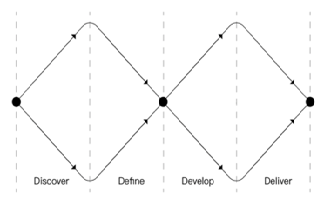
DESIGN THINKING IS THE CORE OF DBL Brown state: "Design thinking is a human-oriented design spirit and method that considers people's needs and behaviors, and also considers the feasibility of technology or business." (Brown, 2009) Design thinking is a people-oriented "problem-solving methodology" that takes people's needs as its basis. The starting point is that design must go through empathy, define, ideate, prototype, and test to find innovative solutions for various issues and create different possibilities. In 2005, the Design Council further studied the different design departments of 11 world-renowned companies and proposed an easy-to-understand double diamond model (Figure 1) to illustrate their design processes (Council, 2005). Before becoming an innovative concept, design thinking was mainly defined in research as the cognitive process of designers (Cross, Dorst, & Roozenburg, 1992). If the strategy was applied to teaching, it was in line with the teaching framework of design learning and design teaching proposed by Oxman called Think-Maps (Oxman, 2004). When domain knowledge becomes clear, the structure of a learner's concept becomes closely linked to the relationship of other teaching concepts, and the content of a specific domain or design task is used to fill these structures. The cognitive
Human Systems Engineering and Design (IHSED 2021) https://openaccess.cms-conferences.org/#/publications/book/978-1-7923-8987-0 content of design thinking needs to be considered alongside the goal of education, providing teachers and learners with methods to improve knowledge.
Figure 1: Double diamond model
In the DBL process, students transform concrete experience and abstract conceptual models, while also generating new designs through data analysis and data synthesis. In order for students to have the ability to face complex and unknown challenges in the future, DBL looks to be a future trend as the main axis of student learning.
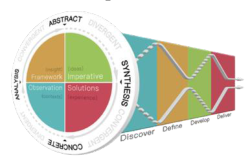
REVERSE DESIGN PROCESS We cannot avoid the fact that design is an intellectual and non-material activity. It is a complex interactive and dynamic conversion process (Stokholm, 2014). A clear design rule can be formed according to the designer’s own self-awareness (Eastman, 1999). This rule is a recognizable cyclical iterative process. Starting from the analysis stage of search and understanding, and ending with the integration stage of experimentation and invention (Owen, 1993), the systematic thinking mode leads designers to think about how to decompose a complex problem into a series of smaller problems and clarify the two problems of design. The ambiguity, directionality, and causality of the end product. Rational design thinking can help designers systematically analyze and evaluate problems. However, there are multiple models of design thinking. This study follows the classic double diamond model as the theoretical basis for the design steps. It is believed that a complete design activity will stimulate at least two forms of divergent and convergent thinking. After divergence, the iteration of convergence becomes a standard process of design thinking. This model divides design activities into 4D: discover, define, develop, and deliver. Each stage has different goals, implementation principles, and specific methods and tools (Figure 2) . It is believed that the ideal course will guide students to implement thematic projects in a contextualized manner with the double-diamond prototype under the framework of design thinking. This architecture is in line with the design process proposed by Owen as a learning model (Owen, 1993). The data generated in the observation process is transferred from a specific field to an abstract field, and the data is re-chained, identified, and
Human Systems Engineering and Design (IHSED 2021) https://openaccess.cms-conferences.org/#/publications/book/978-1-7923-8987-0 defined. Thus, the target architecture can be integrated through ideas. In order to meet the expected results, ideas will be selected as concrete practical solutions. The designer counts the existing resources, shuttles back and forth between concrete and abstract information, and alternately uses analysis and synthesis to generate better innovative solutions in the future. The concrete observation and problem-solving experience is in line with the cone of experience (Dale, 1946).
Figure 2: Comparison between design process and double diamonds CHANGE IN TEACHING METHODS
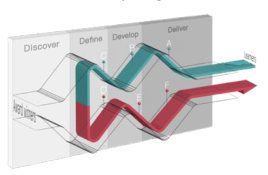
Innovative development is a series of evaluation and decision-making processes. If the structure is designed according to the double diamond model, the traditional innovation course for project planning will follow the exploratory stage that starts with the same user needs, through to the definition of problems, the development of solutions, and the delivery of results. As shown in Figure 3, the current complete innovation development process must include two divergent and convergent deliverables, which include: exploring, defining problems, finding solutions, and completing the final innovative work. This research believes that the ideal innovative curriculum will guide students to implement high-quality divergence and convergence, so reverse thinking is introduced to confirm that learners can accurately complete the design tasks in the relatively vague definition and development stage.
Figure 3: Design process under the framework of reverse innovation engineer How reverse engineering change the original teaching
Different from the established development process, reverse engineering redesign uses an "end-to-start" learning experience as the basis for its innovation. The goal is to follow the framework of the winner's design process, borrowing from its precise and effective divergence and convergence processes to include unsolved problems. Issues, concept definition structure, selected design techniques, and delivery
Human Systems Engineering and Design (IHSED 2021) https://openaccess.cms-conferences.org/#/publications/book/978-1-7923-8987-0 methods, can be implemented within the framework of the winners’ success process, as shown in Figure 3. The green arrow represents reverse analysis; the red arrow represents innovation following the path process. The teaching course steps are as follows:
Step A. Gather prize-winner works Past experience has found that the characteristics of award-winning works are as follows: the works have undergone the same value recognition in reviews, they are easy for students to understand and find, and their issues are relatively influential. Highly evaluated innovation cases are generally expressed in concept, appearance, function, difference, and influence (iF-DESIGN-AWARD-Team, 2020).
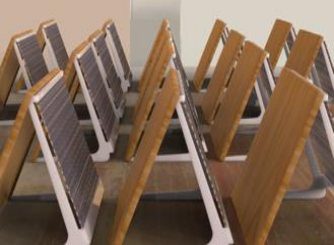
Firstly, methods used in the concept of the work were analyzed, along with the implementation of award-winning work in terms of who carried it out and with what. Through the replacement of the implementation method and the reverse thinking path, learners can quickly understand and develop relatively valuable design projects. For example, one award-winning work gave existing desks in the classroom the additional function of folding. When a disaster occurs, users can physically change the way that desks are used to quickly form a safe space to avoid earthquakes, and use a triangular structure to strengthen their resistance to heavy objects. The supportability of the existing tools, namely the use of additional functions of existing tools, folding, and movement adjustment function complete the innovative concept.
Step C. Conceptual structure analysis Secondly, for analysis of the conceptual structure, the concept should be based on issues or problems (what) that relates to initial thoughts. Here we set the desk to be sheltered during an earthquake while waiting for rescue, and then analyze this as the main use (who) . This work is designed for students in class, based on the use of the desk for everyone in the scene as the design carrier (carrier) .
Step D. Concept structure replacement Replaceable elements in the WWC structure of the above-mentioned award-winning
Human Systems Engineering and Design (IHSED 2021) https://openaccess.cms-conferences.org/#/publications/book/978-1-7923-8987-0 work were selected. For example, in this case, because there are a large number of homogenous characters and resources on the school site, there may be teachers and campus guards who accompany students, and even follow-up rescues during the earthquake by firefighters. Besides the desks, the carrier resources in the classroom to be used in disasters also include chairs, blackboards, podiums, or backpacks held by students. If thinking about other types of natural disasters such as floods or fires, the desk used as a carrier resource could be replaced with a student’s school bag. Indeed, the situation of shelter and student’s response measures at the moment of the disaster will become different.
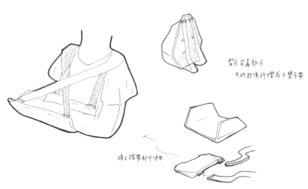
Step E. Redesign of existing methods Observe that award-winning works use existing knowledge and skills to choose the best solutions, using trade-offs and comparisons. The replaced conceptual structure framework can prevent re-designers from getting lost in abstract development information. It can also redefine what is needed in a given situation, by copying previous successful designs to enrich your own design thinking. In the replaced case, when the carrier resource becomes the student’s school bag, if the card are retained, we can still imagine that the first aid measures give the additional function of folding the schoolbag in the classroom, and the user can physically change the schoolbag use when a disaster occurs.
Step F. Product delivery After a series of reinterpretations of conceptual structures and design techniques, the existing WWC architecture has received a situational description that is different from the original design proposal. This gives students in the classroom timely remedial measures in response to injuries associated with the impact of natural disasters, such as earthquakes and landslides. In the case of fracture injuries, students can use backpacks that they carry to make simple steps to change their original function into fixed dressing aids (Figure 5) .
Figure 5: Conceptual simulation after reverse innovation engineer PH cards
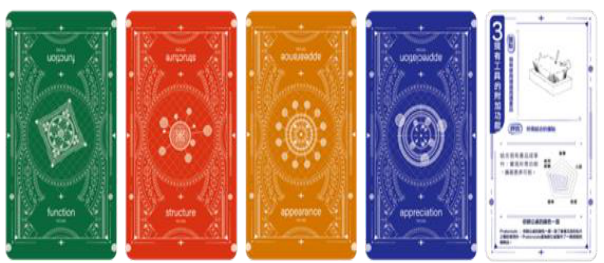
As shown in Figure 6: Prototype heuristics (PH cards) design by this study The research team designed and produced a series of teacher training courses and tools during the nursery project of the Ministry of Education. The prototype-heuristic card design is based on the basic concept generation principles of Yilmaz, Daly, Seifert,
Human Systems Engineering and Design (IHSED 2021) https://openaccess.cms-conferences.org/#/publications/book/978-1-7923-8987-0 and Gonzalez (Yilmaz, Daly, Seifert, & Gonzalez, 2016). Teachers and students in the field serve as producers of ideas and in the prototype development stage. The use of card selection and combination methods to interactively bring about prototype design innovation suggestions can also provide basic product types such as visual assembly. Cards can also be used as inspiration for solutions and to develop concepts after trying the design principles provided by Lenovo cards. Furthermore, it can provide models for simulation or testing.
Figure 6: Prototype heuristics (PH cards) design by this study
METHODS
Highly evaluated innovation cases are generally shown in the concept, appearance, function, difference, and influence school standard. This research uses "redesign" For the proposition, the students in the experimental group and the control group had one semester to complete the project and then scored according to the above five dimensions. After class, students’ questionnaires were used to make up for the hard- to-infer part of the experimental research for the use of reverse engineering and PH.
RESULTS AND DISCUSSION
After the 5-week course, the students in the reverse analysis group obviously had higher evaluations than the other group of students. We also specially selected the same category of wearable protective gear as in the discussion case: S1 is the students in the traditional teaching class and S2 and S3 are the students in the experimental group. Two teachers respectively gave a comprehensive score. The S3 students performed the best, S2 followed, and S1 performed the worst. The two teachers' scores for the three concepts are all consistent, with no significant difference. The reason for the S1’s poor performance is that the students stuck to the "cold pack" they refer to and focused on solving the problem of poor fixation and non-compliance; S2 tried to imagine the same pain as occurring in other parts of the situation; S3 in addition to aesthetics In addition to the fixed spindle for thinking, the unit of the cold
Human Systems Engineering and Design (IHSED 2021) https://openaccess.cms-conferences.org/#/publications/book/978-1-7923-8987-0 and hot compress was also modularized to provide a fixed point for different position changes with a reference basis. After the project had finished, the students generally found the cards that inspired their imagination useful. Although they had to consider the overall consideration to make the best choice, the decision nevertheless depended on the individual's proficiency in the use of tools; however, compared to the current innovation, practical courses and reverse design methods allowed students to think and learn more effectively. Based on the students’ learning reports, it was also found that after the reverse analysis of the winning works, students were able to switch to the design parameters to quickly determine what they should be learning.
REFERENCES
楊朝陽, 康仕仲, 陳彥甫, 林喬茵, 王嫊淩, & 林怡萱. (2018). 以 [設計導向學習] 模式初探 智齡設計課程. 科學教育學刊, 26(S), 399-418. Apedoe, X. S., Reynolds, B., Ellefson, M. R., & Schunn, C. D. (2008). Bringing engineering
design into high school science classrooms: The heating/cooling unit. Journal of science education and technology, 17(5), 454-465. Brown, T. (2009). Change by design. Committee, A. S. f. E. E. G. (1968). Goals of engineering education; final report of the Goals Committee. Council, D. (2005). The ‘double diamond’design process model. Design Council. Cross, N., Dorst, K., & Roozenburg, N. (1992). Research in design thinking: Delft University
Press. Dale, E. (1946). The cone of experience. Audio-visual methods in teaching, 1, 37-51. Eastman, C. (1999). Representation of design processes. Paper presented at the Conference on Design Thinking, MIT, April. Figueiredo, A. D. d. (2008). Toward an epistemology of engineering. Paper presented at the
2008 Workshop on Philosophy and Engineering, The Royal Academy of Engineering, London. Golden-Pin-Design-Award-Team. (2020). Golden Pin Design Award 2020-Life Triangle Desk. Retrieved from https://www.goldenpin.org.tw/project/%E7%94%9F%E5%91%BD%E4%B8%89 %E8%A7%92%E6%A1%8C/ iF-DESIGN-AWARD-Team. (2020). iF DESIGN AWARD 2021 – new jury process, new
criteria, new benefits. Ke, F. (2014). An implementation of design-based learning through creating educational computer games: A case study on mathematics learning during design and computing. Computers & Education, 73, 26-39. Mann, C. R. (1918). A study of engineering education: prepared for the Joint committee on
engineering education of the national engineering societies: Merrymount Press. Nelson, D. (2004). Design based learning delivers required standards in all subjects. K12.
Journal of Interdisciplinary Studies, 17(1), 1-9. Owen, C. (1993). Considering design fundamentally. Design Processes Newsletter, 5(3), 2. Oxman, R. (2004). Think-maps: teaching design thinking in design education. Design Studies, 25(1), 63-91. Perkins, D. N. (1986). Knowledge as design. Hillsdale, NJ: L. In: Erlbaum Associates. Spinks, N., Silburn, N., & Birchall, D. (2006). Educating engineers for the 21st century: The
industry view. London: The Royal Academy of Engineering.
Human Systems Engineering and Design (IHSED 2021) https://openaccess.cms-conferences.org/#/publications/book/978-1-7923-8987-0
Stokholm, M. (2014). Problem based learning versus design thinking in team based project work. Paper presented at the DS 78: Proceedings of the 16th International conference on Engineering and Product Design Education (E&PDE14), Design Education and Human Technology Relations, University of Twente, The Netherlands, 04-05.09. 2014. Strobel, J., Wang, J., Weber, N. R., & Dyehouse, M. (2013). The role of authenticity in design-
based learning environments: The case of engineering education. Computers & Education, 64, 143-152. Yilmaz, S., Daly, S. R., Seifert, C. M., & Gonzalez, R. (2016). Evidence-based design heuristics for idea generation. Design studies, 46, 95-124.
Human Systems Engineering and Design (IHSED 2021) https://openaccess.cms-conferences.org/#/publications/book/978-1-7923-8987-0
LISTED IN THE AHFE DIGITAL BOOKSTORE CATALOGUE
Explore the complete digital volume
Human Systems Engineering and Design (IHSED2021): Future Trends and Applications
Read this individual research paper free through the original publisher, or explore the full digital proceedings book.
ISBN 978-1-7923-8987-0
Explore this ISBN in the AHFE Bookstore ↗Listed in the July 2026 bookstore catalogue; search by ISBN to confirm current availability · Digital book purchase optional