Monica Daniela Gómez Rios, Daniel Humberto Caicedo Estacio, Miguel Angel Quiroz Martinez, Maikel Yelandi Leyva Vazquez (2021). Augmented Reality and digital marketing. Impact on advertising campaigns and promotion. In: Human Systems Engineering and Design (IHSED2021): Future Trends and Applications. AHFE Open Access, vol. 21. https://doi.org/10.54941/ahfe1001162
Technological advance allows the virtual fusion of objects that are beyond our reach. Augmented reality makes it easier to have objects from the virtual world to the real world. This allows many of the commercial activities that use old or conventional methods to be improved more innovatively. Information is a crucial factor in all aspects and even more so in sales activities where the evaluation of the product from different perspectives is a strong indicator in decision-making, which is why how this information is exposed is important. seen from the consumer's point of view. The problem is to determine the effects that the use of visual information produces on real images in the field of marketing and to evaluate the impact that the use of this technology has on people since it is not always possible to affirm that when using AR the result is successful since in some cases the result is not favorable. The objective is to distinguish the impact that the use of AR has in advertising campaigns through digital marketing. The methodology used is of a descriptive-analytical type to carry out a deep and progressive analysis of the references; in addition to a qualitative approach to analyze the social practices of AR. Among the results obtained from the analysis carried out, a list of advantages and disadvantages in the use of AR in advertising campaigns is presented through the use of different types of digital marketing applied to different areas, a list of ways to implement AR to expose the options that must be taken into account when presenting information about a product in a campaign or promotion, and the degree of acceptance that clients have of AR advertising campaigns as a digital marketing strategy through surveys carried out with people of different ages, genders, and knowledge, taking into account determining factors for the success or failure of the implantation of AR in a system. It was concluded that AR is a powerful tool used in digital marketing to promote a product or carry out a campaign in a more innovative way and allows the information to be reflected in the consumer's memory for a longer time, which ensures that the product is better appreciated and there are more possibilities for its commercialization, it also has more consumer attraction for the product and competitive advantage. According to the results analyzed, most people have more acceptance of the product with AR given that the way of presenting it is more innovative, but not all aspects of AR are favorable, in terms of use AR loses ground concerning conventional digital marketing methods. Much of the AR information is not yet known, so interacting with this technology can be quite tedious or in some cases impossible for people who are not very attached to the technological world. AR is a multipurpose technology, but in the field of marketing there is still a long way to go in terms of usability, but compared to the visual benefits it brings, it would not impede its full development.
Due to social changes and technological advancement, Augmented Reality (AR) has grown and welcomed in recent years thanks to its revolutionary way of providing information that is more receptive to people; today brands or companies opt for the use of AR as a digital marketing strategy in advertising and promotional campaigns, to provide their users with the information of their products in a more dynamic way and thanks to the large number of visual benefits that it provides (Wijaya, A.C., Munandar, M.W.A. y Utaminingrum, F., 2019). With the use of digital marketing, a new terminology arises to define this integration between digital marketing and AR called Augmented Reality Marketing (ARM); Many companies are cautious about investing in this new form of marketing due to the lack of conceptualization of this term. Large technology companies such as: Apple, Facebook, Google and Microsoft promote their products to have a profit of one billion for the next few years (Chylinski, M., et al., 2020). Augmented reality is a technology implemented in different sectors such as marketing, education, video games, among others; Currently there is no exact definition of AR, because it is considered a technology that is still in development to reach the maximum capacity; There are a variety of ways to use AR and it may have a different definition. A valid criterion to identify or conceptualize AR is that it must combine the virtual with the real, that is, to be able to interact in real time with virtual objects (Jung, T., Claudia, M., Editors, D., 2018). AR is an unexploited technology on a large scale in the
Human Systems Engineering and Design (IHSED 2021) https://openaccess.cms-conferences.org/#/publications/book/978-1-7923-8987-0 area of digital marketing (Tanmay, K., Ayush, K., 2019); In addition to being an innovative technology applicable to different areas; their full integration into society is not yet complete (Wijaya, A.C., Munandar, M.W.A. y Utaminingrum, F., 2019). At the beginning of the study of digital marketing, it was defined that it is an extension of conventional marketing; the DM makes use of its basic characteristics, but with the great difference of being implemented through the internet; currently the DM is not an extension of conventional marketing, but a type of independent marketing (Piñeiro-Otero, T., Martínez-Rolán, X., 2016). The problem is the determination of the effects produced using visual information on real images in the field of marketing. Why is an analysis of the impact on advertising campaigns and promotion necessary when using technologies such as augmented reality and digital marketing? The investigations carried out indicate the little attraction towards advertising transmitted through conventional media such as newspapers, magazines, brochures, among others; the conventional advertising method creates a loss of audience interest in the promoted product; AR generates curiosity in the client to know a product through a new technology; In addition, AR allows the customer to observe the product in detail. The present work highlights the importance of the use of AR as a powerful tool in the area of digital marketing; the focus is mainly on the impact on advertising campaigns; In addition, the impact on people in the way of appreciating a product through AR is analyzed; The various virtues of this new technology and the benefits that can be obtained are exposed. The objective is to distinguish the impact that the use of AR has in advertising campaigns through digital marketing. The analytical methodology used to carry out a deep and progressive analysis of the references; and a qualitative approach is applied to analyze the social practices that AR has.
RELATED WORK
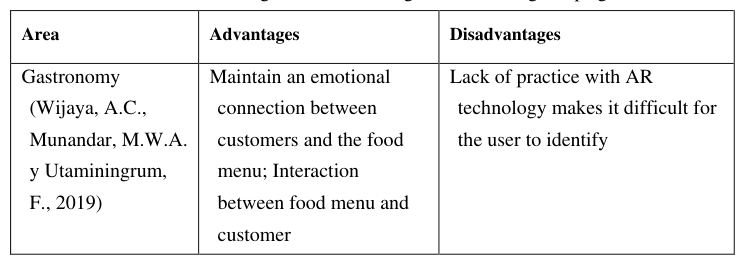
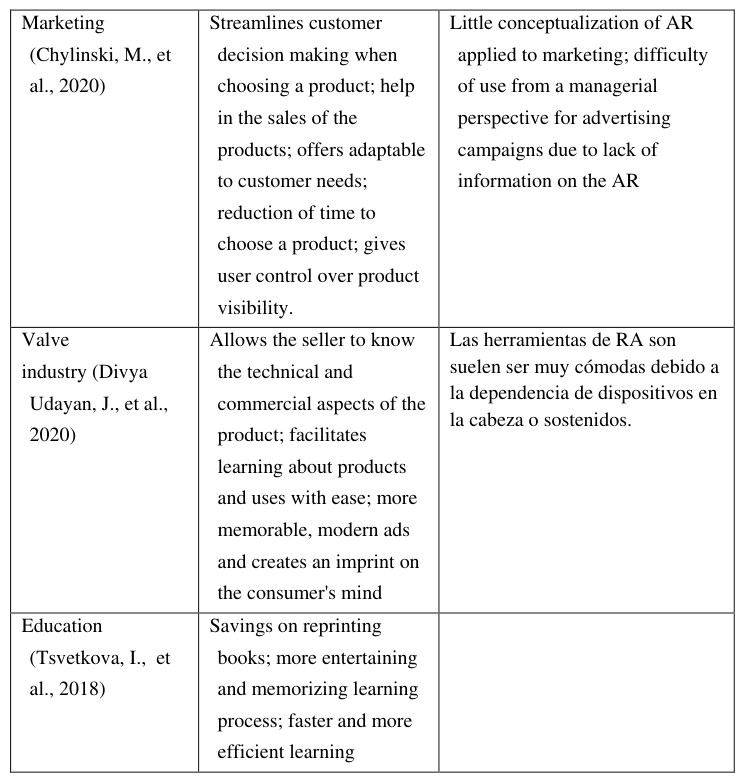
AR has different uses and applications that can be promoted or exposed to the public through digital marketing. As an example of some reviewed applications, we have in the food sector, where consumers can have a view of the dish to be served using 3D images to review information regarding its characteristics, which is activated by the image of the food (Wijaya, A.C., Munandar, M.W.A. y Utaminingrum, F., 2019). In the educational sector, the main advantage of the use of AR is to allow students with the reduction of cognitive load and thus be able to memorize the contents either from media that include images such as books or virtual platforms (Tsvetkova, I., et al., 2018). In the industry there is a knowledge gap between consumers, sellers, manufacturers and workers to understand the product; augmented reality is used to provide production information; images are scanned that serve to display the information in 3D; Also, smartphone camera focus is used to view the product from different angles. The use of the AR provides a clear image of the product that allows a great retention of its operation and characteristics. for example, in the valve area the valve industry, one of the largest industries in the world, RA is used to improve the sales process by helping the seller showing the characteristics of the product more clearly, as well as the buyer (Divya Udayan, J., et al., 2020). On the other hand, in the area of interior design, you
Human Systems Engineering and Design (IHSED 2021) https://openaccess.cms-conferences.org/#/publications/book/978-1-7923-8987-0 can guarantee that the product you want to purchase can be the most accurate to the reality of your needs by showing the user different models and styles and you can evaluate the product in comparison of the real world. This makes it possible to speed up consumer purchases and make them more effective. For example, when buying furniture, find out how you would match the style of the product compared to the actual location space (Tanmay, K., Ayush, K., 2019).
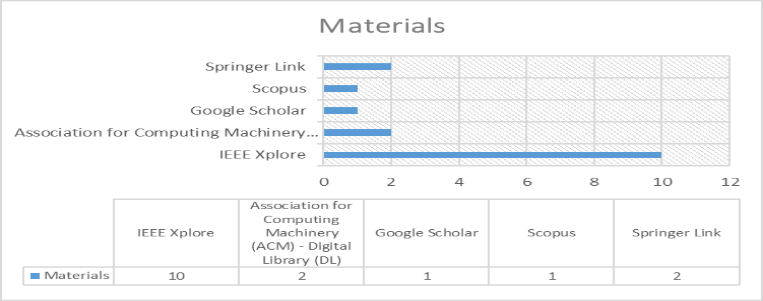
MATERIAL AND METHODS For the development of the following research work, the analytical method is used to carry out a deep and progressive analysis from extracts of information obtained; In addition, verify scenarios in which AR is applied as a digital marketing strategy to carry out advertising campaigns. On the other hand, a qualitative approach to research is applied in order to analyze the social practices that AR has, that is, how people interact with this new technology. Next, a graph of the methodology used for this research is presented (Figure 1) and the result of the data obtained in each of the search engines (Figure 2).
Analyze the Compare the
Select the material that studies and
Detail the results of the
meets the objectives of
results of independent
Select references of scientific works
investigation studies
their characteristics independently
the investigation
Figure 1. Process used to implement an analytical investigation
Figure available in the original PDF paper.
Figure 2. Materials obtained from the different libraries
Human Systems Engineering and Design (IHSED 2021) https://openaccess.cms-conferences.org/#/publications/book/978-1-7923-8987-0
RESULTS
It is very important to highlight that augmented reality is a new technology on the market, therefore, its feasibility needs to be evaluated within an advertising campaign. In order to know the impact that this new technology can have, it is recommended to make use of an experimental investigation. The concept of experimental research is based on manipulating the scenarios or real circumstances in which a product is shown in interaction with the consumer and trying to convert their behavior or reactions into information (Morales, A. C., Amir, O., y Lee, L., 2017). In addition, the use of specific research is highlighted and implemented, since it makes an analysis by groups allowing information to be obtained from different social perspectives. For example, there will be groups that are not very related to technology and others that are, as normally are the elderly against the people of the contemporary world. If a market research of this type is successful, it can be interpreted that the product points to different groups of people having a greater reception in the market. In the results section you can see how the different real scenarios in which AR is implemented show information to evaluate the feasibility of a product that makes use of this technology.
ADVANTAGES AND DISADVANTAGES IN THE USE OF AR IN AN ADVERTISING CAMPAIGN USING DIFFERENT TYPES OF DIGITAL MARKETING The main advantages and disadvantages are described below according to the references that applied AR in digital marketing.
Table 1: Advantages and disadvantages in advertising campaign Area Advantages Disadvantages
Human Systems Engineering and Design (IHSED 2021) https://openaccess.cms-conferences.org/#/publications/book/978-1-7923-8987-0
PARAMETERS IN AN ADVERTISING CAMPAIGN WITH AR AS A DM STRATEGY
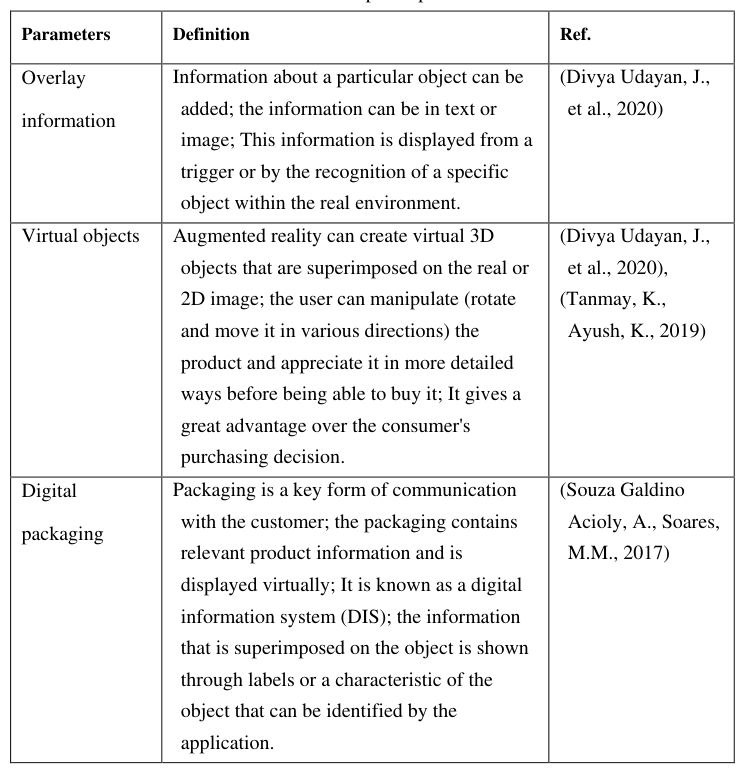
Table 2. describes the types of implementation that must be taken into consideration to carry out an advertising campaign or the promotion of a product. Taking this in-formation into account will allow us to know the best way to exploit the virtues of AR in the exhibition of a product. The misuse of these implementations could generate an unwanted result, therefore, it is important to analyze this information.
Human Systems Engineering and Design (IHSED 2021) https://openaccess.cms-conferences.org/#/publications/book/978-1-7923-8987-0
Table 2: Development parameters Parameters Definition Ref.
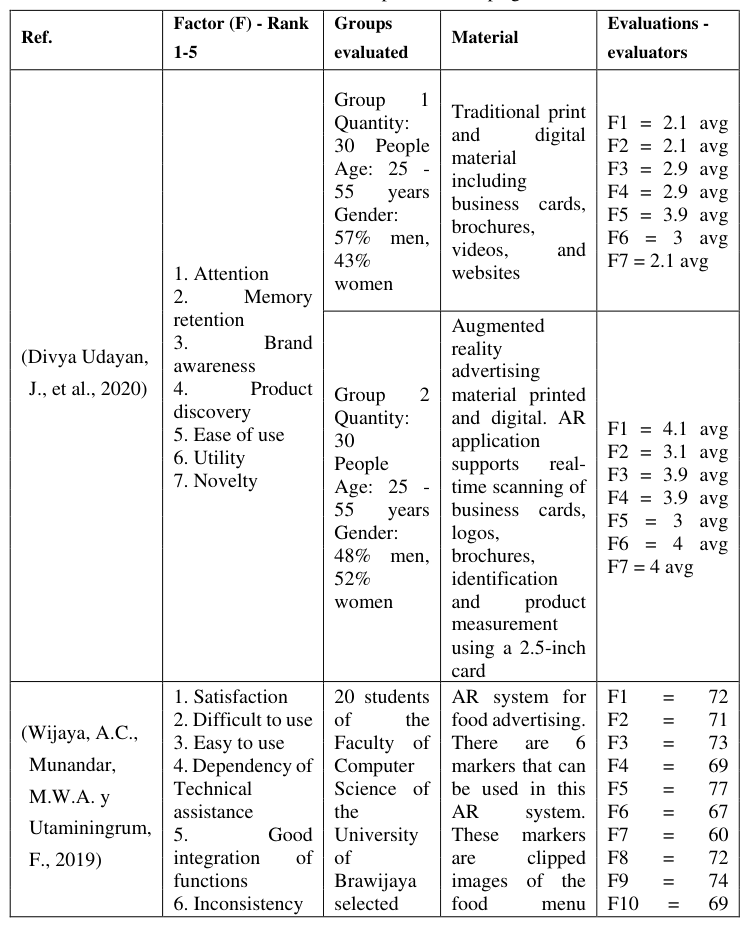
CUSTOMER ACCEPTANCE OF ADVERTISING CAMPAIGNS WITH AR AS AN MA STRATEGY The information shown below is the result of evaluations of people of different ages,
Human Systems Engineering and Design (IHSED 2021) https://openaccess.cms-conferences.org/#/publications/book/978-1-7923-8987-0 genders, and backgrounds. The evaluations carried out are processed with basic mathematics and applying systems to measure usability through means such as the SUS (System Usability Scale).
Table 3: Level of acceptance in campaigns Groups
Human Systems Engineering and Design (IHSED 2021) https://openaccess.cms-conferences.org/#/publications/book/978-1-7923-8987-0 through a random sampling
DISCUSSION
The results collected agree with the current deficiency of AR with respect to the difficulty of use and interpretation of its operation. On the other hand, the fact that AR captures a lot of the user's attention is supported, allowing them to maintain interest in the
Human Systems Engineering and Design (IHSED 2021) https://openaccess.cms-conferences.org/#/publications/book/978-1-7923-8987-0 product and the way it is presented. The analysis of AR in campaigns and promotion is limited only to a study on certain aspects that can make it up, but a complete study is required from the beginning at the end of the process of carrying out an advertising and promotion campaign to be able to identify more thoroughly the benefits or harms you may have with the use of AR. A focus was made on digital marketing with AR since together they would form a powerful tool that would be used for the development of a campaign or promotion. The analysis carried out with the information collected shows ways of implementation that AR can have, and which would be the best for the use of a campaign and the advantages and disadvantages that you can obtain when using it. Considering the various implementation options and the user's appreciation of AR in different factors, a wise decision can be made as to whether to use AR and how it would be most effective.
CONCLUSIONS
AR is a powerful tool used in digital marketing to promote a product in a newer way and allows the information to remain in the consumer's memory for a longer time, it also has more consumer attraction for the product and a competitive advantage; According to the results analyzed, most of the people have more uptake of the product with RA. Although it is true that AR is a technological tool that has great benefits, it lacks ease of use, which prevents the user from performing their activities autonomously, that is, without prior guidance on the operation of a system that does use of RA. In addition, it is necessary for the user of the RA system to have prior knowledge of RA, which makes it less intuitive. Augmented reality has not yet entered its full phase, there is still much to be polished in terms of usability; As time goes by, people will enter the world of AR and many of the current disadvantages will disappear. The RA is not capable of solving the collective needs, but it is capable of specific sectors that can exploit its capacities, as well as the industry.
ACKNOWLEDGMENTS
This work has been supported by the GIIAR research group and the Universidad Politécnica Salesiana.
Human Systems Engineering and Design (IHSED 2021) https://openaccess.cms-conferences.org/#/publications/book/978-1-7923-8987-0
REFERENCES
Ahmed T., T., Shetty S., V., Samirasimha, R., Bedere J., S. (2018), “Performance Evaluation of Augmented Reality based 3D Modelling Furniture Application.” International Conference on Advances in Computing, Communications and Informatics (ICACCI), 2426–2431. Chylinski, M., Heller, J., Hilken, T., Keeling, D.I., Mahr, D., de Ruyter, K. (2020), “Augmented reality
marketing: A technology-enabled approach to situated customer experience”. The Australasian Marketing Journal, 28, 374–384. Divya Udayan, J., Kataria, G., Yadav, R., Kothari, S. (2020), “Augmented Reality in Brand Building and Marketing – Valves Industry.” International Conference on Emerging Trends in Information Technology and Engineering (ic-ETITE), 1–6. Jung, T., Claudia, M., Editors, D. (2018), “Augmented Reality and Virtual Reality.” Springer
International Publishing. Morales, A. C., Amir, O., & Lee, L. (2017), “Keeping it real in experimental research-understanding when, where, and how to enhance realism and measure consumer behavior.” Journal of Consumer Research, 44(2), 465–476. Piñeiro-Otero, T., Martínez-Rolán, X. (2016), “Understanding Digital Marketing—Basics and
Actions”. Souza Galdino Acioly, A., Soares, M.M. (2017), “Mobile Augmented Reality Systems Applied to Food Packaging - A Heuristic Evaluation.” 19th Symposium on Virtual and Augmented Reality (SVR), 243–252. Tanmay, K., Ayush, K. (2019), “Augmented Reality Based Recommendations Based on Perceptual
Shape Style Compatibility with Objects in the Viewpoint and Color Compatibility with the Background”. IEEE/CVF International Conference on Computer Vision Workshop (ICCVW), pp. 3361–3367. Tsvetkova, I., Kinaneva, D., Hristov, G., Raychev, J., Zahariev, P. (2018), “A Complex Workflow for Development of Interactive and Impressive Educational Content Using Capabilities of Animated Augmented Reality Trends.” 17th International Conference on Information Technology Based Higher Education and Training (ITHET), 1–7. Wijaya, A.C., Munandar, M.W.A., Utaminingrum, F. (2019), “Usability Testing of Augmented Reality
For Food Advertisement Based On Mobile Phone Using System Usability Scale.” International Conference on Sustainable Information Engineering and Technology (SIET), 266–269.
Human Systems Engineering and Design (IHSED 2021) https://openaccess.cms-conferences.org/#/publications/book/978-1-7923-8987-0
LISTED IN THE AHFE DIGITAL BOOKSTORE CATALOGUE
Explore the complete digital volume
Human Systems Engineering and Design (IHSED2021): Future Trends and Applications
Read this individual research paper free through the original publisher, or explore the full digital proceedings book.
ISBN 978-1-7923-8987-0
Explore this ISBN in the AHFE Bookstore ↗Listed in the July 2026 bookstore catalogue; search by ISBN to confirm current availability · Digital book purchase optional