Monica Daniela Gomez Rios, Alejandro Drouet, Miguel Angel Quiroz Martinez (2024). Design of an augmented reality software tool to improve user interaction and awareness in geolocation platforms. In: Intelligent Human Systems Integration (IHSI 2024): Integrating People and Intelligent Systems. AHFE Open Access, vol. 119, pp. 266–277. https://doi.org/10.54941/ahfe1004491
People do not give importance to the rules or protocols of each sport through the design of an application in augmented reality it is intended to complement the regulatory information on a sport such as football, such as positioning on a field, offering directions, measurements, radius of the midfield, penalty area, corner area, number of referees and the function of each player. The general objective is to design a tool for learning sports rules related to football using augmented reality. The results are A four-layer architecture such as User, Location, Camera, and Applications; each layer and its components are described in this model. In addition, a first survey of five questions answered by ten professionals in Information Technology on architecture was carried out in this document. The survey indicates that it has a reasonable degree of acceptance, and the professional recommendations are interesting. In addition, a second survey of five questions answered by fifteen players about their interest in using an AR-based application was conducted. It was concluded that architecture has been accepted by professionals and players have disposition or interest in an application in AR.
Augmented reality (AR) applications in sports offer promising results by enhancing user learning and understanding through technology. This pro- posal focuses on utilizing AR with geolocation to provide users with virtual information about sports components and rules. AR combines virtual ele- ments with the real world using devices like cameras, cell phones, and tablets, improving visualization and real-time information access (Delgado, 2018; LoDuca, 2018; Soltani & Morice, 2020; Mahmood et al., 2017). In the context of soccer, where understanding the rules is vital, this AR tool aims to bridge the knowledge gap, especially among beginners, by providing an immersive experience. The design of this AR application allows users to explore and learn about various soccer-related details and elements through
geolocation without the need for additional hardware like AR scoreboards (Skinner & Zollmann, 2019; Leszczynski, 2019; Delgado, 2018; Cie´sl´niski et al., 2016; Lu et al., 2020; Vargas González et al., 2017).
ADVANTAGES OF THE USE OF AR IN LEARNING Augmented reality (AR) in sports learning offers advantages such as improved skill acquisition, enhanced comprehension, better memory reten- tion, and increased physical performance. It provides dynamic information, diverse sensory engagement, and reduces cognitive load, benefiting athletes and learners. AR delivers feedback, including visual and auditory elements, aiding error correction and learning improvement. It offers haptic and visual feedback, enhancing performance in sports like gymnastics. Overall, AR enhances skill development, fosters immersive practice, and provides dynamic feedback, personalized content, and rule customization, making it a vital tool in sports education (Soltani & Morice, 2020; Chernyshov et al., 2018; Baumeister et al., 2017; Denisova & Cairns, 2018; Wiehr & Daiber, 2018; Jeraj & Veit, 2016; Dunleavy, 2018; Rebane & Shijo, 2018; Sano & Sato, 2018; Araki & Fukuda, 2018).
LEARNING THE RULES In soccer, AR can compare physical bodies with virtual bodies, helping players improve posture, reaction times, and route planning. AR provides additional information to athletes and offers advantages in various areas, including sports (Soltani & Morice, 2020). It is also useful for sampling physical training variables and athlete control (Delgado, 2018).
RELATED WORK
Various augmented reality (AR) applications have been developed in the field of sports, each with its unique focus and goals. For instance, (Cie´sl´niski et al., 2016) introduced an educational training simulator for judo competitors, enhancing their techniques and competition accuracy. Eichhorn et al. (2020) created an AR game using drones to improve object visibility during game- play. Pulido (2016) designed an AR application for real-time performance analysis during workouts. (Mahmood et al., 2017) developed a system for providing additional data to baseball players regarding their position and field members. Finally, (Fedosov, 2018) designed a portable ski-based AR system for communication, route mapping, and risk minimization, preparing players for real-world scenarios.
Location-Based Augmented Reality Location-based Augmented Reality uses components of smartphones like an accelerometer, digital compass, and GPS to display location-dependent information (Delgado, 2018). Augmented reality (AR) with geolocation com- bines natural and virtual elements, creating a mixed-reality context (Palmieri et al., 2020). AR-based applications enhance learning experiences by enabling
exploratory learning and virtual interaction with hard-to-access objects or locations (José & Olivencia, 2015) (Batra et al., 2014).
Architecture of an AR-Based System A basic AR architecture with geolocation comprises 2D/3D models, devel- opment software/engine (Khalid et al., 2019), a smart device with cam- era and internet access (Liu et al., 2019), a display for real-world object visualization (Dalim et al., 2017), a GPS for localization (Pulido, 2016), and a relational/non-relational database (Rivera Alvarado et al., 2018). Functional, efficient, reliable, maintainable, and portable attributes are crucial in any architecture (Rivera Alvarado et al., 2018). The archi- tectural design of AR applications is vital for defining models, com- ponents, relationships, and ensuring comprehensibility for developers or specialists.
METHODOLOGY
This research comprises four phases:
1. Article Review: Analyzing scientific articles in augmented reality, focus- ing on geolocation, sports, education, and AR improvements. 2. AR Architecture: Developing a layered AR architecture using activity diagrams to describe its components. 3. AR Architecture Survey: Conducting a survey among 10 system engi- neers and software architecture specialists to assess the acceptance of the proposed AR architecture. 4. AR Application Acceptance Survey: Administering a survey to 15 play- ers and individuals to gauge their interest in a mobile AR application. Analyzing survey results using descriptive and statistical methods.
Figure 1: Methodology.
Figure available in the original PDF paper.
RESULTS
The results begin by presenting the proposed architecture with its respective layers, then the survey results on the architecture and the acceptance of AR applications.
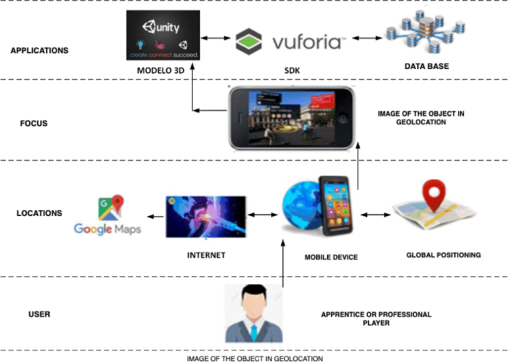
Designing an AR Architecture To propose the architecture of a system using augmented reality in the learning of rules applied in soccer, the main components that are part of the architecture have been taken into account, such as The development software, devices, databases, localization, and visualization components. Figure 2 shows these components:
Design of an Augmented Reality Software Tool 269
Figure 2: Architecture based on augmented reality.
The architecture design involves multiple layers and components:
1. User Layer: This layer caters to professional players, trainees, or users interacting with the application. It enables the visualization of real-life situations by overlaying stored images on real-world visuals. 2. Localization Layer: This layer includes components like the mobile device with network connectivity and specific processing capabilities. Global Positioning offers latitude and longitude coordinates, with Google Maps aiding in location-based guidance. 3. Focusing Layer: Located in the device’s camera, this layer captures still images of real-world scenarios. 4. Applications Layer: Unity and Vuforia tools are used to create aug- mented reality applications on mobile devices. Vuforia provides robust tracking and performance, while Unity facilitates 3D model creation. Unity’s AR camera optimizes the real view, and Vuforia recognizes and converts real-world objects and images into 3D models.
The process involves the user activating GPS on their mobile device, launching the mobile app, capturing the real-world environment, searching for the image, loading it in augmented reality, and presenting it with relevant information. Unity and Vuforia are complementary, offering a versatile mul- tiplatform solution for creating augmented reality experiences. The database stores images, image features, 2D and 3D images, facilitating organized spatial management of geographic data for use in geographic information systems (Khalid et al., 2019; Shaikh, 2021; Liu et al., 2019; Rivera Alvarado et al., 2018; Dalim et al., 2017).
Architecture Survey Results The survey phase involved Information Technology professionals and play- ers. In the professionals’ survey, ten Systems Engineering experts answered questions as follows:
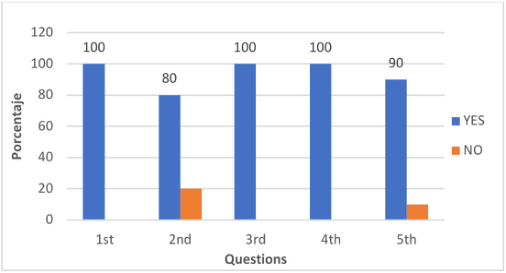
Appropriateness of Tools: 100% answered “YES,” emphasizing that the tools in the proposed architecture are the most suitable for the project.
Expansion of Tool Descriptions: 20% answered “YES,” suggesting more detailed descriptions, while 80% answered “NO,”finding the descriptions clear and concise.
Adaptation to AR with Geolocation: 100% answered “YES,” indicating that the architecture is well-suited to AR with geolocation.
Sufficiency of Tools: 100% found the tools sufficient for the project, meeting its objectives.
Implementation in Other Areas: 90% answered “YES,” suggesting poten- tial applications in various fields. However, 10% answered “NO,” high- lighting suitability for games.
Figure 3 in the survey results illustrates these percentages (blue for “YES” and orange for “NO”).
Figure 3: Survey responses.
The most important thing to note is that the first, third, and fourth questions have 100% complete acceptance, i.e., the tools in the proposed architecture are adequate, the architecture is adapted to the use of AR with geolocation, and the tools applied are sufficient.
Survey of Acceptance of AR Use For the second survey, 15 people between professional players and amateurs only played one sport and answered the digital survey.
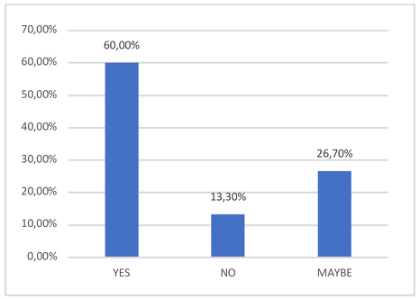
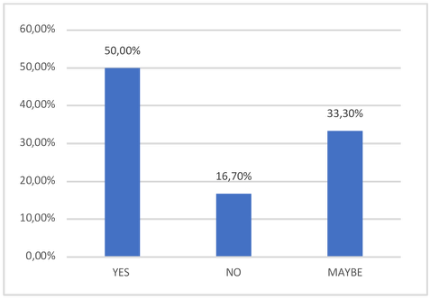
First question: Do you know augmented reality? Among the practitioners, 60% stated that they know AR, i.e., nine people; 26% do not know about AR, i.e., two people; 13% have basic knowledge about AR, i.e., four people, see Fig. 4. Among the professionals, 50% stated that they know AR, i.e., three persons; 33.3% do not know about AR, i.e., two persons; 16.7% have basic knowledge about AR, i.e., one person, see Fig. 5.
Design of an Augmented Reality Software Tool 271
Figure 4: Knowledge of AR in practitioners.Figure 5: AR knowledge in professionals.
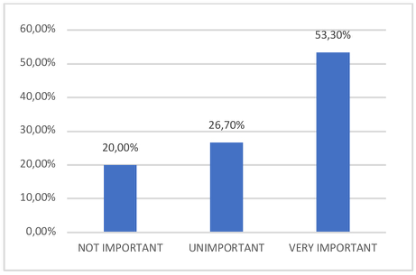
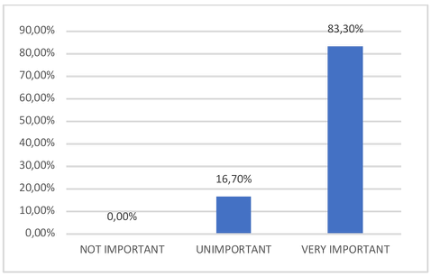
Second question: Are the rules and protocols in sports vital to you? Among practitioners, 53.3% indicate that rules and protocols in sports are very important, i.e., eight people; 26.7% believe that they are not very impor- tant, i.e., four people; and 20%, i.e., three people indicate that they are not very important, see Fig. 6. Among professionals, 83.3% indicate that rules and protocols in sports are very important, i.e., five people; 16.7% believe that they are not very important, i.e., one person; in this case, for all respondents, rules and protocols in sports are essential, see Fig. 7.
Third question: Would you like to learn about the rules and protocols handled in a sport using an application from your cell phone?
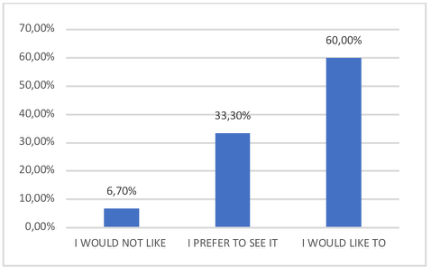
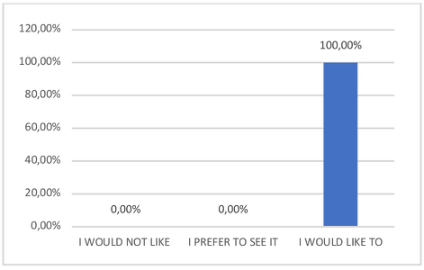
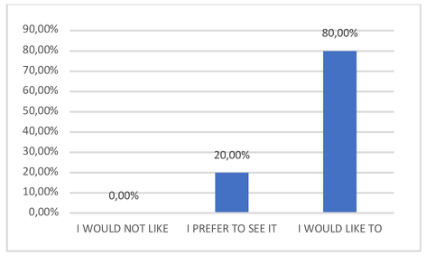
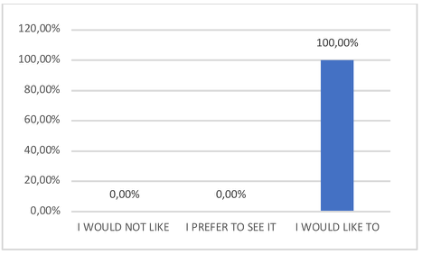
Among the practitioners, 60% of the respondents indicate that, yes, they would like to use an app to learn about the rules and protocols that are in sports, that is nine people; 33.3% prefer only to visualize the sport without knowing about the rules of sports, that is five people; and 6.7% which is one person, would not like or are interested in learning about the rules that are in sports, see Fig. 8. Among the professionals, 100% of the respondents indicated they would like to use a mobile application to learn about sports rules, i.e., 6 people, see Fig. 9.
Fourth question: Would you like sports to be associated with technology?
Figure 6: Importance of the rules in practitioners.Figure 7: Importance of rules in professionals.Figure 8: Learning the rules in practitioners.
Among the practitioners, 80% (12 people) say that they would like or agree that sports are related to technology; 20% indicate that it seems irrelevant or that they do not care if technology is associated with sports, i.e., three people, see Fig. 10.
Among professionals, 100% of the respondents say they would like or agree that sports should be related to technology for six people see Fig. 11.
Design of an Augmented Reality Software Tool 273
Figure 9: Learning the rules in professionals.Figure 10: Linking sport and technology in practitioners.Figure 11: Linking sport and technology in professionals.
Fifth question: Do you use the internet or download apps to learn about specific sports?
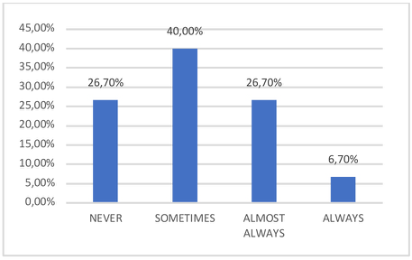
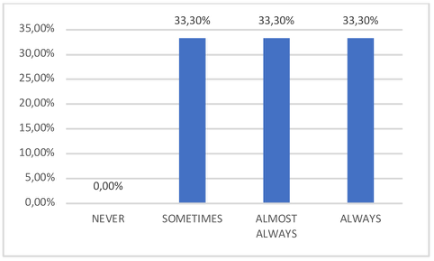
Among practitioners, 6.7% use the Internet to learn about sports, 26.7% almost always use it, 40% sometimes use it, and 26.7% never use it (see Figure 12). Among professionals, 33.3% use the Internet, 33.3% almost always use it, and 33.3% sometimes use it (see Figure 13).
Question 6. Do you frequently use virtual maps to locate yourself in each place?
Figure 12: Internet usage in interns.Figure 13: Internet use by professionals.
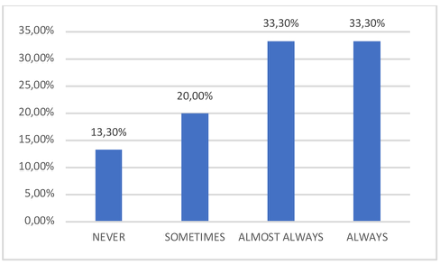
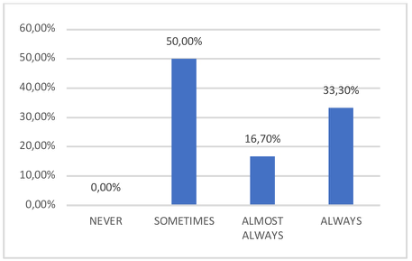
Indeed, here’s a more concise version in English: Among professionals sur- veyed, about one-third (33.3%) always or almost always use virtual maps for location, while 20.0% do so occasionally. 13.3% have never used this tool (Figure 14). Regarding virtual maps for personal location, 33.3% always use them, 16.7% almost constantly, and 50.0% occasionally (Figure 15). These results reflect virtual maps’ preferences and usage patterns among the surveyed professionals.
Figure 14: Use of maps in practitioners.
Design of an Augmented Reality Software Tool 275
Figure 15: Use of maps in professionals.
DISCUSSION
The proposed architecture has broader applications beyond sports, including user experience, sales, learning, and social interactions. Unity and Vuforia are key tools, with other options like AR Core, Dagger, PyTorch, and Sand- box available. Pattern- and recognition-based AR are excluded as they don’t align with the architecture’s goals. Geolocation-based AR is chosen for its suitability for large areas like soccer fields. Rendering might be considered to optimize 3D modeling performance, and the potential integration of Artificial Intelligence is of interest.
Results from both surveys indicate positive acceptance of the AR-based architecture among IT professionals and players’ preference for mobile appli- cations in sports. Questions about development resources, budget, and learning times arise but are beyond the paper’s scope.
CONCLUSION
An AR-based architecture was proposed and can facilitate the learning pro- cess of rules applied in soccer with geolocation; the model is formed in layers and components described for its possible implementation. The first survey conducted on ten Information Technology professionals with knowledge of augmented reality indicates that it has a reasonable degree of acceptance, and the recommendations made by professionals are interesting. The second survey of 15 gamers indicates a great interest in obtaining AR-based applica- tions for another way of learning. The use of mobile applications based on AR influences any type of learning. According to the literature, there is an increase in the learning process, and there may be more motivation for the different ways of learning.
ACKNOWLEDGMENT
This work has been supported by the GIIAR research group of the Universi- dad Politécnica Salesiana.
REFERENCES
Araki, H., Fukuda, H. (2018). HADO as Techno Sports was born by the fusion of IT technology and sports. Laval Virtual ReVolution. Batra, N., Gupta, H., Yadav, N., Gupta, A., & Yadav, A. (2014). Implementation of
augmented reality in cricket for ball tracking and automated decision making for no ball. 2014 International Conference on Advances in Computing, Communica- tions and Informatics (ICACCI), 316–321. https://doi.org/10.1109/ICACCI.2014. 6968378 Baumeister, J., Ssin, S. Y., ElSayed, N. A. M. (2017). Cognitive cost of using augmented reality displays. IEEE Transactions on Visualization and Computer Graphics. Chernyshov, G., Ragozin, K., Chen, J., & Kunze, K. (2018). DubHap: A sensory
substitution based superhuman sport. Paper Presented at the Proceedings of the First Superhuman Sports Design Challenge: First International Symposium on Amplifying Capabilities and Competing in Mixed Realities. Cie´sl´niski, W. B., Sobecki, J., Piepiora, P. A., Piepiora, Z. N., & Witkowski, K. (2016).
Application of the Augmented Reality in prototyping the educational simulator in sport - the example of judo. Journal of Physics: Conference Series, 710(1), 012016. https://doi.org/10.1088/1742-6596/710/1/012016 Dalim, C. S. C., Piumsomboon, T., Dey, A., Billinghurst, M., & Sunar, S. (2017).
TeachAR: An Interactive Augmented Reality Tool for Teaching Basic English to Non-native Children. Adjunct Proceedings of the 2016 IEEE International Symposium on Mixed and Augmented Reality, ISMAR-Adjunct 2016, 344–345. https://doi.org/10.1109/ISMAR-Adjunct.2016.0113 Delgado, J. (2018). Posibilidades de la realidad aumentada aplicada en la gestión de los entrenamientos deportivos. Lecturas de Educación Fisica y Deporte, 22, 236. Denisova, A., & Cairns, P. (2018). Adaptation in digital games: The effect of
challenge adjustment on player performance and experience. Pattern Recognition- Symposium on Computer-Human Interaction in Play, London, United Kingdom. Dunleavy, M. (2018). Design Principles for Augmented Reality Learning. TechTrends, 58(1), 28–34. https://doi.org/10.1007/s11528-013-0717-2 Eichhorn, C., Jadid, A., Plecher, D. A., Weber, S., Klinker, G., & Itoh, Y. (2020).
Catching the Drone - A Tangible Augmented Reality Game in Superhuman Sports. 2020 IEEE International Symposium on Mixed and Augmented Reality Adjunct (ISMAR-Adjunct), 24–29. https://doi.org/10.1109/ISMAR-Adjunct51615.2020. 00022 Fedosov, A., N. (2018). Design and evaluation of a wearable AR system for sharing personalized content on Ski resort maps. International Conference on Mobile and Ubiquitous Multimedia, Rovaniemi, Finland. Hernandez, R. (2015). Metodología de la Investigación. QUINTA EDI, 656. Jeraj, D., Veit, J., H. (2016). How do gymnastics coaches provide movement feedback
in training? International Journal of Sports Science & Coaching,. https://doi.org/ 10.1260/1747-9541.10.6.1015 José, J., & Olivencia, L. (2015). Tecnologías de geolocalización y realidad aumentada en contextos educativos: experiencias y herramientas didácticas. DIM: Didáctica, Innovación y Multimedia, 0(31), 1–18. Khalid, F., Ali, A. I., Ali, R. R., & Bhatti, M. S. (2019). AREd: Anatomy learning
using augmented reality application. 2019 International Conference on Engineer- ing and Emerging Technologies, ICEET 2019. https://doi.org/10.1109/CEET1. 2019.8711843
Design of an Augmented Reality Software Tool 277
Leszczynski, A. (2019). Platform affects of geolocation. Geoforum, 107(June), 207–215. https://doi.org/10.1016/j.geoforum.2019.05.011 Liu, E., Liu, C., Yang, Y., Guo, S., & Cai, S. (2019). Design and Implementation of
an Augmented Reality Application with an English Learning Lesson. Proceedings of 2018 IEEE International Conference on Teaching, Assessment, and Learning for Engineering, TALE 2018, December, 494–499. https://doi.org/10.1109/TALE .2018.8615384 LoDuca, S. (2018). Systems, devices and methods for virtual and augmented reality sport training (p. 12). Lu, P., Lim, J., Graf, R., & Kim, H. S. (2020). IGYM: An Inclusive Augmented
Reality Exergame for People of All Abilities. IEEE Workshop on Signal Processing Systems, SiPS: Design and Implementation, 2020-Octob, 1–6. https://doi.org/10. 1109/SiPS50750.2020.9195226 Mahmood, Z., Ali, T., Muhammad, N., Bibi, N., Shahzad, M. I., & Azmat, S. (2017).
EAR: Enhanced Augmented Reality System for Sports Entertainment Applica- tions. KSII Transactions on Internet and Information Systems, 11(12), 6069–6091. https://doi.org/10.3837/tiis.2017.12.021 Monji-Azad, S., Kasaei, S., & Eftekhari-Moghadam, A.-M. (2014). An efficient augmented reality method for sports scene visualization from single moving camera. 2014 22nd Iranian Conference on Electrical Engineering (ICEE), Icee, 1064–1069. https://doi.org/10.1109/IranianCEE.2014.6999693 Palmieri, S., Righi, A., Bisson, M., & Ianniello, A. (2020). Training with a world
champion: augmented reality applications in sport Design-led research. 2020 IEEE International Conference on Artificial Intelligence and Virtual Reality (AIVR), 366–370. https://doi.org/10.1109/AIVR50618.2020.00075 Pulido, G. D. L. (2016). Estudio sobre la utilización del GPS de teléfonos inteligentes para el análisis de deporte al aire libre. 239. Rebane, K., Shijo, R., S. (2018). Augmented dodgeball. International Symposium on
Amplifying Capabilities and Competing in Mixed Realities, Delft, Netherlands. Rivera Alvarado, L. A., Lopez Dominguez, E., Hernandez Velazquez, Y., Dominguez Isidro, S., & Excelente Toledo, C. B. (2018). Layered software architecture for the development of mobile learning objects with augmented reality. IEEE Access, 6, 57897–57909. https://doi.org/10.1109/ACCESS.2018.2873976 Sano, Y., Sato, K. (2018). Sports support system: Augmented ball game for filling gap
between player skill levels. ACM International Conference on Interactive Surfaces and Spaces, Ontario, Canada. Shaikh, F. S. (2021). Augmented Reality Search to Improve Searching Using Augmented Reality. 2021 6th International Conference for Convergence in Technol- ogy, I2CT 2021, 1–5. https://doi.org/10.1109/I2CT51068.2021.9417827 Skinner, P., & Zollmann, S. (2019). Localisation for Augmented Reality at Sport
Events. 2019 International Conference on Image and Vision Computing New Zealand (IVCNZ), 2019-Decem, 1–6. https://doi.org/10.1109/IVCNZ48456. 2019.8961006 Soltani, P., & Morice, A. H. P. (2020). Augmented reality tools for sports education and training. Computers & Education, 155(June 2019), 103923. https://doi.org/ 10.1016/j.compedu.2020.103923 Vargas González, A. N., Kapalo, K., Koh, S., & LaViola, J. (2017). Exploring the
Virtuality Continuum for Complex Rule-Set Education in the Context of Soccer Rule Comprehension. Multimodal Technologies and Interaction, 1(4), 30. https: //doi.org/10.3390/mti1040030 Wiehr, F., Daiber, F., K. (2018). BetaCube: Enhancing training for climbing by a self-calibrating camera-projection. I Conference Extended Abstracts on Human Factors in Computing Systems, San Jose, California, USA.
LISTED IN THE AHFE DIGITAL BOOKSTORE CATALOGUE
Explore the complete digital volume
Intelligent Human Systems Integration (IHSI 2024): Integrating People and Intelligent Systems
Read this individual research paper free through the original publisher, or explore the full digital proceedings book.
ISBN 978-1-958651-95-7
Explore this ISBN in the AHFE Bookstore ↗Listed in the July 2026 bookstore catalogue; search by ISBN to confirm current availability · Digital book purchase optional