Henry Paananen, Trevor Prendergast, Vesa Salminen, Juha-Matti Torkkel (2023). Enabling active learning experience in XR environments – identifying the design elements for XR learning objects. In: Human Factors, Business Management and Society. AHFE Open Access, vol. 97, pp. 279–285. https://doi.org/10.54941/ahfe1003904
This research focuses on identifying the design elements for XR learning objects. In this research the data gathered is focusing on the Finnish secondary level education pilot projects which use XR-environments. In this concept paper we present the identified phases for data collection. The identified phases are teacher’s design documents, the planning, implementing phases and reflection phase. Data is collected from teachers that are designing the learning object for XR environment.Extended Reality (XR) is an umbrella term for virtual, mixed and augmented realities. Commonly they’re known as Virtual Reality (VR), Mixed Reality (MR) and Augmented Reality (AR). VR is usually associated into Head Mounted Displays (HMD) and they’re referred as VR-glasses in common language. VR-glasses are basically creating stereoscopic picture and it creates the user feeling like they’re immersed in the 3-dimensional space. (Milgram & Kishino, 1994)XR-environments provides many possibilities to support learning. When XR is used effectively in learning, it increases the participant’s interest in and focus on the learning task. XR makes it possible to look at things that would not otherwise be so well illustrated in the real world. Augmented reality increases students motivation and helps them explore the existing environment (Sotiriou & Bogner 2008). Several studies show that the use of AR in education leads to enhanced learning outcomes (Akçayır & Akçayır 2016).Data is collected nowadays everywhere but there’s a big gap in utilizing the data for the purposes to develop learning and pedagogy. Most of the data applied is for business and management purposes. The term Educational data mining has been firstly mentioned in half of the 2005 and since that the applications and research of this field has been growing. One of the substudy fields of EDM is Learning Analytics which is defined as measuring, collecting, analysing and reporting of data from acquired from learning environments (Larusson & White, 2014; Siemens & Baker, 2013). Learning analytics interprets the collected data from various sources. Data is collected from various learning environments which leave “digital footprints” from student interactions. The data is analysed to make predictions, to visualize learning progress and to make interventions in learning processes. Learning analytics field doesn’t limit only to algorithm based interpretations of learning but it could utilize different techniques to analyze the data properly. (Johnson et al, 2011).
This present research concept focuses on identifying the design elements for Extended Reality (XR) learning objects. Extended Reality (XR) is an umbrella term for virtual, mixed and augmented realities. Commonly they’re known as Virtual Reality (VR), Mixed Reality (MR) and Augmented Reality (AR). VR is usually associated into Head Mounted Displays (HMD) and they’re referred as VR-glasses in common language. VR-glasses are basi- cally creating stereoscopic picture and it creates the user feeling like they’re immersed in the 3-dimensional space. (Milgram & Kishino, 1994). XR-environments provide many possibilities to support learning. When XR is used effectively in learning, it increases the participant’s interest in and focus on the learning task. XR makes it possible to look at things that would not otherwise be so well illustrated in the real world. Augmented reality incre- ases students’ motivation and helps them explore the existing environment (Sotiriou & Bogner 2008). Several studies show that the use of AR in edu- cation leads to enhanced learning outcomes (Hu et. Al., 2021; Akçayır &
Akçayır, 2016). According to Parong (2018) virtual reality motivates students better than traditional didactic learning. Student’s who use VR are less bored and more motivated and happier than student’s using traditional learning solutions (Parong, 2018).
Data is collected nowadays everywhere but there’s a big gap in utili- zing the data for the purposes to develop learning and pedagogy. Most of the data applied is for business and management purposes. The term Educational data mining has been firstly mentioned in half of the 2005 and since that the applications and research of this field has been growing. One of the fields of EDM is Learning Analytics which is defined as measu- ring, collecting, analysing and reporting of data from acquired from learning environments (Larusson & White, 2014; Siemens & Baker, 2013). Learning analytics interprets the collected data from various sources. Data is collected from such as learning environments which leave “digital footprints” from student interactions. The data is analysed to make predictions, to visualize learning progress and to make interventions in learning processes. Learning analytics field doesn’t limit only to algorithm-based interpretations of lear- ning but it could utilize different techniques to analyze the data properly. (Johnson et al, 2011). Literature review shows that most of the VR-training simulations do not have pedagogical approach. Radiantis article presents review goes through 59 peer reviewed articles and 68% do not mention any learning theories (Radianti et al. 2020). Gong et al (2021) has created a framework for Extended Reality System Development in Manufacturing in their research projects. The framework is derived from the results of the pilot cases, which consists of five iterative phases: (1) requirements analysis, (2) solution selection, (3) data preparation, (4) system implementation and (5) system evaluation. The framework focuses on many different applications and technologies in XR but it doesn’t consider the learning perspective at all.
DESIGNING LEARNING FOR VIRTUAL ENVIRONMENTS Concepts and trends of learning are theoretical and scientifically pro- ved models which focuses on the learning processes. In the background there’s perceptions of human, knowledge, learning environment and lear- ning situations. Current perception sees learning as constructivist, social interactive knowledge building in certain time and space, culture and com- munity. (Engeström, 2004; Ruohotie, 2000; Kauppila, 2007; Tynjälä, 1999) Learning is seen partly as individuals own cognitive process but also as a social learning process where the knowledge is build upon cognitively and socially. (Hakkarainen, Lonka & Lipponen, 2001; Tynjälä, Heikkinen & Huttunen, 2005).
Nowadays learning happens more and more in online environments. Virtual learning environments makes the learning possible without location and time limits. But when they’re poorly designed they’re not offering more than a place to download or read the materials online (Coates, 2005). Yu & Xu (2022) concludes in their literature review on VR technologies in lear- ning that VR technologies generally exert a strong and positive influence on educational outcomes. But there’s negative findings in their effects on
Enabling Active Learning Experience in XR Environments 281
Lakkala et al. (2008; 2010; 2015) presents model for designing the peda- gogical infrastructure framework which consists of 1) learning situations fundamentals (design - support, tools and practicalities, design and organi- zing) 2) instruction and providing professional support during the learning process (scaffolding). According to Lakkala (2008; 2010) the technology- enhanced collaborative knowledge creation should consist of deliberately designed technical (selecting the technologies and how to use them), social (how to organize collaboration and how to use collaborative tools and tech- nologies, epistemic (how to create and process knowledge), and cognitive support structures (supporting the students autonomy, learning and refle- ction readiness). Also according to Wenger (1998) the theoretical work about communities of practice sees that communities of practice can arise in any domain of human endeavour, for example, the practices of school friends who are defining a shared identity in their school. Learning takes place through people’s participation in multiple social practices. Social learning theory ali- gns nicely with social media and technology usage. The social nature of human learning makes these tools relevant and transformative.
The identified the research gap lies between the XR environments practical solutions and the pedagogical design elements. This presented method colle- cts data from four phases of development of XR learning environment and creates a conceptual framework for designing good learning experiences in XR environment. The following research questions (RQ) are addressed: RQ1. How to identify what the pedagogical design elements are for designing XR learning objects? RQ2. What are the phases for designing learning object in XR?
METHODOLOGY
Concept mapping enables a way to represent information and knowledge visually in graphs (Novak, 1991; Salminen, 2009). Approach to this study is to create data collection concept to integrate the concepts into a framework level in the next research papers. This study focuses on the first concept of data collection to support structured further research.
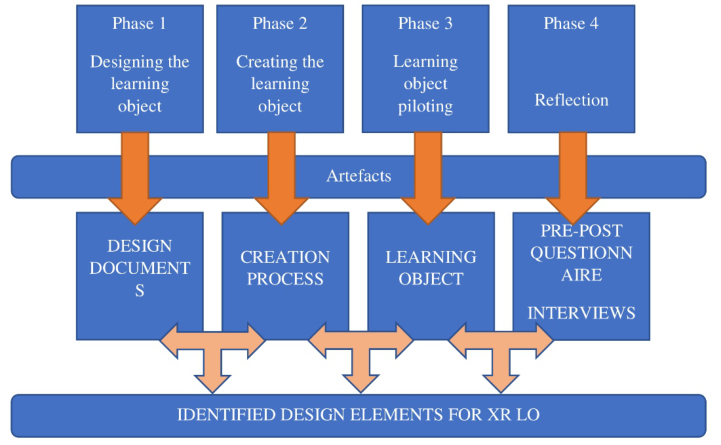
This study combines methods of quantitative and qualitative research, with a focus on qualitative research. The research the data will be gathe- red focusing on the Finnish secondary level education pilot projects which use XR-environments. In this concept paper we present the identified pha- ses for data collection. The identified phases are teacher’s design documents, the planning, implementing phases and reflection phase. Data is collected from teachers that are designing the learning object for XR environment. Also collecting data from students using XR environment fulfills the data collection.
Quantitative research methods are mainly used in potential data fin- dings and interpretations from data gathered from XR environments. Questionnaires with predetermined answer options will be used to gather preliminary design principles and pre-post questionnaires are collected when
Figure 1: The research data collection phases.
piloting the XR learning objects. Qualitative research methods used in the research include analysis of design documents (technical and pedagogical).
PRELIMINARY RESULTS RQ1. How to identify what the pedagogical design elements are for designing XR learning objects? Based on practical observations during the project the teachers are not fami- liar with the possibilities of XR technology. This creates a certain type of “chicken and egg” problem. If the teachers are not trained to use XR envi- ronments in their teaching processes they’re not able to design the learning in XR. Teachers need to have practical training sessions before they enough understanding to begin planning their own learning objects in XR. After the introductory training sessions, the teachers have clearer understanding of possibilities and limitations of XR technology.
After the training sessions teachers can start designing the pedagogical aspects and learning goals for XR. Teachers need more practical help in designing with the best pedagogical practises in XR. Also, the content cre- ation must be done with the help of ICT skilled teachers or designers, usually teachers don’t have this level of ICT skills.
Next step of the project is to finish designing XR learning objects and pilot the learning objects with student groups. The data collection phases are included in every phase of the process and the next step is piloting and data collection. RQ2. What are the phases for designing learning object in XR? Based on practical observations and the modifying the work from Lakkala et al. (2010; 2015) on pedagogical infrastructure model we modified the
Enabling Active Learning Experience in XR Environments 283
model to suit for designing learning to an XR. Based on the design docu- ments that teachers created, the preliminary results indicate that teachers are more willing to start the learning object creation at the same time when they start to design the learning object. Designing learning with XR-technology tools, that teachers are not familiar with, needs more practical approach to support the learning object design process. Further studies should be focused more on modifying the pedagogical infrastructure model to suit more agile way to create learning objects.
CONCLUSION
Designing good quality learning object for XR environment is not an easy task for teachers. Teachers need to be familiar with the possibilities of XR technology. Also, the ICT support is usually needed for content crea- tion. Teachers in Finland have good level of knowledge from their teaching subjects and good pedagogical practices. Although when the learning process is in XR environment the teachers need good practical training before they can start using XR technologies in their own teaching.
The pedagogical infrastructure model should be developed further to suit more concrete XR-technology supported learning situations. Also the desi- gning phase should be facilitated by using design thinking and co-creation models of knowledge creation. It should include faster artefacts that teachers could pilot during the design process with real feedback from colleagues and students.
ACKNOWLEDGMENT
The authors would like to thank Mr. Juha-Matti Torkkel for his expertise and assistance in organizing data collection practicalities and supporting the process.
REFERENCES
Akcayir, M., Akcayir, G., Pektas, H. M., & Ocak, M. A. (2016). Augmented Reality in Science Laboratories: The Effects of Augmented Reality on University Stu- dents’ Laboratory Skills and Attitudes toward Science Laboratories. Computers in Human Behavior, 57, 334–342. https://doi.org/10.1016/j.chb.2015.12.054. Coates, H, Richard, J. & Baldwin G. 2005. A Critical examination of the
effect of learning management systems on university. 27–28. https://link.springer. com/article/10.1007/s11233-004-3567-9. Engeström, Y. 2004. expansive learning and co-development at work - Ekspansiivinen oppiminen ja yhteiskehittely työssä. Vastapaino. Otavan kirjapaino Oy. Gong, L., Fast-Berglund, Å. & Johansson, B. (2021). “A Framework for Exten-
ded Reality System Development in Manufacturing,” in IEEE Access, vol. 9, pp. 24796–24813, 2021, doi: 10.1109/ACCESS.2021.3056752. Hakkarainen, K. 2017. Collective creativity, communal learning and self- transcendence - Kollektiivinen luovuus, yhteisöllinen oppiminen ja itsensä ylit- täminen. Aikuiskasvatus 1/2017, 47–56.
Hakkarainen, K., Lonka K. & Lipponen L. 2001. Inquiry-based learning. Limits of intelligent operation and crossing them - Tutkiva oppiminen. Älykkään toiminnan rajat ja niiden ylittäminen. WS Bookwell Oy. Porvoo. Heikkilä, K. 2006. Learning at work as an interaction between individual starting
points and learning environments - Työssä oppiminen yksilön lähtökohtien ja oppimisympäristöjen välisenä vuorovaikutuksena. Academic dissertation. Univer- sity of Tampere, Department of Education. Akateeminen väitöskirja. Tampereen yliopisto, kasvatustieteen laitos. Tampere University. Press Ltd - Juvenes Print. Tampere. Hu, C.-H., Barrett, N. E., & Liu, G.-Z. (2021). The development and construction of an AR-guided learning model with focused learning theories. Journal of Computer Assisted Learning, 37( 5), 1423–1440. https://doi-org.ezproxy.hamk.fi/10.1111/ jcal.12583 Johnson, L., Smith, R., Willis, H., Levine, A. & Haywood, K. (2011). The 2011
Horizon Report. Austin, Texas: The New Media Consortium. Lakkala, M. (2015). Good practices in teaching supported by digital technology.
Pedagogical infrastructure model - Hyvät käytänteet digiteknologian tukemassa opetuksessa. Pedagogisen infrastruktuurin malli. Available online https://www.sl ideshare.net/MinnaHL/ pedagogineninfra2015. Lakkala, M., Ilomäki, L. & Kosonen, K. (2010). From instructional design to setting up pedagogical infrastructures: Designing technology-enhanced knowledge creation. In B. Ertl (Ed.), Technologies and Practices for Constructing Knowledge in Online Environments: Advancements in Learning (pp. 169–185). New York: Information Science Reference. Lakkala, M., Muukkonen, H., Paavola, S., & Hakkarainen, K. (2008). Designing
pedagogical infrastructures in university courses for technology-enhanced colla- borative inquiry. Research and Practice in Technology Enhanced Learning, 3(1), 33–64. Martinez, S. L., & Stager, G. (2013). Invent to learn: Making, tinkering, and engineering in the. Larusson, J. A., & White, B. (Eds.) (2014). Learning Analytics: from Research to Practice. NY, USA: Springer. doi: 10.1007/978-1-4614-3305-7. Milgram, P., and Kishino, F. (1994). A taxonomy of mixed reality visual displays. IEICE Trans. Inform. Syst. 77, 1321–1329. Novak, J. D. (1991), Clarify with concept maps. The Science Teacher, 58(7),
pp. 45–49. Parong, J. (2018). Learning science in immersive virtual reality. Journal of Educational Psychology, 110(6), 785–797. doi: 10.1037/edu0000241. Radianti, J., Majchrzak, T. A., Fromm, J., & Wohlgenannt, I. (2020). A systema-
tic review of immersive virtual reality applications for higher education: Design elements, lessons learned, and research agenda. Computers & Education, 147, Article 103778. https://doi.org/10.1016/j.compedu.2019.103778. Salminen, V. (2009). Synergy management by hybrid innovation. Tampere University of Technology. Siemens G. Learning Analytics: The Emergence of a Discipline. American Behavioral
Scientist. 2013;57(10): 1380–1400. doi: 10.1177/0002764213498851. Sotiriou, S., & Bogner, F. X. (2008). Visualizing the invisible: Augmented reality as an innovative science education scheme. Advanced Science Letters. Tynjälä P., Heikkinen H. L. T. & Huttunen R. 2005. A constructivist understanding
of learning as a basis for guiding learning - Konstruktivistinen oppimiskäsitys oppimisen ohjaamisen perustana. Teoksessa Kalli, P. ja Malinen A. (toim.), Konstruktivismi ja realismi. s. 20–48. Aikuiskasvatuksen 45. vuosikirja. Dark Oy.
Enabling Active Learning Experience in XR Environments 285
Tynjälä, P. 1999; 2002. Learning as knowledge construction. Basics of the constructivist approach to learning - Oppiminen tiedon rakentamisena. Konstruktivistisen oppimiskäsityksen perusteita. Helsinki: Kirjayhtymä. Wenger, Etienne. 1998. Communities of Practice: Learning, Meaning and Iden-
tity. Cambridge: Cambridge University Press. Yu, Zhonggen & Xu, Wei. (2022). A meta-analysis and systematic review of the effect of virtual reality technology on users’ learning outcomes. Computer Applications in Engineering Education. 30. 10.1002/cae.22532.
LISTED IN THE AHFE DIGITAL BOOKSTORE CATALOGUE
Explore the complete digital volume
Human Factors, Business Management and Society
Read this individual research paper free through the original publisher, or explore the full digital proceedings book.
ISBN 978-1-958651-73-5
Explore this ISBN in the AHFE Bookstore ↗Listed in the July 2026 bookstore catalogue; search by ISBN to confirm current availability · Digital book purchase optional