Oliver Tian, Shanlynn Lee, Vesa Salminen (2024). Aligning Just-in-Time Learning with Digital Transformation. In: Human Factors, Business Management and Society. AHFE Open Access, vol. 135, pp. 276–286. https://doi.org/10.54941/ahfe1004954
Digital transformation commonly refers to the integration of digital technology into all areas of a business. This fundamentally means changing how an organization operates and delivers value to customers. It is expected to entail a cultural change that requires organizations to continually challenge the status quo, experiment, and get comfortable with failure.To support the progress of digital transformation, the management will be expecting its employees to be skilled effectively to work in tandem with the transformation journey. However, digital skills are more than just knowing what the technology is about – there are three levels to acquiring digital skills (a) digital awareness (b) digital competency, and (c) digital fluency. It is critical to align digital skills with the progress of digital transformation in an organization, lest to expect skills mismatch can bring about hindrances to the progress of the journey.In order to reduce the apparent gap between learning and performance objectives, employees must be able to easily access an answer or a short piece of learning content while they are working to supplement the role of action and reflection. Workflow learning happens while the employees are performing their job. Employees are completing tasks at the same time as they are learning how to perform said tasks — ideally without a disruption to their workflow. The goal of this article is to identify and analyze the improved methods of corporate learning being adopted by individual learners or learners’ groups and how learning behavior and learning experiences can be aligned to the organization’s motivation to ride the digital transformation journey. This research is partly constructive, conceptual, and analytical because it introduces the concept of competency models and its adoption by organizations when they deal with the dynamic business opportunities in the marketplace.This article will discuss emerging learning thoughts and the digital transformation paradigm. It will also discuss the various issues leading to the shift in learning expectations over the recent years, and in particular aligning with the digital transformation journey. More importantly, it attempts to understand the drivers and human factors which build up an efficient learning environment.
Aligning Just-in-Time Learning With Digital Transformation 277
INTRODUCTION
Digital transformation considers the adoption of digital technology in the operations of business. This essentially requires an organization to enhance its operations in order to deliver higher value to its customers. It is expected to require a top-down change that continually challenge the status quo, and build a culture that is willing to experiment, and get comfortable with failure.
At the arrival of Industry 5.0 expectations, it is important to create an approach on how leaders can speak about reskilling programs in ways that they could motivate people to act (Clarke et al., 2023). According to the study (Almeida et al., 2023) with immersive metaverses with developed cross- platform virtual reality environments, virtual reality industrial training, is on average, four times faster than classroom-based training. The human-centric approach to digital transformation requires a closer collaboration between humans and machines.
The term Industry 5.0 is emerging as a reference point across most sectors. When people are working in collaboration with robots and smart machines, it is about how robot capacity can augment human capability at work better and how humans are able to leverage advanced technologies like the Inter- net of Things (IoT), big data and AI technologies. It adds a personal human touch to pillars of automation and efficiency in Industry 4.0 framework. In the digital transformation journey human capacity to perform and supervise technology become ever-increasingly critical.
‘Organizations of today are increasingly requiring relevant competencies to deal with the dynamics in the business environment, given the envi- ronmental changes or increasing and emerging technologies. Learning new competencies needs to deliver real business impact and change’ (Tian et al., 2023). In digital transformation, management will be expecting its employees to be skilled effectively to work in tandem with the transformation journey.
‘To top it off, customer expectations are also evolving. To fulfil a rich customer experience, organizations must provide complementary employee experience. Yet, while learning experiences may look impressive, unless they’re designed according to learning science principles, they may just be the mental equivalent of “empty” calories. Employees must be able to eas- ily access an answer or a short piece of learning content while working to supplement the role of action and reflection’ (Tian et al., 2023).
The days of attending full day training classes off-site (bundled training) is numbered and slowly vanishing when working from home is now the new normal. Workflow learning is emerging as a crucial form of develop- ing competencies while the employees are performing their jobs. Employees can complete tasks while learning how to perform - ideally without a disrup- tion to their workflow. Learning in the flow of work (Bersin et al., 2019; Beevers et al., 2019; Illeris, 2010) is picking up momentum, and fast.
It is critical to align digital skills with the progress of digital transformation in an organization, lest to expect skills mismatch can bring about hindrances to the progressive journey.
RESEARCH QUESTIONS AND METHODOLOGY APPROACH The goal of this article is to identify and analyze how the improved meth- ods of corporate learning being adopted by individual learner or learner’s group and how learning behavior and learning experiences can be aligned to the organization’s motivation to ride the digital transformation journey. This article answers for research questions:
What are the considerations to improve methods of corporate learning to be adopted by individual learners or learners’ groups?
How can learning behavior and learning experiences be aligned to the organization’s motivation on digital transformation?
What are possible ways of adopting flexible learning to align with business outcomes which support learning in the flow of work?
This research is partly constructive, conceptual, and analytical because it re-evaluates the concept of competency model and its adoption by orga- nizations when they deal with the dynamic business opportunities in the marketplace coupled with accelerated emergence of proven technologies. While we have not carried out a full survey to gather feedback on its practical use, several inputs have bene gathered via online roundtables hosted by the International Alliance of Robotic Associations (Tian, 2020; Tian and Lee, 2022).
LEARNING MODELS ARRIVED AT AN INFLEXION POINT ‘Learners need a learning infrastructure which is not just another “push- model”, like most scheduled learning curriculum. Learners need to have an avenue to source and curate relevant contents to satisfy their quest for knowl- edge and understand the application of such contents’ (Tian et al., 2023). Learners need to know how to learn – Learning how to learn must become a “non-elective” skill (Flaum and Winkler, 2015).
‘Learning Just-in-Case is no longer the relevant recipe, nowadays. Worse, the nuances are subtle, and painful for the organizations. It is timely that training curriculums must be unbundled to make way for “Just-in-Time (JIT)” Learning’ (Tian et al., 2023). It is also important to consider the rele- vant human factors and emerging technologies that support flexible learning initiatives in the design of learning models. ‘What makes JIT learning unique is a strategy focused on meeting the learner’s need when it arises, rather than pre-scheduled education’ (Tian et al., 2023). As such, learning has to be FUN and helps learner to ‘re-bundle contents to discover relevant and timely knowledge for work to be done’ (Frey, 2020).
‘Learning must be F.U.N. - Flexible, Unlimited and Never-ending’ (Tian and Lee, 2022). In our previous paper (Tian et al., 2023), we proposed that:
1. Learning should not stop if the learner asks too many questions, or questions outside the curriculum. Learning must be Flexible and not rigid, allowing learners to branch out, where necessary, without a strict curriculum.
Aligning Just-in-Time Learning With Digital Transformation 279
2. Learning must be Unlimited – learning should not be contained only in the instructional materials … Learning MUST satisfy “curiosity”. 3. Learning must not stop – end of school, end of learning; end of workshop, end of learning … no, Learning MUST trigger further efforts to look for corroborative and symbiotic knowledge. Learning is Never-ending.
According to the research (Okada and Sheehy, 2020), ‘it has been rec- ognized that Just-in-Time learning can be crucial to support the dynamics business environments of today’. In today’s context, just-in-time (JIT) learning is becoming an emerging practice to help employees manage information overload, allow them to access relevant knowledge when they need it, and more importantly put what they’re learning into prac- tice immediately. JIT learning is helping learners to overcome aspects of the forgetting curve and place employees in control of how and when they access knowledge effectively. Some obvious observations, which have been quoted in our previous paper (Tian et al., 2023) include:
The rise of intelligent context. With the explosion of data, customers are expecting experiences to be specific and contextual to their needs, and continually changing.
The age of experiences. Every element of customer engagement from the content or frequency to the choice of channel adds to the customer experience. Furthermore, the dissolution of channel boundaries requires organizations to bring fluidity to experiences and the ecosystem.
Social Accountability. Trust and privacy are paramount to a customer’s choice in a brand. And all brands are being held accountable by cus- tomers for their ethics and values, both, toward customers and the broader society/community.
As a result, such a practice suggests the need for training to be real-time, available, always on and more critically, it brings up a higher level of knowl- edge intimacy between the employees and the customers. ‘JIT Learning can ease the burden of the employee experience which eventually translates into better service levels’ (Tian et al., 2023).
In our current research as proposed in our previous paper (Tian et al., 2023), ‘we explored the relevance of “Just-in-Time” Learning in support- ing the notion of a connected worker. A Connected Worker solution aims to empower the workforce by providing the tools and support with real time knowledge contents to execute respective job efficiently. By deploy- ing emerging technologies, Connected Worker platforms can increase worker productivity far beyond current industry standards’. (Note: The Connected Worker concept shall be discussed in the later sections.)
Employees can hence be given easy access to learning content while work- ing on respective task assignments. That means that workflow learning happens while the employee is performing their job. Employees can com- plete tasks while learning how to perform the said tasks—ideally without a disruption to their workflow.
DIGITAL TRANSFORMATION AND INDUSTRY 5.0 As organizations attempt to transform themselves to become digital-first, many find themselves in a double bind. The need for such a transformative change to ensure future proofing their businesses to provide them with lit- tle choice but to embark on the transformation journey aligned with a more relevant learning model. However, in many cases, such investment projects are not easy to manage and are likely to turn out to be less desirable than expected.
Further, achieving desired business outcomes from transformation initia- tives requires organizations to develop new capabilities. Successful transfor- mation involves developing a relevant and timely new set of skills in tandem with transformed processes and adopted technologies, in addition to leader- ship and cultural adjustments. As businesses become ever more reliant on technology and software to drive growth and deliver to your customers’ changing expectations, aligning learning with business transformation is critical.
Providing the employees with JIT training means giving them immedi- ate access to learning resources whenever they need them. JIT learning breaks away from traditional classroom methods in favour of a personal- ized approach that ensures the learner is better equipped with information precisely when they require it the most.
Presently, digital competencies are considered important determinants of service quality and customer excellence. Multiple research studies encourage the shift to digital-first capabilities. These studies confirm that those who “adopt digital-first competency are future-proofing the business and disrupt- ing companies moving slowly towards digital transformation.” In this report, the findings (Contentful: The Digital Innovation Gap, 2022) ‘shore up the digital innovation gap - the chasm between what’s needed to be success- ful in the digital-first era and having the tools and capabilities necessary to achieve it’.
In one specific research domain on the digital transformation in the service sector, ‘there’s no question that businesses need strong digital capabilities. Eighty-two percent of the 750-plus people surveyed tie digital experiences directly to increased revenue. But many companies struggle with outdated tools that prevent them from building great digital products’ (Schuster, 2020).
FRAMEWORK FOR DIGITAL PROFICIENCY Learning models enabled by technology is becoming an indispensable tool for developing digital capability as it allows learning contents to support the progress of employees in acquiring more advanced competencies. Companies need to find the balance between digital learning and conventional training activities - this will be one step closer to advancing their goal of building workforce capability for digital transformation success.
As such, JIT learning can certainly align with the progress of transfor- mation towards Industry 5.0 expectations. The management will expect its employees to be skilled effectively to deliver expected performance levels in tandem with the transformation journey. However, digital skills are more
Aligning Just-in-Time Learning With Digital Transformation 281
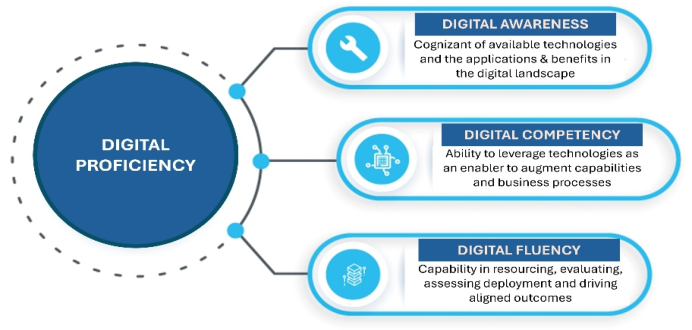
than just knowing what the technology is about – there are three levels to acquiring digital skills (a) digital awareness (b) digital competency, and (c) digital fluency.
Digital Proficiency must not be taken for granted. Scheduling for tradi- tional classes is not an effective method of compacity building. It is critical to align digital skills with the progress of digital transformation in an orga- nization, lest to expect skills mismatch can bring about hindrances to the progressive journey. It is insufficient to be just aware of current trends in technology and innovation as an individual. Digital Proficiency is about digitally empowering the entire organization with the relevant dexterity to propel smooth progress in tandem with the transformation journey. Hence, we proposed the following model.
Figure 1: Digital proficiency model (adapted from Shani, 2022).
A digital culture requires setting an example, coaching others, and leading digital initiatives strategically. When building such as culture, organizations transform themselves increasingly to behave like networks of competency. The younger, tech-minded employees expect to see digital technology utilized in the workplace. Upskilling the entire workforce with the help of digital technologies is vital to ensure that the organization stays ahead by using the most intuitive and effective solutions.
Digital dexterity comprises several important organizational behaviors which are crucial to transformation progress. In the next section, the top four initiatives which leverage appropriate digital proficiency to match the progress of the transformation journey are introduced.
ALIGNING ORGANIZATIONAL COMPETENCY WITH DIGITAL TRANSFORMATION As many of us will agree that digital transformation is not a one-off project, it is a continuous process which embraces digital introduction, digital improve- ment, and digital optimization. The digital transformation maturity index is
an important determinant of the level of digital skills required to accom- pany the digital transformation. Digital fluency is the skilled level which will determine how well an organization can optimize its transformation journey.
There are several critical initiatives in building organization competency to align the progress of transformation.
Onboarding New Employees With JIT Learning As we observe global trends, the days of orientation sessions held in front of a blackboard on a schedule, accompanied by mind-numbing paperwork is slowly vanishing. It is time to consider offering workforce the ability to onboard from any device anywhere. This is especially essential at the onset of digital transformation. Expectations of digital awareness will vary according to the functional requirements and organizational needs. Using JIT e-learning in conjunction with available microlearning methods, employees can acquire relevant contents befitting their role and change expectations from learning bytes such as short videos, podcasts, projects news etc, and assisting them to immediately put it to practice. Learning contents can also be quickly updated regularly and pushed out to the affected teams as the transformation activities progresses.
Providing JIT Compliance Training Rookies aren’t the only ones who will benefit from such a new, flexible form of training. Ensuring that the workforce is equipped with corporate- mandated compliance training is a logistical nightmare. The effort to schedule multiple sessions is even more complicated. The complexity of such knowl- edge becomes more exaggerated when the organization is progressing with digital transformation. Compliance policies may be long-term, or perhaps interim when the changes are in transition. With the JIT learning framework, organization can maintain new compliance matters at the appropriate junc- ture. Whether the training is done on-site or on-the-go, new team members are able to receive the information they need to stay in compliance with all corporate guidelines and safety regulations.
Updating Transition Status Through JIT Learning Utilizing the JIT training approach empowers the workers to source for knowledge themselves. It enhances on their discovery efforts and improves their decision-making abilities through on-demand access to the information they. As the digital transformation progresses along, the workforce is kept up to date with the changes and revised protocols without having to wait for the next training schedule. JIT transition updates can become the basis of new broadcasts for updates residing in a real-time repository for employees to access anytime and anywhere when they need the content. At the same time, this approach can also lead to creating personal learning pathways to support performance objectives (Tell, 2022).
Aligning Just-in-Time Learning With Digital Transformation 283
Creating Just-in-Time Knowledge Centre With the JIT learning management system, it is possible to invite workers to create a “knowledge centre”, with appropriate curation, of course, for rele- vant pieces of information the workforce community will need, or request, to perform their roles. This removes the pressure to memorize many details, and instead, allow the team to relax and be in the moment of know. Hence, digital workers can focus on delivering excellent customer service and know they have the resources to rely on if and when they need it.
There are three common pitfalls that inhibit success (Gaurav and Kersten, 2022) of digital transformation:
1. disparities between strategic priorities driven by senior leadership vs the work being done at team level; 2. disconnects in business and technology alignment; and 3. the need for a level of agility that enables organizations to respond to data and feedback in real time.
‘These can be avoided by combining, visualizing and synchronizing all the systems, tools and metrics associated with development and delivery into a solution that provides end-to-end visibility to enable planning and funding agility across the enterprise’ (Gaurav and Kersten, 2022). This results in a synchronized decision-making model, across portfolios, value streams and teams, and it is also about resource and capital allocation linked to business outcomes, hence generating “connected work”. Our research further con- firms that the JIT Learning approach also narrows the performance gaps in the transformation journey and supports dynamic content creation associ- ated with application context and citation of knowledge sources. Further, old content can be re-purposed and updated with the latest progress.
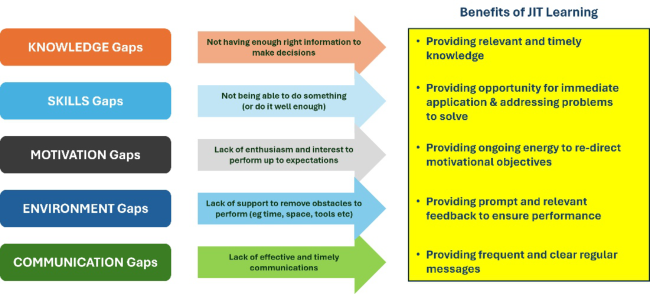
As such a dynamic ongoing process of updating contents can be lever- aged to ensure that the organization competency is kept up-to-date, and more importantly reinforced with feedback from current applications and proven use-cases. In doing so, it is also crucial to adopt a real-time curation process of content identification and approval, without suffering for ‘hallucination’. We summarize our recommendations on the benefits of JIT Learning below.
Figure 2: Benefits of JIT learning to narrow performance gaps.
THE CONNECTED WORKER ‘The Connected Worker, integrated into the workplace environment by advanced networking technologies, is the human representation of digital transformation, interpreting networked and real-time data inputs collected from across an organizational grid to provide context, insight, and guidance that improves decision-making across the value chain’ (Gopinath, 2021). For example, optimizing assembly-line operations, making inventory-adjustment decisions, tracking maintenance of heavy machinery, aligning sales opera- tions and customer service as well as operational efficiency can be performed more effectively (Accenture, 2022).
The connectedness of workers does not only affect the people on the shop floor. Digital solutions change (and improve!) the working environment of people at all levels of the company. While connected workers benefit from fast-response systems, digital solutions also bring many advantages for man- agers. Thanks to connectivity, they gain better insights into the shop floor processes as well as the complete order fulfillment cycle.
What makes networked technologies work is that data is exchanged in real time with other systems. In this way, workers are integrated into a larger system (consisting of hardware and software components). The workers shall become part of a real-time data system. As a positive outcome, the connected worker accesses data and collaborates with disparate teams across time zones and geographies to unlock value in a radically different way with digital assets fast becoming the backbone of industrial organizations. Here are some of the benefits derived from deploying the Connected Worker solution (Gopinath, 2021).
More transparency: Connected Workers generate data while they work. This means that individual process steps along the entire value chain become traceable and transparent. For example, it can be quickly deter- mined at which point in the production process the component is and which steps are still unfinished.
Less error-prone processes: If workers are equipped with digital tools, quality checks can be carried out directly at the point of origin and errors can be detected early. Especially in manufacturing processes with many subcontractors, quality can be significantly improved.
Better knowledge transfer: Because connected workers have access to all relevant information – exactly when they need it, the onboarding of new employees can be significantly improved, for example, through interactive work instructions.
Better communication: Connected workers have the tools they need to collaborate better. Important information can be passed on to colleagues easily and without delay, and communication is contextual and direct.
In a brief survey of my previous work (Tian, 2019), it was discovered that amongst new industry entrants a large number of the workforce find the acquired knowledge from college less relevant to the job requirements.
Aligning Just-in-Time Learning With Digital Transformation 285
Often, these young employees organize themselves to jump onto more learn- ing opportunities, to research for corroborative knowledge to supplement the task requirements or solve specific problems.
It is essential to reduce the apparent gap between learning and performance objectives. Employees must be able to easily access knowledge contents while they are working on task assignments. Employees are completing tasks at the same time as they are learning how to perform the said tasks - ideally without a disruption to their workflow. Hence, reinforcing and supplement already acquired knowledge on the job.
CONCLUSION AND FUTURE WORK According to our research, it has been recognized that Just-in-Time learning can be crucial to support the dynamics of business environments of today, as well as the digital transformation journey. Upskilling and re-tooling the workforce must align with the progressive capability requirements of business dynamics.
In our continuing research, we will study the relationship between “Just- in-Time” Learning and performance objectives. Performance objectives are both organizationally driven and personally aspired. We study the feasibil- ity of a digital tool – the Learning Companion – which is intended to help learners (young and mature) requiring JIT engagements to sustain productive and efficient management of resources in identifying, planning, and achieving learning outcomes to attain desired performance objectives.
We also plan to explore the possibility of how equipping every business mentor/coach with AI tools can enable managers in practice and learners to support content creation in a real-time feedback loop. The broader question is: how can businesses deliver effective upskilling that is scalable and can accelerate skills acquisition across their entire workforce? We are proposing that the Business AI Coach would offer an attractive prospect to consider. However, if deployed responsibly and effectively, the AI Coach can offer an alternative answer to some degree of the skills deficit.
ACKNOWLEDGMENT
We would like to take the opportunity to thank the valuable guidance pro- vided by the leadership team of the Global Robot Clusters (GRC) and the network of members from the International Alliance of Robotics Associa- tions (IARA). They have shared critical observations from industry watch to assist us in this research.
We would also like to express our appreciation to the Committee Members of CARES (Centre for AI & Robotics Education Services) under the super- vision of APARA (Asia Pacific Assistive Robotics Association) for their kind consultation from 2021 to 2024.
REFERENCES
Accenture (2022) Digital Transformation Starts with the Connected Workers.
Almeida, L., Vasconcelos, N., Winkler, I., Catapan, M. (2023) Innovating Industrial Training with Immersive Metaverses: A Method for Developing Cross-Platform Virtual Reality Environments. Journal of Applied Sciences, MDPI, 13, 8915, Basel Switzerland. https://doi.org/10.3390/app13158915 Beevers, K., Rea, A. and Hayden, D. (2019) Learning and development practice in
the workplace. 4th ed. London: CIPD and Kogan Page. Bersin, J. and Zao-Sanders, M. (2019) Making Learning a Part of Everyday Work, Harvard Business Review, 19 February 2019. Clarke, C., Belovai, Z., Davies, M., Surawattananon, N., Elfer, J. (2023) How
to Engage People on Reskilling - A Language Lesson. MIT Sloan Management Review, Reprint #65236, MIT Press, Boston. Contentful: The Digital Innovation Gap (2022) https://www.contentful.com/resou rces/digital-innovation-gap/ Flaum J. P. and Winkler B. (2015) Improve Your Ability to Learn, Harvard Business
Review, -19. Frontiers in Education, 11 December 2020. https://doi.org/10.3389/ feduc.2020.584351 Frey, T. (2020). Just-in-Case Learning vs Just-in-Time Learning The Future of Education Davinci Institute, 8 October 2020. Gaurav, R and Kersten, M (2022) myFT: Is ‘connected work’ the future of digital
transformation? https://www.ft.com/partnercontent/planview/is-connected-work -the-future-of-digital-transformation.html Gopinath, R. (2021) Digital Transformation is Incomplete Without the Connected Worker, HBR 23 July 2021. https://hbr.org/sponsored/2021/07/digital-transfor mation-is-incomplete-without-the-connected-worker Illeris, K (2010) The fundamentals of workplace learning: understanding how people
learn in working life. London: Routledge. Okada, A., Sheehy K. (2020) Factors and Recommendations to Support Students’ Enjoyment of Online Learning With Fun: A Mixed Method Study During COVID https://ec.europa.eu/education/resources-and-tools/coronavirus-online-le arning-resources_en Schuster, S. (2020) Robotics and craftsmanship complement each other, KUKA blog,
May 5, 2020. https://www.mastercontrol.com/gxp-lifeline/3-things-you-need-to -know-about-industry-5.0/ Shani, J (2022) Data Proficiency for HR Professional, AIHR blog https://www.aihr .com/blog/digital-proficiency-for-hr-professionals/ Tell, J. (2022) The Need for Learning Pathways in the Workplace (and How to Build
Them) Emeritus 10 May 2022. Tian, O. (2020) Brief notes from roundtable discussions conducted during AIBotics 2019, 18 November 2019. Tian, O and Lee, F (2022) Next Generation Learning Models 2022. Brief notes from
roundtable discussions conducted during AIBotics 2022, 22 August 2022. Tian, O. (2022) The FUN in Learning, presentation delivered and recorded during Science Agora Workshop Series, Japan Science & Technology Agency, 20B16, 20 October 2022. Tian O, Lee S, Salminen, V. (2023) Unbundling Training towards Just-in-Time Learn-
ing and Re-bundling to Discover Knowledge, presentation delivered and recorded during AHRE 2023 – San Francisco Session 188 Paper 402, 24 July 2023. Tian, O. (2022) The Impact of Technology on Learning, presentation delivered and recorded during Science Agora Workshop Series, Japan Science & Technology Agency, 26A16, 26 October 2023.
LISTED IN THE AHFE DIGITAL BOOKSTORE CATALOGUE
Explore the complete digital volume
Human Factors, Business Management and Society
Read this individual research paper free through the original publisher, or explore the full digital proceedings book.
ISBN 978-1-964867-11-3
Explore this ISBN in the AHFE Bookstore ↗Listed in the July 2026 bookstore catalogue; search by ISBN to confirm current availability · Digital book purchase optional