Oliver Tian, Vesa Salminen, Shanlynn Lee (2023). Unbundling Training towards Just-in-Time Learning and Re-bundling to Discover Knowledge. In: Human Factors, Business Management and Society. AHFE Open Access, vol. 97, pp. 266–278. https://doi.org/10.54941/ahfe1003903
Nowadays business environment has become increasingly complex with which individuals and organizations must deal with. Competencies behind environmental changes or emerging technologies are essential to manage when facing customer expectations and new challenges to solve.Learning new competencies need to deliver real change. Learning Just-in-Case models are no longer the correct recipe. There is an unquestionable distinction between learning and performance objectives. Employees must be able to easily access an answer or a short piece of learning content while working to supplement the role of action and reflection. What are the ingredients and recipe to transfer to all appropriate (and no inappropriate) information to the learner, and, ultimately, deliver real business impact? Let’s make learning FUN and help learners to re-bundle nutritious learning contents to discover relevant and timely knowledge for a fulfilling work to be done.The goal of this article is to identify and analyse the way learning is adopted by the individual learner or learner’s group and how unbundling learning packages are influencing on learning behaviours and learning experiences. This article analyses shortfalls and shifts in learning expectations regarding current learning and how unbundling training packages can be designed and delivered to the learners. It observes drivers and human factors leading to an efficient learning environment. A generic perception of this analysis work is that training is oriented and executed towards Just-in-Time learning. This poses a great challenge to the formation of new learning packages and adoption of new knowledge and skills.This research is partly constructive, conceptual and analytical, because it introduces the concept of Just-in-Time learning and challenges when executing learning packages accordingly. Data and knowledge for this concept creation has been collected over some years on continuous flow from literature studies and by analyzing real implementation cases of training.This presentation will discuss some shortfalls regarding Just-in-Case learning in the current era, and how unbundling training packages can be designed and delivered to the learners. It will also discuss the various issues leading to the shift in learning expectations over the recent years. More importantly, it attempts to understand the drivers and human factors which build up an efficient learning environment. a generic perception of this analysis work is that training is oriented and executed at least partially towards Just-in-Time learning. This poses a great challenge to the formation of new learning packages and adoption of new knowledge and skills.
Organizations of today are increasingly requiring relevant competencies to deal with the dynamics in the business environment, given the dynamic envi- ronmental changes or increasing and emerging technologies. Learning new competencies need to deliver real business impact and change. Knowledge acquisition for knowledge’s sake is no longer viable.
To top it off, customer expectations are also evolving. To fulfil a rich customer experience, organizations must provide a complementary emplo- yee experience. Yet, while learning experiences may look impressive, unless they’re designed according to learning science principles, they may just be
Unbundling Training Towards Just-in-Time Learning, Re-Bundling 267
the mental equivalent of ‘empty’ calories. There is an unquestionable disti- nction between learning and performance objectives. Employees must be able to easily access an answer or a short piece of learning content while working to supplement the role of action and reflection. The era of a full day of learning off-site (bundled training) are slowly vanishing when working from home became the new normal. Instead, workflow learning happens while the employee is performing their job. Employees can be completing tasks while learning how to perform the said tasks — ideally without a disruption to their workflow. Learning in the flow of work (Bersin, Zao-Sanders, 2019; Beevers, Rea, Hayden, 2019; Illeris, 2010) is picking up momentum, and fast.
Learning Just-in-Case models are no longer the relevant recipe, now- adays. Worse, the nuances are subtle, and painful for the organizations. How can we cope? How can training curriculums be unbundled to make way for “Just-in-Time’’ Learning? What are some of the human factors that are needed to be considered in the design of learning models? What are the ingredients and recipe to transfer to all appropriate (and no inap- propriate) information to the learner, and deliver real business impact? Let’s make learning FUN and help learners to re-bundle nutritious lear- ning contents to discover relevant and timely knowledge for work to be done.
In this article, we attempt to present some shortfalls regarding Just-in-Case Learning in the current era, and how unbundling training packages can be designed and delivered to the learners. It will also discuss the various issues leading to the shift in learning expectations over recent years. More impor- tantly, it attempts to understand the drivers and human factors which build up an efficient learning environment. a generic perception of this analy- sis work is that training is oriented and executed at least partially towards Just-in-Time Learning. This poses a great challenge to the formation of new learning packages and adoption of knowledge and skill.
The unbundling/re-bundling debate (Swinnerton, Ivancheva, Coop, Perrotta, 2018) speaks to the battle for the soul of the school, revolving around the purpose of the school. Will schools become businesses specia- lizing in preparing people to work in businesses, solely? Or are they going to be places that create citizens with humane perspectives and critical stances serving the public interest? In our paper, we focus on business, vocational and commercial schools which develop competencies to support industry needs.
RESEARCH QUESTIONS The goal of this article is to identify and analyse the way learning is ado- pted by individual learners or learner’s group and how unbundling learning packages are influencing on learning behaviour and learning experiences.
The main research questions are:
1. What are the human factors that are needed to be considered in the design of learning models for management systems as well as society?
2. What are the ingredients and recipe to transfer to all relevant and appro- priate (and no inappropriate) information to the learner, and, ultimately, deliver real business impact? 3. How can training curriculums be unbundled to make way for “Just-in- Time” Learning? 4. How can we make Just-in-Time Learning to be F.U.N.?
This research is partly constructive, conceptual and analytical because it reinforces the concept of “Just-in-Time” Learning and the challenges faced when executing learning packages accordingly. Data and know- ledge for this concept creation has been collected over some years on continuous flow from literature studies and by analysing real imple- mentation cases of training. This can be seen as a type of applied science.
OUTSIDE THE BOX THINKING IN LEARNING Is it time to think “outside the box” for Learning? A personalized, competency-based approach to learning reimagines how our K-12 educa- tion systems can be transformed. With the goal of ensuring that each learner is empowered with the knowledge and skills they need for the future, the current approach to learning is exhibiting signs of its limitations.
Many educational institutes have put forth their idea of e-Learning, digi- tal campus etc. as the next generation of learning. Many use buzzwords which are attractive. However, as it turns out, mostly, these approaches only call for a conversation of current content repository to a digital format.
Likewise, in the business enterprise, the Human Resources team functions as the school administrator assigning training contents to employees with- out clearly providing for the learning needs. Learning in the flow of work is a huge challenge since they mirror traditional educational model. This in effect does not deal with the learners’ evolving needs and continues to focus on a ‘content push-model’ rather than a ‘learner pull-model’. As a result, large portions of the knowledge acquired may have no immediate application. The purpose of such learning efforts is primarily focused on ‘just-in-case’ the acquired knowledge becomes relevant.
A brief survey (Tian, 2019) amongst the new entrants to the industry sug- gests that a large number of workforces find the acquired knowledge from college not-so-relevant to the job requirements. Many a times, these young employees organize themselves to jump onto the learning train, again, to research for corroborative knowledge to supplement the task requirements or solve specific problems.
Is it time to think outside the box? We need an approach to learning which creates engaging learning experiences customized to each learner’s streng- ths, needs and interests. Regardless of how long learning takes or where it occurs, once learners have demonstrated their competency of concepts and skills, they are allowed to advance progressively, if necessary.
The conventional approach in learning is motivated by a “push-content” model (as suggested above) - the teachers teach what is within the curriculum,
Unbundling Training Towards Just-in-Time Learning, Re-Bundling 269
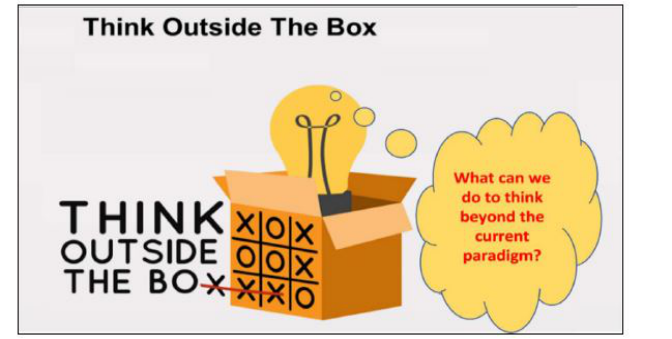
Figure 1: Thinking out-of-the-box for learning.
and what they are good enough to teach. We are now needing an appro- ach which ensures that schools implement the necessary learning support that enable students to take ownership of their learning - an infrastructure which support a “pull-content” model. It is time that the learners need to take sufficient responsibility of their learning needs.
Learning must be FUN - Flexible, Unlimited and Never-ending (Tian, 2022). Learning should not stop if the learner asks too many questions, or questions outside the curriculum.
Learners need a learning companion which is not just another “push-model”, like most outside-classroom learning centers. Learners need to have an avenue to source and curate relevant contents to satisfy their quest for knowledge and understand the application of such contents. Learners need to know how to learn – Learning how to learn has become a “non- elective” skill. More on this shall be discussed in the later paragraphs of this article.
The motivation for learning should be less of assessment grades, but rather problem solving and life survival. Most middle school or secondary school students should understand how the CoVID-19 ART test-kit work. Or... do they? Didn’t they learn about chromatography? Or did they just memorize the contents to re-produce for the examination question.
It is time to think about how we can develop a learning model for our next generation.
LEARNING TO BE AGILE Learning agility (Flaum, Winkler, 2015) is about knowing how to learn - knowing what to do when you don’t know what to do. It’s about learning from experience and applying it in new ways, adapting to new circumstances and opportunities. It’s never too soon (or too late) to increase your learning agility. It requires an open and receptive mindset.
Those who demonstrate strong learning agility (8λαυµ, Winkler, 2015) are able to study, analyse, and understand new situations and solve chal- lenging business problems. Businesses today can no longer tolerate the employees’ attitude of “that was not taught in class”. On the contrary, managers often expect the employees to “go find out”. In the current, mostly unpredictable, business environments which are buffeted by con- stant change, adaptation and evolution, organizations will increasingly need talents with learning agility capabilities to move forward and successfully negotiate volatile times.
In successful business organizations, we often find senior leaders who have an intuitive feeling about the varying level of learning agility within their organizations. Learning agility is not necessarily an academic skill, rather it encapsulates a learner’s ability and passion to quickly study a new problem and use their own learning process to gain deep understanding before making a decision – solving the problem at hand.
Learning agility has somewhat become the X-factor that is expected to propel organisations ahead of their competition in current dynamic business world. In fact, the absolute benefits are seen when all employees have deve- loped sufficient aptitude on learning agile. With a culture of learning agility in the organization, naturally, enterprise agility follows. And it’s this that really drives performance in a VUCA - volatility, uncertainty, complexity, and ambiguity - world (Bennet N. and Lemoine, 2014).
Business leaders need to be more agile than ever - adapting to new business strategies, working across cultures, dealing with virtual teams, and taking on new assignments, all of which demand them to be flexible and agile. As such, the willingness and ability to continue learning throughout one’s career journey is more crucial now than ever, as the workplace has been upended, business models are changing, and technology and industries shifted.
To be agile in learning, it is important to move from just-in-case learning to just-in-time learning. It is also about learning from experience and appl- ying it in new ways, adapting to new circumstances and opportunities. We all need to learn to adapt and thrive in ambiguous or new situations, and as noted in the book Learning Agility: Unlock the Lessons of Experience (Hallenbeck, 2016) when you don’t know what to do, learning agility is the key. If a 3-minute learning is sufficient to do the work, why do we need a 3-day class. It’s never too soon (or too late) to increase your learning agility. There are several ways to boost learning agility.
Firstly, learn to be a knowledge seeker. Seek out new and diverse expe- riences, including failures and the challenge of the unfamiliar. Memorable experiences impact the way learners learn effectively, so seek out more and different experience, especially in situations that broaden the learner’s skills and perspective. If the learners react to the new learning opportunity by sta- ying close to the comfort zone, learning struggles and discomfort may be persist, In the end, learners miss out on the corresponding rebound in growth and performance. Learners need to push for ‘new ideas’ – the less traditional, the better.
Unbundling Training Towards Just-in-Time Learning, Re-Bundling 271
Secondly, in order to hone sense-making in the learning process, it is critical to take an active approach to listening to the crux of business challenges and explore alternatives to the learning process. Max Planck (Sturmberg, 2019) once commented the right way: “When you change the way you look at things, the things you look at change”
Next, it is important to internalize experiences and lessons learned. Such a process will help to solidify insights and lessons learned for subsequent recall and application. If the learning is not processed and simplify parked into storage, the learner may miss important clues to next steps. Being prepared to ask the key questions “Why” and “Why not” enhances the learning outcome. Further, it extends the learning attainment.
Last, but not least, learners must adapt and apply. Over time, the agile learner gets even better at applying those learnings to navigate new and chal- lenging situations. Learners, who are rated high on learning agility, generally operate largely on feel and flexibility. When faced with something new, they look for similarities between the situation and things which have occurred in the past and draw on these similarities to frame the new learnings and apply them onto new challenges?
THE MATURING DAWN OF JUST-IN-TIME LEARNING The just-in-case model is how most of us were taught in school. We are fed a wide variety of information spanning multiple subjects with the expe- ctation that some of the acquired knowledge may prove to be useful in the future. Such learning contents are largely developed centrally, and it is based on a content push-model. The agency, in one instance which could be the school, determines the learning contents and expected outcome. The curriculum panel decides what should be learned and how it should be taught. A huge downside is the bias motivation to remove pre-determined contents from the curriculum or have it adjusted to a preferred set of principles.
This central model is built on the assumption that the agency knows best, and what the agency wants the learners to know. As the learning contents are usually centrally streamed, learning outcome are also inclined towards memory reproduction over creative learning outcome. Learning assessments are hence directed towards a bundle of “ideal answers”.
Such “Just-in-Case” Learning (Frey, 2020) gradually ends up being a poor fit for our “Just-in-Time” business world. Little of what we learn in col- lege ever gets put to use in today’s business world. We learn tons of useful information, but we may not ever need it in the future. As such, everyth- ing we learn in college has a way of colouring our thinking and giving us somewhat a set of reference points which may narrow our perspectives. But schools can only teach what they know, and they are not about to change curricula on a dime. This approach, however, is generally proven for con- sistent and permanent knowledge such principles of sciences and historical contents.
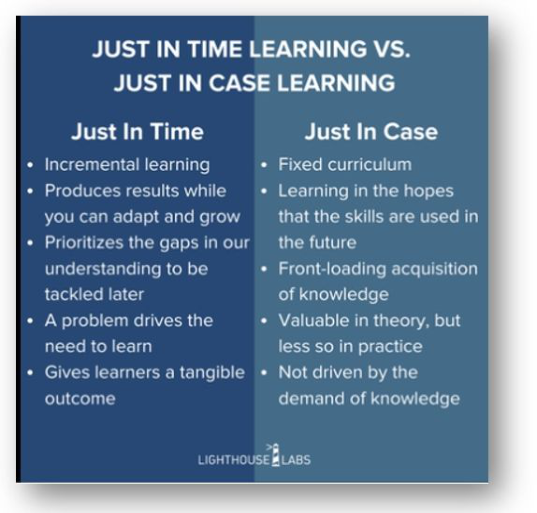
Figure 2: Just-in-time learning compared to just-in-case learning (courtesy of lighthouse labs).
“Just-in-Case” Learning involves backward-facing skills that may or may not be valuable in the future. At the same time, our just-in-time business world needs the most relevant and state-of-the-art skills possible. The que- stion remains (Frey, 2020), though: Are there Fortran- and slide rule-type skills being taught today that will have little or no enduring value in the future? And more importantly, as training costs escalate, does the usefulness of a training programs wear out over time, and how quickly.
With the advent of recent applications on the internet, the convergence of cloud technology and enhanced communications bandwidth and speed, kno- wledge no longer needs to travel though paper media and word of mouth from the human gurus. The shorter life cycle of progressive knowledge from emerging technology is rapidly outdating the contents delivered in schools. Hours of debating case studies on batch processing become mostly irre- levant in the current real time transaction platforms in modern business environments.
The average learners acquire knowledge to avoid pain. The elite learners focus on what they need to get the grade, ace the test, win the award, gain certification, impress people, and obtain honors. However, today, the ascen- dant workforce must learn exactly what is needed to solve a problem that matters to them, exactly when it is needed. No more, no less. No sooner, no later. Artificial Intelligence (AI) as a concept does not replace jobs, it is the humans who know how to leverage AI technologies who will replace the humans who do not apply same.
Unbundling Training Towards Just-in-Time Learning, Re-Bundling 273
The concept of “Just-in-Time”Learning is not new. Some scholars attribute the origin of just-in-time learning to the Toyota car company. This Japanese company created a production system where parts arrive at the warehouse exactly when they are ready to be used, or “just in time.” The notion has been discussed for a decade since.
When it comes to learning, technology is continuing to progress at a rapid pace, which has made people’s expectations rise along with it. Unlike 15 years ago, we now expect information to be available at our fingertips immediately. People put a great amount of value on their time, and they don’t want to wait around for the information that they need.
Just-in-time learning involves taking in small pieces of content in a short time, and when the learner needs the information. People are able to absorb information quickly when they need to, especially when they are confronted with a knowledge gap that is preventing them from getting their job done. With the principles of microlearning and mobile learning in mind, it should be short, targeted, and cover just one specific training need. It can be formatted as short videos, targeted eLearning micro-courses, or job aids.
A comparison between “Just-in-Time” learning and “Just-in-Case” lear- ning is neatly summarized in the table below.
UNBUNDLING TRAINING FOR JUST-IN-TIME LEARNING Unbundling and re-bundling education contents are already happening for the more progressive schools which possess better control over the curri- culum. This is usually done through new forms of teaching and learning provision, and in every possible dimension and aspect.
An online search on the notion of unbundling and re-bundling today will show results not only in retail but also in the computer industry, legal services, and of course, the music and banking industry. Recently, these concepts have become realities in the learning arena. The availability and convergence of technologies to facilitate a more flexible model of learning have also lend greater support to such a practice.
For clarity, the term unbundling refers to the process of disaggregating educational provision into its component parts, very often with external actors (Swinnerton, Ivancheva, Coop, Perrotta, 2018). And, at the same time, the term re-bundling refers to the reaggregation of those parts into new components and models (Swinnerton, Ivancheva, Coop, Perrotta, 2018). Unbundling doesn’t simply happen. Aspects of the learner experience beco- mes disaggregated and fragmented, while they get re-created – rebounded - in different forms. As this approach progresses, it begs a few pertinent questions:
What does this all look like?
How will the current pedagogy be adapted?
How will it modify and/or improve the learning outcome?
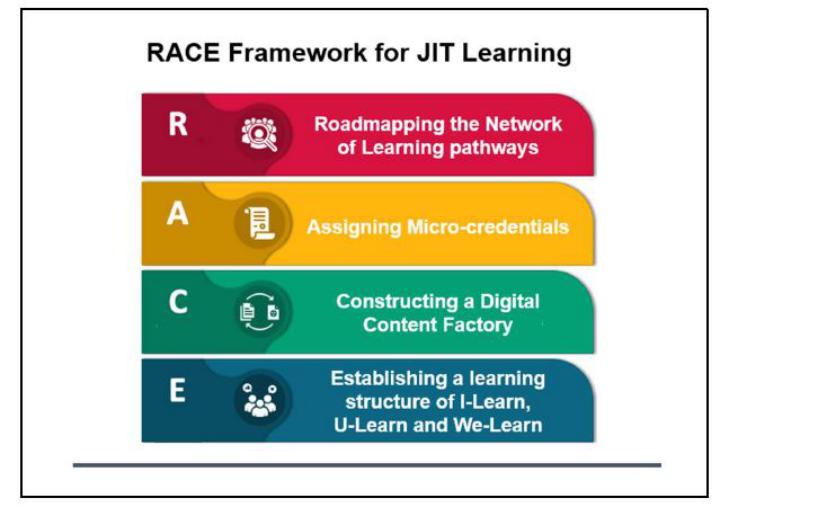
We are proposing a RACE framework to support “Just-in-Time” Lear- ning. Here are some of the ingredients and recipe we recommend transferring knowledge to ultimately deliver real business impact:
Figure 3: The RACE framework for just-in-time learning. (a) Road mapping the Network of Learning pathways Whereas a learning course provides the learner focused instructions on something specific, a Learning Pathway (Tell, 2022) will provide a netw- ork of micro-learning bundles of content focused on the specific topic, with each bundle created as a standalone module with progressive and prerequisite dependencies. It provides various learning options for the learner to acquire knowledge towards building a strong set of compe- tency and learning goals, from the foundation level to appropriate and relevant knowledge levels. A learning pathway, in essence, is a selection of ‘learning bites’ bound together for learners, to helps them progress. The learning pathway allows trainees or employees to pick up skills to sharpen the saw via a clear learning pathway.
(b) Assigning Micro-credentials Micro-credentials (Oliver, 2019) allow learners to personalize their lear- ning, as they can select short-form micro-learning components tailored to match their learning objectives, and hence career goals and responsi- bilities. These pace the learners to demonstrate mastery in a particular area, and are personalized, flexible and performance-based.
Learners will be better prepared to deal with the business dynamics and solve challenging and emerging problems in the flow of work. The structure of a micro-credential shows the relationship between the competencies, evidence of learning, and the digital badge. Having appropriate micro-credential structure will also manifest the rules and requirements needed to complete the micro-credential and earn the digital badge.
Unbundling Training Towards Just-in-Time Learning, Re-Bundling 275
(c) Constructing a Digital Content Factory To better understand the concept of a digital content factory, let’s first define it: A content factory is a highly optimized integration of systems - including people, processes, and technology - designed to pro- duce digital content at scale. Digital Content Factory stands out as the solution that provides frequent, agile, and extensive content production to meet the needs of the ascendent learner. Such a solution covers the entire content development lifecycle, encourages content reuse, manife- sts agile content production, and most importantly, enables the relevant additions which are peer curated and discovered to drive effective digital transformation globally and locally.
(d) Establishing a learning structure of I-Learn, U-Learn and We-Learn Successful learning models are seldom one way. Bloom’s taxonomy of learning Bloom, B. S., Engelhart, M. D., Furst, E. J., Hill, W. H., Krathwohl, D. R. (1956) confirms that a learner masters the learning contents upon being able to create new contents. Attaining ace grading in the assessment is by no means an effective measure of learning, how- ever, only one such indicator of achieving the learning objectives. The RACE framework suggests three levels of learning attainment.
I-Learn : This indicator is effectively measure via traditional asses- sment manifesting the learner’s ability to re-produce the knowledge acquired.
U-Learn : This indicator is a measure of how much a learner has internalized the knowledge and demonstrates the ability to transfer knowledge to another learner.
We-Learn: This indicator is a measure of learning outcome can further be achieved by extrapolating, creating new knowledge by col- laborating as a group.
The last indicator is a distinctive measure of how learners can absorb newly acquired knowledge and apply it to real business problems. By solving new problems and confronting unknown challenges, the learners as a group developed new learning outcome.
The RACE framework is a recommendation that identifies the necessary ingredients and forms the basis recipe to transfer to relevant information to the learner, and, ultimately, deliver real business impact.
JUST-IN-TIME LEARNING SHOULD BE F.U.N.
The fun of learning is the feeling of satisfaction, even pleasure, we derive from knowing and understanding. Aristotle (Keil and Kreft 2019) said that man is a rational being and desires to know. Because we are rational beings, learning must appeal to reason. Knowledge that is orderly and logical appeals to the human mind. Further, the fun in learning can simulate greater acquisition and absorption of learning contents.
Imagine if lessons involved throwing books into a special machine that transmits knowledge directly into learners’ brains. The whole process beco- mes mechanical. Understanding the main components that influence the
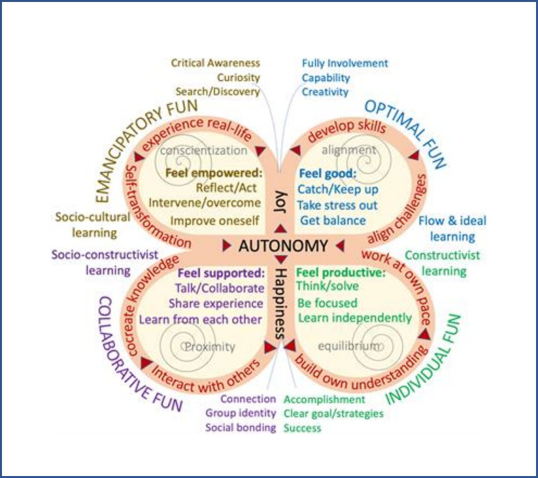
Figure 4: Learning butterfly for fun (Okada, Sheehy, 2020).
learner’s motivation and enjoyment of learning is increasingly important to enhance both academic and job performance as well as knowledge retention. Although there is a growing body of research about learner’s engagement with learning capacity, a research gap remains concerning whether fun affect learner’s increase in learning outcome. A contributing factor to this situa- tion is that the meaning of fun in learning is unclear, and its possible role is controversial.
In a framework, proposed by Okada and Sheehy (2020), on the Learning Butterfly for fun (Okada, Sheehy, 2020; Okada, 2021), the authors recom- mended four categories of factors and recommendations for learners to enjoy learning.
Optimal fun is the joy of being fully involved in learning, moving toward full capability and creativity.
Individual fun is the happiness of fulfilling accomplishments, supported by clear goals and strategies.
Collaborative fun is the happiness of making connections with others, creating social bonding and developing group identity.
Emancipatory fun is the joy of being curious, able to search and discover whilst being critically aware.
Learners need a learning companion which is not just another “push-model”, like most outside-classroom learning centers. Learners need to have an avenue to source and curate relevant contents to satisfy their quest for knowledge and understand the application of such contents. Lear- ners need to know how to learn – Learning how to learn is must become a “non-elective” skill.
Unbundling Training Towards Just-in-Time Learning, Re-Bundling 277
Then … What are the aspects of the F.U.N. in learning? Learning has to be F.U.N. (Tian, 2022) - Flexible, Unlimited and Never-ending.
1. Learning should not stop if the learner asks too many questions, or questions outside the curriculum. Here are three guidelines that we recommend. Learning must be Flexible and not rigid, allowing learners to branch out where necessary without a strict curriculum. 2. Learning must be Unlimited – learning should not be contained only in the instructional materials … Learning MUST satisfy “curiosity”. 3. Learning must not stop – end of school, end of learning; end of workshop, end of learning … no, Learning MUST trigger further efforts to look for corroborative and symbiotic knowledge. Learning is Never-ending.
CONCLUSION AND FUTURE WORK According to the research, it has been recognized that Just-in-Time learning can be crucial to support the dynamics business environments of today. Some obvious observations include:
The rise of intelligent context. With an explosion of data, customers are expecting experiences that are specific and contextual to their needs.
The age of experiences. Every element of customer engagement from the content or frequency to the choice of channel adds to the whole customer experience. Furthermore, the dissolution of channel boundaries requires organizations to bring fluidity to experiences and the eco-system.
Social Accountability. Trust and privacy are paramount to a customer’s choice in a brand. And all brands are being held accountable by custo- mers for their ethics and values, both, toward customers and the broader society/community.
These aspects point to the need for training to be real-time, and more critically, it is a race to higher level of knowledge acquisition between the employees and the customers. JIT Learning can ease the burden of the employee experience which eventually translates into better service levels.
In our further research, we will explore the relevance of “Just-in-Time” Learning in supporting the notion of a connected worker. A Conne- cted Worker solution aims to empower the workforce by providing the tools and support with real time knowledge contents to execute respe- ctive job efficiently. By deploying emerging technologies, connected worker platforms can increase worker productivity far beyond current industry standards.
ACKNOWLEDGMENT
We would like to take this opportunity to thank the guidance provided by the leadership team of the Global Robot Clusters (GRC).
We would also like to express our appreciation to the Committee Mem- bers of CARES (Centre for AI & Robotics Education Services) within the
supervision of APARA (Asia Pacific Assistive Robotics Association) for their kind consultation through 2021 and 2022.
REFERENCES
Beevers, K., Rea, A. and Hayden, D. (2019) Learning and development practice in the workplace. 4th ed. London: CIPD and Kogan Page. Bennet N. and Lemoine G. J. (2014) What VUCA Really Means for You, Harvard
Business Review, Jan-Feb 2014. Bersin, J. and Zao-Sanders, M. (2019) Making Learning a Part of Everyday Work, Harvard Business Review, 19 February 2019. Bloom, B. S., Engelhart, M. D., Furst, E. J., Hill, W. H., Krathwohl, D. R.
(1956). Taxonomy of educational objectives: The classification of educational goals. Vol. Handbook I: Cognitive domain. New York: David McKay Company. European Commission JRC (2021) Coronavirus: online learning resources https://ec.europa.eu/education/resources-and-tools/coronavirus-online-learning -resources_en. Flaum J.P. and Winkler B. (2015) Improve Your Ability to Learn, Harvard Business Review, 8 June 2015. Frey, T. (2020). Just-in-Case Learning vs Just-in-Time Learning. The Future of
Education Davinci Institute, 8 October 2020. Illeris, K (2010) The fundamentals of workplace learning: understanding how people learn in working life. London: Routledge. Keil, G.and Kreft, N. (2019) Aristotle’s Anthropology , pp. 23–96 Cambridge
University Press 2019. Okada A. (2021). Emancipatory fun in education for sustainability: why is an enjoyable responsible dialogue between science, arts and religion relevant for students? The 6th International Multidisciplinary Scientific Conference on the Dialogue between Sciences & Arts, Religion & Education, MCDSARE- THE LIMITS OF SCIENCE AND HUMAN KNOWLEDGE, held at IFIASA, ONLINE (ROMANIA), 17–18 June 2021. Okada, A., Sheehy K. (2020) Factors and Recommendations to Support Stu-
dents’ Enjoyment of Online Learning With Fun: A Mixed Method Study During COVID-19. Frontiers in Education, 11 December 2020. https://doi.org/10.3389/ feduc.2020.584351. Oliver, B (2019) Making micro-credentials work for learners, employers and providers Deakin University August 2019. Sturmberg, J.P. (2019).If You Change the Way You Look at Things, Things You Look
at Change. Max Planck’s Challenge for Health, Health Care, and the Healthcare System. In: Sturmberg, J. (eds) Embracing Complexity in Health. Springer, Cham. Swinnerton B, Ivancheva M, Coop T, Perrotta C, Morris NP, Swartz R, Czerniewicz L, Cliff A, Walji S. The Unbundled University: Researching emerging models in an unequal landscape. Preliminary findings from fieldwork in South Africa. Netw- orked Learning 2018 Proceedings of the 11th International Conference on Networked Learning 2018, pp. 218–226. Tell, J. (2022) The Need for Learning Pathways in the Workplace (and How to Build
Them) Emeritus 10 May 2022. Tian, O and Lee, F (2022) Notes on Next Generation Learning Models 2022. Tian, O. (2020) Brief notes from roundtable discussions conducted during AIBotics 2019, 18 November 2019. Tian, O. (2022) The FUN in Learning, presentation delivered and recorded during
Science Agora Workshop Series 20B16 2022, 20 October 2022.
LISTED IN THE AHFE DIGITAL BOOKSTORE CATALOGUE
Explore the complete digital volume
Human Factors, Business Management and Society
Read this individual research paper free through the original publisher, or explore the full digital proceedings book.
ISBN 978-1-958651-73-5
Explore this ISBN in the AHFE Bookstore ↗Listed in the July 2026 bookstore catalogue; search by ISBN to confirm current availability · Digital book purchase optional