Dumani Kunjuzwa, Brenda Scholtz, Ifeoluwapu Fashoro (2021). Design Guidelines for a Gamified Indigenous Knowledge System that Promotes Awareness of Water Resources Issues. In: Human Systems Engineering and Design (IHSED2021): Future Trends and Applications. AHFE Open Access, vol. 21. https://doi.org/10.54941/ahfe1001176
Problem Description – The current water landscape in South Africa is in a state of crisis due to a severe water shortage. In 2018, Cape Town’s “day zero” became the focus of South Africa’s water crisis. This situation was unique in the country’s water sector and the causes of this water shortage were not – high water demand or inadequate water supply. South Africa heavily relies on its rainwater levels, which are unpredictable and decreasing because of global warming. The water shortage is further worsened by citizens’ unawareness of the water shortage situation and irresponsible water usage behaviour. The water shortages problem requires an understanding of water resource issues such as water usages and conservation. Water shortages are becoming increasingly common and raising awareness thereof has been proposed as a key strategy for empowering citizens with knowledge relevant to water resource issues.Research Goal – Under the theme of sustainability, The World Development Report of 1998/99 recognised knowledge as the key to sustainable social and economic development. This knowledge should incorporate indigenous knowledge, which is unique, trustworthy, and confined to a particular culture. This study aims to design an artefact, the Indigenous Knowledge System (IKS) to promote awareness of water resource issues. This IKS will be adopted and evaluated in a South African water resource context. Research Design – A consistent framework for research in IS is required to guide and guarantee significant progress in the development of an artefact. Significant progress of utilising Design Science Research (DSR) particularly in IS design research is widely adopted by researchers and practitioners. The strengths of DSR in the IS discipline are the rationale for selecting DSR as an appropriate research methodology for this paper. These strengths include employs a theoretical founded base to improve or promote knowledge; DSR tries to solve a real problem in which its solution is often conceptualised prior to designing and developing processes; and research is presented by formulated objectives and methods, whereby the objectives require a multi-methodological approach to artefact development.Research Limitations – Indigenous knowledge is an integral part of socio-economic development. However, the lack of documentation of this knowledge is the limitation of this study. Practical implications – An adoption of a social awareness mobile application of an IKS with features that informs, motivates and engages the end-users in water resource issues would provide an effective sound platform for sustainable water. Social implications – In principle, effective integration of indigenous knowledge within appropriate technologies would enhance knowledge sharing on social forums, promotes societal awareness, and ultimately improve behavioural change on water resource issues through shared social norms. Originality – While the topic of water management and sustainability is globally discussed, the role of appropriate technologies and incorporating indigenous knowledge within these technologies for promoting awareness of water resource issues is under-researched. This situation provides a significant research opportunity for exploration by sustainability researchers, to conduct their investigation on the effective role of appropriate technologies (gamification and social technologies) in designing an indigenous knowledge system that promotes awareness of water resource issues. Moreover, this design can provide useful guidelines to other researchers when developing knowledge management systems that support natural sustainability. Keywords – Awareness, Gamification, Indigenous Knowledge Systems, Water Resource Issues, Social technologies, Sustainability
Human Systems Engineering and Design (IHSED 2021) https://openaccess.cms-conferences.org/#/publications/book/978-1-7923-8987-0
INTRODUCTION
Water is a vital natural resource for both human and environmental survival and an integral part of social and economic development. The task to improve water management is critical and has become more relevant due to the increase in water resource issues such as shortages (Kunjuzwa, Scholtz and Fashoro, 2020). The problem of water shortages is increasingly reported as a compromising threat to the sustainability of several major cities worldwide (Booysen et al., 2019). South Africa’s state of water has been declared a crisis (Gdo, 2018) where millions of South Africans have no access to basic levels of water supply or have very limited levels of access (Rhodes and Mckenzie, 2018). The problem of the water shortage is most noticeable in developing countries that are characterised by water management challenges, rapid population growth, and an increased rate of urbanisation (Enqvist and Ziervogel, 2019). Water resource issues call for a transition towards improved water management, which includes consideration of urban water resilience towards water sustainability (Johannessen and Wamsler, 2017). Several studies have proposed gamification as a solution to environmental awareness (Börner et al., 2017; and Böckle et al., 2018). However, according to Böckle et al. (2018) connecting gamification to theoretical principles is limited, and the majority of empirical research on gamification is not based on theoretical principles. In addition, existing studies have not investigated indigenous knowledge and the role it plays in gamification for awareness. This paper addresses this gap and presents design guidelines for a gamified knowledge management system, derived from Self- determination Theory (SDT). The proposed guidelines also consider the incorporation of indigenous knowledge for promoting awareness of water resource issues. The structure of this paper is as follows: The research method is described in the next section; this is followed by the literature review, the proposed design guidelines for Gamified Indigenous Knowledge Systems (GIKS). The paper concludes by reflecting on key findings of the review and lessons learnt in the last section.
RESEARCH METHOD This paper adopted the Critical Literature Review (CLR) as an appropriate method for driving the literature search, which enabled the authors of this paper to gain insights into what has been done by other researchers, and to the current state of knowledge in the field of water management. From this gaps were identified with regard to indigenous knowledge documentation; and studies with systems that use indigenous knowledge to address water resource issues.
Human Systems Engineering and Design (IHSED 2021) https://openaccess.cms-conferences.org/#/publications/book/978-1-7923-8987-0
LITERATURE REVIEW
The Strive Towards Urban Water Resilience The City Water Resilience Approach (Fletcher, 2019) defines urban water resilience as “the capacity of the urban water system, including the human, social, political, economic, physical and natural assets, to anticipate and absorb, adapt and respond to, and learn from shocks and stresses to protect public health and wellbeing and the natural environment and minimize economic disruption”. City managers are faced with challenges to ensure that citizens have enough and safe drinking water to survive and thrive through sustainable, and resilient urban water systems. The response to the growing demand for water and urban water management shows that there has been a gradual shift from the “control by construction” model to “stewardship and dynamic/adaptive management” for balancing environmental concerns and the economic benefits of water resources development (Petts, Nestler and Kennedy, 2006). From the economic aspect, the significance of urban water resilience should capacitate cities to function in the face of water-related stresses and support the survival of those living and working in the cities (Fletcher, 2019). Furthermore, a water resilient city can survive water resource issues ranging from prolonging drought to floods while exhibiting the capacity to:
Provide access to high-quality water resources for all citizens.
Protect citizens from water-related hazards.
Connect citizens through water-based mobility. Putting water at the centre of a city’s socio-economic development plans can present opportunities for the water sector to develop innovative solutions in addressing urban water resource issues (Jalilov et al., 2017). This approach can improve water practices while promoting awareness of water resource issues, enhancing urban water resilience, improving water management, and sustainable water benefits. Self-Determination Theory and Gamification
Self Determination Theory (SDT) can be thought of as metatheory in the sense that it comprises several “mini-theories”, which are incorporated together to offer a comprehensive understanding of human motivation (Legault, 2019). According to Ryan and Deci (2020), SDT states that people can become self-determined when the following three needs are satisfied:
Autonomy (the need to feel free and self-directed);
Competence (the need to feel effective or motivated to overcome the challenge and achieve success) and;
Relatedness or connection (the need to feel closely connected with others) to prosper and develop. Alsawaier (2018) states that human motivations, both intrinsic and extrinsic, are often used as the main theoretical constructs in gamification frameworks, as grounded in SDT for promoting motivation and engagement in game-based learning. Intrinsic
Human Systems Engineering and Design (IHSED 2021) https://openaccess.cms-conferences.org/#/publications/book/978-1-7923-8987-0 motivation refers to “the behaviour that is inherently satisfying or enjoyable”, while extrinsic motivation refers to “performance of a behaviour that is depending upon the attainment of an outcome” (Legault, 2019). Gamification is the use of game elements and playing in a non-game context (Deterding, 2011). Gamification has been shown to promote learning (Maharjan and Maharjan, 2017), which can be harnessed to social knowledge sharing and the promotion of societal awareness sustainability issues (such as water) (Castelletti et al., 2019). Gamification has also been shown to incorporate intrinsic and extrinsic motivation techniques to play a key role in achieving natural resource sustainability. Gamification has been widely adopted since its inception, receiving strong attention from academic scholars, researchers, and practitioners. Deterding et al. (2011) SDT has also been used as a successful theory for the motivational psychology of video games. Playing video games for “fun” or “entertainment” is the prototypical example of a purposeful, intrinsically motivating activity, and SDT is arguably the most empirically well researched psychological theory of motivation (intrinsic and extrinsic).
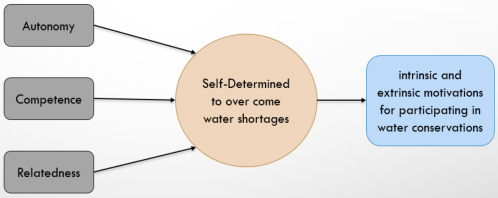
To tackle the challenge of solving water resource issues, it is believed that SDT can be used as a lens to understand human psychology towards these issues by investigating these three basic psychological needs for capacitating human development and improving a person’s self-determination to overcome water shortages and their intrinsic and extrinsic motivations for participating in sustainable water conservation and engagement in water resource issues. These constructs are illustrated in Figure 1.
Figure 1: Self-Determination Theory for Water Shortages According to Kapp (2012) gamification is “using game-based mechanics, aesthetics, and game thinking to engage, motivation action, promote learning and solve problems”. Gamification provides features of an interactive system, which aims to motivate and engage users through the use of game design elements (Deterding, 2011), such as those proposed by Kiryakova, Angelova and Yordanova (2018): • Player(s) – all the participants (students, teachers, and/or citizens) that play the games. • Challenges – tasks the player has to win to progress to the objective of the game. • Levels – these are the stages of the game which may range from easy to difficult. • Points – collected and accumulated through the progressive winning of challenges.
Human Systems Engineering and Design (IHSED 2021) https://openaccess.cms-conferences.org/#/publications/book/978-1-7923-8987-0
Badges – these serve as a reward to the player for completed stages.
Leaderboard – ranking of players based on their achievements, which motivates them to become game leaders.
Knowledge Management Systems and Indigenous Knowledge Knowledge management is defined by Igbinovia and Ikenwe (2018) as a process of identifying capturing, leveraging, sharing, and effective utilisation of an organisation's assets to enhance its performance. The authors further state that knowledge management systems have been an electromotive force for social, economic, and educational advancement for competitive advantage. Knowledge sharing and information exchange within the field of Integrated Water Resource Management, can be improved with an understanding of cultural considerations, technical opportunities, and the theory underpinning knowledge management (Delfau, 2018). Furthermore, knowledge within the field of water resource management is normally built through practice and is highly linked with contextual factors and personal experience. At the center of knowledge management systems for water resources, people can access information using technologies that support knowledge management for their needs. This approach can present an opportunity to enhance the capacity of human knowledge and contribute towards sustainable water resource management. For an effective knowledge system for managing water as a resource, citizenry cooperation is necessary and should be built on a willingness to engage in water resource issues, and on local and traditional/indigenous knowledge that is trustworthy and truthful.
Indigenous knowledge is defined by Johnson and Johnson (1992) as “a body of knowledge built up by a group of people through generations of living in close contact with nature”. Historically, indigenous knowledge was transmitted by word-of-mouth from one generation to another and is the fundamental component of indigenous knowledge systems (IKS), which have existed for centuries in Africa (Olokesusi, 2004). However, the colonial past has suppressed the growth and further development of IKSs and the capacity of Africans to solve their problem using locally developed technologies. Indigenous knowledge has the potential to unleash the power of cultural diversity, which can contribute to knowledge (indigenous or local knowledge) exchange by citizens. This study therefore recognises indigenous knowledge related to water resource issues that is relevant to all citizens as a key component of our proposed design guidelines for gamified IKSs.
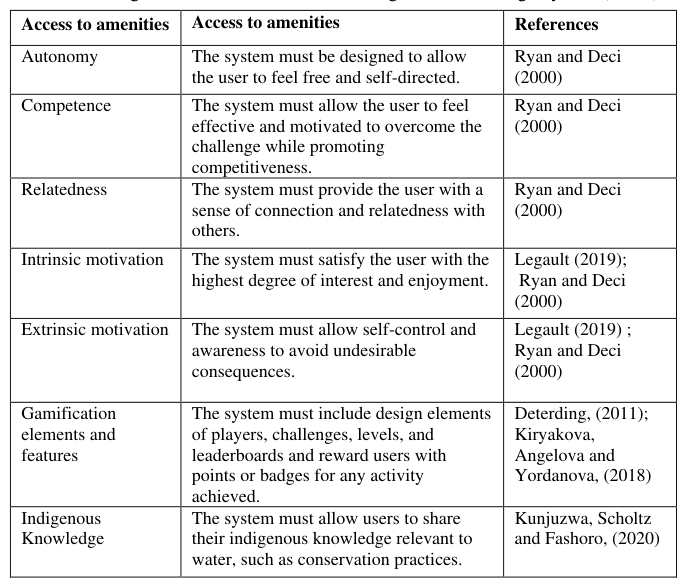
GAMIFIED INDIGENOUS KNOWLEDGE SYSTEM In this section we present how indigenous knowledge can be incorporated within gamification to promote awareness of water resource issues. The guidelines for a Gamified IKS (GIKS) are summarised in Table 1. Motivation is a fundamental component in the proposed guidelines that aims at triggering the desired human
Human Systems Engineering and Design (IHSED 2021) https://openaccess.cms-conferences.org/#/publications/book/978-1-7923-8987-0 attitude towards water resource issues. Gamification enables a purposeful integration with game elements to bring out competitiveness amongst citizens on water usage and conservation, while enhancing urban water resilience.
Table 1: Design Guidelines for a Gamified Indigenous Knowledge System (GIKS) Access to amenities Access to amenities References
The proposed guidelines respond to the lack of theoretical underpinning of gamification research, by using SDT as a theoretical foundation for the design of a gamified IKS (GIKS). The GIKS should encourage best practices in water usage and management at the household level, and the sharing of relevant water knowledge, including indigenous knowledge. These guidelines can be adopted by other researchers when designing gamification-based, knowledge management systems.
CONCLUSION
While the topic of water management and sustainability is globally discussed, the role of gamification and incorporating indigenous knowledge within such technologies for promoting awareness of water resource issues is under-researched. There is a lack of empirical research on incorporating indigenous knowledge with modern technologies for enhancing the sustainability of natural resources such as water. This
Human Systems Engineering and Design (IHSED 2021) https://openaccess.cms-conferences.org/#/publications/book/978-1-7923-8987-0 situation provides a significant research opportunity for exploration by sustainability researchers to conduct investigations into the effective role for designing an IKS that promotes awareness of water resource issues. This paper presented design guidelines for a gamified IKS for water management. We have successfully identified gamification as an appropriate technology, which triggers human behavioural change with motivating, engaging, and informing capabilities.
ACKNOWLEDGMENTS
The authors would like to acknowledge the financial support from National Research Foundation (NRF) for this project.
REFERENCES
Alsawaier, R. S. (2018) ‘The effect of gamification on motivation and engagement’, International Journal of Information and Learning Technology, 35(1), pp. 56– 79. doi: 10.1108/IJILT-02-2017-0009. Böckle, M. et al. (2018) ‘A Design Framework for Adaptive Gamification
Applications’, Proceedings of the 51st Hawaii International Conference on System Sciences, (January). doi: 10.24251/hicss.2018.151. Booysen, M. J. et al. (2019) ‘Fees and governance: Towards sustainability in water resources management at schools in post-apartheid South Africa’, Sustainable Cities and Society, 51, p. 101694. doi: 10.1016/j.scs.2019.101694. Börner, D. et al. (2017) ‘Pervasive interventions to increase pro-environmental
awareness , consciousness , and learning at the workplace’. Castelletti, A. et al. (2019) ‘Gamified Approaches for Water Management Systems: An Overview’, Smart Water Grids, pp. 169–201. doi: 10.1201/b21948-7. Delfau, K. (2018) ‘Knowledge Management and Integrated Water Resource
Management—Types of Knowledge and Key Considerations’, 4(2). Deterding, S. et al. (2011) ‘From Game Design Elements to Gamefulness: Defining “Gamification”’, MindTrek ’11 Proceedings of the 15th International Academic MindTrek Converence: Envisioning Future Media Environments, pp. 9–15. doi: 10.1145/1979742.1979575. Deterding, S. (2011) ‘Situated motivational affordances of game elements: A
conceptual model’, CHI 2011 Workshop ‘Gamification’, (July). Available at: http://gamification-research.org/chi2011/papers. Enqvist, J. P. and Ziervogel, G. (2019) ‘Water governance and justice in Cape Town: An overview’, Wiley Interdisciplinary Reviews: Water, (April), p. e1354. doi: 10.1002/wat2.1354. Gdo, J. R. C. (2018) 2018 – Drought and Water Crisis in Southern Africa. doi:
10.2760/81873. Igbinovia, M. O. and Ikenwe, I. J. (2018) ‘Knowledge management: processes and systems’, Information Impact: Journal of Information and Knowledge Management, 8(3), p. 26. doi: 10.4314/iijikm.v8i3.3.
Human Systems Engineering and Design (IHSED 2021) https://openaccess.cms-conferences.org/#/publications/book/978-1-7923-8987-0
Jalilov, S.-M. ; et al. (2017) ‘Enhancing Urban Water Resilience. Science-based Approaches and Strategies for Asian Megacities’, Policy Brief, (9), pp. 1–5. Johannessen, Å. and Wamsler, C. (2017) ‘What does resilience mean for urban
water services?’, Ecology and Society, 22(1). doi: 10.5751/ES-08870-220101. Johnson, M. and Johnson, M. (1992) LORE: Capturing Traditional Environmental Knowledge. Available at: http://lib.icimod.org/record/9841/files/1418.pdf (Accessed: 18 July 2019). Kapp, K. M. (2012) The gamification of learning and instruction : game-based
methods and strategies for training and education. Kiryakova, G., Angelova, N. and Yordanova, L. (2018) ‘Gamification in Education’. doi: 10.4018/978-1-5225-5198-0. Kunjuzwa, D., Scholtz, B. and Fashoro, I. (2020) ‘Incorporating Indigenous
Knowledge within Appropriate Technologies for Promoting Awareness of Water Resource Issues’, IST-Africa 2020, pp. 1–9. Available at: www.IST- Africa.org/Conference2020. Legault, L. (2019) ‘Encyclopedia of Personality and Individual Differences’, Encyclopedia of Personality and Individual Differences, (June). doi: 10.1007/978-3-319-28099-8. Maharjan, S. K. and Maharjan, K. L. (2017) ‘Indigenous Peoples, Indigenous
Knowledge and Their Issues on Climate Change , particularly on REDD , in Developing Countries’, 5, pp. 273–283. doi: 10.3126/ijasbt.v5i3.18293. Olokesusi, F. (2004) ‘Survey of Indigenous Water Management and Coping Mechanisms in Africa: Implications for Knowledge and Technology Policy’, ATPS/EIIPD Conference on Science, Technology’Water and Environment in Africa. Held at ILRI Campus, Addis Ababa, Ethiopia, (25). Petts, G. E., Nestler, J. and Kennedy, R. (2006) ‘Advancing science for water
resources management’, Hydrobiologia, 565(1 SPEC. ISS.), pp. 277–288. doi: 10.1007/s10750-005-1919-1. Rhodes, B. and Mckenzie, M. T. (2018) ‘To what extent does socio-economic status still affect household access to water and sanitation services in South Africa ? affect household access to water and sanitation’, (March). Ryan, R. M. and Deci, E. L. (2000) ‘Intrinsic and Extrinsic Motivations: Classic
Definitions and New Directions’, Contemporary Educational Psychology, 25(1), pp. 54–67. doi: 10.1006/ceps.1999.1020.
Human Systems Engineering and Design (IHSED 2021) https://openaccess.cms-conferences.org/#/publications/book/978-1-7923-8987-0
LISTED IN THE AHFE DIGITAL BOOKSTORE CATALOGUE
Explore the complete digital volume
Human Systems Engineering and Design (IHSED2021): Future Trends and Applications
Read this individual research paper free through the original publisher, or explore the full digital proceedings book.
ISBN 978-1-7923-8987-0
Explore this ISBN in the AHFE Bookstore ↗Listed in the July 2026 bookstore catalogue; search by ISBN to confirm current availability · Digital book purchase optional