Jose Oleas Orozco, Angel Mena, Daniel Ripalda (2022). Hearing loss, mobile applications and inclusive social environments: Approach to learning sign language for children without disabilities. In: Intelligent Human Systems Integration (IHSI 2022): Integrating People and Intelligent Systems. AHFE Open Access, vol. 22. https://doi.org/10.54941/ahfe1001044
This project was developed in the interest of social problems by inclusion of people with hearing loss in social environment. The investigation was carried out in two stages. The first, a diagnostic analysis focused on the learning of people in the social environment, instead of the individual with disabilities. The project has used a mixed research approach, in the qualitative approach, with semi-structured interviews to the social and family circle of people with hearing loss and to the individual himself. In addition, professionals in the area of learning sign language, expert professionals in special education, were consulted. In the quantitative aspect, surveys were carried out on a group of parents from the "Celite" Bilingual Educational Unit of Ambato city, to determine their willingness to learn sign language to promote social inclusion in their children. Likewise, it was possible to identify their behavior in the face of digital technologies. With the data obtained, it was possible to determine the feasibility of developing interactive applications. The resulting technological application, shows a friendly structure for learning basic phrases in sign language for early ages, focused on children without disabilities. The second stage of the research, with the interactive application for mobile devices running, it was possible to determine the feasibility of using new technologies and communication. The interactive application has audiovisual content in digital animations and interactive resources typical of an application on mobile devices. The App was tested using the target group, children and parents. Subsequently, it was evaluated through the application of surveys to parents, interpreters and people with hearing loss, who certified their experience as users and evaluated its relevance, where favorable results were collected for this initiatives.
One problem of people with disabilities, is access to job opportunities, which directly influences their socioeconomic situation, this varies in magnitude depending on the country (Organización Mundial de la Salud, 2001).
The concept of disabilities from ancient times to the present has been associated with abnormality (Rojas, 2015). People with hearing disabilities are usually called deaf-mutes, however, the term deaf mute is not a correct adjective for a person with hearing disabilities (Rodríguez & Velásquez, 2000). Disabilities present different cognitive abilities in each individual, thus avoiding associating disability as a cognitive limitation (Vanegas, et al., 2015). Likewise, the deficiencies of people with disabilities should be considered only in the contexts or models of disregard (Quintero-Uribe & Osorio-Montoya, 2018). In Latin American context, in Chilean government studies, they refer that people with disabilities should be understood as: People with disabilities are people who, in relation to their physical, mental, intellectual, sensory or other health conditions, when interacting with various contextual, attitudinal and environmental barriers, present restrictions in their full and active participation in society (Ministerio de las Culturas el Arte y el Patrimonio, S.F.).
The situation of people with disabilities has been analyzed from various perspectives, in this regard, there are models of disability functioning, with these there is a dialectical relationship between the "medical model" and the "social model". The medical model focuses on the physiological field, considering disability as a problem of the person caused by pathological factors, trauma or health conditions. On the other hand: (…) The social model of disability, considers the phenomenon fundamentally as a problem of social origin and mainly as an issue centered on the complete integration of people in society. Disability is not an attribute of the person, but a complicated set of conditions, many of which are created by the social environment. Therefore,
Intelligent Human Systems Integration (IHSI 2022): Integrating People and Intelligent Systems https://openaccess.cms-conferences.org/#/publications/book/978-1-7923-8988-7
managing the problem requires social action and it is the collective responsibility of society to make the necessary environmental modifications for the full participation of people with disabilities in all areas of social life (Organización Mundial de la Salud, 2001).
CLASSIFICATION OF SPECIAL ABILITIES There are several documents that propose a classification of special capacities, these are regional ones, developed by Latin American governments such as the one proposed by the Mexican institution INEGI (INEGI, S.F.). Each state has carried out an analysis of the problem according to the definitions of the World Health Organization WHO. In this regard, in the Ecuadorian case, the National Health Authority (Ministerio de Salud Pública del Ecuador, 2018), defines 7 types of disabilities:
1. Hearing impairment 2. Language disability 3. Physical disability 4. Intellectual disability 5. Multiple disability 6. Psychosocial disability 7. Visual impairment In reason of the approach of this analysis, where hearing impairment implies, according to the Ministry of Public Health of Ecuador (Ministerio de Salud Pública del Ecuador, 2018), its definition refers to. “(…) The deficiencies, limitations and functional and / or structural, irreversible and unrecoverable restrictions of the perception of external sounds, due to the loss of partial hearing capacity (hearing loss) or total (cofosis), of one or both ears”.
Hearing loss, hearing impairment, hearing impairment or deafness are medical terms to define types and degrees of hearing loss (Rodríguez, 2016). Likewise, for Álvarez Urbay et al (2007): Hearing loss is defined as a decrease in hearing acuity that ranges from minimal expression to profound loss of about 110db. The absolute loss of response to amplified sound is called cophosis or anacusis. Its causes are closely related to the anatomy and physiology of hearing.
Sign language and hearing loss Hearing loss is a disability in which the problem to be solved is the communication barriers between the person who has it and the people who use oral language and do not know sign language. The effort in this line has taken several paths, but with a single goal, that of people with that disability to have access to sources of information and culture. In this field, there are Oralist Methods, which involve labiofacial reading, verbotonal method and the
Intelligent Human Systems Integration (IHSI 2022): Integrating People and Intelligent Systems https://openaccess.cms-conferences.org/#/publications/book/978-1-7923-8988-7 complemented word. Gesturalist methods correspond to Sign Language and Sign Language. It should be noted that there is no universal sign language, since there are differences from one place to another (Martínez Cortés, et al., 2008).
Sign language has a documented antecedent since 1198 with the words of Pope Innocent III “he who cannot speak, in signs can manifest himself”. In the 16th century, the first deaf teacher, Benedicto Pedro Ponce León and Pablo Bonet developed “Reduction of letters and arts to teach the mute to speak”, an illustrated manual alphabet book. Between 1712-1789 Abad de L'Epée, in Paris started the first school for deaf people, where he developed a dictionary of Parisian sign language. Already in 1980, studies of William Stoke the deaf population is recognized as a minority community with its own language (Rodríguez & Velásquez, 2000).
In Ecuador, the antecedents of studies published on the Ecuadorian Sign Language LSE date back to 1988 with Lenguaje de Señas: Guía Básica sobre una Comunicación Especial Tomo I, prepared in conjunction with the Asociación de Sordos de Quito, who since 1983 guided the desire to register local signs. For 2012, the official Diccionario oficial de Lengua de Señas Ecuatoriana (Oviedo, et al., 2015), was published. The LSE has been the subject of study by the Sommer Institut of Linguistics, SIL International, in its publication Sociolinguistic Survey Report of the Ecuadorian Deaf Community, which are a compilation of lexical files compiled from the country coastal and highlands in 2011 (Eberle, et al., 2012). On the part of the Ecuadorian state, in collaboration with the Federación Nacional de Personas Sordas del Ecuador FENASEC, they publish the Glosario Básico de Lengua de Señas Ecuatoriana LSE (Viceprecidencia República del Ecuador, 2013).
ICT and Disabilities Technological resources support people in their daily lives, regarding special abilities, technologies range from chairs, to adapted toilets, uneven steps, artificial limbs, signage with Braille reading, audiovisuals with sign language and educational articles. The aforementioned, in the context of ICTs, are related to the dissemination of news, cinema, digital television, mobile phones, tablets and personal computers, likewise, the internet, social networks, digital applications, augmented reality, all of them for facilitate the independence of people with disabilities (Luna Kano, 2013).
Likewise, Martins et al. (Martins, et al., 2013), point out that ICTs are considered as part of science, education and learning, which provide applications and tools supported by free software for their algorithm design model in the training of programming for use in various resources as in the interpretation of the Argentine sign language LSA aimed at people with hearing or speech problems.
Similarly, in the Spanish context, the Competencia Digital Docente (CDD) has an imbalance with regard to the issue of inclusion. Therefore, they face and invest in assuming the letter "i" to what refers to inclusion, so that its acronym is CDDI (Competencia Digital Docente
Intelligent Human Systems Integration (IHSI 2022): Integrating People and Intelligent Systems https://openaccess.cms-conferences.org/#/publications/book/978-1-7923-8988-7
Inclusivos) with help of ICTs, since it is proven that it helps in drastic situations and helps inclusive environments (Baños García, et al., 2018).
Other research indicates a deficit of ICTs in their access to people with disabilities in their family and educational environments. ICTs, their access and understanding are a useful method in teaching, knowledge and learning to generate positive changes in the search for equal opportunities for people with and without disabilities (Silva Sánchez & Rodríguez Miranda, 2017). In a practical application of inclusive environments and ICTs, Jadán- Guerrero, Arias-Flores and Altamirano (Jadán Guerrero, et al., 2020), point out practical ways of linking technology and society. Q'inqu is a Quichua word means "labyrinth", which has served as the basis for the development of an inclusive technological tool through a board game, for the family and inclusive environment. The inclusion of cards with braille codes, textures and the incorporation of applications for reading QR codes and AR Augmented Reality, mainly for people with visual disabilities.
Research and experimentation The research was carried out in two phases, a diagnostic phase and an experimental phase. Using a mixed, quantitative and qualitative approach (Hernandez-Sampieri & Mendoza Torres, 2018).
In the first stage, in the qualitative approach, interviews were conducted with people in the environment of individuals with disabilities, that is, parents, teachers, interpreters and the person with hearing loss. With them, the problems of individuals with hearing loss were determined, as well as their form of communication, based on the Ecuadorian sign language LSE.
In the quantitative approach, information was collected with a social perspective, since a group of parents of hearing children was analyzed, to know the perception of an inclusive initiative of people with disabilities. 54 parents of children between 8 and 9 years old, from the “Celite” Bilingual Educational Unit of Ambato city, were consulted about their children's relationship with ICTs.
The results of the diagnosis show a predisposition of parents to learning SLE, to reach the development of inclusive environments, through technological resources, such as interactive educational applications.
In the environment of individuals with hearing loss, it was possible to determine several difficulties in relation to inclusion in their community. There is little interest in normalizing SLE in the Ecuadorian educational system on the part of state authorities, since the environment of children with hearing loss is limited to special schools, and the rest of the population does not know how to communicate, which shows the lack inclusion of this community.
Intelligent Human Systems Integration (IHSI 2022): Integrating People and Intelligent Systems https://openaccess.cms-conferences.org/#/publications/book/978-1-7923-8988-7
About to interpreters and teachers, the LSE should focus on specific hand movements and directions, the alphabet, and general vocabulary such as greetings and signs from family members.
Based on ICTs, it was determined that they are a very adequate resource, as it facilitates communication and breaks down barriers between people with and without hearing loss, in order to build inclusive environments.
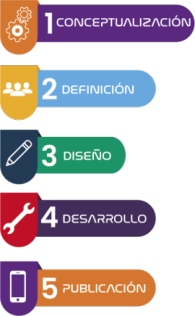
Prior to the experimental phase, the design of the application includes the development of a mobile APP, which includes multimedia resources, such as digital animation audiovisuals, following the Torres Remón (2017) methodology.
Figure 1. Design phases for creating apps
Adapted from Torres Remón.
The conceptualization stage is framed in the need to generate inclusive environments for people who suffer from hearing loss and their community.
The definition established the target group to which the App is directed. In this sense, they are children from 8 to 9 years old from the Bilingual Educational Center "CELITE" of Ambato.
The Design, the character design was developed, being an application aimed at children, it was decided on child-like illustrations.
Intelligent Human Systems Integration (IHSI 2022): Integrating People and Intelligent Systems https://openaccess.cms-conferences.org/#/publications/book/978-1-7923-8988-7
Figure 2. LSE Development of child avatars
Figure available in the original PDF paper.
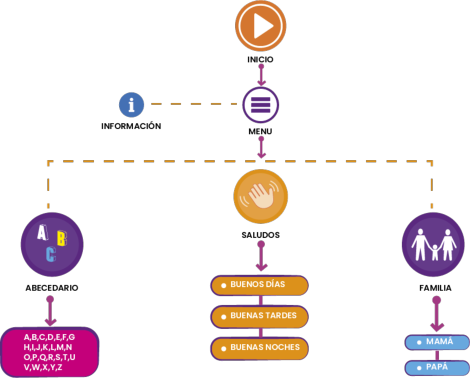
In the information architecture, the following navigability scheme for the application was developed.
Figure 2. APP Architecture
Likewise, the brand identity of the APP is developed based on graphic considerations based on compositional criteria.
Intelligent Human Systems Integration (IHSI 2022): Integrating People and Intelligent Systems https://openaccess.cms-conferences.org/#/publications/book/978-1-7923-8988-7
Figure 3. APP identifier development
Desarrollo. Se inicia con el análisis de la usabilidad de la interfaz del diseño inicial, con el propósito de analizar su navegación y evaluar la interacción.
Intelligent Human Systems Integration (IHSI 2022): Integrating People and Intelligent Systems https://openaccess.cms-conferences.org/#/publications/book/978-1-7923-8988-7
Figure. 4. Application Wireframes.
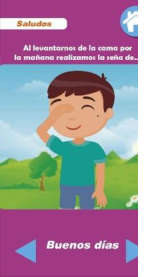
After this stage, the development of the prototype began. Next, the hi-fi design graphics are placed.
Figure 5. High fidelity images
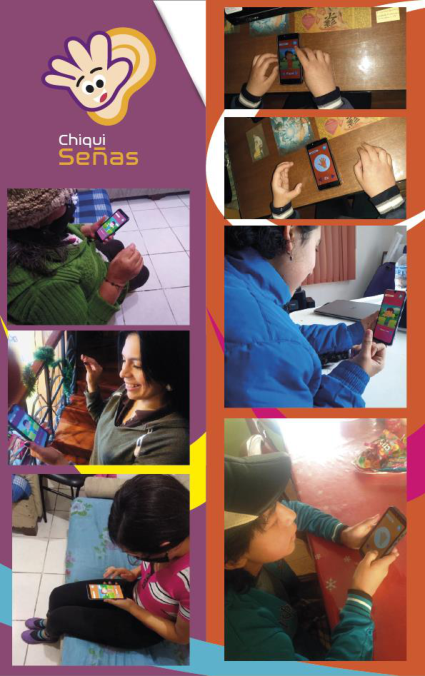
Own elaboration In the same way, after the prototype performance tests, the app was put to the test with a focus group of 20 people, among students and teachers, from whom their impressions of this inclusion technology initiative could be collected.
Intelligent Human Systems Integration (IHSI 2022): Integrating People and Intelligent Systems https://openaccess.cms-conferences.org/#/publications/book/978-1-7923-8988-7
Figure 6. Prototype Test Pictures
The test results showed a functionality perception and a positive predisposition to content. the overall design and interface valued as Very Good and Excellent scores, higher than 80% of those consulted.
CONCLUSIONS
The need to generate inclusive environments, is a public and private institutions responsibility. From the university, it contributes with the technological resources that collaborate with these initiatives.
Intelligent Human Systems Integration (IHSI 2022): Integrating People and Intelligent Systems https://openaccess.cms-conferences.org/#/publications/book/978-1-7923-8988-7
Much of the research on which this project was based, focused on the inclusion of people in social settings. However, the studies that have an inverse approach, in which society collaborates with people with disabilities are few, this is one of many reasons that the proposed APP has been accepted with the results shown.
The project is planning an extension to cover more content in subsequent updates, as it could only be tested on a limited number of people. Likewise, the LSE contents have been the most basic in the first instance, of which it is projected to place a greater amount of language within the App and include more educational institutions for its application.
ACKNOWLEDGEMENTS
The authors would like to thank the Universidad Tecnologica Indoamérica, the Faculty of Architecture, Arts and Design, and the Research Institute of the Universidad Indoamérica. Likewise, the respective thanks to the educational institutions that allowed us to carry out the tests of the applications.
REFERENCES
Álvarez Urbay, M., Ronda Marisy, H., Conejero Álvarez, H. & Borges de Almeida, C., 2007.
Comportamiento de las Hipoacusias de conducción. Archivo Médico de Camagüey. Baños García, M. E., Lezcano Barbero, F. & Casado Muñoz, R., 2018. Materiales multimedia: Diseño desde una pedagogía inclusiva. European Journal of Child Development, pp. 107-118. Eberle, D., Parks, E., Eberle, S. & Parks, J., 2012. Sociolinguistic Survey Report of the
Ecuadorian Deaf Community. s.l.:SIL International. Hernandez-Sampieri, R. & Mendoza Torres, C. P., 2018. Metodología de la Investigación.
Las rutas cuantitativa, cualitativa y mixta. s.l.:McGraw Hill. INEGI, S.F.. Clasificación de Tipo de Discapacidad - Histórica. [En línea] Available at: https://www.inegi.org.mx/contenidos/clasificadoresycatalogos/doc/clasificacion_de_ti po_de_discapacidad.pdf Jadán Guerrero, J., Arias Flores, H. & Altamirano, I., 2020. Q’inqu: Inclusive Board Game
for the Integration of People with Disabilities. En: Applied Technologies. Communications in Computer and Information Science. . s.l.:Springer, Cham. Luna Kano, M. d. R., 2013. Tecnología y discapacidad: Una mirada pedagógica. RDU Revista Digital Universitaria. Martins, A. y otros, 2013. Aplicaciones de las TIC en Educación y Ciencias. Paraná-Entre
Ríos, Departamento Computación Aplicada/ Facultad de Informática Universidad Nacional del Comahue, pp. 1191-1195. Martínez Cortés, M. d. C. y otros, 2008. Métodos de intervencion en discapacidad auditiva.
International Journal of Developmental and Educational Psychology, pp. 219-224. Ministerio de Salud Pública del Ecuador, 2018. Calificación de la discapacidad.
Quito(Ecuador): Dirección Nacional de Normatización.
Intelligent Human Systems Integration (IHSI 2022): Integrating People and Intelligent Systems https://openaccess.cms-conferences.org/#/publications/book/978-1-7923-8988-7
Ministerio de las Culturas el Arte y el Patrimonio, S.F.. Uso de lenguaje inclusivo. Persona en situación de discapacidad. [En línea] Available at: https://www.cultura.gob.cl/wp-content/uploads/2017/01/guia- recomendaciones-lenguaje-inclusivo-discapacidad.pdf Organización Mundial de la Salud, 2001. Clasificación Internacional del Funcionamiento,
de la Discapacidad y de la Salud: CIF. Ginebra: Organización Mundial de la Salud. Organización Mundial de la Salud, 2011. Informe Mundial sobre la discapacidad, s.l.: Banco Mundial. Oviedo, A., Carrera, X. & Cabezas, R., 2015. Ecuador, atlas sordo. [En línea]
Available at: https://cultura-sorda.org/ecuador-atlas-sordo/ Quintero-Uribe, J. F. & Osorio-Montoya, L. M., 2018. Discapacidad, diversidad e inclusión: concepciones de fonoaudiólogos que trabajan en educación inclusiva. Investigación Social, pp. 52-59. Rodríguez, D. M., 2016. ¿Discapacitado? No,Sordo! La creación de la identidad sorda, su
formulación como comunidad diferenciada y sus condiciones de accesibilidad al sistema de salud.. Barcelona: Departament d´ Antropología social i cultural. Rodríguez, M. I. & Velásquez, R. d. P., 2000. Historia y gramática de la Lengua de Señas.
Pedagogía y Saberes, pp. 91-104. Rojas, S. M., 2015. Discpacidad en clave decolonial. Una mirada de la diferencia. REALIS, pp. 175-202. Silva Sánchez, G. & Rodríguez Miranda, F. d. P., 2017. Una mirada hacia las TIC en la
educación de las personas con discapacidad y con trastorno del espectro autista: Análisis temático y bibliográfico.. EDMETIC Revista de Educación Mediática y TIC. Torres Remon, M., 2017. Desarrollo de aplicaciones con android. Lima: Macro. Vanegas, L. P., Vanegas, C., Ospina, O. H. & Restrepo, P. A., 2015. Entre la discapacidad y los estilos de aprendizaje: Múltiples significados a la diversidad de capacidades. Revista Latinoamericana de Estudios Educativos, s.d abril.pp. 107-131. Viceprecidencia República del Ecuador, 2013. [En línea] Available at: https://www.vicepresidencia.gob.ec/wp- content/uploads/downloads/2013/04/Compilacion-Final-Interactivo.pdf
Intelligent Human Systems Integration (IHSI 2022): Integrating People and Intelligent Systems https://openaccess.cms-conferences.org/#/publications/book/978-1-7923-8988-7
LISTED IN THE AHFE DIGITAL BOOKSTORE CATALOGUE
Explore the complete digital volume
Intelligent Human Systems Integration (IHSI 2022): Integrating People and Intelligent Systems
Read this individual research paper free through the original publisher, or explore the full digital proceedings book.
ISBN 978-1-7923-8988-7
Explore this ISBN in the AHFE Bookstore ↗Listed in the July 2026 bookstore catalogue; search by ISBN to confirm current availability · Digital book purchase optional