Leon Reinsch, Christoph Greb, Thomas Gries (2022). Ontologies - Introduction and practical approach to textile engineering. In: Intelligent Human Systems Integration (IHSI 2022): Integrating People and Intelligent Systems. AHFE Open Access, vol. 22. https://doi.org/10.54941/ahfe1001061
Ontologies and Semantic Web technologies offer great potential for interoperability of production processes, yet they still lack awareness in the textile industry. Successful examples of ontology-based approaches already display benefits but the implementation requires the contribution of knowledge engineers and expert domain knowledge. Currently textile domain experts often lack the informational basis to identify application scenarios. Textile engineering is predominantly characterized by experience-based approaches and tacit knowledge in specialized application domains. Ontologies serve as an approach for the formalization of knowledge in human and machine-readable form. This paper aims to convey ontology-based approaches in textile production technology and delineate additional application fields.Based on the research done by Lipp et al and Brillowski et al, this paper rests on three hypotheses:•Potential fields of application of ontologies in the textile industry are largely unused•This is due to lacking awareness and unclear benefits•Availability of textile domain knowledge and the kind of tacit knowledge make ontology-based approaches particularly complexTo evaluate the penetration of ontologies and their potential applications in textile engineering, existing applications from literature are classified. A narrative review is conducted and application fields are classified based on the suggested by Lipp et al. A comprehensible explanation for the target group of textile practitioners and scientists, a description of central concepts and an explanation with the help of target group oriented analogies are given. Finally, the suitability of the application area is analyzed by matching the requirements, prerequisites and limitations of ontologies with the current and envisioned characteristics of textile knowledge and interoperability industrial cross company cooperation and interoperability.The results show that current examples in textile production are mainly focused on vocabularies for human-readable communication rather than technical interoperability. Examples from manufacturing technology are well suited to be adapted for the field of textile production. This paper presents a basis for decision making on where to apply ontology-based approaches within individual production environments. Limitations are identified in circumstances, where quality-relevant decisions and experienced-based approaches are at play. The benefits of ontologies are delineated, as economic gain is a necessary prerequisite. The need for interdisciplinary cooperation and a growing amount of knowledge to be organized from the field of textile technology, related industries and science disciplines are identified as important challenges that require innovative new approaches. The need for knowledge management to foster interdisciplinary cooperation is the main target for the advancement of ontology technologies. The digitalization of these kinds of resources is the first step in this process and the ontology-based formalization is a useful next step.
Intelligent Human Systems Integration (IHSI 2022): Integrating People and Intelligent Systems https://openaccess.cms-conferences.org/#/publications/book/978-1-7923-8988-7
INTRODUCTION
For practitioners in industrial environments, ontologies remain hard to access and therefore hard to implement in domain applications. Without the widespread competence to use ontologies, their potential in practical domains remains largely unused and domain expert’s detailed knowledge predominantly is shared in uncontrolled and unformalized forms. As a part of the industrial revolution, Semantic Web Technologies are utilized to manage the increasing amount of data (Lipp and Schilling, 2020). Digital Shadows are a concept which besides Semantic Web Technologies combines various Industry 4.0 applications and derives contextual knowledge from the multitude of processed data (Schuh et al. 2019). Ontologies can provide a conceptual basis to implement the generic objectives of Digital Shadows (Gruber, 2016). In this paper we present a review of ontology-based approaches in textile production. The paper begins with an initial placement of Industry 4.0 applications in production environments. The next section is divided in two subsections. First, a general overview of Semantic Web Technologies, Digital Shadows and Ontologies in production environments is given. Thereafter, the specific potentials and challenges of Industry 4.0 in textile engineering are addresses. The research questions we address are:
What are unused fields of application of ontologies in the textile industry?
How can awareness among practitioners be raised?
What makes ontology-based approaches complex in the textile domain?
To answer these research questions, a narrative literature review is conducted in the remainder of this work. In the remainder the methodology of the literature review is introduces and the results of the review are presented. The paper ends with a discussion of the results and a conclusion.
INDUSTRY 4.0 Digital Shadows and Semantic Web Applications in Production Environments
The industrial revolution will contribute decisively to economic growth and will result in various challenges (Pessôa and Becker, 2020; Jarke et al. 2018). A concept to tackle those challenges is an “Internet of Production (IoP)”. By providing context- specific data from the whole value chain in real-time and adequate granularity, an interconnected and collaborative production environment and the vision of the IoP are fostered (Jarke et al. 2018; Brillowski et al. 2021). The enabling of single and small batch production and the optimization of flexible production is of utmost importance. Digital Shadows provide a conceptual basis to facilitate knowledge management in the IoP. (Schuh et al. 2019)
Intelligent Human Systems Integration (IHSI 2022): Integrating People and Intelligent Systems https://openaccess.cms-conferences.org/#/publications/book/978-1-7923-8988-7
For implementation of Digital Shadows, Semantic Web Technologies provide helpful solutions. The goal of those Semantic Web Technologies is to integrate and cooperate with already existing solutions in Industry 4.0 applications. (Lipp and Schilling, 2020) Ontologies are part of the W3C Semantic Web standard and ontologies for manufacturing and specific domains already exist. (Lipp and Schilling, 2020; Gruber, 2016) Need for Knowledge and Complexity Management in Textile Engineering
A conflict can be identified between analytical knowledge and tacit knowledge as well as between industrial manufacturing of technical textiles and the more social based design of aesthetic garments. While mass production in particular is focused on uniform process conditions, in addition to quantitative research methods, creative design processes also achieve added value through explorative and experimental approaches. (Bye, 2010; Igoe, 2020) The textile industry in recent years was less focused on innovation and design (Elmogahzy et al. 2020). Current trends to include specific customer requirements and to produce unique items efficiently leads to more emphasis on the design process and variable process conditions in industrial production (Schuh et al. 2019). The textile industry consists to a large extent of small and medium enterprises (SME) with a high degree of specialization and unique selling points (Maschler, 2010). Some SME found their niche by providing extraordinary customer service and engineering textile products for specific applications and demands. However, this applies more to certain types of products such as textile machinery than to textile products. (Gloy, 2020) Research in textile engineering is increasingly directed towards non-physical products and design systems for the development of complex textile products itself (Brillowski et al. 2021; Kaspar et al. 2019; McCann et al. 2016; Peiner et al. 2021). At the same time, in recent surveys, SME overwhelmingly rated their own knowledge of Industry 4.0 as medium to poor and consider the shortage of skilled workers a greater priority (Gloy, 2020). This indicates the need of further bridging apparent conflicts between technology, design and human factors (Brillowski et al. 2021). The authors of this paper therefore suggest the investigation and the widespread use of ontologies in the applied textile industry. The following chapters aim to convey ontology-based approaches in textile production technology and delineate additional application fields.
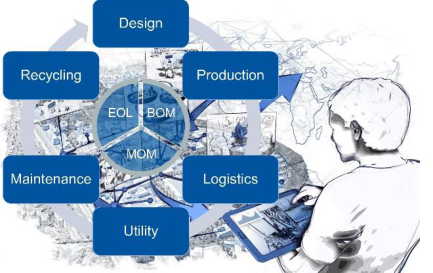
With respect to the whole of textile production, various product phases have to be taken into account. Throughout their lifetime textile products pass different stages, that can be managed with Product Lifecycle Management (PLM) (Elmogahzy et al. 2020). Important stages in the lifecycle are design, production, logistics, utility, maintenance, and recycling that are further divided into beginning of life (BOL), middle of life (MOL), and end of life (EOL). Depending on the various stages and perspectives different information can be necessary, e.g. concerning customer requirements, maintenance, design, production, product status and recycling information. (Li et al. 2015)
Intelligent Human Systems Integration (IHSI 2022): Integrating People and Intelligent Systems https://openaccess.cms-conferences.org/#/publications/book/978-1-7923-8988-7
Figure 1: Stages of the PLM Cycle in context of the IoP (Li et al. 2015) – Photo: Dr. Martin Riedel
As shown above, the different stages in textile manufacturing are complicatedly connected with each other. The higher complexity of product development and slower implementation of corresponding digital support systems compared to systems that optimize production itself can also be observed in other industries (Pessôa and Becker, 2020). The semantic description of insufficiently defined product features is of current research interest (Romero et al. 2019). What applies to widespread and digital CAD models is all the more relevant for textile products and their models, since relevant characteristics and functional properties to a large degree are based on subjective perceptions, difficult-to-measure parameters and application-specific concepts. In order for the Product Lifecycle Management with support of Digital Shadows to function in textile engineering, there is a special need for a formalization of available information and knowledge. Tacit knowledge not only is characteristic for textile design, but also for multiple manufacturing processes in the experience-based textile industry (Brillowski et al. 2021; Bye, 2010). The flexible nature of textiles leads to the special requirements in the design and processing of products (Elmogahzy et al. 2020). Additionally, complex material composition and product architectures have the potential to add beneficial and individual functionality during the usage of a given textile, but further complicate the recycling of textile products. Useful approaches and terminologies for characterization and processing of textiles are largely unknown in other industries (Elmogahzy et al. 2020). However, to exploit the potential of an adaptive manufacturing process, these approaches and terminologies must be managed in reusable conceptualizations within the textile industry itself. Since ontologies facilitate this interoperability, their usage and potentials in textile manufacturing should be further investigated. Till date, the reusability of research and development of industry 4.0 approaches in the textile industry is low and individual solution each have to be developed for each use-case individually and tediously (Fromhold-Eisebith et al. 2021). Especially the reuse of ontologies involves a lot of ongoing research questions. To the best of the authors knowledge, till dated no similar work towards a structured overview and a classification of previous ontology-based approaches in textile engineering exists.
Intelligent Human Systems Integration (IHSI 2022): Integrating People and Intelligent Systems https://openaccess.cms-conferences.org/#/publications/book/978-1-7923-8988-7
METHOD
Based on the research done by Lipp et al. (Lipp and Schilling, 2020) and Brillowski et al. (Brillowski et al. 2021), this paper rests on three hypotheses:
Ontologies’ fields of application in the textile industry are largely unused
This is due to lacking awareness and unclear benefits
Tacit knowledge makes ontology-based approaches particularly complex To evaluate the penetration of ontologies and their potential applications in textile engineering, existing applications from literature are classified by the objectives of the underlying smart system and the stage in the PLM cycle. A narrative, unstructured review is conducted. Thereafter the application fields of ontologies in textile engineering from the literature are classified based on the suggested categories by Lipp et al. (Lipp and Schilling, 2020). The classification for semantic web applications is divided into Data/Service Catalog, Integrating Domains, Database Access, Consistency and Reasoning and Data Aggregation. A detailed description of the types of applications can be found in Lipp et al. (Lipp and Schilling, 2020). A comprehensive explanation for the target groups of textile practitioners and scientists, a description of central concepts and an explanation with the help of target group oriented analogies are given.
RESULTS
The results of this paper are presented in the following chapter which is subdivided into a classification of the literature reviewed followed by a narrative review. The narrative review is based on the authors impressions of the research. Finally, the findings and special features of various practical examples from textile manufacturing and its concepts are traced back to and categorized by the abstract terms of the formal definition of ontologies.
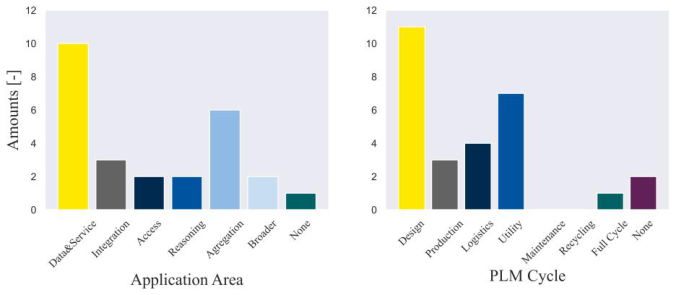
Classification of Semantic Web Applications in Textile Manufacturing Eighteen publications from an unstructured literature review were selected for further evaluation and classification. The publications are allocated to the five application areas suggested by Lipp et al. (Lipp and Schilling, 2020) and to the PLM cycles. Moreover, special features of the presented applications and textile engineering in general are collected. The results are shown in Figure 2.
The results show that for all five categories suggested by Lipp et al. (Lipp and Schilling, 2020), examples can be allocated in textile engineering. With the possibility of assignment to several categories, ten examples have characteristics of Data and Service Catalogs.
Intelligent Human Systems Integration (IHSI 2022): Integrating People and Intelligent Systems https://openaccess.cms-conferences.org/#/publications/book/978-1-7923-8988-7
Figure 2: Classification results of ontology-based solutions in textile industry Three examples are designed to integrate different domains. Two utilizations of ontologies facilitate access to databases. Two examples are used to conduct some kind of consistency check or reasoning. Six examples are focused on data aggregation. Two of the results contain allocations in the broader sense and one recorded result has no allocation to an application category whatsoever. With respect to the PLM cycle, five of the publications were concerned with fashion and six with engineered design, three addressed the production process, four referred to logistics and seven were concerned with utility. Maintenance and recycling were not addressed individually. A full PLM cycle was subject of one work and two publications could not be allocated to a PLM cycle.
The special features that are mentioned in the works are Heterogeneity of Data, Concepts and Entities, which was mentioned four times, Information Overload, which was mentioned two times, Structural Complexity, which was mentioned six times, Interdiciplinarity, which was mentioned six times and Accessibility of Knowledge, which was mentioned seven times.
Literature Results – Narrative Review The impressions from the reviewed literature and the summarized categorization show that all potential application field can be allocated to existing research in textile engineering. A heavy preponderance of data and service catalogs can be detected, especially compared to consistency checking and reasoning. Stolz et al. (Stolz and Hepp, 2018) provide an example, where the ontology is mainly used to populate a data and service catalog in standardized product descriptions. In comparison, the presented system by Kim et al. (Kim et al. 2014) is designed to make intelligent conclusions from acquired sensor data and based on that to provide additional services to the users of healthcare systems. While the former is a helpful approach to formalize existing information in a reusable form, the latter also automatically derives new conclusions and actions from otherwise potentially unused or overlooked
Intelligent Human Systems Integration (IHSI 2022): Integrating People and Intelligent Systems https://openaccess.cms-conferences.org/#/publications/book/978-1-7923-8988-7 information.
An example of domain integration in an interdisciplinary environment is a development platform for smart sensors. Innovative tasks and complex collaborations between experts from textile, electronics, software, application, design and manufacturing domain require exchange of information in a common language. (Gehrke et al. 2020) The scope of most of the works is limited to specific applications and PLM cycles. Solely “VetiVoc” is described as a tool for modeling of the full PLM cycle (Aimé et al. 2016). Many works which address the fashion and clothing domain are predominantly concerned with finished products and MOL. Fewer works specifically address the engineering and manufacturing process for technical products, especially with high technical detail. However, development platforms for smart textiles or the selection of optimization algorithms in a textile production enterprise are examples for existing approaches with technical perspectives (Gehrke et al. 2020; Chaouch et al. 2021).
Definitions, Terms and Explanations for Textile Practitioners According to a basic definition, an ontology is an explicit specification of a conceptualization (Duque et al. 2009). Ontologies are said to provide a “semantic” level instead of a “logical” or “physical” level like database schema (Gruber, 2016). However, just like their key applications (Lipp and Schilling, 2020; Gruber, 2016) the definition of an ontology is commonly too theoretical and generic for practitioners to initiate an application in their own field of expertise. According to Lipp et al. (Lipp and Schilling, 2020) the lacking ontology knowledge among employees in production technologies is a major obstacle for a widespread implementation in industrial environments. With respect to textile production theory as a whole, a lack of reference to the practical application benefit can be identified (Bücher, 2021). Therefore, the authors of this paper suggest a more illustrative description of ontologies’ definitions and benefits and therefore provide a subjective interpretation, analogies and potential applications derived from their impressions in the textile industry.
Formal Representation Standards and norms play a significant role in textile manufacturing, engineering and testing. Using the same basis, different operators are able to perform procedures in a reproducible and transferable manner. Moreover, formality means, that those instructions have a logic that is unambiguous and potentially also is interpretable by machines. In textile testing, the benefit of common terms and procedures are well known. Reusability of results by others and general comparability are absolutely necessary in the textile process chain. Other activities in the manufacturing process are still less formalized and mostly up to the operator’s experience. Formal knowledge representation can prevent the loss of tacit expert knowledge in textile
Intelligent Human Systems Integration (IHSI 2022): Integrating People and Intelligent Systems https://openaccess.cms-conferences.org/#/publications/book/978-1-7923-8988-7 manufacturing caused by demographic change.
Concepts, Classes and Attributes Useful approaches and terminologies for characterization and processing of textiles are largely unknown in other industries (Elmogahzy et al. 2020). Units of measurement e.g. for yarn fineness are unique to textile production. Moreover, in most manufacturing environments there exist additional terms and abstractions to simplify a frequent activity. Those concepts are often custom made and new employees have to familiarize with company- or application-specific parlance. While this habit is helpful for established groups, it makes it difficult for new ones to get started and to collaborate with others. However, in textile manufacturing, groups with different views and concepts constantly have to interact with each other.
Relationships In addition, those concepts are complicatedly entangled with each other. The experience based fine-tuning of a very peculiar machine setting might in turn be dependent on the special feature of a unique product type. Due to the high degree of specification in textile engineering, those particular relationships are mostly experiential knowledge of operators and in some cases stored in analogue notepads. If asked for their insight, operators often generously share their knowledge but the findings are difficult to place and utilize for people without the same basis of knowledge and experience.
Abstraction of Data Models The adequate placement of knowledge and information moreover leads to the topic of abstractions and data models. The above mentioned relationships and specialties are hard to formalize, but every producing company uses some kind of tabular data. Commercial MES and ERP systems provide a good basis for many operational tasks. To reflect the technical depth and reality, textile companies additionally develop and maintain their own custom-made databases. In that sense, e.g. excel sheets and relational databases in the company are a simplified model of the manufacturing arrangements. Information and knowledge that does not fully fit into this tabular form is not represented in the company’s data model.
DISCUSSION
Ontologies – as part of Industry 4.0 applications, Digital Shadows, and textile manufacturing environments – are gaining in importance in research and practical applications. Yet ontology-based approaches still lack awareness in the textile industry, their benefits from best-practice examples do not fully cover most pressing issues in the industry and the complexity of textile manufacturing leads to special
Intelligent Human Systems Integration (IHSI 2022): Integrating People and Intelligent Systems https://openaccess.cms-conferences.org/#/publications/book/978-1-7923-8988-7 challenges.
Examples in textile production are focused on vocabularies for human-readable communication rather than technical interoperability. The vision of the IoP introduces demanding objectives with respect to the orchestration of individual process stages, data aggregation and quantitative information about individual products themselves. However, in textile engineering, different stages are not necessarily characterized by clear boundaries and defined interfaces between them. Current limitations are identified in circumstances, where quality-relevant decisions and experienced-based approaches are at play. Nevertheless, the application scenarios of semantic web technologies generally do address relevant issues in textile environment. The benefits of ontologies for further examples and extensions of smart systems in production environments are delineated, as economic gain is a necessary prerequisite for their development.
CONCLUSIONS
Summarizing the findings from this work, the authors of this paper conclude that there are various benefits of ontology-based solutions in smart industrial automation and manufacturing. Loosely inspired by the literature examples analogies and identified gaps, the benefits of ontologies in textile manufacturing environments include:
Preservation of expert knowledge,
accessibility to knowledge and resources like technologies, materials, legislation, norms, suppliers, science, algorithms,
management of diverse items and heterogeneous data,
flexibility and innovation in production and the product development process
and the inclusion of different perspectives and backgrounds.
Therefore, to actually foster an IoP in textile manufacturing, the technical detail of existing models has to be further extended and a large quantity of tacit knowledge has to be made accessible, e.g. with ontology-based smart manufacturing systems. Reusable ontologies in material modeling and technology description should be integrated in industrial processes and actions. The need for interdisciplinary cooperation and a growing amount of knowledge to be organized from the field of textile technology, related industries and science disciplines are identified as important challenges that require innovative new approaches.
ACKNOWLEDGMENTS
Funded by the Deutsche Forschungsgemeinschaft (DFG, German Research Foundation) under Germany’s Excellence Strategy – EXC-2023 Internet of
Intelligent Human Systems Integration (IHSI 2022): Integrating People and Intelligent Systems https://openaccess.cms-conferences.org/#/publications/book/978-1-7923-8988-7
Production – 390621612.
REFERENCES
Aimé, X.; George, S.; Hornung, J.: VetiVoc (2016) A modular ontology for the fashion, textile and clothing domain. In: Applied Ontology Vol.:11, Pt. 1, pp. 1--28 Brillowski, F.; Dammers, H.; Koch, H.; Müller, K.; Reinsch, L.; Greb, C. (2021)
Know-How Transfer and Production Support Systems to Cultivate the Internet of Production Within the Textile Industry. In: Intelligent Human Systems Integration, Springer Bücher, D. (2021) Methodik für die kostenoptimale Analyse textiler Produktionssysteme, Aachen: Shaker; Zugl.: Aachen, Techn. Hochsch., Diss., 2021, ISBN: 978-3-8440-8052-0 Bye, E. (2010) A Direction for Clothing and Textile Design Research, Clothing and
Textiles. In: Research Journal Vol.:28, Pt. 3, S. 205--217 Chaouch, R.; Ghorbel, H.; Khalfallah, S. (2021) Model for the classification of scheduling problems based on ontology. In: Procedia Computer Science Vol.:181, Pt. 2, pp. 890--896 Duque, A.; Campos, C.; Jiménez-Ruiz, E.; Chalmeta, R. (2009) An Ontological
Solution to Support Interoperability in the Textile Industry. In: Enterprise Interoperability. Berlin, Heidelberg: Springer Berlin Heidelberg, pp. 38--51 Elmogahzy, Y. E. (2020) Engineering textiles. Woodhead Publishing, Cambridge Fromhold-Eisebith, M.; Marschall, P.; Peters, R.; Thomes, P. (2021) Torn between digitized future and context dependent past – How implementing ‘Industry 4.0’ production technologies could transform the German textile industry. In: Technological Forecasting and Social Change Vol.:166 Gehrke, I.; Knuth, M.; Kolvenbach, S.; Riedlinger, U.; Gries, T.; Tramp, S. (2020)
Development and Implementation of an Ontology to Support the Product Development of Smart Textiles Using Open Innovation Platforms. In: ALLDATA 2020. Wilmington, DE, USA: IARIA Gloy, Y.-S. (2020) Industrie 4.0 in der Textilproduktion. Berlin, Heidelberg: Springer Berlin Heidelberg Gruber, T. (2016) Ontology. In: LIU, LING; ÖZSU, M. TAMER: Encyclopedia of
Database Systems. New York, NY: Springer New York, pp. 1--3 Igoe, E. (2020) Textile design theory in the making. Ava Academia; Bloomsbury Publishing, London Jarke, M., Schuh, G., Brecher, C., Brockmann, M., Prote, J.-P. (2018) Digital
Shadows in the Internet of Production. In: ERCIM news. 115, pp. 22--28 Kaspar, A.; Makatura, L.; Matusik, W. (2019) Knitting Skeletons: A Computer- Aided Design Tool for Shaping and Patterning of Knitted Garments: http://arxiv.org/pdf/1904.05681v2 Kim, J.; Kim, J.; Lee, D.; Chung, K.-Y. (2014) Ontology driven interactive
healthcare with wearable sensors. In: Multimedia Tools and Applications Vol.:71, Pt. 2, pp. 827--841 Li, J.; Tao, F.; Cheng, Y.; Zhao, L. (2015) Big Data in product lifecycle management. In: The International Journal of Advanced Manufacturing Technology Vol.:81, 1-4, pp. 667--684
Intelligent Human Systems Integration (IHSI 2022): Integrating People and Intelligent Systems https://openaccess.cms-conferences.org/#/publications/book/978-1-7923-8988-7
Lipp, J.; Schilling, K. (2020) The Semantic Web in the Internet of Production. In SEMAPRO 2020. Wilmington, DE, USA: IARIA Maschler, T. (2010) Ontologiebasierte Unterstützung von wissensintensiven
Produktionsprozessen. In: Unternehmenskybernetik 2020: Duncker & Humblot, S. 357–362 McCann, J.; Albaugh, L.; Narayanan, V.; Grow, A.; Matusik, W.; Mankoff, J.; Hodgins, J. (2016) A compiler for 3D machine knitting, ACM Transactions on Graphics Vol.:35, PT. 4, pp. 1—11 Peiner, C.; Löcken, H.; Reinsch, L.; Gries, T. (2021) 3D Knitted Preforms Using
Large Circular Weft Knitting Machines. In: Applied Composite Materials Vol.:38 Pereira Pessôa, M. V.; Jauregui Becker, J. M. (2020) Smart design engineering: a literature review of the impact of the 4th industrial revolution on product design and development. In: Research in Engineering Design Vol.:31, Pt. 2, pp. 175--195 Romero, F.; Sanfilippo, E. M.; Rosado, P.; Borgo, S.; Benavent, S. (2019) Feature
in product engineering with single and variant design approaches. A comparative review. In: Procedia Manufacturing Vol.:41, pp. 328--335 Schuh, G.; Kelzenberg, C.; Wiese, J.; Ochel, T. (2019) Data Structure of the Digital Shadow for Systematic Knowledge Management Systems in Single and Small Batch Production. In: Procedia CIRP Vol.:84, pp. 1094--1100 Stolz, A.; Hepp, M. (2018) Integrating Product Classification Standards into
Schema.org: Approach and Use Cases. In: On the Move to Meaningful Internet Systems. OTM 2017 Conferences. Cham: Springer International Publishing, pp. 103--113
Intelligent Human Systems Integration (IHSI 2022): Integrating People and Intelligent Systems https://openaccess.cms-conferences.org/#/publications/book/978-1-7923-8988-7
LISTED IN THE AHFE DIGITAL BOOKSTORE CATALOGUE
Explore the complete digital volume
Intelligent Human Systems Integration (IHSI 2022): Integrating People and Intelligent Systems
Read this individual research paper free through the original publisher, or explore the full digital proceedings book.
ISBN 978-1-7923-8988-7
Explore this ISBN in the AHFE Bookstore ↗Listed in the July 2026 bookstore catalogue; search by ISBN to confirm current availability · Digital book purchase optional