Kimi Ueda, Ryuhei Sakamoto, Hirotake Ishii, Hiroshi Shimoda, Fumiaki Obayashi, Junya Morita (2022). Examining the Mechanism of Concentration on Intellectual Works by Simulation Using Cognitive Architecture. In: Intelligent Human Systems Integration (IHSI 2022): Integrating People and Intelligent Systems. AHFE Open Access, vol. 22. https://doi.org/10.54941/ahfe1001075
In general, it is believed that concentrating on a task increases the performance of intellectual tasks such as office work, and this has been the focus of attention as an index for performance evaluation. Although there have been studies that have attempted to estimate whether or not a person is concentrating based on physiological indicators such as EEG and cerebral blood flow, and behavioral measurements such as facial expressions and posture, there has been no analysis of the mechanism of concentration that focuses on the actual cognitive process. The purpose of this study is to examine the mechanism of human concentration on intellectual tasks from the viewpoint of cognitive processes by reproducing the answering time data of cognitive tasks actually answered by humans with the cognitive architecture ACT-R (Adaptive Control of Thought--Rational) [1,2]. In this study, we made a model which runs on ACT-R to reproduce the cognitive process of successively answering a cognitive task consisting of multiple questions of constant difficulty [3], which authors have been using for evaluating intellectual concentration. The target cognitive task requires relatively complex processing, such as comparing numbers and the semantic categories of words. Therefore, in the reproduced model on ACT-R, we had to adjust a total of six parameters to fit actual answering time data of humans, including "ease of entry into short-term interruptions," which is related to whether or not the cognitive process proceeds smoothly for smooth answers, and "ease of entry into long-term rest," which is related to whether or not it is difficult to proceed with the task continuously due to fatigue for example. We focused on the characteristic of answering time data based on the shape of the answering time distribution, and used genetic algorithms to search for sub-optimal parameters of the ACT-R model to represent each of the actual answering time data of actual human answers. The number of the target actual answering time data to represent was 60 that different participants answered for 30 minutes and chosen to have various shape characteristics of answering time distributions. By comparing the distributions of the ACT-R parameter values with the features of the actual answering time data, we discussed the cognitive processes that are most closely related to the features of the answer time data. In particular, it was noteworthy that the most influential factor on intellectual work performance was the parameter that represents “ease of getting out of a long rest”.[1] Anderson John Robert: How Can the Human Mind Occur in the Physical Universe?,Oxford University Press, New York (2007).[2] ACT-R Research Group, Department of Psychology, Carnegie Mellon University: ACT-R, http://act-r.psy.cmu.edu/ (accessed Oct. 24th, 2021)[3] Kimi Ueda, et.al: Development of a new cognitive task to measure intellectual concentration affected by room environment, The Fifth International Conference on Human- Environment System ICHES2016 Nagoya, 2016.
In general, it is believed that concentrating on a task increases the performance of intellectual tasks such as office work, and this has been the focus of attention as an index for performance evaluation. The authors also have focused on intellectual concentration, and have developed an index called CTR (concentration time ratio), the ratio of time when workers concentrated on their work during their working time (Miyagi et al. 2013) to evaluate intellectual work performance. However, although there have been studies that have attempted to estimate whether a person is concentrating based on physiological indicators such as EEG and cerebral blood flow, and behavioral measurements such as facial expressions and posture, there has been no analysis of the mechanism of concentration that focuses on the actual cognitive process.
The authors have been examining the mechanism of human concentration on intellectual tasks from the viewpoint of cognitive processes by reproducing the answering time data of cognitive tasks actually answered by humans with the cognitive architecture ACT-R (Adaptive Control of Thought--Rational) (ACT-R Research Group 2002). An ACT-R model was created to simulate the answering process of a cognitive task (Ueda et al. 2016) that has been used to evaluate workers' concentration on intellectual work. In this study, parameters in the model that are related with variation of the simulated answering time data of cognitive task were semi-optimized using a genetic algorithm for the data that are characteristic of the actual answer time data. Based on the results of semi-optimized parameters, how performance in cognitive tasks is due to changes in cognitive processes was discussed.
METHODS
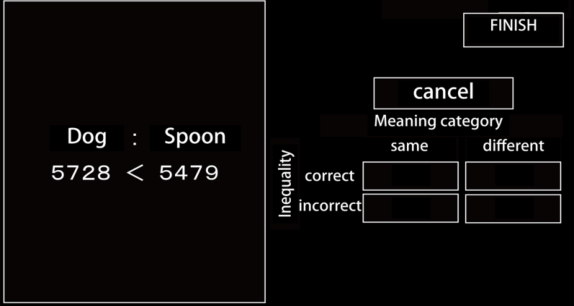
COGNITIVE TASK AND ITS ANSWERING TIME DATA CHARACTERISTICS TO BE REPRODUCED BY ACT-R SIMULATION Answering process of a comparison task, a cognitive task developed to evaluate workers' concentration on task (Ueda et al. 2016) was simulated by using ACT-R. Figure 1 shows an example of a comparison task. The comparison task is a series of questions that can be answered by selecting the corresponding button from the right side, based on the results of word comparison: comparing the semantic categories of two words and number comparison: comparing the size of two numbers dis-played on the left side. The comparison task is designed so that the difficulty level of each question is uniform.
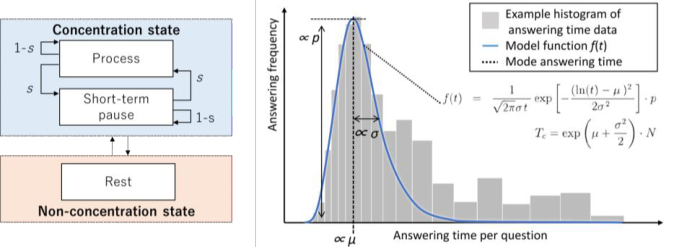
In order to express the characteristics of the answering time data of the comparison task, we used two values that show the shape of the solution time distribution and CTR (concentration time ratio) (Miyagi et al. 2013), which is an index developed for intellectual performance evaluation. CTR is based on the idea of the three-state model, which represents
Intelligent Human Systems Integration (IHSI 2022): Integrating People and Intelligent Systems https://openaccess.cms-conferences.org/#/publications/book/978-1-7923-8988-7 the state during intellectual work, including process when answering process goes on, short- term pause state when answering process interrupt unconsciously, and pause state when an answerer stop task to rest consciously. The progress state and the short-term pause state were defined as concentration state because they were aware of the work progress, and the rest state was defined as non-concentration state because the participants were not aware of the work progress as shown in the left side of Figure 2. CTR is calculated as a ratio of time length that an answerer concentrated on their task to the total task time by fitting analysis of answering time data by log-normal distribution as shown in the right side of Figure 2.
In this study, we focused on CTR and the shape of answering time data distribution of concentration state, which is expressed by μ and σ of log-normal distribution, to be reflected workers’ intellectual work performance and concentration characteristics. The answering time data to be reproduced in the ACT-R were selected from the answering time data collected in our previous experiment from 408 data, in which multiple participants were participated and conducted a series of the comparison task for 30 minutes. A total of 60 pieces of data were selected as the characteristic answering time data, each 10 of which had high and low CTR, high and low μ, and high and low σ. SIMULATION OF ANSWERING COGNITIVE TASK ON ACT-R ACT-R, a kind of cognitive architecture, was used to simulate the solution of a comparison problem in this study. ACT-R needs a model mainly with declarative memory, which stores factual knowledge, and procedural memory, which stores processing methods as production rules. By running the model on ACT-R, we can perform sequential simulations of human actions based on many cognitive psychological findings.
Figure 1. Example question of the comparison task. (Ueda et al. 2016)
Intelligent Human Systems Integration (IHSI 2022): Integrating People and Intelligent Systems https://openaccess.cms-conferences.org/#/publications/book/978-1-7923-8988-7
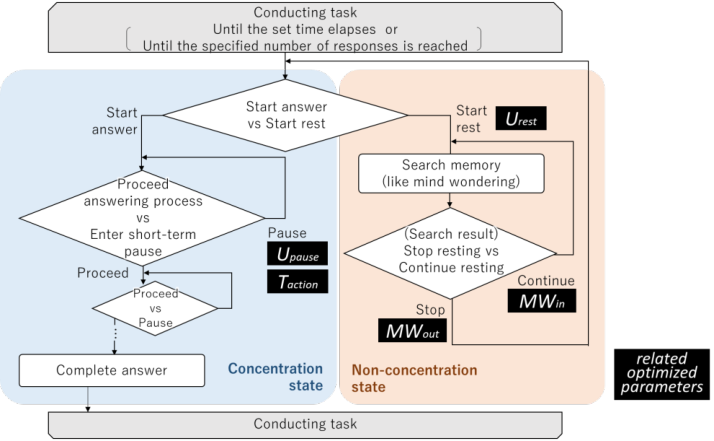
Figure 2. Three-state model (left) and an image of answering time data fitting analysis (right) To simulate the answering of comparison task, we created a model with production rules that operates in the flow as shown in Figure 3, based on the idea of the three-state model shown on the left side of Figure 1. The progression of the answering process corresponds to the production rules required for answering each question of comparison task, such as "moving the gaze to the word on the left", "memorizing the word at the gaze position" and "searching for the semantic category of the memorized word".
Since the answering time data when a human being actually conducted a comparison task is affected and changes due to various factors such as individual characteristics, work environment, fatigue, and mood, it takes various shapes like the characteristic data selected in 2.1. Therefore, in the ACT-R simulation, five parameters were set to be adjusted according to the answering time data to be reproduced, as shown in Table 1. PARAMETER SEMI-OPTIMIZATION WITH GA (GENETIC ALGORITHM) In order to reproduce each of the characteristic answering time data selected in 2.1 in the ACT-R simulation, the parameters of ACT-R were optimized by a GA (genetic algorithm) (Holland 1992, David and John 1988) implemented in GAlib (Matthew 1995). The GA was conducted with 80 initial individuals and 100 generations, using the roulette selection method with elite strategy, the single point crossover method with a crossover rate of 0.6, and general mutation with a mutation rate of 0.02. In the simple GA, the parameters need to be discrete values. The parameters to be optimized, the range of candidate values for each parameter, and the numbers of ticks are as shown in Table 1. As the evaluation value of the GA, which used as a measure of similarity between the actual data and the simulated data, we used combined value of RMSE (Root Mean Squared Error) and EMD (Earth Mover’s Distance) (Rubner et al. 2000): RMSE for the part approximated by the lognormal distribution of the answers in the concentrated state of the answering time, and EMD for the other part calculated. In this way, for each of the 60 characteristic answering time data selected in 2.1, the values of parameters that optimize the answering time data obtained from the ACT-R simulation were calculated.
Intelligent Human Systems Integration (IHSI 2022): Integrating People and Intelligent Systems https://openaccess.cms-conferences.org/#/publications/book/978-1-7923-8988-7
Figure 3. Overview of the simulation flow of conducting task by ACT-R.Table 1: Optimized parameters and their explanation
Table available in the original PDF paper.
3 245 50
Parameters How parameters affect on cognitive process min max step Urest Utility (probability) of entry into rest -0.30 0.30 51 Upause Utility (probability) of entry into short-term pause -0.30 0.30 51 MWin Base level of the activity value of dummy memory to continue rest (Ease of continuing rest)
3 245 50
MWout Base level of the activity value of dummy memory to stop rest (Ease of stopping rest to restart answer)
0.020 0.100 51
Taction Length of one short-term pause (Speed of cognitive processing)
Intelligent Human Systems Integration (IHSI 2022): Integrating People and Intelligent Systems https://openaccess.cms-conferences.org/#/publications/book/978-1-7923-8988-7
RESULTS AND DISCUSSION
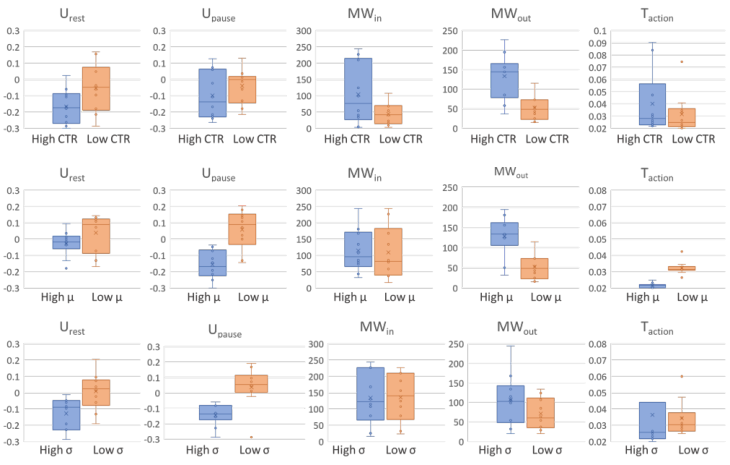
The values of the parameters that optimize the ACT-R simulation for each 10 of 6 characteristic answering time data resulting from the GA are shown in Figure 4. Values exceeding 1.5 times the quartile range are excluded as outliers, and the minimum and maximum values, first quartile, second quartile, and third quartile are shown as lines, with each data position indicated by a circle and the average value indicated by a cross. The first and third quartiles are calculated using a method that does not use the median.
Looking at the optimization results for High CTR and Low CTR shown in the upper part of Figure 4, Urest is lower and MWout is higher for the data with high CTR. In other words, by making it harder to start resting and easier to stop resting and resume work when performing the task, the data with longer periods of concentrated work were reproduced. This is a reasonable result in terms of the cognitive meaning of these parameters. On the other hand, MWin varied greatly in High CTR, and the mean values were not as different as MWout. MWin is a parameter that adjusts how easy to continue resting, and like MWout, it was set to be related to the length of the rest, but it is thought that the ease of leaving the rest is more likely to affect CTR based on these results.
Looking at the results for High μ and Low μ shown in the middle of Figure 4, the values of Upause and Taction are smaller when the data with large μ is reproduced. This indicates that the unconscious pause of work that occurs during answering task is likely to occur, and that each pause is longer, relatively longer answering time for each question was reproduced, which is consistent with the cognitive meaning. Taction, in particular, has a small variability and is considered to be a parameter that contributes to the variability of the answering time. In addition, the value of MWout is also larger for high μ. As shown in Figure 3, MWout is a parameter that was set to have nothing to do with the answering process during concentration state. Therefore, it might be due to the concentration time is longer and the CTR is often higher for data with large μ, based on the formula for calculating the concentration time Tc described in Figure 2.
Based on the results for high and low σ shown in the lower part of Figure 4, the value of Upause is smaller when reproducing data with large σ. This indicates that by simulating the data in such a way that unconscious pauses can easily occur during the answering process, data with a large variation in the answering time for each question when the subject concentrates on it can be reproduced. The variability of the Upause values in High and Low σ was relatively small, so that Urest thought to be representative parameter to express the variation of σ. In addition, the value of Urest is also smaller in high σ. Similar to the MWout results of high and low μ, Urest is a parameter that was set to have nothing to do with the answering process during concentration state, so that it might be due to the longer concentration time for data with large σ.
Intelligent Human Systems Integration (IHSI 2022): Integrating People and Intelligent Systems https://openaccess.cms-conferences.org/#/publications/book/978-1-7923-8988-7
Figure 4. Box plots of the semi-optimized model parameters.
CONCLUSION
In this study, as a first attempt to examine the mechanism of concentration on intellectual tasks from the perspective of cognitive processes, we searched for parameters to optimize the simulation using ACT-R based on characteristic answering time data. Based on the results, it was inferred what cognitive processes are responsible for the variation of the answer time data. The results suggested the probability that variation in CTR, the percentage of time spent concentrating on a task, could be explained by variation in the probability of starting a break during a task and of restarting conducting a task during a break: variation in μ, in particular, by variation in the length of a single unconscious pause during answering process: variation in σ, by variation in the probability of an unconscious pause during answering process.
In the future, it is required to increase knowledge through further trials, such as examining what kind of cognitive process variation is responsible for changes of intellectual concentration due to the variation of various factors, such as work environment, fatigue and mood.
Intelligent Human Systems Integration (IHSI 2022): Integrating People and Intelligent Systems https://openaccess.cms-conferences.org/#/publications/book/978-1-7923-8988-7
ACKNOWLEDGMENTS
The software for this work used the GAlib genetic algorithm package, written by Matthew Wall at the Massachusetts Institute of Technology.
REFERENCES
Miyagi K, Oishi K, Uchiyama K, Ishii H, Shimoda H. (2013). “Proposal of intellectual productivity model based on work state transition”, proceedings of Conference on Human Computer Interaction, Engineering Psychology and Cognitive Ergonomics, Las Vegas, Part I, pp. 335-343 ACT-R Research Group, Department of Psychology, Carnegie Mellon University (2002).
ACT-R, http://act-r.psy.cmu.edu/ Ueda K., Shimoda H., Ishii H., Obayashi F., Taniguchi K. (2016). “Development of a new cognitive task to measure intellectual concentration affected by room environment”, proceedings of the Fifth International Conference on Human-Environment System, Nagoya Holland J.H. (1992). Adaptation in natural and artificial systems. MIT Press, Massachusetts. David E.G., John H.H. (1988). Genetic algorithms and machine learning. Mech. Lean. 3, pp.
95-99 Matthew W. (1995) GAlib: Matthew's Genetic Algorithms Library: http://lancet.mit.edu/ga/ Rubner Y, Tomasi C., Guibas L.J. (2000). The Earth Mover’s Distance as a metric for image retrieval, International Journal of Computer Vision, Volume 40, pp.99-121
Intelligent Human Systems Integration (IHSI 2022): Integrating People and Intelligent Systems https://openaccess.cms-conferences.org/#/publications/book/978-1-7923-8988-7
LISTED IN THE AHFE DIGITAL BOOKSTORE CATALOGUE
Explore the complete digital volume
Intelligent Human Systems Integration (IHSI 2022): Integrating People and Intelligent Systems
Read this individual research paper free through the original publisher, or explore the full digital proceedings book.
ISBN 978-1-7923-8988-7
Explore this ISBN in the AHFE Bookstore ↗Listed in the July 2026 bookstore catalogue; search by ISBN to confirm current availability · Digital book purchase optional