Hao Song, Yan Zhang (2022). Numerical simulation and impact test of hand-held vacuum cleaner dust collector. In: Intelligent Human Systems Integration (IHSI 2022): Integrating People and Intelligent Systems. AHFE Open Access, vol. 22. https://doi.org/10.54941/ahfe1001076
In order to study the dynamic response of the dust collector in the process of free fall, the author used the HYPERMESH/LS-DYNA software to simulate the fall-ing process; set up a drop test platform and used a high-speed camera to record the collision process, and used sensors to obtain parameters such as impact force and acceleration during the fall. Finally, the experimental results are compared with the simulation results. The results show that: (1) The numerical simulation shows the collision process of the dust collector very well, which is very con-sistent with the part disengagement and structural deformation that occurred in the experiment. (2) The impact force and acceleration values obtained by simulation and experiment are relatively close, which also verifies the reliability of the simu-lation. This study evaluated the impact resistance of the dust bucket, which con-tributed to the reduction of product development costs and subsequent structural improvements.
Intelligent Human Systems Integration (IHSI 2022): Integrating People and Intelligent Systems https://openaccess.cms-conferences.org/#/publications/book/978-1-7923-8988-7
INTRODUCTION
The impact generated during the fall may cause mechanical or functional damage to the product, such as the shell rupture, the parts detached, etc. The essence of drop failure is the violent and short-term elastoplastic deformation of the object under impact load, which exceeds the fragility value of the product or fails in the connection of parts (Low et al. 2004, Tempelman et al.2012). The early drop impact test mainly used the prototype to perform the drop test to analyze the phenomenon of damage, deformation, and separation of product parts, but there are many limitations. For example, the test can only be carried out after the prototype is available, and the experimenter can only get limited parameters. In addition, it is impossible to intuitively understand the cause of the damage. In recent years, more researchers are beginning to use dynamic software such as LS-DYNA to simulate the process of product drop, predict structural deformation and perform failure analysis. Min-Chun Pan completed the drop simulation, experimental verification and design modification of the TFT-LCD display, and successfully improved the shock resistance of it. The improved technology she applied can also be extended to other TFT-LCD products (Pan et al.2007). Zhou C.Y studied the behavior of typical portable electronic equipment under drop impact loads and proposed technical measures to better guide the design of related devices and drop/impact protection (Zhou et al.2008). Researchers such as Mattila T.T. have evaluated the product-level free fall response of smartphones from different manufacturers, and provided guidelines for developing board-level drop test methods to better reproduce the field load conditions of modern portable electronic devices (Mattila et al.2014). When using a hand-held vacuum cleaner, the user needs to disassemble the dust collector frequently to clean up the garbage, and in this process, the dust collector is easy to accidentally fall and cause damage. This article analyzes its dynamic response under drop impact through a series of simulations and experiments.
NUMERICAL SIMULATION AND RESULT ANALYSIS Establishment of finite element model
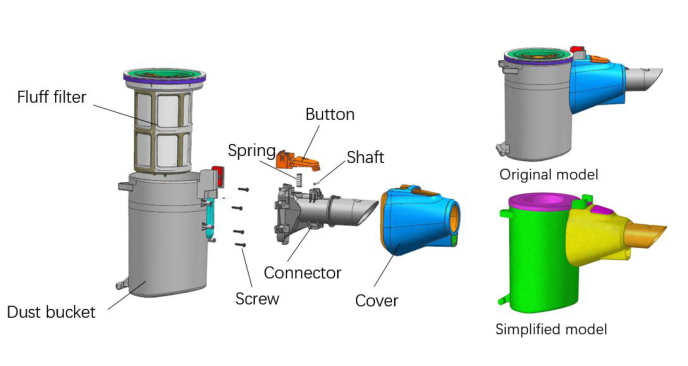
The dust collector is mainly composed of the fluff filter, the dust bucket, the button, and other parts. First, the original model needs to be simplified. Small parts such as internal wires and rubber rings are ignored, the non-collision area of the filter is simplified, and only the parts shown in Figure 1 are retained in the end.
Secondly, the synchronous modeling in UG and the preprocessing function in HYPERMESH were comprehensively used to repair the overlap, misalignment and other defects in the original model, and to clean up small features such as fillets, chamfers, small holes, and symbols. In order to ensure the accuracy of the simulation results, the buckles of the original model and the reinforcement ribs of the bolt column
Intelligent Human Systems Integration (IHSI 2022): Integrating People and Intelligent Systems https://openaccess.cms-conferences.org/#/publications/book/978-1-7923-8988-7 were still retained. In addition to the buckle connection of the model, the bolt connection can be simulated by using beam elements and node rigid bodies, while the spring connection can be simulated by using discrete elements. The actual product after applying the load is about 0.650 kg, and the simplified simulation model is about 0.625 kg.
Figure 1. The structure of the dust collector (left) and the comparison between the original model and the simplified model (right).
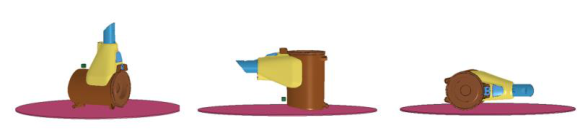
The six drop postures of the dust collector to be analyzed are shown in Figure 2. The dust collector fell freely from a height of h=40 cm and hit the ground with a PVC (Polyvinyl chloride) floor. In order to reduce the calculation time, the initial posture of the dust collector during the simulation is set to be 1 mm(h0) from the ground, and the initial speed is added to the dust collector as 2800 mm/s (v=√2𝑔(ℎ−ℎ0)). The coefficient of friction between the ground and the dust collector is set to 0.2.
O) Fall onto front Q) Fall onto top M) Fall onto side surface "left"
P) Fall onto back L) Fall onto bottom N) Fall onto side surface "right"
Figure 2. 6 types of drop postures.
Intelligent Human Systems Integration (IHSI 2022): Integrating People and Intelligent Systems https://openaccess.cms-conferences.org/#/publications/book/978-1-7923-8988-7
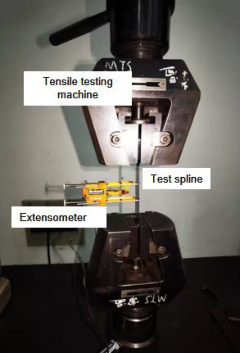
Material properties In order to obtain the mechanical parameters of the material required for the simulation, the tensile test of the material spline is carried out on the universal electronic tensile testing machine, the stretching rate is 50mm/min. After obtaining the engineering stress-strain curve of the main material of the dust collector, it needs to be converted into a real stress-strain curve. Figure 3 shows the stress-strain curve of the experimental equipment and ABS (Acrylonitrile butadiene styrene plastic).
Considering that plastic materials such as ABS have the characteristics of strain softening, the ideal shaping stage is used in the LS-DYNA software to simulate the plastic process after the yield point. The main material parameters used in the dust collector are shown in Table 1 below.
Figure 3. The CMT5105 universal electronic testing machine (left) and ABS material stressstrain curve. (right).Table 1: Material properties of the dust collector Poisson's Material Parts Elastic modulus ratio Density (g/cm3)
Intelligent Human Systems Integration (IHSI 2022): Integrating People and Intelligent Systems https://openaccess.cms-conferences.org/#/publications/book/978-1-7923-8988-7
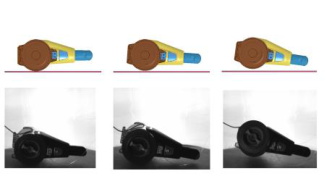
Result analysis As shown in Figure 4,the simulated falling process is consistent with the real falling process of the dust collector captured by the high-speed camera. In most of falling postures, the filter detaches from the dust bucket when it hits the ground and rebounds. This reflects that the dust bucket of the dust collector is not tightly connected to the filter, which subsequent structural improvements are needed. The tip of the connector in the drop posture O, the convex post of the dust bucket in the P posture, and the tabs of the dust bucket in the Q posture need to be carefully analyzed and judged whether there will be deformation or damage.
O) Fall onto front P) Fall onto back
Q) Fall onto top L) Fall onto bottom
M) Fall onto side surface "left" N) Fall onto side surface "right"
Figure 4. Comparison of impact process between numerical simulation and high-speed camera shooting.
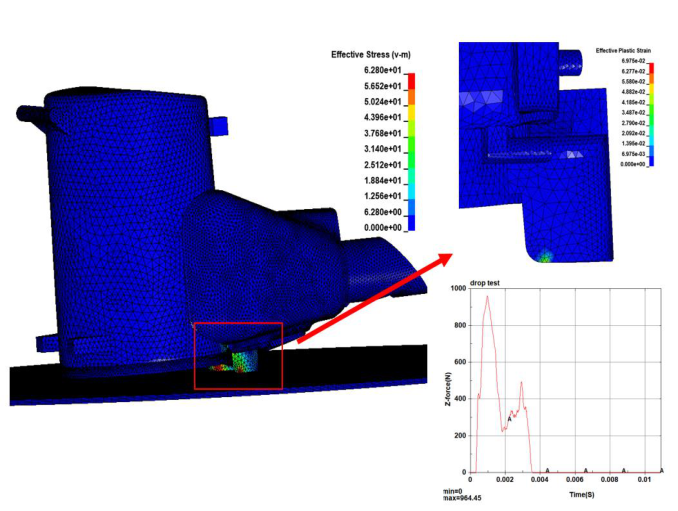
Due to space limitations, we take the fall posture Q as an example to analyze the simulation results. During this drop, the two lugs located on the outside of the outer cylinder first collided with the ground and reached the maximum stress of 62.8 MPa at 1.1 ms, which has reached the yield strength of the PC(Polycarbonate) material, so this part will appear irreversible. Plastic deformation, and the equivalent plastic strain of this part is 0.06975. As can be seen from the time history curve of the impact force
Intelligent Human Systems Integration (IHSI 2022): Integrating People and Intelligent Systems https://openaccess.cms-conferences.org/#/publications/book/978-1-7923-8988-7 on the dust bucket (Figure. 5), the maximum impact force on this position is about 950 N.
Figure 5. Stress and strain distribution and time history curve of impact force on the dust bucket in drop posture Q.
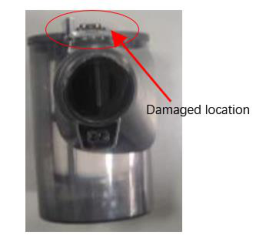
During the drop attitude Q test, some prototypes did indeed suffer from obvious plastic deformation or even fracture at the protruding position, which is consistent with the simulation results. Similarly, the simulation results of other attitudes are in good agreement with the experimental results, which also proves that the drop simulation results using the finite element method are reliable.
Figure 6. Sample after drop posture Q test.
Intelligent Human Systems Integration (IHSI 2022): Integrating People and Intelligent Systems https://openaccess.cms-conferences.org/#/publications/book/978-1-7923-8988-7
IMPACT TEST Drop test bench and drop/impact test process
Considering that the falling posture of the dust collector needs to be precisely controlled, a suspended posture adjustment drop test bench was designed. It mainly uses ropes and pulleys to adjust the initial posture and drop height of the dust collector, and uses the sticky hook fixed on the dust collector as a fixed point. After the initial posture is accurately determined, loosening the rope can ensure that the dust collector falls freely in the required initial posture. By flexibly arranging fixed points and using multiple strands of ropes, the drop tester can be used for drop impact tests of a variety of products. The experimental process is shown in Figure 6.
a) Drop/impact test process
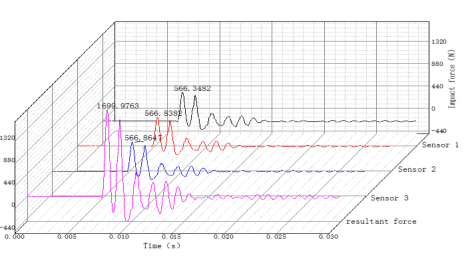
b) Experimental impact force (drop posture P)
Figure 7. Drop/impact test
Intelligent Human Systems Integration (IHSI 2022): Integrating People and Intelligent Systems https://openaccess.cms-conferences.org/#/publications/book/978-1-7923-8988-7
Comparison and analysis of experimental and simulation results It is worth mentioning that although the initial posture of the dust collector falling is strictly controlled, due to the influence of the load, the initial posture of the dust collector colliding with the PVC ground will be different from the that of the simulation, which will affect the accuracy of the results. Therefore, each posture needs to be repeatedly tested and compared with the video taken by the high-speed camera to ensure that the initial posture of the collision is as consistent as possible with the simulation. We compared the results of the standard posture in the simulation with the real falling posture in the experiment recorded by the high-speed camera, and the results with large differences with the attitude in the simulation were excluded, and the retained experimental results were used as valid data(As indicated by the underline in Table 2), and the mean value was taken. Finally, 6 sets of data for each posture are obtained, as shown in Table 2.
Table 2: Comparison of peak impact force obtained from experiment and simulation Peak impact force(N) Time Drop posture O P Q L M N
Table available in the original PDF paper.
Experiment
1 2117.8 1596.7 2221.9 1655.4 1768.1 2625.4 2 1873.5 1790.2 1507.2 1727.7 1488.3 1903.9 3 2144.3 2009.6 1544.6 1751.8 1672.5 2313.2 4 1958.8 1672.3 1303.2 1711.5 1918.7 2797.8 5 1386.4 2100.0 2114.3 1955.8 2104.5 2295.7 6 1832.8 1700.0 1271.3 1717.4 1676.8 2685.3 Average value of valid data 2051.6 1700 2168.1 1753.3 1918.7 2711.6 Simulation 1070 1500 2510 1740 2150 2610 Relative error 47.8% 11.8% 15.8% 0.8% 12% 3.7% Theoretically, given that the shape of the collision position of the drop posture O is extremely sharp, this position will produce greater deformation and absorb more deformation energy, its collision time is relatively long and the impact force received is relatively small, which is consistent with the simulation results. However, the experimental results of the impact force measured from the drop posture O are much larger than the simulation result. The reason is that the prototype has fillets at the collision position, and the collision contact area increased due to plastic deformation of the collision position after multiple tests.
On the whole, drop postures M and N and Q (the filter will hit the ground) will generate a larger impact force due to the larger collision contact area. Although the impact force of other postures is small, the collision position will produce a large deformation (such as the tip position of the falling posture O), which will lead to a high risk of damage to the product.
Intelligent Human Systems Integration (IHSI 2022): Integrating People and Intelligent Systems https://openaccess.cms-conferences.org/#/publications/book/978-1-7923-8988-7
CONCLUSIONS
This paper analyzes the structure dynamic response of the dust collector during the fall process from the two aspects of experiment and simulation. The results show that the filter is detached from the dust bucket in almost six drop postures, and the collision position of the O posture and the Q posture may have large plastic deformation, and the impact force on the P and Q postures is relatively small. The M and N postures received the greatest impact. On the whole, under this working condition, the impact force of the whole dust collector bare metal drop is about 2 kN. In the subsequent structural improvement work, it is recommended that the dust collection bucket and joint use materials with better impact resistance (such as plastics modified by blending ABS and PC) and enhance the reliability of the connection between the dust collection bucket and the filter (using threaded connections instead of just relying on friction).
REFERENCES
Low, K.H., Wang, Y., Hoon, K.H. (2004), “A virtual boundary model for a quick drop–impact analysis of electronic components in TV model.” Advances in Engineering Software, 35(8-9),537-551. Tempelman, E., Dwaikat, M.M.S., Spitás, C. (2012), “Experimental and Analytical
Study of Free-Fall Drop Impact Testing of Portable Products.” Experimental Mechanics. 52(9),1385-1395. Pan,M.C., Chen, P.C. (2007), “Drop simulation/experimental verification and shock resistance improvement of TFT–LCD monitors.” Microelectronics Reliability. 47(12),2249-2259. Zhou, C.Y. Yu, T.X. (2008), “Drop/impact tests and analysis of typical portable
electronic devices.” International Journal of Mechanical Sciences. 5(50),905- 917. Mattila, T.T., Vajavaara, L., Hokka, J. (2014), “Evaluation of the drop response of handheld electronic products.” Microelectronics Reliability. 54(3),601-609.
Intelligent Human Systems Integration (IHSI 2022): Integrating People and Intelligent Systems https://openaccess.cms-conferences.org/#/publications/book/978-1-7923-8988-7
LISTED IN THE AHFE DIGITAL BOOKSTORE CATALOGUE
Explore the complete digital volume
Intelligent Human Systems Integration (IHSI 2022): Integrating People and Intelligent Systems
Read this individual research paper free through the original publisher, or explore the full digital proceedings book.
ISBN 978-1-7923-8988-7
Explore this ISBN in the AHFE Bookstore ↗Listed in the July 2026 bookstore catalogue; search by ISBN to confirm current availability · Digital book purchase optional