Shuandong Cui, Yan Zhang, Yunfei Chen (2023). Visual aesthetic calculation and evaluation model of background pattern formed by the repeated arrangement of single patterns. In: Intelligent Human Systems Integration (IHSI 2023): Integrating People and Intelligent Systems. AHFE Open Access, vol. 69, pp. 723–733. https://doi.org/10.54941/ahfe1002895
The background pattern formed by the repeated arrangement of a single pattern is widely used in modern interface design, textile, and packaging design. The existing aesthetic evaluation of such images is mostly based on subjective evaluation. This paper proposes two different calculation models for the proportion of a single element on a page and the calculation model for the density of a single pattern arrangement. This paper will design an experiment to study the influence of the proportion of a single pattern in the cell and the arrangement density on the page aesthetics of this type of background pattern. The conclusion of the experiment is as follows: for a fixed number of cells on the page, when the proportion of a single pattern area is about 0.5, the page will get the best aesthetic feeling; When the area proportion of patterns on a page is constant, the page beauty increases with the increase of pattern density. When the density increases to a certain value, that is, 5-8 single patterns per 100 pixels in the horizontal or vertical direction, the page beauty is the highest, and then the page beauty decreases with the increase of pattern density. This experiment provides a theoretical basis for the design and evaluation of patterns.
Visual beauty is an important aspect to consider in graphic, packaging and interface design. The pattern background formed by the repetitive arran- gement of single patterns is widely used in the field of flat packaging and graphical interface. In ancient China, a variety of traditional patterns have been widely used in textile, printing, sculpture and other fields. In the modern computer design era, the pattern background generated by single repea- ting pattern has been used more widely. The beautiful pattern background has an important influence on the overall aesthetic degree of the interface and packaging. The aesthetic evaluation and arrangement design of repea- ted arrangement patterns of single patterns are mostly carried out according to subjective experience. Few studies use mathematical calculation combined with physical parameters of single patterns to establish a relationship between
the aesthetic degree of patterns and physical parameters of single patterns, so as to guide the design and arrangement of background patterns.
Ngo put forward 13 beauty indexes that affect the aesthetic feeling of page layout and the calculation formula of each index (Ngo, 2003). Lai proposed a variety of computational models for quantifying the composition elements of a page to help develop an automated measurement of the aesthetics of a page layout design (Lai, 2010). Zhou Lei used grey correlation theory to comprehensively evaluate 13 interface beauty indexes (Zhou Lei, 2013). Balinsky demonstrated the importance of symmetry in interface design, and proposed a calculation model for the symmetry beauty of pages (Balinsky, 2006). Valencia applied the Gestalt principle and proposed the calculation method of three beauty indexes: symmetry, balance and continuity (Vale- ncia, 2016). Maity used SVR method to explore the calculation of monomer position and color beauty in the interface, and built a prediction model of interface beauty (Maity, 2016). Tsai studied the influence of the ratio of white space in the interface and element ratio on interface beauty. Zhou used AHP to study the influence of elements on the sense of interface balance (Tsai, 2014). Lai studied the beauty calculation model of balance and symmetry in color interface based on HSV color space model (Lai et al., 2010). Zhou Aimin studied the comprehensive evaluation model of lively beauty to inter- face style beauty based on the idea of moderate standardization (Aimin et al., 2020). Zhu used genetic algorithm to arrange national patterns so as to gene- rate overall patterns with aesthetic characteristics (Miaomiao et al., 2019). Su Jianning applied latent semantic analysis to resume the comprehensive evaluation method of morphological beauty (Su Jianning et al., 2018).
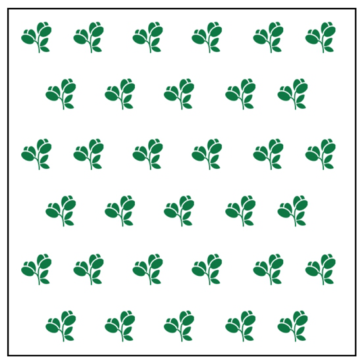
The main graphical interface studied in this paper is the background pattern formed by repeated arrangement of monomer patterns. The back- ground pattern formed by the repeated arrangement of monomers is shown in Figure 1, which is usually a monomer pattern as shown in Figure 2. After copying several quantities, they are arranged equidistant in the horizontal direction and misplaced in the vertical direction at the same time to form the background pattern with aesthetic value. The more common application scenarios of this type of pattern are product packaging, textile printing pat- tern and graphical interface background, etc. Usually, when designing the background of monomer repeated arrangement pattern, the user will scale the monomer element to a certain size in the page, and then copy different numbers for horizontal and vertical equidistant arrangement. At the same time, the distance between the elements and the size of the monomer ele- ment need to be adjusted constantly to make the interface look beautiful. It would be very helpful to have a proper size, proportion and density of the background pattern suitable for the repeated arrangement of the monomer
Visual Aesthetic Calculation and Evaluation Model of Background Pattern 725
Figure 2: The background pattern.
pattern, which can be directly applied to the production of the background pattern. Because the different dimensions, proportions and densities of mono- mer graphics have different effects on the aesthetic feeling of the page, it is necessary to have an appropriate calculation model to automatically quan- tify and compare the beauty index of the background patterns formed by the repeated arrangement of monomers. This calculation model can automati- cally generate the optimal size proportion and arrangement density from the input monomer pattern.
Lai studied the influence of white space on the aesthetic feeling of page layout, and studied the influence of different proportion of white space on the beauty of interface (Lai et al., 2010). However, this model is only applicable to the visual aesthetic evaluation and prediction generated by the superposi- tion of background pattern and text containing only one main pattern. If the background is the interface formed by the repeated arrangement of mono- mer patterns, the influence of the size ratio of monomer elements and the density of the arrangement of monomer patterns on the beauty of the inter- face should be considered. Proper proportion and density will be used to improve the overall beauty of the interface. As shown in Figure 1, the mono- mer pattern in the background of the image is too large and too high density, which makes the pattern crowded and not beautiful enough. Therefore, it is assumed that in the background pattern formed by repeated arrangement of monomer patterns, the proportion of density and size is an important index to measure its beauty.
Aesthetic Evaluation Experiment of Background Pattern Formed by Repeated Arrangement of Monomer Patterns The size percentage of the single element in the cell of the page and the den- sity of the cell in the page are two factors that affect the beauty of this type of page, which can help to automatically arrange the single element into the page to meet the aesthetic requirements of the interface. This research will mainly
explore the following issues: design the calculation model of the monomer pattern area ratio in the cell of the page; Explore the optimal area ratio of monomer pattern in the cell; Explore the appropriate density of cells on the page. In this paper, experimental samples will be designed according to the monomer pattern size ratio and cell density. Each sample was scored by sub- jective evaluation of the subjects; The curve fitting method is used to solve the relationship between page beauty, monomer pattern size ratio and cell density, so as to find the best ratio and density and verify.
Calculation Model of Traditional Pattern Proportion For the traditional page layout, (Ngo et al., 2003) proposed the calculation formula of page density beauty:
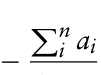
Equation reproduced from the original PDF.
i ai aframe
∈[0, 1]
0.5 −
For formula (1) only considers the page element and the area proportion of the whole page, and when the area accounted for fifty percent or so pages of dense beauty most, but repeated arrangement for single element form may not be applicable for background, such as several elements of different size respectively occupy different positions of the page and only need area accoun- ted for fifty percent which can reach the best page density aesthetic, this is obviously unreasonable, at the same time, it ignores the same elements of interaction on the vision. Therefore, what needs to be considered in this expe- riment is not the area ratio of all elements in the page, but the proportion of monomer patterns among cells and the arrangement density of cells in the page. Therefore, the experiment will be divided into two parts to explore the influence of two parameters, the size proportion of monomer pattern in the cell and the density of cell arrangement, on the beauty of the page.
Calculation Model of Monomer Pattern in Cell Proportion In this model, the background is usually a solid color; In the middle of the background image, it is divided into rectangular boxes of continuous arran- gement and uniform size. The area proportion of the single pattern in the rectangular frame is calculated by changing the size of the single pattern to control its area proportion in the rectangular frame. The area ratio is between 0 and 1. The greater the value, the greater the area ratio. Based on the expe- riment, a calculation model for the area proportion of two single patterns in a rectangular frame is proposed. The two formulas for calculating the area proportion of a single pattern in a rectangular frame are as follows: (1) Area calculation model based on single pattern boundary rectangular frame:
Wb=Ab/As According to the Gestalt principle, the area of a single pattern arranged in a unit rectangular frame is sometimes habitually regarded as the area of the smallest external rectangular frame. Where, Ab is the area of the smallest external rectangular frame of a single pattern, and As is the area of the rectangular frame of a unit.
Visual Aesthetic Calculation and Evaluation Model of Background Pattern 727
(2) Area calculation model based on individual pattern’s own pixels: Wo=Ao/As In this model, the background is split into fixed 100x100 pixel cells with a monomer pattern in the center. The area of a single pattern is its actual number of pixels. Ao represents the number of pixels of a single pattern, and As represents the area of a rectangular frame of a unit.
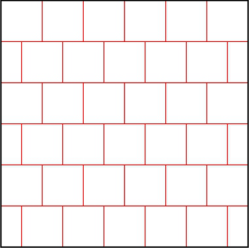
Calculation Model of Cell Arrangement Density In this model, the background area is continuously arranged with rectangular boxes of equal area along the horizontal and vertical directions respectively. Meanwhile, the rectangular boxes of even rows and odd rows are staggered, that is, the first rectangular box of even rows is arranged horizontally betw- een the first and second rectangular boxes of the previous row, as shown in the figure. Change the density of the cell by changing the area of the rectan- gular box, increasing or decreasing the number of backgrounds on the same area. The calculation formula of cell density S is as follows: S=n/As Where n is the number of cells and As is the area of the background.
Experimental Evaluation Two experiments were set in this study. Experiment 1 and Experiment 2 respectively explored the influence of the proportion of monomer patterns in cells and the density of cell arrangement on the beauty of the page. During the experiment, the subjects were asked to rate the different images presented.
The Participants In the two experiments, there were 30 participants in each experiment. In order to eliminate the possible influence of gender on the results, the two experiments were stratified by gender, including 15 males and 15 females respectively. All of the subjects had normal vision.
Experimental Samples Experiment 1 mainly explores the influence of monomer pattern in cell proportion on beauty. The experimental samples are pictures made by Poth- oshop, each of which is 600x600 pixels in size, and each picture is divided into cells with equal number and size, as shown in Figure 3. Different styles of patterns represent different styles and types in modern graphic design, so that the experimental results are more universal. In this way, the size of the monomer pattern in each cell is changed to make its proportion area in the cell different. The pictures of experimental samples are shown in Table 1.
Experiment 2 mainly explores the influence of cell arrangement density on page beauty. The experimental samples are pictures made in Photoshop, each of which is 600x600 pixels in size. The size and number of cells are different, and the area of a single pattern in the cell is the same in each picture. Single pattern and experiment 1 respectively choose the pattern composed of geometric shape, natural style flowers these two styles of pattern. The pictures of experimental samples are shown in Table 2.
Figure 3: The cell of pattern.Table 1. The pictures of experimental samples.
Table available in the original PDF paper.
Experimental Process Two groups of questionnaires were designed according to the above set of experimental samples, and the subjects rated the aesthetic feeling of each experimental sample according to the Richter 7-point scale. The aesthetic feeling of each experimental sample was 7 points for very strong, 6 points for very strong, 5 points for strong, 4 points for general, 3 points for weak, 2 points for very weak, and 1 point for very weak. Participants rated the beauty of the layout based only on comparing different images in the same set of tests to each other, rather than rating one of them individually.
Experimental Results To eliminate the influence of dimension on the experimental results, the eva- luation results were normalized. Utilizing curve fitting, the optimal area ratio of a single pattern is found. Curve fitting includes polynomial curve fitting, logarithmic curve fitting, exponential curve fitting, power function curve fit- ting, Gaussian function curve fitting, etc. Before curve fitting, it is necessary to observe the distribution position of points, and then select the appropriate curve for fitting.
Ratio of Single Pattern in Cell (1) Based on the influence of the area of the boundary rectangular frame of a single pattern on the beauty of the page, a scatter chart of the relationship between the area ratio AO and the beauty of the page is drawn according
Visual Aesthetic Calculation and Evaluation Model of Background Pattern 729
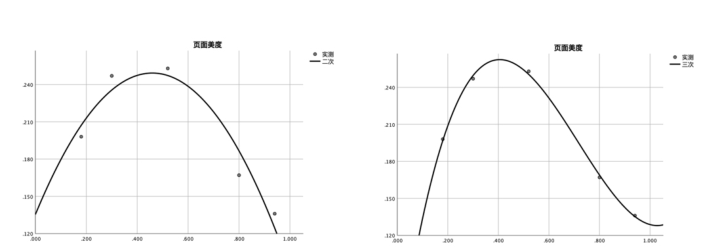
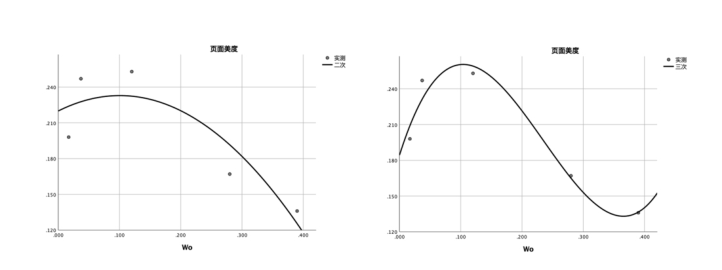
to Table 3. According to observation, it can be found that the scatter points are arranged in an inverted bell shape. The quadratic curve fitting and cubic curve fitting were selected to obtain the curves as shown in Figure 4. The R square value after conic fitting is 0.925, and the standard estimation error is 0.02. The R square value of cubic curve fitting is 0.998, and the standard estimation error is 0.004. According to Figure 4, when the area ratio of the single pattern is between 0.4 and 0.5, the page aesthetic degree is the highest.
(2) Influence of pixel area on page beauty based on a single pattern. According to Table 4, draw a scatter diagram of the relationship between the area ratio AO and the beauty of the page. According to observation,
it can be found that the scatter is arranged in an inverted bell shape. The quadratic curve fitting and cubic curve fitting were selected to obtain the curves as shown in Fig. 5. The R square value after conic fitting is 0.572, and the standard estimation error is 0.33. The R square value of cubic curve fitting is 0.839, and the standard estimation error is 0.020. According to Fig. 5, in the quadratic fitting curve, when the area ratio is 0, the page still has a high aesthetic degree; at the same time, when the area ratio reaches 0.4, the page’s aesthetic degree is 0. This does not apply to thin patterns or the compact arrangement of individual elements seen in real life. Cubic curve fitting synthesizes an S-shaped curve, which is not consistent with the actual situation. By combining the two experimental data of the influence of the area of the bounding rectangular frame of the single pattern on the page beauty and the influence of the area of the pixel of the body pattern on the page beauty, it can be seen that the influence of the area of the bounding rectangular frame of the single pattern on the page beauty is more consistent with the actual situation, with a high fitting degree and small error. According to the fitting situation, the aesthetic degree of the page is the highest when the rectangular frame area of the single pattern is 0.4–0.5 per unit rectangular frame area.
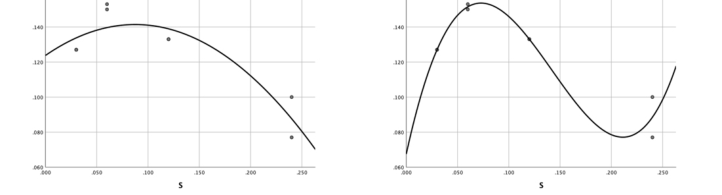
Experimental Results of the Influence of Cell Arrangement Density on Page Beauty According to SPSS analysis, the correlation between page beauty and cell arrangement density is at a 0.05 level, indicating a significant correlation. According to Table 5, a scatter diagram of the relationship between cell arran- gement density and page beauty was drawn. Quadratic curve and cubic curve
Visual Aesthetic Calculation and Evaluation Model of Background Pattern 731
were selected for fitting, and the curve was obtained as shown in Figure 6. The R square value after the conic curve fitting is 0.841, and the standard estimation error is 0.012. The R square value of cubic curve fitting is 0.940, and the standard estimation error is 0.008. It is observed from the curve that the page has the highest aesthetic degree when the density is between 0.5–1.0. A page looks best when 5–8 single elements are arranged in a horizontal or vertical direction with fewer than 100 pixels.
RESULTS AND DISCUSSION
The result of Experiment 1 is consistent with the conclusion proved by Tullis [13]. When the element area ratio of the page is 0.5, the aesthetic degree of the page reaches the optimal level. For the page beauty of the background pattern formed by the repeated arrangement of monomer elements studied in this paper, for a fixed number of cells in the page, when the area ratio of monomer elements is about 0.5, the page will get the best aesthetic feeling. At the same time, when the area ratio is greater than or less than 0.5, the beauty of the page begins to decline. In the actual design, the layout of the page usually should consider the page white space, the page white space will affect the beauty of the page, the single pattern area proportion can not be too low, so that the page is too empty and lack of visual appeal. At the same time, its area ratio can not be too high, from the proportion of white space so in the field of graphic design to find suitable for different page types of different white space ratio. The area ratio of single element studied in this paper is suitable for wallpaper, packaging, page background and other sce- nes where single pattern is repeatedly arranged. On the other hand, when
the area proportion of the elements in the page is fixed, that is, when the area proportion of the elements in the cell is determined, the influence of the density of the elements in the page on the aesthetic degree of the page is: As the element density increases, the beauty of the page also increases. When the density increases to a certain value, that is, 5–8 monomer elements are arranged every hundred pixels in the horizontal or vertical direction, the beauty of the page is the highest, and then the beauty of the page decreases with the increase of the monomer arrangement density. When designing the actual guide page, the arrangement of monomer elements should not be too small or too large. When the number of monomers is too large, the subje- cts expressed special physiological phenomena such as “trypophoria” during the experiment. At the same time, the single element can not be too little, so that the page lacks the beauty of repeated arrangement, and loses the basic characteristics of this kind of page pattern.
Some deficiencies were not taken into account in this experiment. For pages with repeated arrangement of single patterns, they are often compo- sed of patterns of different colors. This experiment did not take into account that different colors may have different effects on the experimental results. At the same time, this type of pattern is rich in variety. For some monolithic pat- terns with more than a dozen meanings, their own semantic and visual style may affect the experimental results. Some background patterns are made up of different patterns that are arranged repeatedly. Different elements may interact with each other and the way they are arranged can also affect the aesthetics of the page. These are the aspects that need to be improved for further study in the future.
REFERENCES
Balinsky H. Evaluating interface aesthetics: measure of symmetry [J]. Proceedings of SPIE: The International Society for Optical Engineering, 2006, 6076: 52–63. Lai C Y, Chen P H, Shih S W, et al. Computational models and experimental investiga-
tions of effects of balance and symmetry on the aesthetics of text-overlaid images [J]. International Journal of Human-Computer Studies, 2010, 68(1/2): 41–56. Maity R, Madrosiya A, Bhattacharya S. A computational model to predict aesthetic quality of text elements of GUI [J]. Procedia Computer Science, 2016, 84: 152–159. Mien-Tsung Tsai, Kuo-An Wang, Yili Liu, Jen-Shin Hong. Perceived Visual Aesth-
etics of Text-Overlaid Images: Computational Models and Experimental Rese- arch for White-Space Fraction [J]. International Journal of Human-Computer Interaction, 2014, 30(1). Ngo D C L, Teo L S, Byrne J G. Modelling interface aesthetics [J]. Information Sciences, 2003, 152(8): 25–46. Su Jianning, Yang Wenjin, Zhang Shutao, Kang Yajun. Morphological beauty com-
prehensive evaluation method based on latent semantic analysis [J]. Journal of Lanzhou University of Technology, 2018, 44(06): 39-43+189. Tullis T S. Predicting the usability of alphanumeric displays [J]. Dissertation Abstracts International, 1984, 45(4): 1310. Valencia R A, Lugo J E. Part-worth utilities of gestalt principles for product aesth-
etics: a case study of a bottle silhouette [J]. Journal of Mechanical Design, 2016, 138(8): 801102.
Visual Aesthetic Calculation and Evaluation Model of Background Pattern 733
Zhou Aimin, Zhou Caixia, Ouyang Jinyan, Zhang Shutao. A comprehensive evaluation model of interface style beauty based on moderate standardization of indexes Journal of Zhejiang University (Engineering Science), 2020, 54(12): 2273–2285. (in Chinese). Zhou Lei, Xue Chengqi, Tang Wencheng, et al. Beauty Evaluation Method of Inter-
face Element Layout Design [J]. Journal of Computer Aided Design & Computer Graphics, 2013, 25(5): 758–766. (in Chinese). Zhou. Analysis of Design Elements and Their Mechanisms affecting interface balance [D]. Southeast University, 2018. Zhu Miaomiao, Lv Jian, Liu Xiang, Pan Weijie, Zhao Huiliang. Application of intera-
ctive genetic algorithm in ethnic pattern innovation design. Computer Engineering and Design, 2019, 40(11): 3342–3348.
LISTED IN THE AHFE DIGITAL BOOKSTORE CATALOGUE
Explore the complete digital volume
Intelligent Human Systems Integration (IHSI 2023): Integrating People and Intelligent Systems
Read this individual research paper free through the original publisher, or explore the full digital proceedings book.
ISBN 978-1-958651-45-2
Explore this ISBN in the AHFE Bookstore ↗Listed in the July 2026 bookstore catalogue; search by ISBN to confirm current availability · Digital book purchase optional