Kyoko Ito, Yuta Tsuji, Hirotake Ishii, Hiroshi Shimoda, Kazuhiro Taniguchi, Fumiaki Obayashi (2022). The Recovery Effect in Work Efficiency by Temporary Stimulative Airflow. In: Intelligent Human Systems Integration (IHSI 2022): Integrating People and Intelligent Systems. AHFE Open Access, vol. 22. https://doi.org/10.54941/ahfe1001078
In recent years, research to improve the efficiency of intellectual work by improving the office environment has been pursued and has produced significant results [1]. Among the indoor environments that affect intellectual work, the thermal environment has been the subject of many studies because of its significant impact on intellectual work. Regarding airflow as one of the factors, the DR (DraftRisk) model [2] , which predicts discomfort of airflow in a cool environment, and the PS (Percentage of Satisfied People) model[3], which predicts comfort in a warm environment, have been studied. The psychological effects of airflow properties such as turbulence [4] and fluctuation [5] as well as velocity have also been studied.The purpose of this study is to examine temporary stimulative airflow to effectively recover the efficiency of intellectual work and to confirm its effectiveness. This study uses the efficiency of intellectual work as an indicator of the impact of temporary stimulative airflow.First, based on the results of preliminary experiments, two types of airflow were selected. Next, we conducted an experiment to examine the effects of these airflows. Nine participants in the experiment performed a cognitive task. The work efficiency was measured from their work performance, and the airflow was exposed by detecting a decrease in the arousal level of the participants. To detect the decrease in arousal level during the work, PERCLOS (PERcent of eyelid CLOSureover pupil) [6] was used as a measurement index of arousal level. In addition to the measurement of arousal level by PERCLOS, the activity state was measured by several physiological indices. Electroencephalogram (EEG) was measured as an indicator of brain activity, and electrocardiogram (ECG) and skin potential, which indicate autonomic nerve activity, were measured as indicators of body activity.As a result, six out of nine participants were included in the analysis. Twenty-six airflows were delivered to the six participants. Then, as a result of analyzing before and after exposure to the airflow, we analyzed various indices when work efficiency was recovered by exposure to the proposed airflow.From the results of physiological indices, when PERCLOS exceeded the threshold before the airflow exposure, there was an increase in alpha waves (EEG) indicating rest etc., and a continuous decrease in the LF/HF ratio of the heartbeat indicating sympathetic dominance. In addition, fluctuations in skin potential were observed during the airflow exposure. Furthermore, after the airflow exposure, alpha wave (EEG) dominance was no longer observed, and the LF/HF ratio showed an upward trend. Comparing the measurement results before and after the start of the airflow exposure, the power of alpha wave of EEG increased before the start, but was suppressed after the exposure.In the future, we would like to improve the proposed airflow stimulus in order to sustain the recovery effect of the airflow stimulus, and consider the experimental design to expose the airflow before the arousal level decreases too much. In addition, it is expected that the design of airflow to increase the recovery effect of airflow stimulation would lead to even greater performance recovery effect.[1] Lawrence Berkley National Laboratory: Indoor Air Quality, Scientific Findings Resource Bank, http://www.iaqscience.lbl.gov/ (2021-10-22).[2] P. O. Fanger, N. K. Christensen: Perception of draught in ventilated spaces. Ergonomics, Vol. 12, pp. 215-235 (1986).[3] M. Fountain, E. Arens, R. J. de Dear, F. Bauman, K. Miura: Locally controlled air movement preferred in warm isothermal environments, ASHRAE Trans., Vol.100, pp. 937-952 (1994).[4] E. Mayer: Physical causes for draft: some new findings, ASHRAE Trans., Vol.98, pp. 540-548(1987).[5] S. Tanabe, K. Kimura: Importance of air movement for thermal comfort under hot and humid conditions, ASHRAE Trans., Vol.100, pp.953-969(1994).[6] D. F. Dinges, R. Grace, Perclos: A valid psychophysiological measure of alertness as assessed by psychomotor vigilance, FHWA-MCRT-98-006, US Department of Transportation, Federal highway Administration (1998).
In recent years, research to improve the efficiency of intellectual work by improving the office environment has been pursued and has produced significant results (Laurence Berkley National Laboratory 2022), . Among the indoor environments that affect intellectual work, the thermal environment has been the subject of many studies because of its significant impact on intellectual work. Regarding airflow as one of the factors, the DR (DraftRisk) model (Fanger et al. 1986), which predicts discomfort of airflow in a cool environment, and the PS (Percentage of Satisfied People) model (Fountain et al. 1994), which predicts comfort in a warm environment, have been studied. The psychological effects of airflow properties such as turbulence (Mayer 1987) and fluctuation (Tanabe et al. 1994) as well as velocity have also been studied.
In recent years, there have been attempts to mitigate the use of air condition-ers and promote energy conservation through the active use of fans in hot summer environments (C’andido et al. 2011). It can also be used as a stimulus to lower the sensory temperature of the area exposed to the airflow, albeit temporarily. These effects indicate that strong airflow from air conditioning may interfere with sleep (Morito et al. 2010). Exposure to airflow, even temporary, can be expected to affect the sense of warmth and comfort, and the way it is perceived depends on seasonal changes in metabolic rate and personal preference. The degree to which temporary stimulative airflow affects the efficiency of intellectual work is also expected to vary depending on the circadian rhythm and fatigue.
The purpose of this study is to examine temporary stimulative airflow to effectively recover the efficiency of intellectual work and to confirm its effectiveness. This study uses the efficiency of intellectual work as an indicator of the impact of temporary stimulative airflow.
METHOD
Consideration of Airflow First, based on the results of preliminary experiments, two types of airflows (front and side airflows) were selected; the airflow duration and interval time were set to respec-tively 10 seconds and the repetition was set to three times. For both front and side airflows, the time required for the airflow sequence was 50 seconds. The position
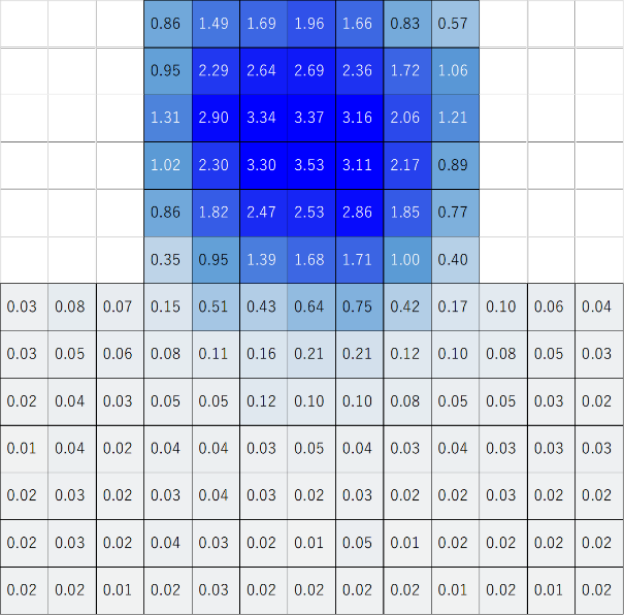
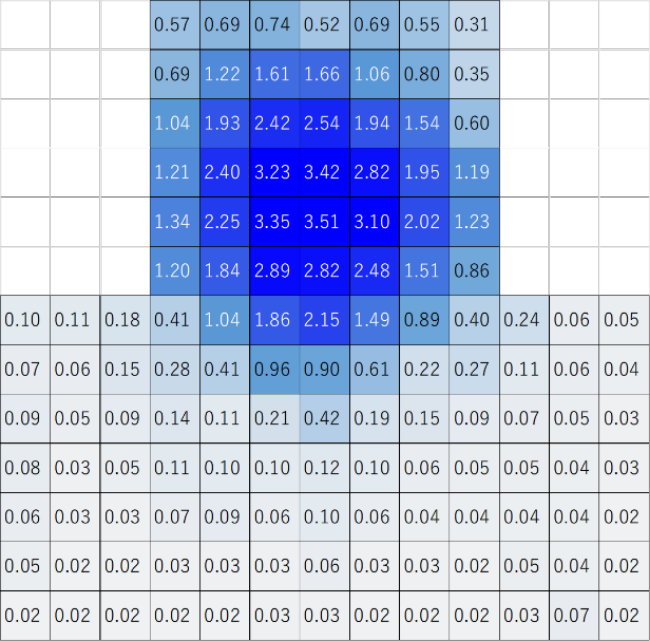
Intelligent Human Systems Integration (IHSI 2022): Integrating People and Intelligent Systems https://openaccess.cms-conferences.org/#/publications/book/978-1-7923-8988-7 of the airflow and the wind speed settings are shown in Table 1. The airflow was set to no rhythm and no fluctuation. Fig. 1 and Fig. 2 show the wind speed around the par-ticipant when exposed to 3.5 m/s of front airflow and 3.2 m/s of side airflow. In Figs. 1 and 2, one square represents about 4 cm square, and the unit of the numbers is m/s. The darker the blue color is, the higher the air velocity is, indicating the exposure of airflow around the head.
Table 1: Setting of airflow speed.Figure 1. The wind speed around a participant due to airflow (exposed 3.5 m/s of front airflow).
Intelligent Human Systems Integration (IHSI 2022): Integrating People and Intelligent Systems https://openaccess.cms-conferences.org/#/publications/book/978-1-7923-8988-7
Figure 2. The wind speed around a participant due to airflow (exposed 3.2 m/s of side airflow).
Experiment Next, we conducted an experiment to test the effects of these airflows. Nine participants took part in the experiment and performed a cognitive task. The work efficiency was measured from their work performance, and the airflow was exposed to detect a decrease in the arousal level of the participants. In order to detect the decrease of arousal level during the work, PERCLOS (PERcent of eyelid CLOSureover pupil) (Dinges et al. 1988) was used as a measurement index of arousal level. In addition to the measurement of arousal level by PERCLOS, the activity state was measured by several physiological indices. Electroencephalogram (EEG) was measured as an indicator of brain activity, and electrocardiogram (ECG) and skin potential were measured as indicators of body activity. The threshold of PERCLOS, which is judged as a decrease in the level of arousal, was set at 0.1 (10% of eye closure time in a certain period of time) for Participants 1 and 3, and 0.03 (3% of eye closure time in a certain period of time) for Participants 2 and 4 to 9, based on the appearance during the task practice. On the other hand, as mentioned earlier, for all participants,
Intelligent Human Systems Integration (IHSI 2022): Integrating People and Intelligent Systems https://openaccess.cms-conferences.org/#/publications/book/978-1-7923-8988-7 if PERCLOS was always 0 at a certain time after exposure to airflow, i.e., if the percentage of eye closure for a certain time was 0, the arousal level was considered to have recovered for that time.
RESULTS
As a result, six of the nine participants were included in the analysis; for the six participants, the airflow was exposed a total of 26 times. With respect to the recovery of work efficiency, the work efficiency before airflow exposure (60 seconds) and after airflow exposure (60 seconds) were 8.4 (2.5) and 9.5 (2.4), respectively. The figures in parentheses indicate the standard deviation. A paired two-tailed t-test was performed, resulting in a p-value of 0.37. Next, we compared the work efficiency immediately before and after the airflow exposure with respect to the values of work efficiency before the airflow exposure (15 seconds) and after the airflow exposure (15 seconds). The values were 1.7 (1.1) and 2.8 (1.3), respectively. Figures in parentheses indicate the standard deviation. As a result of paired two-tailed t-test, the p-value was 0.017. From these results, the effect of recovery of work efficiency would be observed for 15 seconds after exposure to the airflow and was not retained for 60 seconds.
Then, we analyzed various indices in the recovery of work efficiency by the exposure to the proposed airflow.
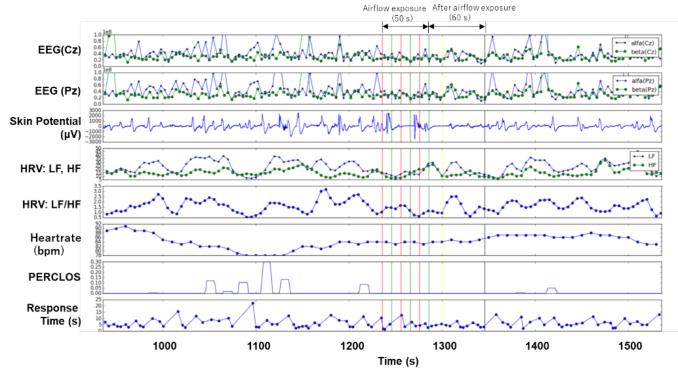
First, as an example of how the airflow may have recovered the arousal level for one minute, the various indices for the second airflow exposure of participant 3 are shown in Fig. 3. Fig. 3 shows the response time per a task, PERCLOS, heartrate(bpm), heart rate variability (HRV) (LF/HF), heart rate variability (HRV) (LF, HF), skin potential, electroencephalogram (EEG) (Pz), and electroencephalogram (Cz) in order from the bottom. In Fig. 3, the PERCLOS value exceeded the threshold value of 0.03 around 1100 seconds, however the airflow was not exposed because 8 minutes had not passed since the previous exposure. In Fig. 3, the airflow was ex-posed at the time after 1200 seconds. Fig. 3 shows that the airflow exposure took 50 seconds from start to finish. After the airflow exposure, PERCLOS was zero for more than 60 seconds.
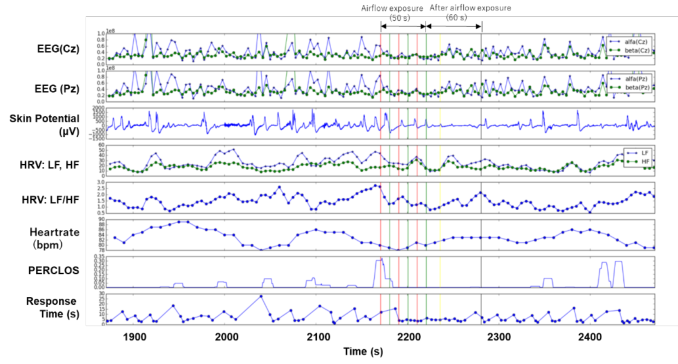
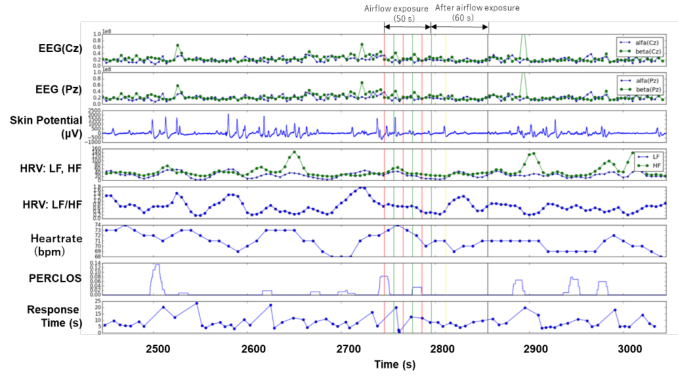
The various indices for the fourth airflow exposure of participant 3 are shown in Fig. 4. Comparing before and after the start and end of the airflow exposure, the power of alpha wave increased before the start, however, was suppressed after the end.
On the other hand, for participant 8, the airflow did not recover the arousal level for one minute. The various indices of the fifth airflow exposure for participant 9 are shown in Fig. 5. Fig. 5 shows how the airflow exposure recovered the arousal level for one minute.
From the results of physiological indices, when PERCLOS exceeded the threshold before airflow exposure, there was an increase in alpha wave (EEG) indicating rest
Intelligent Human Systems Integration (IHSI 2022): Integrating People and Intelligent Systems https://openaccess.cms-conferences.org/#/publications/book/978-1-7923-8988-7 etc. and a continuous decrease in LF/HF ratio indicating sympathetic dominance. In addition, fluctuations in skin potential were observed during the airflow exposure. Furthermore, after airflow exposure, alpha wave (EEG) dominance was no longer observed, and the LF/HF ratio showed an upward trend. Comparing the measurement before and after the start of airflow exposure, the power of alpha wave of EEG increased before the start, however, it was suppressed after the exposure.
Figure 3. The wind speed around a participant due to airflow (exposed 3.2 m/s of side airflow).Figure 4. The measurement result on forth airflow for participant #3.
Intelligent Human Systems Integration (IHSI 2022): Integrating People and Intelligent Systems https://openaccess.cms-conferences.org/#/publications/book/978-1-7923-8988-7
Figure 5. The measurement result on fifth airflow for participant #9.
CONCLUSIONS
In this study, we examined stimulative airflows to recover the arousal level and performance of office workers. First, two types of airflow were selected as candidates based on the results of preliminary experiments. Next, we conducted an experiment to verify the effects of these airflows. There are nine participants in the experiment, in which a cognitive task was used, and work efficiency was measured from their work performance. The airflows were exposed to detect a decrease in the arousal level of the participants. From the results, six participants were included in the analysis. We analyzed the results before and after exposure to the airflow using various physiological indicators.
In the future, we will improve the proposed airflow stimulus in order to sustain the recovery effect of the airflow stimulus, and we may consider the experimental design to expose the airflow before the arousal level decreases too much. In addition, it is expected that the design of airflow to increase the recovery effect of airflow stimulation will lead to even greater performance recovery effect.
ACKNOWLEDGMENTS
This work was supported by JSPS KAKENHI Grant Numbers 17H01777 and 20H01748.
Intelligent Human Systems Integration (IHSI 2022): Integrating People and Intelligent Systems https://openaccess.cms-conferences.org/#/publications/book/978-1-7923-8988-7
REFERENCES
C ’andido, C., de Dear, R. J., Lamberts, R. (2011) ‘Combined thermal acceptability and air movement assessments in a hot humid climate’, Build Environ., Vol.46, pp. 379-85 Dinges, D. F., Mallis, M. M., Maislin, G., Powell, J. W. (1988) ‘Evaluation of
techniques for ocular measurement as an index of fatigue and the basis for alertness management’, HS-808 762, National Highway Traffic Safety Administration Fanger, P. O., Christensen, N. K. (1986) ‘Perception of draught in ventilated spaces.
Ergonomics’, Vol. 12, pp. 215-235 Fountain, M., Arens, E., de Dear, R. J., Bauman, F., Miura, K. (1994) ‘Locally controlled air movement preferred in warm isothermal environments’, ASHRAE Trans., Vol.100, pp. 937-952 Lawrence Berkley National Laboratory (Jan 11, 2022) ‘Indoor Air Quality, Scientific
Findings Resource Bank’, https://iaqscience.lbl.gov/ Mayer, E. (1987) ‘Physical causes for draft: some new findings’, ASHRAE Trans., Vol.98, pp. 540--548 Morito, N., Nishimiya, H., Tsuzuki, K. (2010) ‘Effects of Cool Airflow on Sleep and
Skin Temperatures: Comparison of Two Types of Air-Conditioners by Human Subject Experiments, Transactions of the Society of Heating, Air-conditioning and Sanitary Engineers of Japan, Vol. 35, pp. 19-27 (in Japanese) Tanabe, S., Kimura, K. (1994) ‘Importance of air movement for thermal comfort under hot and humid conditions’, ASHRAE Trans., Vol.100, pp.953-969
Intelligent Human Systems Integration (IHSI 2022): Integrating People and Intelligent Systems https://openaccess.cms-conferences.org/#/publications/book/978-1-7923-8988-7
LISTED IN THE AHFE DIGITAL BOOKSTORE CATALOGUE
Explore the complete digital volume
Intelligent Human Systems Integration (IHSI 2022): Integrating People and Intelligent Systems
Read this individual research paper free through the original publisher, or explore the full digital proceedings book.
ISBN 978-1-7923-8988-7
Explore this ISBN in the AHFE Bookstore ↗Listed in the July 2026 bookstore catalogue; search by ISBN to confirm current availability · Digital book purchase optional