Peta Chirgwin (2022). The future of skills in mining automation control rooms. In: Intelligent Human Systems Integration (IHSI 2022): Integrating People and Intelligent Systems. AHFE Open Access, vol. 22. https://doi.org/10.54941/ahfe1001028
This study reviews the possibility of a higher education curriculum at work within the role of a mine controller of mining automation systems, whereby the traditional pedagogical framework for higher education is gained through work-based, experiential learning and partnered with a strong and sustainable work-based education program. The research aims to evaluate current academic pathways for technology users in autonomous mine control rooms and examines if there is an existing ‘curriculum’ already present in work-based practice within the control room that could be tailored to suit a higher education. Advances in technology and work demand in autonomous mine control rooms have contributed to a resources gap in the domain. This has been coupled with poorly integrated systems and pressures of skilling the current workforce to remain relevant and capable of providing outcomes expected using new technologies. Additionally, when trying to integrate ‘soft skills’ while keeping pace with changing technology and increased automation, the question of academic validity of the role provides an opportunity to lead the way in work-based learning. This paper utilises behavioural and social science methodologies of qualitative research to understand the knowledge and skills requirements of a mine controllers’ role when working with new technologies. Through interviews, in-situ observations, and analysis of job descriptions of current mine control roles, data was collected and analysed to reveal any shortcomings that currently exist in the mine control role relevant to the application of Human Machine Interfaces (HMI). Further examination was conducted on human factors issues found within an autonomous control room to understand what was required in the anticipated ‘curriculum at work’. Observed behaviours and actions were triangulated with informal interviews and a literature search to enable the researchers to form a better understanding of the mine controller role and the application of knowledge within the role as the mining industry moves into a more digital world. In reviewing the application of higher education degrees within work, the paper also examines new methods of delivery such as gamification to supplement what is being learned in the workplace and motivate the learner to increase their knowledge. Qualitative methodologies of organisational analysis reveal similarities of knowledge being applied within work-based learning in the control room that exists currently in curricula being taught at universities in fields such as engineering and management.This research evaluated the specific role of the mine controller of mining automation systems and the introduction of mining automation and examined current literature and research revealing large gaps in the understanding of the mine controller role, the effects of increased automation on the employees within these roles, and the integration of humans and autonomous systems. The researcher suggests that the changing pace of technology advancements could see an end or at least a slowing down of several traditional university degrees and increased application of adult learning principles through work-based curricular.
This study reviews the possibility of higher education curriculum at work within the role of a mine controller of mining automation systems, whereby the traditional pedagogical framework for higher education is gained through work-based, experiential learning and partnered with a strong and sustainable work-based
Intelligent Human Systems Integration (IHSI 2022): Integrating People and Intelligent Systems https://openaccess.cms-conferences.org/#/publications/book/978-1-7923-8988-7 education program, with the expected benefit of improving organisational culture and acceptance when considering Human Systems Integration (HSI). The research aims to evaluate current academic pathways for technology users in autonomous mine control rooms and ex-amines if there is an existing ‘curriculum’ already present in work-based practice within the control room that could be tailored to suit higher education.
This research evaluated the specific role of the mine controller of mining automation systems and the introduction of mining automation and examined current literature and research revealing large gaps in the understanding of the mine controller role, the effects of increased automation on the employees within these roles and the integration of humans and autonomous systems. The researcher suggests that the changing pace of technology advancements could see an end or at least a slowing down of several traditional university degrees and increased application of adult learning principles through work-based curricular.
In reviewing the application of higher education degrees within work, the pa-per also examines new methods of delivery such as gamification to supplement what is being learnt in the workplace and motivate the learner to increase their knowledge. Qualitative methodologies of organisational analysis reveal similarities of knowledge being applied within work-based learning in the control room that exist currently in curricular being taught at universities in fields such as engineering and management.
METHODOLOGY AND CASE STUDY This paper utilises behavioural and social science methodologies of qualitative re- search to understand the knowledge and skills requirements of a mine controllers’ role when working with new technologies.
Informing the research analysis was a previously conducted literature review with authors such as Taylor and Szalma (2009) Parasuraman and Manzey (2010) and Konig, Buhner & Murling (2005) referred to in understanding human factors issues when dealing with technology integration.
Through interviews, in-situ observations, and analysis of job descriptions of current mine control roles, data was collected and analysed to reveal any shortcomings that currently exist in the mine control role and the application of Human Machine Inter- faces (HMI).
Finally, a case study on the first mine control qualification was conducted through observation and interviews of 10 mine controllers operating in a live control room and controlling a fleet of 100 autonomous trucks and feedback and observations from the same participants who participated in the only nationally recognised training for mine controllers in Australia.
Observed behaviours and actions were triangulated with the informal interviews and
Intelligent Human Systems Integration (IHSI 2022): Integrating People and Intelligent Systems https://openaccess.cms-conferences.org/#/publications/book/978-1-7923-8988-7 the afore mentioned literature research to enable the researcher to form a better understanding of the mine controller role and the application of knowledge within the role as the mining industry moves into a more digital world.
The objectives of this study were to;
1. Understand the role of the mine controller and the interface with technology.
2. Evaluate the current academic pathway for the role/future roles moving into automation.
3. Reveal any existing ‘curriculum’ within work-based practice in the control room suited to higher education.
4. Understand the shortcomings of HSI and Human Factors (HF) in the control room and provide recommendations on inserting the learnings within a new curriculum for Mine Controllers.
5. Question the academic validity of the role.
6. Assess similarities of work-based practice in the control room to curricular being taught in engineering and management degrees at university.
7. Examine new curriculum delivery tools and methods to supplement work-based learning to suit higher education.
FINDINGS Understanding the role of the mine controller
A review of literature revealed a sparce field of research in relation the role of the mine controller. When trying to determine what a mine controller is or does through the search of literature available, the researcher turned to recruitment advertisements to demonstrate sort after requirements for a mine controller. A summary of the most sort after requirements of a mine controller are;
Previous role-based experience
Previous experience and knowledge of mining
Knowledge of fleet management systems
Safety leadership
Computer literacy
Ability to multitask
Intelligent Human Systems Integration (IHSI 2022): Integrating People and Intelligent Systems https://openaccess.cms-conferences.org/#/publications/book/978-1-7923-8988-7
Time management and ability to work under pressure
Communication skills
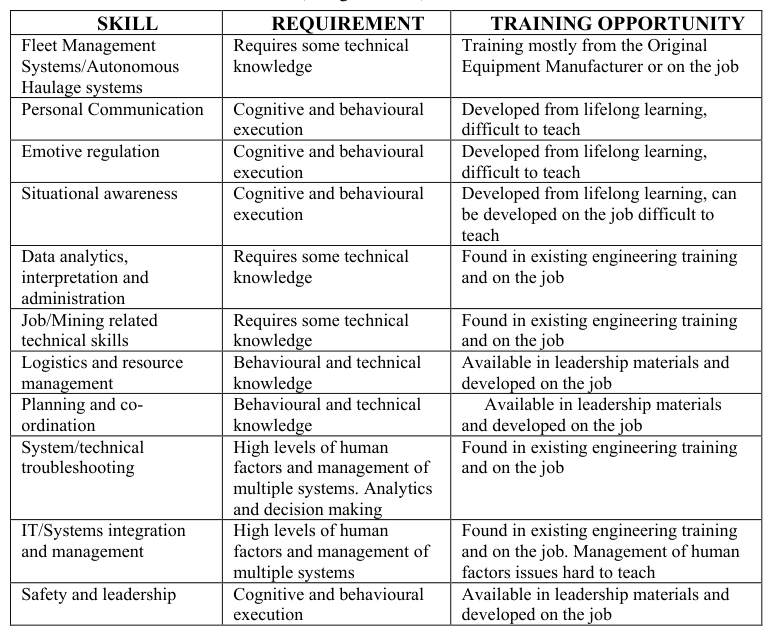
Interpersonal skills Further analysis of the role of the mine controller revealed the following major skills, requirements, and training opportunities:
In 2018 the researcher joined a working group known as the ‘WA Vocational Education Training (VET) Collaboration Alliance’ (Ferrante 2018) formed as a collaboration with the mining industry, suppliers, and TAFE (Training and Further Education) to address shortcomings in available skilled labour for autonomous
Intelligent Human Systems Integration (IHSI 2022): Integrating People and Intelligent Systems https://openaccess.cms-conferences.org/#/publications/book/978-1-7923-8988-7 mining. The researcher noted during one of the first meetings with the working group, the expectation from human resources, training members and academic staff regarding training for mine controllers was that they would take existing mine control accredited training and modify it to suit automation and developing technology. It was clear, that very few in the room realized that the mine control area across all mining organisations had largely been left to integrate and train themselves with new technologies that had been introduced. This is an inefficient and obvious problem for both safety and production and is be-coming increasingly apparent with the introduction of more automation in mining. It could be surmised that these issues could have been the catalyst for the forming of the 2018 working group however, the forming of the working group is not the focus of this current paper.
The research revealed a lack of formal training in the mine control role which has led to an over-reliance on costly original equipment manufacturer (OEM) training and a poor understanding of issues faced in an autonomous mine control room. The OEM training focused directly on their systems that had been implemented and had very little, if any training on human factors issues found in the control room or with integrating and being the interface between multiple systems.
The working group began to develop training for mine controllers in charge of systems operated by humans as well as machines and developed the very first nationally recognised curriculum for mine control, rolled out in 2020 and written with contribution from the researcher of this paper.
The role out of this first mine controller certification means that the industry has taken the first step in recognizing the contribution that a mine controller has on technology integration and production, however, the pathway beyond a certificate IV course is still unclear.
Existing ‘curriculum’ within work-based practice in the control room suited to higher education Whilst developing the curriculum and practical training activities for the role of the mine controller, the researcher faced challenges in not focusing on any specific tech- nology, as the changing pace of technology, and the availability of many different systems, meant that it was not practical to design a training package around a system that was expensive but could soon be outdated or on one that the student may never come across in their working life simply because it was not developed by a preferred supplier of a particular mining company. Therefore, the researcher analyzed the tasks associated to the role of the mine controller and determined if there were any skills and behaviours that correlated to existing curricular in other areas, or that could be packed into a specific curriculum for mine control (see table 1).
Through observations and interviews within the control room, there were several correlations with existing units of competence revealed in aeronautical, de-fense,
Intelligent Human Systems Integration (IHSI 2022): Integrating People and Intelligent Systems https://openaccess.cms-conferences.org/#/publications/book/978-1-7923-8988-7 management, and engineering.
It was also important for the researcher to determine which of the major skills and tasks were suitable for transition from workplace training or VET (vocational education training) for at TAFE colleges to higher education curriculum.
Classifications of skills found in an engineering domain, such as analysing, troubleshooting, configuring, and adjusting had overlaps in the skills classification for a mine controller. Similarly, leadership and management skills classifications of time management, people management, communication, problem solving also fit well in a mine controllers’ skills and task classification list. Interestingly, moving into automation, many of the skills classifications for the role of equipment operator, also begin to become embedded in the list of tasks allocated to the mine controller role.
The many synergies within the role of a mine controller to those of existing curricular found in other fields, reveals that indeed there is an existing ‘curriculum’ at work that could be used in providing higher education training at work.
Competing with the development of such a curriculum is the advances in technology adoption with the mining industry and the reliance on the role to utilize the technology. The reliance of the mine controller role in using new and existing systems is providing some unique human factors issues like those found in air traffic control (SKYbrary) or the defence industry and must be accounted for when developing a curriculum to suit the role.
Developing HSI and Human Factors (HF) in mine control curriculum Impacts of automation and systems integration require deep consideration to ensure that cognitive wellbeing of the operator is not affected (Taylor and Szalma 2009) however the research for this paper revealed a strong focus of risk evaluation on functional systems safety, or injury rates, but a lack of risk assessments on psychological or psychosocial impacts of HSI.
Observations of mine control rooms and interviews with mine controllers exposed high cognitive processing issues, situation awareness, multitasking, working memory capacity, vigilance, high mental workload, and trust in the system to be in the top seven human factors issues found in the control room.
In developing the VET training qualifications for the role, these human fac-tors issues were considered, however without up-to-date technology found withing the grounds of the VET center, it was difficult to replicate the HSI and human factors issues found in the real working life of a controller.
SUMMARY OF FINDINGS
Intelligent Human Systems Integration (IHSI 2022): Integrating People and Intelligent Systems https://openaccess.cms-conferences.org/#/publications/book/978-1-7923-8988-7
Question the academic validity of the role The Australian Qualifications Framework defines 10 levels of qualifications and criteria contained within, from Level 1 – Certificate 1 to Level 10 – Doctoral degree. In leveraging this framework with the findings from this current research, it is apparent, that a mine controller with the current skills and task requirements, could have the ability to be educated in a curriculum aligning to a level 7 (Bachelor) or level 8 (Bachelor honours, graduate certificate, graduate diploma).
The introduction of the certificate II (level 2) and certificate iv (level 4) courses go some way in recognizing the underlying competence found within the role of a mine controller and justifying the credibility and academic validity of the role, however, the research for this paper has found that there is an opportunity to focus further on the available curriculum found within this role and apply effective human factors and human systems integration training to increase this validity to be recognised through a higher education qualification.
This paper utelises the word competence in correlation to the word expertise and suggests then, the importance of role of the mine controller in being recognized as experts in their professional practice through the availability of a higher education accreditation for the role. It is assumed by the researcher that, much like one can understand the role of an engineer having credibility in the professional expertise due to the level of higher education competence attached to the title of the role, such a competence would assist the mine controller to also be recognized as having this level of expertise in their field.
CONCLUSION AND RECOMMENDATIONS An informed and future facing education approach, a well-designed training curricu- lum, and a broader understanding of the requirements of the mine controller role, will assist to facilitate improvements in human factors and effective human systems inte- gration, and improve our chances of managing any future skills gap. Whilst many of the skills taught in engineering curricula were prevalent in the controller role, it was not necessarily an engineer who best fit the role of an autonomous controller, and for effective human systems integration to occur it is integral that industry ensure the correct application of training and skills meets future industry requirements.
Whilst very little research had previously been done on the field of education in an autonomous mine control room, this study revealed that issues with technology integration and acceptance including controller role satisfaction, could improve with developing effective HMI, consideration of task allocation, considering changes to organisational structure and importantly, a robust higher education training framework.
This recent examination of practice and literature shows a need to develop rigorous
Intelligent Human Systems Integration (IHSI 2022): Integrating People and Intelligent Systems https://openaccess.cms-conferences.org/#/publications/book/978-1-7923-8988-7 workplace training practices, coupled with higher education that is valid, effective, and adaptable to an ever-changing and technology-intensive working envi-ronment.
REFERENCES
Australian Qualification Framework, https://www.aqf.edu.au/aqf-levels Ferrante, M.: Rio Tinto, (2018) “TAFE Launch Australia’s First Automation Course.” In: Northwest Telegraph, Konig C, Buhner M & Murling G (2005) “Working Memory, Fluid Intelligence, and
Attention Are Predictors of Multitasking Performance, but Polychronicity and Extraversion Are Not. In: Human Performance”. Parasuraman, R & Manzey, D (2010) “Complacency and Bias in Human Use of Automation: An Attentional Integration:. In: Human Factors, vol.52, pp. 381 – 410 SKYbrary,https://www.skybrary.aero/index.php/The_Human_Factors_%22Dirty_D
ozen%22 Taylor G & Szalma, J (2009) “The Effects of the Adaptability and Reliability of Automation on Performance, Stress and Workload”, In: Proceedings of the human factors and ergonomic society 53rd annual meeting.
Intelligent Human Systems Integration (IHSI 2022): Integrating People and Intelligent Systems https://openaccess.cms-conferences.org/#/publications/book/978-1-7923-8988-7
LISTED IN THE AHFE DIGITAL BOOKSTORE CATALOGUE
Explore the complete digital volume
Intelligent Human Systems Integration (IHSI 2022): Integrating People and Intelligent Systems
Read this individual research paper free through the original publisher, or explore the full digital proceedings book.
ISBN 978-1-7923-8988-7
Explore this ISBN in the AHFE Bookstore ↗Listed in the July 2026 bookstore catalogue; search by ISBN to confirm current availability · Digital book purchase optional