Mi Tian, Jie Zhang, Yuchao Cai, Xiaori Dong (2022). Design of smart products for the elderly based on affordance. In: Human Interaction & Emerging Technologies (IHIET-AI 2022): Artificial Intelligence & Future Applications. AHFE Open Access, vol. 23. https://doi.org/10.54941/ahfe100884
In today's Chinese society, the aging of the population is accelerating, and the elderly have become an important group of social concern. Research on products for the elderly is also increasing. On the other hand, with the continuous advancement of technology, smart products also occupy an increasingly important position. However, there is a huge mismatch between the use of the elderly and smart products. Understanding the perception, cognition and behavioral habits of the elderly is of great significance for designing research and improving elderly products. The affordance theory and its research methods define the function of the product from the perspective of the system level and scope of the conceptual design of the product, which can be directly mapped to the user's intentional behavior. Product matching information, thereby helping designers better grasp the relationship between products and the elderly. From the perspective of affordance, the article analyzes the perception, cognition and behavioral habits of the elderly, identifies the perception characteristics, cognitive ability attributes, and behavioral characteristics of the elderly, and summarizes and organizes the elderly's own. At the same time, it analyzes the characteristics of elderly smart products, and uses the research method of affordance to establish a research framework for smart product aging-appropriate design under the guidance of affordance, which provides a basis for the development and optimization of subsequent products.
With the continuous development and progress of information technology, more and more intelligent products have entered daily life, and people are experiencing the baptism of intelligence. However, in this process, due to the physiological and psychological changes of the elderly, many problems have arisen in the use of smart products. They often cannot accurately understand product information, nor can they smoothly complete a certain demand, which has caused a great burden on the body and mind. The reason for this phenomenon is that smart products have great problems in aging-appropriate interaction. Therefore, in the face of the elderly group, strengthening the interactive design for aging is an important issue that needs to be solved urgently.
Many scholars have done research on smart products for the elderly. In these studies, they found that due to the particularity of the elderly group, they are more accustomed to relying on their own cognitive abilities to interact with the external environment. Therefore, studying the intuitive interaction of the elderly is an important direction for the development of intelligent products. Affordance theory focuses on the intuitive relationship between organisms and objects in the environment, reflecting the immediacy of behavior, which can well help study the interaction between the elderly and smart products.
AFFORDANCE THEORY Affordance theory is an ecological psychology theory proposed by Gibson(Gibson, 1979), who believes that affordance is a behavioral relationship between organisms and the environment that has the characteristics of triggering direct perception. Norman(Norman, 2013) then introduced this concept into the field of design, arguing that affordances are behavioral properties of things that dictate how they are used. Gaver(Gaver, 1991) further deepens the point made by Gibson and Norman, but also conveys a message: affordance is not a one-time completion, visual and tactile information exists at different levels of perception, presented as nested Action progression. With the deepening of research, affordance has become an important theory in the field of interaction. Both designers and users hope that the human- machine relationship is simple and natural. When users use the product, they can
Human Interaction & Emerging Technologies (IHIET-AI 2022) Artificial Intelligence & Future Applications https://openaccess.cms-conferences.org/#/publications/book/978-1-7923-8989-4 know how to use the product by observing the external shape and interface information of the product, and can successfully complete a certain requirement without too much guidance.
Hartson(Hartson, 2003) may be one of the most creative researchers in the field of human-computer interaction to explore the theory of empowerment. He proposed the concept of cognitive function support, which refers to the knowledge and experience of users that can help users use and understand product functions information. He believes that affordances should be able to be discovered, recognized and used by people, so affordances can be divided into perceptual affordances, cognitive affordances, functional affordances and physical affordances. He tries to give designers certain ideas on how to effectively incorporate the four types of affordances into specific designs to be considered, taking into account the needs of users and operational differences.
RESEARCH ON AGING SUITABILITY OF SMART PRODUCTS Characteristics of Elderly Users
As a special group in the design, the elderly have their own unique characteristics. In terms of physiological characteristics, the physical function of the elderly gradually degenerates, the visual sensitivity decreases, and the ability to receive and process information declines. It is difficult for the complex information in the current smart products to be processed. The graphics and symbols can respond quickly. In terms of memory, short-term memory is better, while long-term memory for new things is obviously insufficient, and the memory of content unrelated to life and learning experience is weaker. In terms of behavioral operation, the perception ability is poor, the response to the new type of intelligent products is slow, and the solidification of thinking makes the elderly often run into trouble when operating. In terms of emotion, the increase of age and the elimination of society have brought a great sense of gap to the elderly, especially those who are facing retirement or just retired. They often give up after failing to use smart products, and they are afraid.(Iancu and Iancu, 2020, Mannheim et al., 2019) Understanding the physiological, psychological and behavioral characteristics of the elderly has important practical significance for the aging-appropriate design of smart products.
Research on Intelligent Product Design According to relevant literature research, smart products for the elderly mainly include smart home products, such as smart TVs, smart washing machines, and smart refrigerators; health management monitoring products, such as smart bracelets and smart pill boxes; service products, such as companion robots. These smart products
Human Interaction & Emerging Technologies (IHIET-AI 2022) Artificial Intelligence & Future Applications https://openaccess.cms-conferences.org/#/publications/book/978-1-7923-8989-4 for the elderly satisfy the relationship of three attributes, product appearance, product function and product interface. Based on the elderly user group, the demand for products is different from that of young people. After investigation, it was found that more elderly people tend to have simple appearance of products and do not need too fancy colors; the use of products is limited to basic life needs, social sharing, learning and entertainment, and most intelligent advanced needs applications are relatively Fewer; more seniors focus on the application experience of the product interface, hoping to solve specific interactive interface problems.
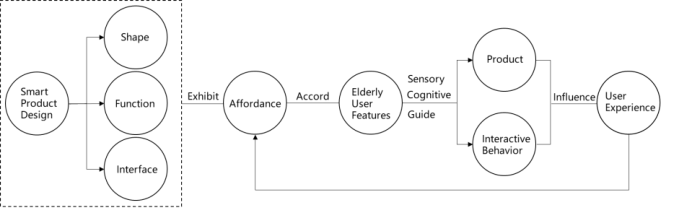
Significance of Affordance Theory in Aging Design of Smart Products In the face of smart products on the market, affordance carries the visual instructions of product appearance and interface to elderly users, guides elderly users to use the product with the correct operation process and operation purpose, and restricts and restricts users not to occur or Fewer misoperations occur. When studying the interaction between the elderly and smart products, the subjective cognition of the elderly and various attribute relationships of the product itself affect the results of the elderly using smart products. Therefore, affordance can be used in the cognitive process of the elderly. Playing an important role in the use of product affordance, rational use of product affordance can not only help elderly users to recognize products and become interested in products, but also guide the behavior of elderly users, so that they can easily and smoothly complete the product use process and reduce the elderly's anxiety. Cognitive burden, so that life is comfortable and enjoyable. (see Figure 1)
Figure 1. The affordance process of smart products for the elderly
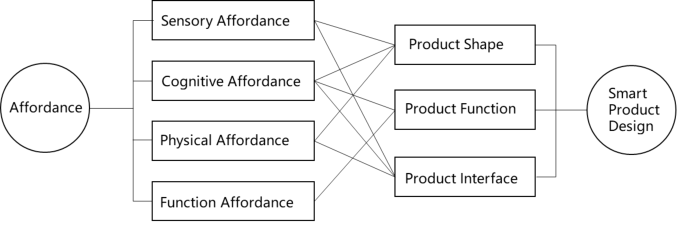
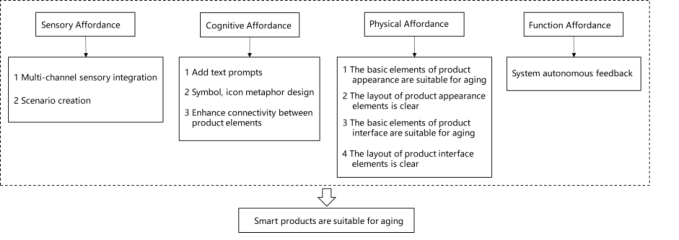
AFFORDANCE ANALYSIS OF SMART PRODUCTS FOR AGING Affordance has corresponding specific manifestations in the three aspects involved in the aging of smart products (see Figure 2). Applying Hartson's theory to analyze the specific performance of affordance at each level will help designers grasp the experience of elderly users, measure the design effectiveness of smart products for the elderly, and provide specific evidence for aging. (see Figure 3)
Figure 2. The relationship between affordance and smart product designFigure 3. Application of Availability in Aging of Smart Products Sensory Affordance Sensory affordance is a design attribute brought about by the appearance of a product perceived by users through their own sensory systems. Perceptual affordances provide functionality to a product, while perceptual information represents the appearance or characteristics (including shape, size, material, words, and symbols) of objects presented to the audience. The relationship between sensory affordance and sensory information is that it can be reflected through perceived information.(Cooper et al., 2014, Reed, 1988) By assisting the elderly users to sensory information with the help of the physiological characteristics of the elderly, the interests and hobbies of the elderly are aroused from an intuitive point of view. Research needs to be
Human Interaction & Emerging Technologies (IHIET-AI 2022) Artificial Intelligence & Future Applications https://openaccess.cms-conferences.org/#/publications/book/978-1-7923-8989-4 strengthened from two aspects.
On the one hand, from the perspective of multi-channel sensory integration. Most smart products tend to use the user's visual perception channel, and rely on the user's observation to realize the function of the product. However, due to the decline of the physical function of the elderly, it is difficult to achieve the goal simply by relying on vision. Therefore, it is necessary to add hearing and touch. Establish multiple channels for the elderly to correctly obtain information, enrich the sensory world of the elderly, and increase their interest in the use of products.
On the other hand, from a situational scene perspective. Smart products go deep into the lives of the elderly, and their use scenarios need to be subdivided. In different situations, an effect mode that is easy for the elderly to accept is established. Through the combination of basic elements such as color, pictures, and layout, it presents the interests of the elderly. The product form is easier for the elderly to accept and use, and it can also enhance the pleasure of its use.
Cognitive Affordance Cognitive affordance refers to the design attributes that can help elderly users to understand, learn, and master products, and it basically runs through all aspects of product design. Cognitive affordance can help elderly users predict the results of using products. For example, turning a knob can start work, and a button logo on the interface can be pressed. The cognitive process is related to the cognitive ability of the product and the knowledge level of the elderly user. close relationship. In the age- appropriate design of smart products, cognitive affordance has two main functions.
The first is as a way to prompt the elderly to understand the product and its implementation and reduce cognitive errors, mainly including simple text and icon cognitive prompts. The life experience of the elderly is very rich, but the experience of using smart products is limited, and they often cannot fully understand how the product operates and how the interface proceeds to the next step. Therefore, it is necessary to appropriately add text information so that the elderly can read and understand the information quickly. react correctly. At the same time, with the assistance of certain icons and symbols that the elderly often contact in their lives, the elderly have a natural favorability for things they are familiar with. Through the design of these icons, they can resonate with them and reduce cognitive friction.
The second is to show the relationship between the various elements of the product and play a role in guiding behavior. The cognitive level and memory ability of the elderly decline, and it is difficult to remember complex information and operation procedures. It is hoped that unnecessary cognitive processes can be minimized, and they can be reasonably guided when they come into contact with products and interfaces. Cognitive affordance needs to help elderly users to judge the meaning conveyed when the interaction occurs, and to predict the results. At the same time, given enough time for the elderly users to understand the cognitive process, the
Human Interaction & Emerging Technologies (IHIET-AI 2022) Artificial Intelligence & Future Applications https://openaccess.cms-conferences.org/#/publications/book/978-1-7923-8989-4 information should be simplified as much as possible in an interaction process, so as not to let the elderly. People get bored, and it doesn't make them frustrated.
Physical Affordance Physical affordances are primarily attribute relationships that drive bodily action. It is reflected in the appearance of the product and the interface relationship of the product, mainly relying on some basic elements to achieve the purpose that elderly users can easily use the product. Physical affordance is an important measure of product visibility. On the one hand, it is an orderly combination of various functions based on product form, with clear elements and reasonable layout. Users can recognize the product by identifying the size, shape, and color of various buttons. The other side is the interface information of the product. It is also necessary to consider the physiological characteristics of the elderly, adapt to aging in terms of color, text, graphics, etc., and strengthen the rationality of the page layout, highlight key goals, and attract the attention of elderly users, which can be easily identified and understood. Get ready for a smooth operation later.
Functional Affordance Functional affordance refers to the internal functions provided by the system during the interaction process, mainly to help users complete the requirements and goals in the interaction process. In products suitable for aging, help the elderly to make up for the lack of cognitive affordance, consider the usage habits of the elderly from the underlying logic, and reduce the difficulty of use through systematic analysis and self-response. When the elderly are operating the product, the feedback from the system can be used to complete the task without operation. For example, the Alipay scan code function, when the distance is far, automatically activates the focus function, and the system provides independent feedback, reducing the repetition frequency and use time of elderly users, which can increase the comfort of the elderly user experience.
CONCLUSIONS
Smart products have penetrated into all aspects of life. To live a better life, the elderly need the assistance of smart products. Therefore, the aging of smart products has become an important topic in current research on active aging. Most of the previous studies focused on the characteristics of the elderly in aging-appropriate design, ignoring the interaction process between the elderly and products, while affordance can be formed using the relationship between product-people-environment. Connect, guide user behavior. In the field of intelligent product design for the elderly, guided by affordance thinking, according to the design goals and user needs, establish an interactive relationship, and design products that are more in line with the cognitive and perception level of elderly users.
GIBSON, J. J. J. П. (1979). The Ecological Approach to Visual Perception. NORMAN, D. (2013). The design of everyday things: Revised and expanded edition, Basic books. GAVER, W. W. (1991). Technology affordances. Proceedings of the SIGCHI
conference on Human factors in computing systems Reaching through technology - CHI '91. HARTSON, R. (2003). Cognitive, physical, sensory, and functional affordances in interaction design. Behaviour & Information Technology, 22, 315-338. IANCU, I. & IANCU, B. (2020). Designing mobile technology for elderly. A
theoretical overview. Technological Forecasting and Social Change, 155. MANNHEIM, I., SCHWARTZ, E., XI, W., BUTTIGIEG, S. C. & ZAALEN, Y. V.
(2019). Inclusion of Older Adults in the Research and Design of Digital Technology. International Journal of Environmental Research and Public Health, 16, 3718. COOPER, A., REIMANN, R., CRONIN, D. & NOESSEL, C. 2014. About face: the essentials of interaction design, John Wiley & Sons. IANCU, I. & IANCU, B. 2020. Designing mobile technology for elderly. A
theoretical overview. Technological Forecasting and Social Change, 155.
Read this individual research paper free through the original publisher, or explore the full digital proceedings book.
ISBN 978-1-7923-8989-4
Explore this ISBN in the AHFE Bookstore ↗Listed in the July 2026 bookstore catalogue; search by ISBN to confirm current availability · Digital book purchase optional