Shuyu Wu, Jie Zhang, Yuchao Cai, Gang Liu (2022). Design and research of household small electric drill based on users' perceptual needs. In: Affective and Pleasurable Design. AHFE Open Access, vol. 41, pp. 253–259. https://doi.org/10.54941/ahfe1001805
East China University of Technology, 130 Meilong Road, Shanghai, China 2189 Qianshan Middle Road, Lishan District, Anshan City, Liaoning Province, China ↗
Objective: in order to solve the problem that the existing electric drill does not consider the perceptual needs of users, optimize the existing household electric drill, Bring better "double experience" to users (emotional experience and use experience) and improve the visual presentation effect of the electric drill. Methods:1, collect the samples of the existing electric drill through network collection and field investigation, and analyze the modeling characteristics, color and material of the electric drill in the market, as well as the volume and operability of the electric drill through the collected pictures of the electric drill. Classify and summarize the pictures, screen them by experts, and eliminate them after they are similar to the samples, Eight relevant samples were obtained; 2: Through investigation, it is found that the appearance and shape of the existing household electric drill are lack of aesthetics, the volume is large, it is difficult to master, and dust will be scattered in use, which is lack of environmental protection and safety. Therefore, this paper positions the design of household electric drill products as beautiful, small, easy to operate, environmental protection and safety. 3: Through user research and brainstorming, the vocabulary that is not of great significance to the design of household electric drill products is deleted, and 6 pairs of perceptual image words are selected; 4: Starting from users' perceptual needs, understand users' emotional needs, use the semantic difference method in perceptual engineering, and make a seven level test scale according to the eight samples and six pairs of perceptual words. Collect users' emotional demands for household electric drill through the seven level scale questionnaire, and according to the results of the survey questionnaire, The entropy weight method is used to analyze the questionnaire data and the correlation between the data. Results: 1: the reliability of the data was evaluated, and the results showed that the questionnaire results had good reliability, 2: After standardizing the survey data by entropy weight method and relevant calculation, the importance ranking of six pairs of perceptual words and the data indicators between each sample are obtained. The correlation, strong correlation and strong correlation between words are calculated by Pearson correlation; 3: According to the above data processing results, it is found that the most important thing of household electric drill is environmental protection, which means that the electric drill will not produce a large amount of debris to pollute the surrounding environment and human health during use; Labor saving and light means that the overall volume of the electric drill should be light and easy to master, so as not to make the hole deviate; Simplicity is to minimize the complex design of product modeling design, and it is found that there is a strong correlation between labor-saving, lightness and simplicity. Therefore, the above perceptual words correspond to the design elements of household electric drill respectively, and a household small electric drill is designed according to the samples with high scores. Conclusion: under the guidance of semantic difference method and entropy weight method in perceptual engineering, the users' perceptual emotional needs are rationalized and digitized, the subjective components of designers in designing products are reduced, and a certain direction is provided for the design of household electric drill, so as to design a household electric drill more in line with the users' perceptual needs.
Household electric tools are essential tools in daily life. In all kinds of manual labor in life, household electric tools have become a more and more important role in life, and the development of modern technology also provides a guarantee for the safety and convenience of household electric tools. in modern social life, people’s demand for daily necessities has gra- dually changed from need to want, and new requirements have been put forward for product design. When young users buy electric drills, in addi- tion to the functions and operability of electric drills, they will also pay attention to the modeling, experience and their own emotions of electric drills.
Wang Xinyan put forward from the perspective of ergonomics: “through the application of new materials and intelligent technology, the handle can be adjusted through the intelligent screen” in this study, only one part of the electric drill was designed, and the user’s favorite products could not be accurately designed without considering the user’s feelings. Liu Chuanlong also put forward from the perspective of ergonomics: “improve and inno- vate the design from the ergonomics, safety, modeling, dust prevention and
other aspects of electric percussion drill.” the electric drill handle is redesi- gned, and the design thinking of dust cover is added. However, this article also does not start from the user’s point of view, but focuses on the electric drill itself. Jia Shuyuan and others put forward: “analyze and optimize the safety, comfort and drilling accuracy of traditional electric drill” it is mainly through the design of dust cover and positioning scale to achieve impro- vement and optimization. It also focuses on the product itself rather than the user. At the same time, it also lacks a certain rational analysis method. Wei Yongxia put forward: “the shape design of electric hand drill is rea- lized through perceptual analysis, the realization of perceptual engineering and perceptual evaluation” the design is mainly based on the correlation between word pairs and design elements, and the user’s perceptual needs are transformed into data. However, there is a lack of importance analysis of design elements, and the main design points considered in the design are not obvious.
Through the research on the design of electric drill products, it is found that when designing electric drill products, designers focus more on the pro- duct itself and ignore the emotional and experience needs of users themselves, resulting in the lack of certain emotional communication and connection between users and products. Therefore, it is necessary to study and design a household electric drill to meet the emotional and experience needs of users. That is, designers should pay attention to the research of product perceptual image in product design, and reflect users’ emotional tendency in product modeling, material, color and operation mode, so as to enhance the added value of products. At the level of studying the perceptual needs of target users for product appearance, texture, touch and experience, perceptual engi- neering, as a mature theory, has been widely used in product research and development in various fields in China. Therefore, the research method used in this paper is to mine the emotional needs of users with perceptual engi- neering, study how to make users get a better emotional experience when using products, and get the design scheme of household small electric drill products.
PERCEPTUAL ENGINEERING AND USER PERCEPTUAL DEMAND THEORY Perceptual Engineering
Perceptual engineering, first known as “emotional Engineering”, is a new discipline that combines ergonomics, humanized design concept and emo- tional design concept. Perceptual engineering mainly refers to quantifying people’s perceptual needs with relevant means of engineering, visualizing the quantitative results, and obtaining relevant design directions to guide product design. In short, it is through the study of people’s emotional needs (sen- sibility), and then carry out product design according to people’s subjective feelings or preferences. The way that users’ perceptual needs are processed by data helps designers intuitively study users’ emotional trend, guide product design, and enable users to produce positive emotions when using products.
Design and Research of Household Small Electric Drill Based on Users’ Perceptual Needs 255
User Perceptual Demand Theory Users’ perceptual needs mainly refer to users’ emotional demands for produ- cts. Users hope to obtain positive emotional experience when using products. According to Donald Norman’s emotional design theory, based on three dif- ferent design dimensions: instinct, behavior and reflection, user needs can be divided into perceptual needs, cognitive needs and emotional needs. In terms of products, users’ perceptual needs mainly refer to that the shape, material, function, operability and color of products will bring users different psych- ological experiences. Through the research on users’ perceptual needs, users can get a better emotional experience when using products.
INVESTIGATION AND RESEARCH ON HOUSEHOLD ELECTRIC DRILL Investigation on Household Electric Drill
Through the investigation of the existing household electric drill, it is found that the main functions of household electric drill in the market are not very different. The existing household electric drill mainly has the following pro- blems: 1 In terms of the shape and function of electric drills, most of them are of the same shape and are stereotyped. They feel heavy industrialization and are not suitable for home use scenes. In addition, the existing electric drills are overweight and large. For some non- professional youth groups and older people, they are inconvenient to use and difficult to master, so they are prone to deviation and mistakes, resulting in hole deviation Crooked, etc. 2. In terms of safety, the drill bit of the existing electric drill directly leaks out, which will cause damage to the drill bit on the one hand, and lack of certain safety on the other hand. For example, after work, the drill bit is in a hot state, the naked leakage is outside, without any protective measures, and it is very easy to burn the user. In addition, the electric drill will produce huge dust during use, which will not only affect the environment, but also harm the user’s health. 3. In terms of color, the color of electric drill products is mainly divided into red, orange, green, blue, yellow and gray.
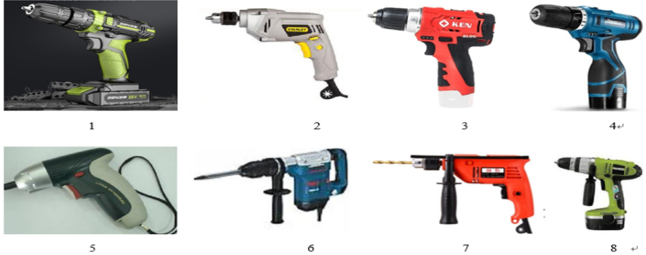
Product Sample Library The product drawings of household electric drill are collected in the network and physical stores. Through the collected electric drill pictures, the modeling characteristics, color and material of electric drill in the market, as well as the volume and operability of electric drill are analyzed. Classify and summarize the pictures, such as whether there is a base, whether the angle between the electric drill body and the handle is a right angle or an obvious obtuse angle, and whether the surface design is complex or simple. Then remove the electric drills that are similar in the same category, and finally select eight sample drawings, as shown in Figure 1.
Perceptual Vocabulary Collection and Determination In order to ensure the rationality and accuracy of words, it is necessary to screen 30 pairs of perceptual words, delete words that are of little significance to the design of household electric drill products, and screen out 6 pairs of effective perceptual words, as shown in Table 1.
Figure 1: sample screening diagram (Source network).Table 1. Vocabulary screening result table (drawn by the author).
Table available in the original PDF paper.
Serial number Perceptual vocabulary 1 Simple - complex 4 Light - heavy 2 Simple and elegant -Gorgeous 5 Textured - rough 3 Environmentally friendly -polluting 6 Labor saving -laborious
Table 2. Questionnaire (self - drawn by the author).
Use Semantic Difference Method to Conduct Questionnaire Survey According to the eight samples of relevant words selected from Figure 1, and then use the perceptual words selected from table 1 to make a seven level test scale. Let the user evaluate the subjective feeling of each sample sepa- rately. The perceptual evaluation vocabulary is the perceptual vocabulary in Table 1. There are seven options in each pair of perceptual vocabulary, and the seven options correspond to seven scores. For example, in sample 1, in the word pair “simple - complex”, the user selects the score according to his subjective feeling of sample 1, The closer the score to the left, the more com- plex it is. Similarly, the closer the score to the right, the simpler it is. Thus, a questionnaire is made, as shown in Table 2.
Data Quantification Results and Design Direction Data Collection and Reliability According to 43 questionnaires, the data were analyzed. table 3 is the average value of the corresponding word pairs of each sample, and the bottom data is the sum of the average values of each word pair in eight samples.
Design and Research of Household Small Electric Drill Based on Users’ Perceptual Needs 257
Table 3. questionnaire data sheet (self - drawn by the author).
Analysis of Perceptual Vocabulary by Entropy Weight Method Calculate the weight of each word pair, as shown in Table 4.
According to the weight analysis, it is found that the weight of environ- mental protection is the highest, followed by labor-saving and lightweight. Combined with the analysis of the average value in Table 3, it is found that among the six pairs of words, what the existing electric drill lacks most is environmental protection and labor saving.
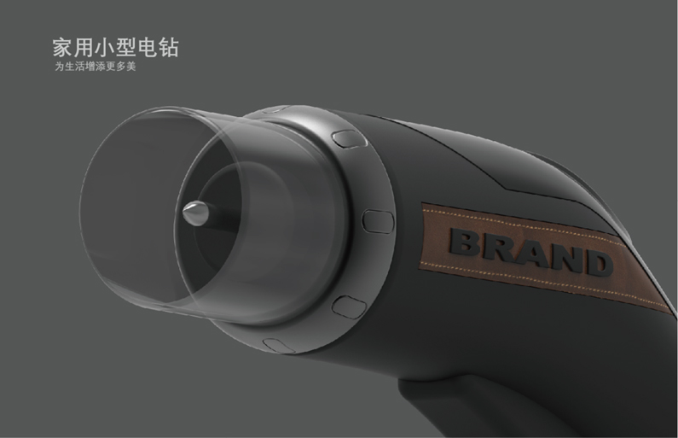
SMALL HOUSEHOLD ELECTRIC DRILL DESIGN INNOVATION SCHEME According to the above data processing results, it is found that the most important thing of household electric drill is environmental protection, which means that during the use of electric drill, it will not produce a large amount of debris to pollute the surrounding environment and human health; Labor saving and light means that the overall volume of the electric drill should be light and easy to master, so as not to make the hole deviate; Simplicity is the product modeling design to minimize complex design. The above perceptual words correspond to the design elements of household electric drill respecti- vely, as shown in Figure 2. Then brainstorm according to the sample diagram corresponding to the weight results to obtain the design scheme.
Since the electric drill is required to be environmentally friendly and labor- saving, a protective cover is added at the front end of the electric drill. When the switch is turned on, the drill bit of the electric drill rotates out, and the protective cover will collect dust and debris. The overall volume of the electric drill is small, which can achieve the effect of labor-saving.
Figure 2: Rendering (self - drawn by the author).
CONCLUSION
Because the number of samples and the number of questionnaires is limited, there may be some deficiencies. Besides, in the questionnaire stage, we did not take into account the specific use scenarios of electric drills, such as wood drilling, wall drilling, drilling depth and so on..
ACKNOWLEDGMENT
Thank my teachers for their help and team members for their efforts. Thank you.
REFERENCES
Bi Yifei, Wang Nianwen, Zhu Yiwu (2018) Modeling design of elderly escort robot based on perceptual engineering [J] Packaging engineering, 39 (02): 160–165 Chen Jinliang, Zhao Feng, Li Yi, Zhang Qianyi (2019) Research on product design
method based on perceptual engineering [J] Packaging engineering, 40 (12): 162–167 Chen Yibing, Wan Zhongjiao, Yu Dongjiu, ye Junyi (2020) Research on innovative design of household water dispenser based on users’ perceptual needs [J] Packaging engineering, 41 (08): 173–179+ Donald A. Norman (2017) emotional design [J] Industrial design, (6): 32–33 Jia Shuyuan, Wang Haowei, Chang Zhiquan, Tang Zhou, Dong Xuewen, Ma
Jixu, Yan benzhong, Xiang Mingsen (2018) Human factors design of dustproof positioning household electric hand drill [J] Value engineering, 37 (10): 97–98 Liu Chuanlong. (2013) Improved design of dustproof electric drill [D] Nanchang University. Wang Xinyan. (2017) Design of intelligent household rechargeable electric drill based
on ergonomics [J] Value engineering, 2017, 36 (36): 116– 117
Design and Research of Household Small Electric Drill Based on Users’ Perceptual Needs 259
Wei Yongxia Design of electric hand drill based on perceptual engineering [J] Packaging engineering, 2016, 37 (24): 108–113 Wu Shan. (2013) Product design of household small electric drill [D] Nanchang
University Yu Dongjiu, Yi Xianqin, Wang Yang (2017) Research on the design of shopping cart for the elderly based on user experience [J] Packaging engineering, 38 (12): 99–103 Zhang Xuan (2019) Research on lamp design based on perceptual engineering [D]
Northern University of technology. Zhao Xiang, Wei Feng, Hu Zhixiong (2020) Research on Modeling Design of office wireless mouse based on perceptual engineering [J] Journal of Fujian Institute of engineering, 18 (04): 403–408
LISTED IN THE AHFE DIGITAL BOOKSTORE CATALOGUE
Explore the complete digital volume
Affective and Pleasurable Design
Read this individual research paper free through the original publisher, or explore the full digital proceedings book.
ISBN 978-1-958651-17-9
Explore this ISBN in the AHFE Bookstore ↗Listed in the July 2026 bookstore catalogue; search by ISBN to confirm current availability · Digital book purchase optional