Vera Barradas, Cátia Rijo (2022). Co-Design as a Tool to Improve Our Cities. In: Human Dynamics and Design for the Development of Contemporary Societies. AHFE Open Access, vol. 25, pp. 141–148. https://doi.org/10.54941/ahfe1001382
Valoriza – Research Centre of Endogenous Resource Valorization, Polytechnic Institute of Portalegre, Edifício BioBIP, Campus Politécnico, 10, 7300-555 Portalegre, Portugal ↗
This paper aims to develop an academic project in the field of design under the theme"New European Bauhaus" with the aim of contributing to a better experience andliving in the city and the development of a more sustainable city. The theme has afocus on the project developed in the Master of Digital Identity of PortalegrePolytechnic that intends to know the city of Portalegre from a singular place and itsidentity. This study is part of this international project called “Design, experience,and identity: meeting spaces to design a livable city” that has the collaboration of sixNational and International Higher Education Institutions and aims to address thisinterdisciplinary issue through the development of academic projects in thedisciplinary field of design. In these ways we can contribute to a better experience inthe city, as well as to a more sustainable development of the place, without losingsight of its identity.
The New European Bauhaus project is part of a creative and interdiscipli- nary initiative that opens space for dialogue for the future, with a view to projecting future ways of living and positioning itself at the intersection of art, culture, social inclusion, science, and technology. The initiative intends to bring sustainability to the cities where we live and demand a collective effort to imagine and build a sustainable, inclusive, and “beautiful” future for everyone’s mind and soul. This initiative aspires to inclusive and acces- sible spaces, from which the dialogue between people of different cultures, disciplines, genders, and ages translates into an opportunity to imagine a better city for all. It also means a more inclusive economy, where wealth is distributed, and spaces are intended to be equitable.
The city has a crucial role in promoting sustainable development with a focus on people and respect for human rights, as recognized in the 2030 Agenda for Sustainable Development, where one of the goals is to make cities inclusive, safe, resilient, and sustainable and so identify culture and creativity as one of the essential levers for action in this context. To this end cooperation and the sharing of experiences and knowledge are essential to make creativity a lever for urban development and to design new solu- tions to face common challenges, responding to the challenge launched by UNESCO.
According to Santos (2000, p. 160) “the space, that is, the places that realize and reveal the world, making it historicized and geographized, that is, empiricized.” The author goes further and assumes that places are “the world that they reproduce in specific, individual, and diverse ways. They are singular but also global, manifestations of the world-totality, of which they are particular forms”.
CO-DESIGN METHODOLOGY In a global world with complex structures, collaboration is essential. The way of thinking and solving problems is also composed of different ways of thinking in different areas. Thus, collaboration and multidisciplinarity may be a possible answer to achieve more innovative and creative results. More than recognizing individual knowledge, collaboration encourages experimen- tation with methods from different perspectives, enriching processes and allowing unexpected and effective answers and results to emerge.
Involving creatives and stakeholders in the creative process should happen as far in advance as possible, allowing problems to be analyzed from a col- laborative point of view. Co-design from the broader, non-formal point of view implies according to Manzini (2015, p. 49) “multifaceted conversation among individuals and groups who set design initiatives rolling at the nodes of the network they are part of”. This participation in the act of thinking and creating in different ways and in different dimensions constitutes the richness of co-creation.
DESIGN TO THE CITIES A city should not be considered an innocuous or objective space, but, on the contrary, it is loaded with subjective meaning and for this reason, it acquires a symbolic value where identity is the layer that covers subjectivity to show itself to others and to be recognized. The identity of a city is what is shown, it is a representation whose objective is to make visible the subjective, the complex.
The characteristics that identify a city are transformed with each of the experiences in the social, cultural, economic and technological context in which citizens live; and with it being able to adapt to a collective future, as stated by Joan Costa (2003) the identity can be the same physical presence, or the evocation in the mind of the other, of something that exists outside of him.
Contrary to what happens with the companies’ brand, the creation of a visual identity for a city is not subordinated to a market for which it was conceived, nor does it intend to sell goods or products, its conception passing through the task of establishing a representation capable of consecrating the city’s identity by rewarding the recognition of its citizens. The creation of this representative visual identity of the city must have as its main objective to increase the feeling of belonging of those who inhabit it.
The graphic representation of this city identity must portray the values, culture and history of the city in question in order to create self-recognition
Co-Design as a Tool to Improve Our Cities 143
in its inhabitants, identifying them as belonging to the place. His visual iden- tity of the city must be transmitted through a coordinated and coherent image, which facilitates communication between citizens and the city, pro- moting respect and credibility, because its graphic representation is a strong element in linking citizens to the place and, therefore. For this reason, its identity and distinctive elements must be present in it. It is necessary to try an appealing representation without breaking the identifying and differenti- ating elements of the city. The visual representation of the city’s identity must consider elements such as history, memory and cultural heritage, as they con- stitute references that will promote a sense of belonging in the inhabitant, strengthening the city’s identity.
From the Market to the City: The Project The project aims to develop an academic project in the field of design with the aim of promoting the identity of the city, considering questions like: “How can Design contribute to the communication of the city’s identity in a more sustainable way”; “How design can contribute to a more inclusive city”. Manzini (2015) states that a territory is a “(...) place is a space endowed with sense. In other words, it is a space that is meaningful for someone. In view of this, and given that meaning emerges from conversations, for a place to exist there must be a group of people who talk about it and act in it. Traditionally, this group was the residence community”.
It is intended to find, from the design, a space for reflection around the construction of the imaginary of a city; find and define spaces of action in graphic design to create a visual language of its own, which allows represen- ting the meaning of a unique and differentiated city; look at a city from a design perspective and guide it towards the best possible identity model and explore design methodologies that make it possible to capture the subjective dimension of the city through its complex individuality and value its impor- tance for the study of urban phenomena in relation to their desires for future ways of life.
Inspired by the new European Bauhaus, the project is based on his desire to change the world through art and the aesthetic revolution. It is inten- ded to portray the history, memory and identity of the city of Portalegre, reconstructing its identity through design. Through knowledge and social participation, it is intended to stimulate in people the feeling of belonging in the construction of the cultural identity and territorial identity of Portalegre, making it more alive through the information and repercussions of its history, making it more collaborative and participatory. through the cultural-social movement. Leaf by leaf and the surprise of new discoveries. Culture, history, territory, knowledge, memories, identity, flavors, photographs, design, expe- rience, drawing, traces, sketches, communication, social sustainability and belonging. Collecting rich information from the past to praise and enhance the culture, memory and identity of a people and their territory.
The project is entitled “From the market to the city”and the main objective was for students to make the city of Portalegre known from a “place” and its identity. It was intended that the students identify the place and make this
144 Barradas and Rijo
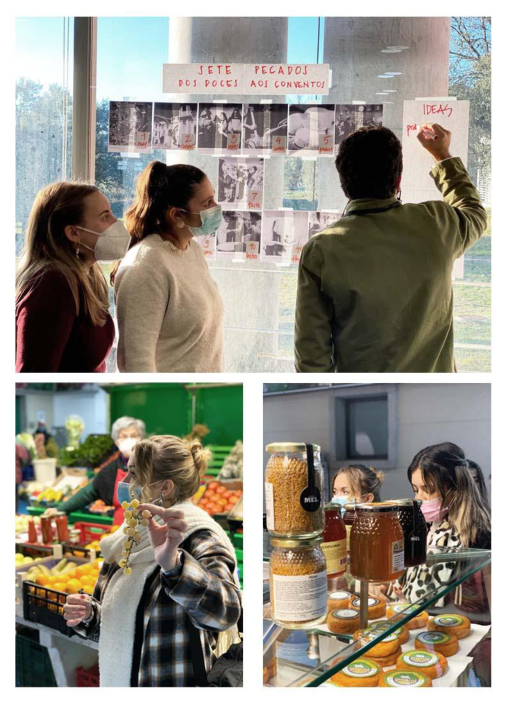
Figure 1: Moments of collaboration. Marketplace and workshop.
place the starting point for the recognition of the identity of the territory. This place was the Municipal Market.
RESULTS
Following the starting point already presented above, two projects were deve- loped. Each group included students from the areas of digital animation, graphic design and communication. Workshops and fieldwork took place in the market space, which aimed essentially at collecting data from two disti- nct forms of research, observation and interviews. (Fig. 1) The contact with local producers and traders allowed the exchange of experiences and know- ledge, essential in the co-creation process, and ensured the genius loci - spirit of place - suitable for the creation of projects aligned with the territory under study.
Project 1: WITH TIME. A festival with time for everything - COMTEMPO (original name)
Co-Design as a Tool to Improve Our Cities 145
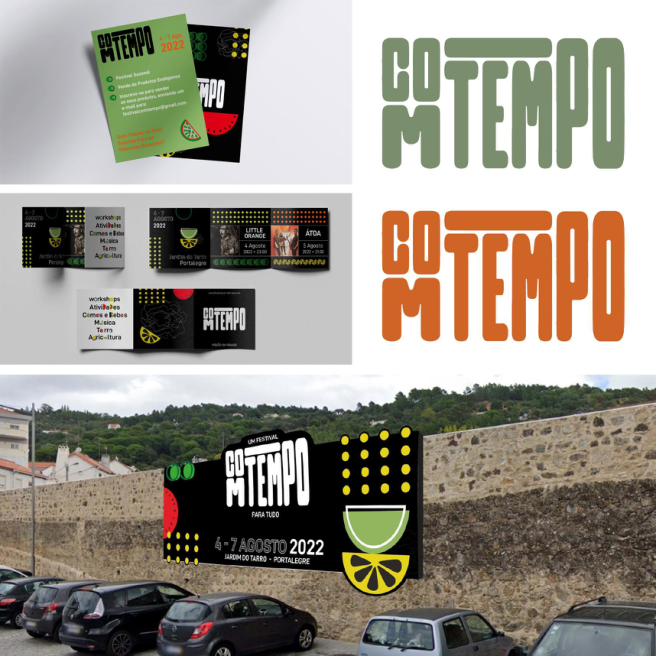
In the research phase interviews were made to individuals between 59 and 73, all of whom live in Portalegre and only go to the market on Saturdays. Among the products they buy at the market, all of them highlighted fruit and vegetables. Regarding the choice of producer, opinions were different, some customers choose the stalls because of the prices at which the pro- ducts are, others because they already know and trust the quality of the products. For the customers, in a word the market is: accessibility, qua- lity, modernity and beauty. Based on the various methodologies applied, the working group developed a seasonal festival COMTEMPO (com=food, tem=tempo, po=Portalegre) which aims to make Portalegre’s endogenous products known to the population, thus valorising its territory. It is a cul- tural event which, besides the sale of products, will hold live concerts with musicians from Portalegre, as well as workshops and other activities rela- ted to the themes of cultivation and food preparation. From 0 to 90. The seasonality of the festival would respect the seasonality of the products.
The project is then defined with the words: street, market, creative city, identity, environment, development, market evolution, product embodiment, heritage, tradition, endogenous products and culture. The development of the project’s graphic identity results from the project’s personality being inti- mately linked with the endogenous products and the chromatic richness of these same products. Below are some visual results proposed by the working group (Fig. 2).
Project 2: 7 SINS- from candy to convent - 7 PECADOS (original name) Based on the same challenge and participating in the same moments of sharing and project development, the team of this project that designated its investigative phase as “looking through the eyes of others”related the market to a secular gastronomic tradition. The conventual sweets. These were swe- ets that used essentially sugar, eggs and almonds with countless variations of execution, always made by nuns who lived in convents. In the investigative phase, through interviews it was concluded that 75% of people don’t have knowledge about the sweets but were unaware of their history and the relati- onship between these sweets and the convents, which in the city of Portalegre, are 7, the same as mortal sins.
At the culmination of a research and co-creation process (lasting 3 months) the general objective was reached: “The project 7 Pecados, dos Doces aos Conventos” aims to contribute to a better experience of the city of Portalegre through the experience of informative guided tours having as route the 7 convents of the city and the tasting of conventual sweets. Attracting visitors, showing its history, memory, culture and investing in social sustainability.”
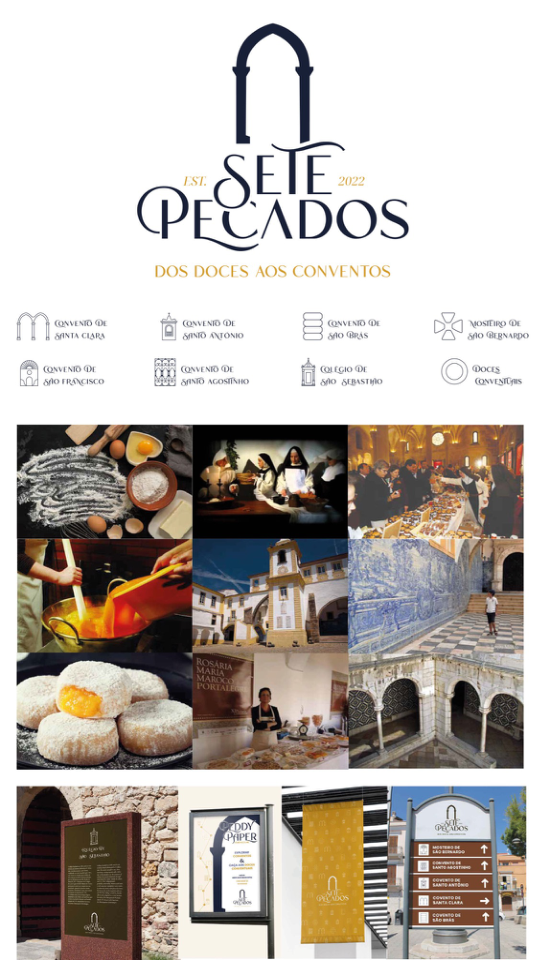
After analyzing the history and characteristics of the 7 convents, a process was developed to create a graphic identity capable of enriching the knowledge and identification of the population and future visitors in a creative and inte- ractive way. From a formal point of view, the visual identity was inspired by the historical and architectural heritage with a focus on the perfect arches, present in the Convent of Santa Clara in Portalegre.
146 Barradas and Rijo
Figure 2: Some results of the project.
“Not everyone knows the stories behind the seven convents and the conventual sweets of Portalegre. ... Sheet by sheet, the surprise of new discoveries. Culture, history, territory, knowledge, memories, identity, flavors, photographs, design, experience, drawing, traces, sketches, communication, social sustainability, and belonging. Gathering rich information from the past to praise and leverage the culture, memory and identity of a people and its territory.”1 (Fig. 3)
CONCLUSION
Local diversity becomes especially significant in the context of globalization, as local culture is disseminated on a global level, implying that local speci- ficities - unique and distinctive - are transmitted to others, which rewards a collective recognition of them. In this context, the preservation of cities and their material and nonmaterial culture is a crucial aspect of the identification process - which contributes to the formation of a sense of local belonging.
1Excerpts from project manual.
Co-Design as a Tool to Improve Our Cities 147
Figure 3: Some results of the project.
In this specific theme, as in many others, the collaborative methodology can be structural about the ability to integrate diverse sensibilities and points of view. Places, complex and multifaceted entities, have diverse characteristics in the perception of the various actors. Through the creative process of the two projects presented, we can verify that co-design played a fundamental role in enabling us to find diverse answers, starting from the same challenge. Without altering the truth of the territory, these two very different projects are the result of a process that was believed in. There is no doubt that the
148 Barradas and Rijo
attitude of the people involved also shapes the outcome. Trust in the process and trust in the work developed. According to Godin (2021) “attitudes are competencies - which is good news for all of us because it means that if we care enough, we can learn.”
ACKNOWLEDGMENT
The authors would like to acknowledge all those involved in the project. A special thanks to the students of the Master in Digital Identity Design of Poli- técnico de Portalegre, Ana Ramos, Beatriz Ferreira, Catarina Rocha, Diogo Maurício, Jennifer Barbosa, Margarida Santos, Maria Vintém e Mónica Lameiras, to the shopkeepers and producers and to the colleagues who developed the workshop with us Javier Antón Sancho and Victor Larripa Artieda..
The authors also would like to acknowledge the VALORIZA Research Center, from the Polytechnic Institute of Portalegre, for the possibility of being present at this conference and to the Foundation for Science and Technology (FCT) for funding this research.
REFERENCES
Santos, M. (2000) Por uma outra Globalização: do pensamento único à consciência universal. Rio de Janeiro: Record. Costa, J. ( 2003) A imagem da marca. Um fenómeno social. 1a edição espanhola.
São Paulo: Rosari. Manzini, E. (2015). Design, when everybody designs. An introduction to design for social innovation. London, England: the MIT Press Cambridge. Godin, S. (2021). O processo criativo. A inspiração não acontece por acaso. Porto,
Portugal: Porto Editora.
LISTED IN THE AHFE DIGITAL BOOKSTORE CATALOGUE
Explore the complete digital volume
Human Dynamics and Design for the Development of Contemporary Societies
Read this individual research paper free through the original publisher, or explore the full digital proceedings book.
ISBN 978-1-958651-01-8
Explore this ISBN in the AHFE Bookstore ↗Listed in the July 2026 bookstore catalogue; search by ISBN to confirm current availability · Digital book purchase optional