Cátia Rijo, Vera Barradas, Carolina Galegos, Patricia Pombo (2022). Design Thinking a Methodological Approach in Design Process: "3 seeds" as a Case Study. In: Human Dynamics and Design for the Development of Contemporary Societies. AHFE Open Access, vol. 25, pp. 157–162. https://doi.org/10.54941/ahfe1001384
1 Valoriza – Research Centre of Endogenous Resource Valorization, Polytechnic Institute of Portalegre, Edifício BioBIP, Campus Politécnico, 10, 7300-555 Portalegre, Portugal ↗
2 Escola Superior de Tecnologias e Gestão do Instituto politécnico de Portalegre, Campus Politécnico, 10, 7300-555 Portalegre, Portugal ↗
This article aims to demonstrate the design thinking methodology applied in a specific challenge and its inherent problems. Nowadays, with the common concern of climate change issues, design assumes a global responsibility to change habits and behaviors. Universities as living laboratories of ideas and an-swers are called to action. In the work presented here, students were challenged to develop a project under the theme, seeds. With sustainable design and circular economy at the base of the creative process, in a thinking oriented towards truth, honesty, clarity and respect for people, 3 seeds are born. A hand-made clothing brand with dyeing based on three seeds: Paprika, Saffron and Pink Pepper. From the result were part not only the garments, but also communication strategy and graphic pieces that accompanied the whole concept and process of the project. For the development of the project, we intend a methodology that integrates practice as part of the method has come to characterize our action – practice-based and practice-led (Candy, 2006) - considering: wants to practice and reflection on the results of practice, as a source of new knowledge.Move forward from this knowledge about the practice and within of practice we adopted design thinking methodology not only because is a flexible methodology but also because can be used in any work field, since it as valuable elements, such as iterating frequently based on continuous feedback from all the intervenient. Through rapid low-resolution prototyping, ideas are continuously tested with the potential users. “Fail early in order to succeed sooner” is the Design Thinking principle that helps to maximize learning and insights, crucial for human centred innovation. Collaborative work in a small groups scenar-io map, leads to the discussion of solutions, and to the innovation that emerges from the different perspec-tives given by each person.In this context, it will be important to realize that, as a methodological resource in the development of a project, design thinking is able to provide an effective approach to problem solving, naturally facilitating the development of innovative approaches to problem solving, from the perspective of prototyping, rapid analysis and potential selection of end-user-focused solutions. Design thinking, besides guiding as a meth-odology, emerges as a unifying element of visual thinking and the creative process. Our aim with the students involved, based on active research and expression, is give them with skills capable of complementing their expertise, behaviors and methodologies in real work context since this methodology offered focuses on a practical approach.
Nowadays, with the common concern of climate change issues, design assumes a global responsibility to change habits and behaviors. Universi- ties as living laboratories of ideas and answers are called to action. In the work presented here, students were challenged to develop a project under the theme, Seeds. With sustainable design and a circular economy at the base of the creative process, in a thinking oriented towards truth, hone- sty, clarity and respect for people, 3 seeds are born. A handmade clothing brand with dyeing based on three seeds: Paprika, Saffron and Pink Pep- per. The result was not only the garments, but also communication strategy and graphic pieces that accompanied the whole concept and process of the project.
For the development of the project, we intend a methodology that inte- grates practice as part of the method has come to characterize our action – practice-based and practice-led (Candy, 2006) - considering: wants to pra- ctice and reflection on the results of practice, as a source of new knowledge.
Move forward from this knowledge about the practice and within the pra- ctice we adopted design thinking methodology not only because it is a flexible methodology but also because it can be used in any work field, since it has valuable elements, such as iterating frequently based on continuous feed- back from all the intervenient. Through rapid low-resolution prototyping, ideas are continuously tested with the potential users. “Fail early in order to succeed sooner” is the Design Thinking principle that helps to maximize learning and insights, crucial for human centred innovation. Collaborative work in a small groups scenario map, leads to the discussion of solutions, and to the innovation that emerges from the different perspectives given by each person.
In this context, it will be important to realize that, as a methodological resource in the development of a project, design thinking is able to provide an effective approach to problem solving, naturally facilitating the develo- pment of innovative approaches to problem solving, from the perspective of prototyping, rapid analysis and potential selection of end-user-focused soluti- ons. Design thinking, besides guiding as a methodology, emerges as a unifying element of visual thinking and the creative process.
Our aim with the students involved, based on active research and expres- sion, is to give them skills capable of complementing their expertise, behavi- ors and methodologies in real work context since this methodology offered focuses on a practical approach.
DESIGN THINKING METHODOLOGY The design thinking methodology has gained notoriety, particularly in the last decade, in the design practice, as a catalytic tool for the development of ideas, projects and resolutions in various business areas. Design Thinking is a design method, understood as a multidisciplinary methodology, detached from the connection with design as a profession. Despite Design Thinking being explored and developed together with professional designers, strate- gies have been identified as relevant to other disciplines and areas of activity (Linberg et al., 2010).
This methodology can be defined as a model of people-centered thin- king and reflection. The use of this methodology can be advantageous not only in inter-disciplinary terms, but also in other disciplinary approa- ches, especially when researching and projecting new services and products. This method promotes the development and stimulation of metacognitive skills using formal processes. Design Thinking procedures offer the teacher support in carrying out teaching based on methods that promote refle- ction, critical analysis, construction of ideas and group work (Magro et al., 2020). Design thinking can provide, in a process of co-work and co-creation in project development, a vision capable of strengthening connections towards a common goal. “It is a discipline that uses designers’ sensibilities and meth- ods to match people’s needs with what is technologically feasible and with what a viable business strategy can convert into customer value and customer opportunity for the market”(Brown, 2009, p. 4).
Design Thinking a Methodological Approach in Design Process: “3 Seeds” as a Case Study 159
Can be said that using the design thinking methodology, it is possible to define results more easily, and thus conveniently build the path to the right solution. As an actor in the development of the project, this tool can help eradicate the complexity and clutter, usually found at the beginning of the project development process, allowing to focus the work development on the essence of the needs and problems that are commonly encounte- red. necessary to resolve. This methodology focuses on a practical, flexible approach and has elements as valuable as frequent iteration based on con- tinuous feedback from all stakeholders. The Design Thinking methodology can be characterized by four phases: Immersion, Ideation, prototyping and implementation.
CHALLENGE This project arose from the theme “Seed”, a challenge launched in the Curricular Unit of Project II on the third year of Communication Design Gra- duate of Portalegre. Based on this theme, we reflected, research and asked ourselves “why not produce our own pigment, from the seed/germinated plant/fruit?” and “if from 3 natural pigments, we could create Eco-Friendly handicraft/textile products?”.
This was the motto that gave rise to the development of the project in que- stion. It started with the idea of finding 3 pigments for application, which we forwarded to the production of 3 exclusive garments, combining authenti- city, quality and sustainability, giving primacy to products without corrupting them. “The Pigment”is then the specific topic he decided to address. The esta- blished concept was based on: Paprika, Saffron and Pink Pepper - 3 people, 3 pigments and 3 applications - with the name of the project having emerged from the same principle, 3 Seeds.
Sustainability, whether environmental, economic (using a circular eco- nomy) and social, is the main motto for the emergence of this project, using something banal or luxurious, according to the connotation that each one gives to clothing, but whatever it is, it is a necessity that the human being needs, to protect yourself, to beautify yourself, to keep warm. With this project, it is intended, in addition to its aesthetic, fashion aspect, to pass a message to consumers and producers who embrace this branch. The aim is to pass on values and teach more ecological practices, encouraging a change in attitude, promoting good practices and harmony among those who inhabit the planet.
SEEDS: THE PROJECT This project aims to create a women’s clothing brand where the link between textile and natural is its great differentiating character, a brand that combi- nes ecological and sustainability. 3seeds is governed by values such as truth, sincerity, respect, clarity and justice towards the people with whom it works, towards its customers as well as towards the environment. Sustainable ety- mologically means sustenance, support, resist, defend, balance and maintain, values that are pillars of the brand. 3 Seeds wants a brand that cares about
the environment, with the impact caused every day by our actions, promoting harmony among the inhabitants of our planet.
Slow Fashion & Zero Waste 3seeds creates limited edition collections with a small number of handmade pieces where the entire production is made in Portugal, from the pigment to the piece, thus helping to stimulate the national market, governed by fair trade.
3seeds is concerned with using eco-friendly and quality fabrics, not only for their benefits, but also for their durability.
The fabrics chosen were linen and organic cotton. Linen of plant origin has 3 characteristics that mark it: absorbency, brea- thability and durability. Absorbency is perhaps the most remarkable quality of this material. The base fibers are all hygroscopic, which means they can absorb a lot of moisture. This makes it extremely desirable for many clothes and bedding, as it will pull perspiration out of the body. As a result, fabrics tend to feel cool to the touch and extremely breathable. It is famous for its durability, which, unlike other fabrics, tends to improve with use. Washing linen products tends to make them stronger, shinier and smoother.
Organic cotton, more than 25% of the world’s pesticides are used in the production of conventional cotton, this is grown without toxic chemicals and synthetics.
Project Development & Results After immersing in the project and after carrying out the research that led to the definition of the project and its concept, mentioned above, we moved on to the ideation and after the prototyping phase.
In response to the challenge, several experiments were carried out to ensure its success, initially it was necessary to form the brand identity and is graphic representation in order to give a visual representation that was able to mirror all its goals, deepest values and beliefs, never leaving aside the seeds worked and the pigment extracted from them, characteristics that make it unique. It is mainly represented by a manual process (brushstroke) combined with digital, using necessary means. Subsequently, a dyeing process was adopted, which corresponded to the brand identity.
A traditional and manual process, combined with a sustainable strategy, where natural / virgin / raw fabrics were used, clean and without ornaments. That said, according to the fabric and the pigment, several tests were carried out to achieve the desired result. Then, the creation of sketches elaborated according to the brand’s aesthetics, later modeled and sewn. At this stage, a vast amount of research began to select products related to more sustainable ornamentation, such as wooden, coconut and pearl buttons. Finally, the cre- ation of graphic pieces required various tools and means, depending on the elements to be implemented.
After all the previous phases and all the prototype tests the project was ready for the implementation. For the execution of the project, natural and
Design Thinking a Methodological Approach in Design Process: “3 Seeds” as a Case Study 161
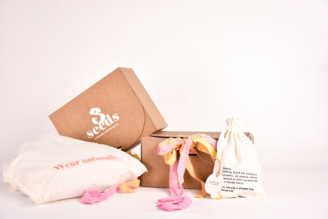
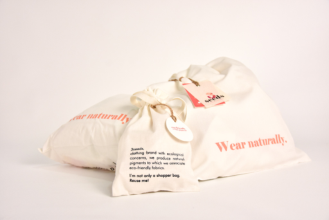
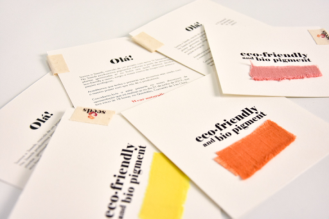
Figure 1: A. Graphic pieces: Press Kit and Cotton Bags. B. Graphic branding silkscreen printed on cardboard packaging. Author’s image (2019).Figure 2: A. Cotton Bags - silkscreen printed. Author’s image (2019). B. Scarves in cotton and linen fabrics are dyed with pigments and the tie dye technique. Author’s image (2019).Figure 3: Graphic piecie’s. A. Brand presentation invitation, Author’s image (2019). B. Stickers and pins. Author’s image (2019).
sustainable materials were chosen, namely, the organic cotton paper used in clothing identification tags, as well as elements belonging to the brand presentation press kit. Organic cotton fabric was also used for the bags, 100% reusable, as well as 100% recycled cardboard packaging. At this point, priority was given to the manual serigraphic printing process, with water- based inks, a resource made available by the Escola Superior de Tecnologia e Gestão – IPPortalegre.
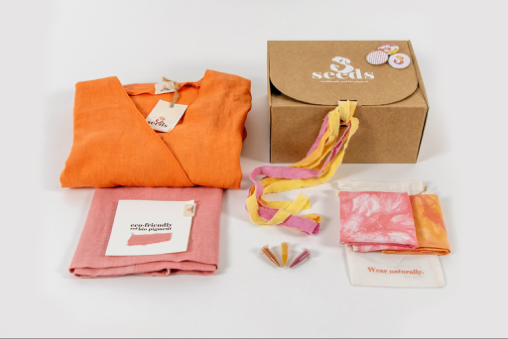
Figure 4: Elements of the work - graphics and clothing items. Author’s image (2019).
CONCLUSION
This article aimed to explain the importance of design thinking methodology on design teaching as a tool that increases creativity while establishes the essential steps in the design process. As a case study we bring the 3 Seeds project, a project developed by 3rd year graduates in Communication Design that adopted thinking methodology applied in a specific challenge and its inherent problems. In the end we prove the importance of this methodology on the project development, through the adoption of the four phases of design thinking it was possible to achieve to the 3 Seeds the visual communication where the fundamental values are visible on the brand mark and consequent communication.
ACKNOWLEDGMENT
The authors also would like to acknowledge the VALORIZA Research Cen- ter, from the Polytechnic Institute of Portalegre, for the possibility of being present at this conference and to the Foundation for Science and Technology (FCT) for funding this research.
REFERENCES
Brown, T. (2009). Change by Design; How Design Thinking Transforms Organisations and Inspires Innovation, Boston: Harvard Business Press. Candy, L, Amitani, S & Bilda, Z. (2006). Practice-Led Strategies for Interactive Art
Research, International Journal of CoCreation in Design and the Arts, Interactive Art Collaboration (Special Edition), Vol. 2 No. 4 December, 209–223. Magro, J. C., & Riccó, J. C. (2020). Design Thinking in contemporary teachinglearning processes. Convergences - Journal of Research and Arts Education, 13(26), 23–29. https://doi.org/10.53681/c1514225187514391s.26.14 Lindberg, T., Kroper, M., Fay, D., Meinel, C. (2010). Interrelations between Moti-
vation, Creativity and Emotions in Design Thinking Processes - An Empirical Study Based on Regulatory Focus Theory. In Proceedings of the 1st International Conference on Design Creativity ICDC 2010, Kobe, Japan, November 2010.
LISTED IN THE AHFE DIGITAL BOOKSTORE CATALOGUE
Explore the complete digital volume
Human Dynamics and Design for the Development of Contemporary Societies
Read this individual research paper free through the original publisher, or explore the full digital proceedings book.
ISBN 978-1-958651-01-8
Explore this ISBN in the AHFE Bookstore ↗Listed in the July 2026 bookstore catalogue; search by ISBN to confirm current availability · Digital book purchase optional