Carlos Manuel Figueiredo, Ana Rafaela Diogo, Joana André Leite (2022). Adapting Jane Austen to the screen: fashion and costume in Autumn de Wilde’s movie "Emma". In: Human Factors for Apparel and Textile Engineering. AHFE Open Access, vol. 32, pp. 56–62. https://doi.org/10.54941/ahfe1001538
The visual and behavioral codes prevalent in society at any given moment are part of its social conventions and constitute a framework that rules everyone´s image, dress and the attitudes that society not only tolerates but expects from them. However, it is unquestionable that despite the rigidity and formality imposed on personal appearance and manners, it is still possible to find some room to play with the possibilities afforded to people, albeit conditioned by their social status, so as to manage to express their inner self, mood, and even outlook on life, at any point in time. What is more, it is possible for an individual inserted in such a society to become the center around which everything revolves and trace a path to success, without necessarily trespassing any of the red lines drawn by society's norms. In her novels, Jane Austen chose as protagonists middle to upper class young women that stand out by managing to, in the limited scope of action afforded to them, work society in their favour so as to achieve their perceived notions of fulfillment and personal happiness. Based on one of Austen's novels Emma, and its 2020 movie adaptation directed by Autumn de Wilde, we will assess how Alexandra Byrne’s costumes work in relation to the aesthetics of Emma’s world and surroundings. As well as investigate how they showcase, are impacted and can even be read as symbolic representations of the course of her life, evolution and relationships in this movie, which is considered to be particularly faithful to the novel.Keeping this in mind, we will analyse several scenes that are key both in terms of the plot and the costumes of the main character—Emma. This analysis will consider filmic and design notions of characters, narrative and space, as well as their construction and representation. It will focus on questions of storytelling regarding how the viewer is informed about Emma’s personality and mood, as well as capable of feeling her emotions, in the key events of the plot. As well as try to answer why and how Emma and her costumes remain the main focus in almost every shot of the movie, and how components such as the fictional space, its framing and composition are always in relation and dependent on her and her portrayal.Despite this movie being Autumn de Wilde’s debut, her mastery of notions of visual hierarchies, aesthetics and cinematic techniques that keep Emma highlighted and the focus of the action at all times, in the foreground of the shot, is undeniable. This translates to impeccably shot spaces that are completely in tune with the costumes, providing a sense of ease or contrast to the characters' relation to the space, further highlighting the subjects in the main action.In such an aesthetically developed piece, it is then also unavoidable that Emma’s every interaction and the development of her relationships will have a direct impact on her inner image, and therefore her outer image, affecting her relation and attachments to her costumes.
During the Regency Era, there were glaring changes in fashion from the 18th century to the 19th century in England. The fashion went from colorful, overly detailed and adorned in both men’s and women’s clothes to a more neoclassical inspired look of effortless beauty for women and a somber look that focuses on good tailoring and the quality of materials for men.
However, despite the many changes in look, craftsmanship, and materials, one thing that did not change was how coded fashion was. If anything, with Regency people now owning fewer clothes, for their attire, could be refreshed by a simple change to one of their layers, fashion came to communicate all the more about a person from the very first glance.
If there ever were a great commentator of society and fashion of this period, it would be Jane Austen, who, during her short life, prolifically put to paper a portrait of her society, utilizing her uncompromising gaze that “is as accurate,
Adapting Jane Austen to the Screen: Fashion and Costume 57
wry and humorous when turned to clothing as it is on all other subjects.” (Davidson, 2019, p. 10) Indeed the greatest value of Austen’s novels “lies in the immersivity of the narrative: the way the reader learns to read and understand people and situations along with the heroine (…)” (Wiesenberg, 2020, p. 10). And it is precisely due to this engagement, which was remarkably translated to the screen in the 2020 film adaptation of Austen’s novel, Emma (de Wilde, 2020), directed by Autumn de Wilde and with costumes by Alexandra Byrne that we chose it as our subject of study.
Our aim with said study is to assess how Alexandra Byrne’s costumes work in relation to the aesthetics of Emma’s world and surroundings, as well as investigate how they showcase, are impacted, and can even be read as sym- bolic representations of the course of her life, evolution, and relationships in this movie. As well as try to answer why and how Emma and her costumes remain the focus in almost every shot of the movie. To do so, we will analyze three key scenes of this film, paying attention to how her costumes and com- ponents, such as the fictional space, its framing, and composition, are always in relation and dependent on Emma and her portrayal.
EMMA AND HARRIET’S FRIENDSHIP Having just lost her governess, who had through the years become her closest confidante and mother figure, Emma now finds herself in a predicament she had yet to have experienced in what is described by Austen as a life “with very little to distress or vex her.” (Austen, 2014, p. 1)
Being, as she is aware, in an unusually privileged position for a woman of her time, not having to worry about marriage, status or fortune, she then finds herself in need of a project to fill her time. It is with this in mind that she singles out Harriet as the perfect candidate in whom to deservedly employ her matchmaking skills. She sees promise, despite her condition as someone less fortunate and sophisticated than her, if for no other reason than her reve- rence for Emma. Which she conceitedly interprets as a clear sign of taste and potential for social improvement on Harriet’s part.
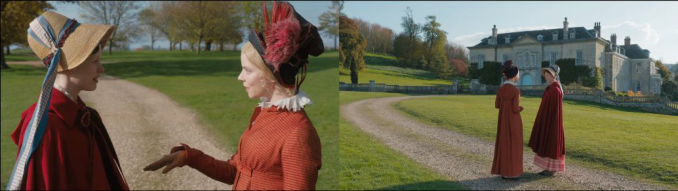
The scene (Fig. 1) portrays Emma and Harriet’s first one-on-one intera- ction. The two friends are always emphasized by a backlit key light, over the surrounding space. However, the viewer still always ends up looking at Emma as it’s made to follow her actions and behaviors. All other characters and the fictional space are bound to her. The scene begins with a frontal eye-leveled two-shot and progresses in a follow-up, moving in a dolly-out, backwards in space as the characters move towards us. They are placed in one and two thirds, slightly shifted to the left, leaving more surrounding space on Emma’s side, leading the viewer’s eyes to the right side of the frame. The landscape flows in the perspective behind them and fades, depicted in a blurry, desatu- rated manner. The dreamy, diffused light of the surrounding space creates a greater contrast with the harder light that creates volume readings in them and their costumes.
The supposed equal weight and symmetrical placement in this frame are overcome by the lighting on Emma. On opposing framing sides, the amplified distance between them tells us that their friendship is not one between equals.
Figure 1: Emma and Harriet first one-on-one encounter.
It is interesting to note what can be interpreted to the level of curation Emma puts her exterior image and interactions through. Indeed, the simila- rity between the two characters’ costumes can be interpreted as a conscious choice on Emma’s part. In fact, it’d seem that Emma, being obviously aware of Harriet’s use of the red cape, as it is part of the uniform of Mrs. Goddard boarding school, perhaps chose this particularly colored pelisse to further bridge the gap imposed on their friendship by their disparaging social status.
However, upon closer inspection it is easily recognized that despite her somewhat good intentions, it is impossible, nor would Emma have it be oth- erwise, to overcome their differences in social status. That is only further highlighted by the fact that even though Emma calls Harriet by her given name, Harriet does not, only ever addressing her, throughout the entire film, as Miss Woodhouse.
It is with this in mind that the differences between these visually similar figures become all the more evident. Indeed, it is the use of differently weigh- ted and shine fabrics in both costumes, as well as their confection and level of detail employed, that allow a stronger highlight to truly bounce off Emma’s pelisse and detailed embellished hat, and fall dimly on Harriet’s simple wool cloak and straw hat. Once again calling attention to the ambiguity of Emma’s intentions towards Harriet, that stem, at least at the beginning of their fri- endship, from a place of social superiority and a sense of unchallenged, yet questionable righteousness over Harriet’s life.
EMMA FALLS IN LOVE WITH KNIGHTLEY At this point in the story, Emma begins to see not only Mr Knightley in a new light but also, to a certain degree, starts rethinking her desire and sli- ghtly imposed condition of never getting married. This comes about very unexpectedly for Emma, for she had, up until that evening, only considered Knightley as her often critical equal. However, once she does take notice of her affection for him, her feelings evolve rapidly within her.
Interestingly, it is her friendship with Harriet that Emma had viewed, at least at the beginning, as a personal project, that provokes this change of heart in Emma regarding Mr. Knightley. Indeed, it is only by first being affe- cted by Mr. Elton’s dismissal of Harriet and then having her worries over her friend assuaged by the chivalrous actions of Mr. Knightley, who steps in
Adapting Jane Austen to the Screen: Fashion and Costume 59
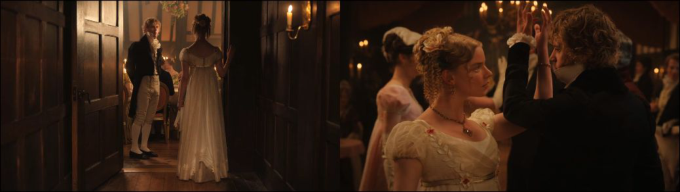
Figure 2: Emma’s newfound love for knightley.
and invites her to dance to save her the embarrassment of the dismissal, that Emma realizes the nature of her affections.
The scene (Fig. 2) begins with Emma and Knightley holding hands, ready to take to the dance floor after this generous attitude towards Harriet. The two-shot symmetric, sideways, double frame and the blurred space of the room behind them make it so that they are the ones highlighted. The frame balance is absolute. An establishing shot shows us the ballroom in a centered perspective and stretched with the use of a wide lens space, aligned in-depth with the two rows of dancers, one on each side. Yellow candlelight chandeli- ers throughout the centerline and practical lines are intended to justify all the lighting the viewers see. Then the camera dives into the ball action, showing details of couples dancing in a complex choreography, alternating medium shot views concerning the central axis, aligned with the dance and space to establish the viewer’s line of sight. The shots quickly progress to the depiction of only Emma and Knightley.
The telling slows and calls our attention as the choreography makes them get near each other. In these precise close-ups, beginning with side views, the camera focuses on Emma, with all lighting on her, as she goes from mere politeness to being caught by surprise by her feeling of love. Soon she is placed in the center of both the frame and Knightley’s POV so as to further emphasize her. This is accentuated by the lighting that becomes almost mystical, making us go deep into Emma’s inner newfound passion.
Given the opportunity, it is her that takes the first step in possibly changing their relationship. This can be seen as Emma finally taking a step into doing something solely of her own volition, suspending, even if only for a while, her concerns about making sure never to leave her hypochondriac father and even about propriety when she goes dancing with him without her double scalloped, tall gloves on.
For the time period, this is the greatest scandal, for it makes them the only couple withholding that rule. However, the purpose of this misstep in propri- ety is only to further emphasize the tension of this scene. Indeed, this loss of layers, both in Emma’s dress, which is at this point composed of only a sheer, subtly checkered silk over a satin petticoat, and her simple one-layer puffed sleeves, as well as her act of forgoing her gloves, can also be interpreted as a symbol of Emma’s emotional walls coming down as she becomes increasin- gly closer to Mr. Knightley. However, it can also be interpreted as the leeway they both possess due to their elevated social status.
What is more, from the very beginning of the scene, the viewer is constantly reminded of Emma’s status as “the big fish in the small pond” (Byrne, 2020). This is achieved by the harmonious relationship between her entire costume, the lighting and the way the scene is shot, that work together to highlight Emma’s quality as the picture of the classical female figure ideal of the time. For even though the cut, silhouette and color may be similar to all the other dresses, Harriet’s included, it is still impossible for the viewer not to take notice of Emma before anyone else.
In fact, the sheer unsuitability of Mrs. Elton’s costume for this social event, with its exaggeration of embellishments, in both her gown and her hairstyle, only further calls attention, by contrast, to Emma’s expertise in the curation of one’s external image. Not only that, but the disparity between the two is a perfect visual depiction of what the conversation around fashion was at the time, with Emma being the example of how a lady should present herself in an effortless manner, giving the impression of not paying fashion that much attention, on behalf of other more appropriate concerns. And Mrs. Elton, clearly being a “slave to fashion’s whims” (Davidson, 2019, p. 41), with all her excesses, made all the more abhorrent by the fact that she is the priest’s wife and, therefore, the subject of even greater expectations for her to hold herself more restrainedly, to showcase her dedication to more charitable causes.
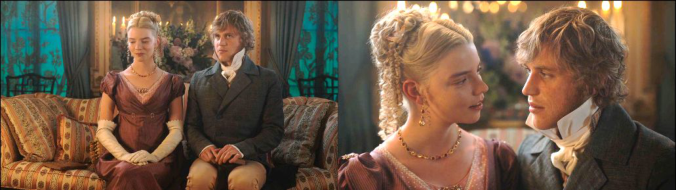
EMMA’S HAPPILY EVER AFTER This scene takes place at Emma’s family estate, where she lives with her father. The first shot is a frontal shot of the living room, which shows us the cha- racter of Emma’s house, and, therefore, also her father’s. The framing shot is strictly balanced (Fig. 3), presenting an almost formal symmetry with its pairs of servants, furniture, paintings, and candles, suggesting the peace and order of this estate. The classic draw of a door in the center and a double framing let us see a room behind, opening the space in-depth as it closes it on both sides.
The viewers can see Emma, her father, and Knightley in a triangle dispo- sition, in an establishing shot that reveals the scene’s space of action and the character’s relative placements. The house’s space and ambiance emphasize peace and harmony. They are positioned alone yet remain connected, with the father in the highest triangle vertex, in the center of the framing, so as to showcase that he is the one in charge of the scene.
Emma is on a couch, centered, framed by a symmetrical foreground and background. The warm light from the left side highlights her from the envi- ronment, which has softer and cold lighting. Especially her face, revealing her expressions to the viewer’s attention. Then a shot shows Knightley completely subdued to Emma, positioned in the two-thirds, turned to her on one-third, to the left of the frame.
Emma’s father uses a cold breeze as the pretext to ask the servants to place a screen for the young couple’s privacy. As Knightley joins Emma on her sofa, the camera is placed very near to and between them, alternating opposing views from each side. A detailed shot shows Knightley putting his hand on
Adapting Jane Austen to the Screen: Fashion and Costume 61
Figure 3: The beginning of Emma and knightley’s joint future.
hers, and as he proposes a solution to her anxieties about leaving her father, she kisses him, officializing the engagement.
Emma’s striped silk gown is one she has already worn in the movie, as are the gloves she had previously discarded in her dance with Mr. Knightley. The gown is crossed and gathered at the front, with short sleeves covered by jeweled brooches, and unlike in the previous scene she has worn it in, in this one, she wears it on top of a colored petticoat. This repetition of the same gown, with the change of some details like the petticoat or the accessories, gives Emma the look of sporting a completely different outfit, showcasing the versatility of the wardrobe of the time.
This scene is perhaps the one that showcases the events of Emma’s story that stray the most from what would be expected. Indeed, Mr. Knightley’s offer to move in with Emma to her family house, relinquishing his estate and privacy so that she doesn’t have to leave her father, is a clear challenge to the ascribed gender and social norms of the time. This showcases the range of freedom both her and Knightley possess, for by being part of the higher class in a small environment, they have a greater ability, within certain boundaries, to dictate themselves what those boundaries are.
It is also interesting to note that Emma’s father’s approval and encourage- ment of their relationship can be interpreted as him understanding that Mr. Knightley has, from the very beginning, taken on the role of Emma’s moral compass. In fact, it being Knightley and not him, the figure that usually takes on this position, shows how Emma came to form her often inflated views of her talents and discernment.
Indeed, this is what sets Emma out to commit the errors of judgment that she does throughout the movie. And that despite her and Knightley’s best efforts, only afforded her growth as a character, but never a significant change in her way of being and seeing the world. Even at the end of the movie, and despite her obvious growth and effort to correct her mistakes, the viewer is still aware that she will keep trying and evolving but always remain Austen’s most flawed and, therefore, real character.
CONCLUSION
Throughout this paper, we have tried to demonstrate that it is, in fact, possible for an individual inserted in society, and therefore restricted by its boundaries and social and sartorial codes, to still manage, to a certain degree, to question
and stretch said limits. Be it through the manipulation and expertise of the discoursal paradoxes imposed on fashion at all times or through the way each person holds themselves within their confines.
This is precisely why we have chosen this film, for its morally ambiguous heroine is the personification of a character that has managed to surmount the limitations imposed on her by her society and gender. However, it is also important to note that this has not been conquered without her having prede- termining advantages such as her class and her unique position as the prime carer for her father.
This has been beautifully adapted to the screen by Autumn de Wilde, brought to life with the use of notions of visual hierarchies, aesthetics, and cinematic techniques that managed to keep Emma always highlighted and the focus of the action, regardless of everything and everyone around her. Alexandra Byrne’s costumes have also undoubtedly played their part, being in tune with every aspect of the shots’ composition to provide a sense of ease or contrast to Emma’s relation to the space.
Not only that, but they have masterfully showcased both the versatility afforded to the Regency wardrobe and how Emma’s image revolved around her overly exaggerated self-narrative. An exaggeration that was extended to her flawed critical skills that impacted not only her every interaction and development of her relationships but also the relationship established betw- een Emma and the viewer, from Austen’s work to de Wilde’s adaptation. Indeed, we as readers or spectators, having a limited perspective that is wholly guided by Emma’s, have some impairment in our judgment of her as a heroine and her misguided actions until she herself realizes the errors of her ways.
It is precisely this complete immersion of the viewer in Emma’s story that makes it all the easier for us to, while not living in the same society, “defined by the same manners and culture as Austen’s heroines, we too can relate to the struggles of pride, vanity, prejudice, misjudgment, social standings, and expectations that Elizabeth and Emma are affected by.” (Wiesenberg, 2020, p. 11).
REFERENCES
Austen, J. (2014) Emma. Available at: http://www.vlebooks.com/vleweb/product/op enreader?id=none&isbn=9781473513716 (Accessed: 31 March 2022). Byrne, A. (2020) ‘Emma’s Oscar-nominated costume designer walks us through all
the movie’s best looks’. Available at: https://www.youtube.com/watch?v=k349G pdjlnc&list=PLBu9h2wsU8tU70QdjkFM7ar3dSp6t1wgz&index=8&t=126s (Accessed: 25 March 2022). Davidson, H. (2019) Dress in the age of Jane Austen: Regency fashion. 1st edn. New Haven ; London: Yale University Press. de Wilde, A. (2020) Emma. Working Title Films. Wiesenberg, E.B. (2020) Adaptations of Austen: How Does Multimedia Impact Our
Ability to Read Between the Lines of ‘Pride and Prejudice’ and ‘Emma’? Stern College for Women Yeshiva University. Available at: https://repository.yu.edu/ha ndle/20.500.12202/5638.
LISTED IN THE AHFE DIGITAL BOOKSTORE CATALOGUE
Explore the complete digital volume
Human Factors for Apparel and Textile Engineering
Read this individual research paper free through the original publisher, or explore the full digital proceedings book.
ISBN 978-1-958651-08-7
Explore this ISBN in the AHFE Bookstore ↗Listed in the July 2026 bookstore catalogue; search by ISBN to confirm current availability · Digital book purchase optional