Lan Xia, Deqiang Sun, Ming Yan (2022). Design Analysis of Sit-up Booster Based on KANO Model. In: Human Factors in Aging and Special Needs. AHFE Open Access, vol. 38, pp. 157–165. https://doi.org/10.54941/ahfe1001676
Purpose: With the advent of the Industry 4.0 era, technology's continuous development and progress. Working and studying in a fixed posture for a long time has become a regular part of people's lives. The resulting diseases such as lumbar disc protrusion, lumbar strain, and scoliosis increase yearly. The age of patients is also showing a trend of low generation. At the same time, the elderly and pregnant women occupy a large proportion of them. Most of the products on the market for lumbar problems are still lumbar massagers, lumbar pillows, and other products used to relieve lumbar pain. They still do not solve the inconvenience of daily life caused by lumbar diseases. In response to the problems mentioned earlier, the sit-up booster can provide adequate assistance to patients as an additional indoor product. Through external support and the appropriate amount of external force to give users a certain amount of support in the process of rising and setting, to reduce the discomfort in the process of rising and sitting.Methodology: As a product that improves the life of users and enhances the quality of life of users, it is necessary to follow the "people-oriented" design concept in the design and put the user experience in the first place. Therefore, we conducted market research and user research to analyze the existing products to discover their shortcomings. Then, through user interviews and user journeys, we summarized the problems in users' lives and the problems they encountered with existing products. Conclusion and concluded the product design that derives elements that can improve user experience, designed questionnaires, and analyzed the results using the KANO model to derive the most real pain points of users.Result: According to the information obtained from the fuzzy front-end research, the design practice of the sit-up booster was carried out by continuously improving the details to make the connection between the user and the product closer. While solving the pain points, the product can be applied to more people, regardless of age, gender, and other restrictions.Conclusion: This design study addresses the growing number of people with back discomfort in today's society and finds that they need to improve and enhance their needs in life. The design of a sit-up booster emerges as a general trend. Use the KANO model to analyze the preliminary research results and get the critical needs of users for the product. According to the user's requirements for different functions, the user's needs are ranked, and then the aspects that need to be considered a priority, and the booster is designed for these aspects. It provides a direction for the future design of the sit-up booster.
With the advent of the Industry 4.0 era and the continuous development of technology, it has become a regular part of people’s lives to work or study in a fixed posture for a long time. It resulted in more and more lumbar disc herniation, lumbar strain, scoliosis, and other diseases year by year. The age of patients is also showing a trend towards the young generation. At the same time, the elderly and pregnant women account for a large proportion of them. Most of the products on the markets for lumbar diseases are still lumbar massagers, lumbar pillows, and other products used to relieve lumbar pain. However, the problems are still not solved about the inconvenience of daily life caused by lumbar diseases.
In response to the problems mentioned above, the sit-up booster can pro- vide practical assistance to patients as an indoor product, through external support and supply the appropriate amount of external help, reducing the discomfort in the process of standing up and sitting down. In this paper, through market research, user research, and other means, the sit-up booster innovative design will be realized to be adapted to the use of a broader range of people, by fully understanding users’ needs, and through the KANO model analysis.
RESEARCH ON FUZZY FRONT-END OF PRODUCT DESIGN As a product that enhances the quality of lives of users, it is necessary to follow the “people-oriented” design concept in the design and put the user experience in the first place. Firstly, through researching the existing products in the markets, the shortcomings of the current developments and the critical problems during the user interviews are analyzed. Secondly, the questionnaire was designed to expand the research population further. The KANO model was used to analyze the results to find out the most fundamental users’ pain points which were solved so that the product can be applied to more people regardless of age, gender, and other aspects.
COMPETITIVE ANALYSIS To better understand the existing lumbar products, we focused on market research and analyzed the results. It is found that current products aim at relieving lumbar discomfort, especially lumbar pillows, and massage instru- ments, which can only alleviate the problem of lumbar pain in a short period. However, it is a long process to treat many lumbar diseases, such as lumbar disc protrusion, muscle strain, and other conditions. Existing products focus on relieving long-term pain, however, the users still suffer from such diseases long time, and so that the resulting inconvenience of standing up and sitting down are still not well resolved.
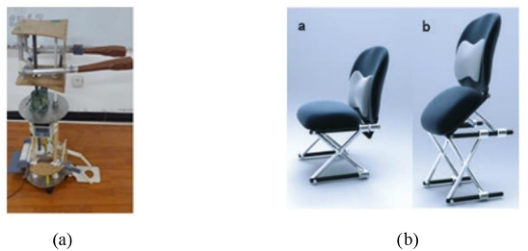
Three different representative products were selected for analysis among the investigated products. The first is a portable device designed by Associate Professor Wang Yongquan for the elderly to help the elderly to get up and sit down (see Figure 1(a)) (Wang Jiaqing, 2021). This product is mainly used through its equipped transmission lift module, simulating the human arms to slowly help the elderly get up and sit down, to prevent the elderly from falling and other accidents to the maximum possible extent. It does help the elderly to get up and sit down. However, its overall shape is slightly oversized, so that it occupies an ample space, and is not suitable for many narrow scenes. There is also some improvement room in terms of form.
As for the improvement of the fixation device, an elderly mobility scooter booster seat designed under the guidance of Professor Cao Jujiang from Sha- anxi University of Science and Technology, (see Figure 1(b)) (Meng Ya, 2012) was also selected, which takes into account both comfort and functionality. The seat surface will rise and tilt forward for the elderly during use, and the back of the seat will follow the trend of slight adjustment to adapt to the body posture of the elderly. The chair entirely takes into account the ergo- nomic principle. The design fully reflects the humanistic care for the elderly, with a certain degree of innovation. However, there is no support for users’ hands when standing and sitting down, which becomes a significant product defect.
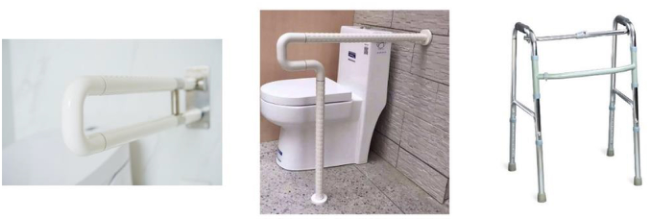
The last type is a ubiquitous handrail device in daily life, installed in many public places to support the body and maintain balance. There are three main types of assisted grab bars (Guo Jie, 2019), I, T, and U type (see Figure 2). In use, I type grab bars are often used in places with small spaces or long corridors, T type is often used on both sides of the toilet to provide support
Design Analysis of Sit-up Booster Based on KANO Model 159
Figure 1: Products designed under the guidance of Professor Cao Jujiang: (a) Movable power assist device for the elderly; (b) Power assist seat for the elderly scooter.Figure 2: I T type (left), T type (middle), and U type (right) auxiliary armrests.
for users when they get up or move forward, and U type grab bars are mainly used to help people with walking difficulties. These products have a large footprint and cannot be moved after installation, and are not suitable for different users under different use scenarios. The comfort of products also needs to be improved.
USER RESEARCH User experience refers to the feeling that a product brings to users from all aspects, which is an essential principle of design. Users’ behavior, thoughts, and feelings during use should be considered when designing a product. The overall comfort of service should be improved through continuous product iteration while truly solving the design pain points. During the design pro- cess, the designers firstly understand the shortcomings of existing products through market research, then build user profiles and journeys through inte- rviews to grasp the most real pain points, analyze typical user journeys, and prepare for the design of the KANO questionnaire.
User Interview Many designers consider the user-centered design as the basis of creation, and identifying the target users is the key. There are many reasons for lumbar discomfort through the previous research. Pregnant women, the elderly,
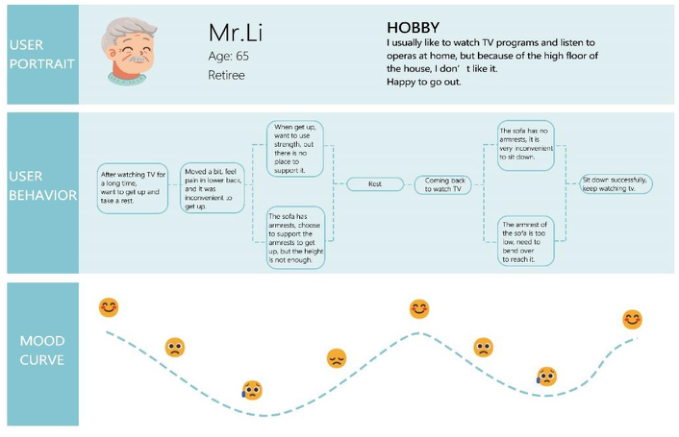
Figure 3: User journey diagrams.
sedentary people are prone to lumbar problems. Even though the reasons are different, but these patients also face inconvenience in standing up and sitting down. Due to the back pain, they are always looking for a place to support when getting up, but many scenes in their lives do not provide such conditions. Based on this, the emergence of a sit-up booster can effectively reduce the inconvenience of their standing up and sitting down.
In the process of obtaining specific user pain points, user interviews were conducted first to get a closer look at what inconveniences the back diseases brought to their lives, what products they would most like to have when the disease appears, and what needed to be improved in their daily lives. Among all the interviewed users, even according to different types of people with various jobs, ages, and genders, they are troubling the same problems in their lives: they are subject to waist pains when standing up and sitting down. The sit-up booster product is a product that they care about and need to help them save more power, and is a product that can improve the quality of their lives.
User Journey Analysis Using user journey diagrams to analyze users’ behavioral and emotional changes during the experience and thus find out the fundamental pain points of users can effectively improve user experience and provide services to users (Endmann, 2016). The second typical user’s real-life situation was chose to draw the journey map. The following user journey map was drawn based on a series of behaviors that occur as described by the user in the interview (see Figure 3).
The mood curve clearly shows that the user’s mood starts to drop when he feels back pain, drops to the lowest level when there is no support, or
Design Analysis of Sit-up Booster Based on KANO Model 161
the height of the armrest is not high enough when he gets up, and recovers after a short rest, but his mood becomes worse when he sits down again. The main reason for this mood change is that users need to exert more force than average during the process of getting up and sitting down due to physical causes. Most people with back discomfort hope to have a platform around the seat where they can lend their strength to reduce the difficulty of their force. In the preliminary market research, there is currently no product to alleviate their physical discomfort in various places and help them save more energy in the process.
Therefore, through the analysis of the user’s journey, we can think the primary demand of the user is to have a support point around the seat and preferably provide some assistance, in addition to its essential functions. The comfort of the product and whether it can adapt to different scenarios has also become the focus of user concern.
PRODUCT DEMAND CLASSIFICATION BASED ON KANO MODEL Questionnaires were designed for the findings of preliminary research, mar- ket research, and user research, respectively. Then KANO analysis was conducted on the questionnaire results to get the final demand situation for the design output and prototype development.
KANO MODEL ANALYSIS Based on the analysis of the impact of user needs on user satisfaction, the KANO model reflects the nonlinear relationship between product performa- nce and user satisfaction and is a practical tool invented by Noriaki Kano for classifying and prioritizing user needs (Berger, 1993), which is used in the design of the sit-up booster that thinks about their needs for the product or service from the user’s point of view. The requirements are divided into five categories in the KANO analysis (Lai, 2004). The Basic requirements (M), Attractive demand (A), Performance demand (O), Neutral type demand (I), and Reverse demand (R).
KANO QUESTIONNAIRES Firstly, a questionnaire was designed based on the preliminary research results and KANO analysis model. The critical questions obtained are then compi- led into a questionnaire. The questions are designed in both positive and negative directions. At the same time, answer options vary from satisfaction to dissatisfaction divided into five dimensions. The user’s demand attributes are classified according to the KANO model evaluation criteria (see Table 1), which can derive the actual situation of the user’s demand degree for each function of the sit-up booster product. Which mainly focuses on three aspe- cts of appearance, process, and operation. Involving the research on the demand for product color scheme, shape, material, primary function, addi- tional function, comfort, and convenience, we can understand the specific needs of users for product functions. In the 150 responses, 136 were valid,
Table 1. The KANO model evaluation criteria.
Table available in the original PDF paper.
Reverse question: Does not provide this function Product Demand
Very satisfied
Positive question:
Satisfied Fairly Dissatisfied Very dissatisfied Provide Very Satisfied A A A O this Satisfied R I I I M feature Fairly R I I I M Dissatisfied R I I I M Very Dissatisfied R R R R
accounting for 89%. Respondents were a small number of older adults over 60 years old and most middle-aged people around 35 years old.
DATA ANALYSIS BASED ON KANO MODEL According to the following theory, the valid questionnaire was analyzed using the KANO model (Lai, 2004). In the KANO model, the formula for satisfaction with user needs is:
Equation reproduced from the original PDF.
When the user satisfaction is more significant than 0.5, and the absolute value of dissatisfaction is also greater than 0.5, the demand satisfies the Per- formance demand (O). When the user satisfaction is more significant than 0.5, and the absolute value of dissatisfaction is less than 0.5, the market sati- sfies the Attractive demand (A). When the user satisfaction is less than 0.5 and the total value of dissatisfaction is less than 0.5, the request meets the Neutral type demand (I). When the user satisfaction is less than 0.5 and the absolute value of dissatisfaction is more significant than 0.5, the requirement meets the Basic requirements (M).
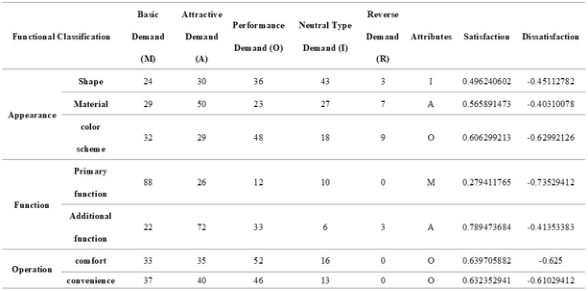
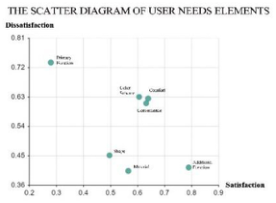
According to the above theoretical analysis, the user needs classification and satisfaction coefficient were obtained (see Figure 4), and the scatter diagram of user needs elements were brought (Figure 5).
In the scatter diagram of user requirement elements, as the distance of requirement from the origin indicates the priority of the function in the design, the closer the length from the source, the lower the importance of development. Therefore, the emphasis of requirements can be obtained intuitively according to the diagram, from high to low: comfort, extended function, convenience, color scheme, an essential function, material, and shape. As the condition is a non-differentiated demand, the design can ignore it. At the same time, the basic procedure is a necessary demand, and only the process can be satisfied in the design, so the focus of the invention should be on comfort, extended function, convenience, color, and material, which are the keys to improve user satisfaction.
Design Analysis of Sit-up Booster Based on KANO Model 163
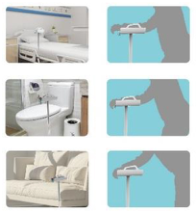
Figure 4: User needs classification and satisfaction coefficient.Figure 5: The scatter diagram of user needs elements were obtained.Figure 6: The use of the product scene diagram (Left) and the use flow chart (Right).
ESIGN PRACTICE When users use a product, they experience it mainly through behavior and psychology (Huiping Liang, 2008). Design acts as a bridge for communica- tion between products and users by improving details to connect users and products closer. The sit-up booster will be designed around the user’s primary needs using the KANO model to analyze and get the center of gravity of the user’s needs that sort the product functions according to demand.
The five key aspects of improving user satisfaction are behavioral experie- nces and psychological perceptions. Behavioral experiences include comfort, extended function, and convenience, while psychological perceptions mainly
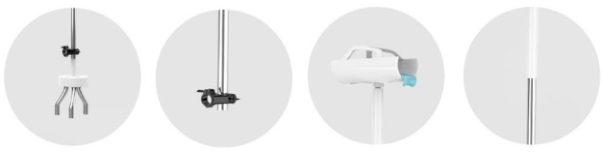
Figure 7: Product details.
include color matching and material. The product mostly follows the fol- lowing principles when designing the details (see Figure 7): the principle of security, usability, and universality.
Safety principle: As a health care product, mainly users include pregnant women and older adults who need special care and have limited mobility, so the product’s safety cannot be ignored. The sit-up booster is used to assist users in standing up and sitting down. It is an essential element to ensure that it does not injure them in the process, and it must be safe and reliable in design.
Ease of use principle: No matter the elderly, pregnant women, or other users who are all people with inconvenient mobility, more attention should be paid to the difficulty of operation when designing. Especially for elderly users, their physical function deteriorates and their memory also declines weakened learning ability so that it takes longer to digest complex processes. The ope- ration of the sit-up booster must be simple, and the time cost and reduce use as much as possible difficulty.
Universal Principle: With the progress of society, the object of inclusive design has gradually shifted from the disabled to the whole population, dividing it into three categories: people-centered, product-centered, and environment-centered. Simeon Keates and P. John Clarkson pointed out inclusive design as a design philosophy, aiming to make products and services accessible to the broadest possible range of users, regardless of impairment, age, or ability, creating products and services. Availability is greatly improved.
As a solution to the general difficulties of more and more people in society, the sit-up booster can apply to different statures, ages, heights, and even pla- ces which have become an essential function of the product. Aiming different types of users considers color matching and materials more severely in the product design stage.
THE USE PROCESS OF SIT-UP BOOSTER The figure shows the scene diagram of product use and the flow chart (see Figure 8). When using the device to stand up, the forearm is placed on the device first to support the body through downward force. The palm holds the front end of product for better detail, while the reaction force by the air pressure bar will provide the user to achieve the purpose of completing the act of standing up in a more energy-efficient manner. Using this product to sit down is just the opposite.
Design Analysis of Sit-up Booster Based on KANO Model 165
CONCLUSION
Although the product has a certain degree of feasibility, the product lacks feedback signals such as vibration, sensory stimulation, magnetic suction, and other signs, so the user cannot determine whether the product is working correctly after completing the operation. The corresponding part needs to be optimized to strengthen the movement to a more convenient interactive behavior experience.
This design research is aimed at more and more people with waist discom- fort in today’s society, and it is found that they need to improve and improve their needs in life, and the design of sit-up boosters has emerged as a general trend. This paper conducts research on it through user interviews and user journeys, and at the same time using the KANO model to analyze the survey results to obtain the critical needs of users for the product. According to the user’s requirements in different functions, the accepted aspects are prioriti- zed, based on which the sit-up booster design is realized, which provides a direction for creating the sit-up booster in the future.
REFERENCES
Berger, C, Blauth, R, Boger, D, Bolster, C, Burchill, G, DuMouchel, W, Pouliot, F, Richter, R, Rubinoff, A, Shen, D, Timko, M and Walden, D (1993) Kano’sKano’s method for understanding customer-defined quality, Center for Quality of Mana- gement Journal Vol 2 No. 4 pp. 3–35. Endmann, A., & Keßner, D. (2016). User Journey Mapping – A Method in User
Experience Design. i-Com, 15(1). doi:10.1515/icom-2016-001 Guo Jie, Liu Dawei, Wang Gan, Cui Jiaqi, Zou Jinluo, Zhao Pengyang (2019). Research status and development trend of assistive standing devices [J]. Mechanical Research and Application, 2019, 32(06): 196–201. doi: 10.16576/j.cnki.1007– 4414.2019.06.063. Huiping Liang, & Rongbing Mu. (2008). Research on humanization design based on
product details. 2008 9th International Conference on Computer-Aided Industrial Design and Conceptual Design. doi:10.1109/caidcd.2008.4730513 Lai, X, Xie, M and Tan, K C (2004). Optimizing product design using the Kano model and QFD, in 2004 IEEE International Engineering Management Conference, 18–21 Oct., pp. 1085–1089. Meng Ya, Cao Jujiang, Sun Jiwei, Liu Dandan (2012). Design of standing-
assisting seat for the old scooter[J]. Packaging Engineering, 2012, 33(02):47-50. doi:10.19554/j.cnki.1001 -3563.2012.02.013. Wang Jiaqing, Dai Hongwei, Li Yu, Liu Wanfu, Wang Xiongzhi, Wang Yongquan (2021). Design of a movable power assist device for helping the elderly to sit up [J]. Light Industry Science and Technology, 2021, 37(12):51–52.
LISTED IN THE AHFE DIGITAL BOOKSTORE CATALOGUE
Explore the complete digital volume
Human Factors in Aging and Special Needs
Read this individual research paper free through the original publisher, or explore the full digital proceedings book.
ISBN 978-1-958651-14-8
Explore this ISBN in the AHFE Bookstore ↗Listed in the July 2026 bookstore catalogue; search by ISBN to confirm current availability · Digital book purchase optional