Valeria Bopp-Bertenbreiter, Stefan Klein, Doreen Engelhardt, Lena Rittger, Frederik Diederichs, Harald Widlroither, Matthias Peissner (2022). Eliciting potential for positive UX using psychological needs: Towards a user-centered method to identify technologies for UX in the car interior. In: Usability and User Experience. AHFE Open Access, vol. 39, pp. 58–66. https://doi.org/10.54941/ahfe1001691
Positive user experiences (PUX) in the vehicle interior will be enabled by choosing the technologies with the potential to provide such experiences. Design for PUX in general exists, but methods to assess and compare technologies regarding their PUX potential are missing. Building on the insight that fulfillment of basic psychological needs may lead to PUX (Hassenzahl et al., 2010), this paper presents the first iteration of the user-centered method Tec4UXNeeds. Tec4UXNeeds combines VR representations of technologies and half-structured interviews to identify PUX potential of technologies: which basic psychological needs a technology may fulfill and in which use cases the technology could be used to enable need fulfillment. The method is applied for two display technologies in a standardized within-subjects study (n = 27). The study investigates whether the method Tech4UX enables participants to describe whether a technology has a potential to fulfill psychological needs for them and whether the method is specific enough to find differences in need fulfillment potential between technologies described by participants.Preliminary results identified distinct levels of need fulfillment for the first and second display technology (Display on Demand & Holography). Data will be analyzed further using qualitative content analysis. The method will be optimized iteratively in the future.
Future positive user experience (PUX) of automotive brands will depend on implementing innovative technologies into the interior of the future and appl- ying them in a suitable context for PUX. User experience is defined as “user’s perceptions and responses that result from the use and/or anticipated use of
Eliciting Potential for Positive UX Using Psychological Needs 59
a system, product or service […] [including] […]the users’ emotions, beliefs, preferences, perceptions[…].” (ISO International Organization for Standar- dization, p. 4) Technologies are defined as the know-how to solve a technical problem, which, once applied, results in technical solutions (Bullinger 1994). Understanding the PUX potential of technologies early on in the product development of a vehicle will be a key factor to satisfy customer needs in the appropriate use cases for future vehicles (Rittger & Schrader, 2021).
Assessing Technology Potential Regarding User Experience Methods from technology management are used to assess emerging tech- nologies: The technology potential analysis identifies relevant applications, technological and economic potential of a technology (Ardilio, 2013). Bauer et al. (2019) combine methods of traditional technology management with a user-centered approach. They identify a technology’s relevant application scenarios by combining the Delphi method (Niederberger & Renn, 2019), literature reviews, impact analysis, and expert discussion. These scenarios are transferred into Virtual Reality (VR) to assess user acceptance. While these methods are valid for traditional technology assessment, their focus lies on technology potential for technological and economic development, not PUX. Like Bauer et al. (2019), this work uses VR to make technologies experienceable.
User Experience as a discipline provides several approaches to develop towards PUX: Positive design aims to develop for a range of positive emo- tions (Desmet, 2012), while the Experience Categories approach seeks to enable activities experienced as positive (Haspel et al., 2020; Laib et al., 2017). The need-based approach develops for PUX through the fulfillment of basic psychological needs (Pollmann et al., 2018), as need fulfillment during human-machine interaction may lead to PUX (Fronemann & Peissner, 2014; Hassenzahl et al., 2010). Furthermore, human development and well- being depend on the fulfillment of needs (Deci & Ryan, 2000). Therefore, the needs-based approach is used as foundation of this work. Need-based methods include replicating PUX patterns for fulfillment of specific needs (Knobel et al., 2012), building PUX from scratch based on the needs (Eckoldt et al., 2013), eliciting user improvements for product concepts with the needs serving as a basis for ideation (Fronemann & Peissner, 2014) or using needs profiles to create empathy in the developers for the users’ perspective (Krüger et al., 2017). However, methods to explicitly elicit and compare technologies’ potential for PUX and to identify suitable use cases early on in product deve- lopment are currently missing. This paper contributes to the state of the art by introducing a method to assess which needs a technology may fulfill once it is implemented in the vehicle.
TOWARDS A METHOD TO IDENTIFY NEED FULFILLMENT POTENTIAL OF TECHNOLOGIES IN THE CAR: TEC4UXNEEDS Fulfilling basic psychological needs seen as particularly relevant in human- machine interaction (Fronemann & Peissner, 2014; Hassenzahl et al., 2010) a promising approach to enable PUX. Therefore, it is crucial to identify the
need-fulfillment potential of technologies to choose the best technology for desired PUX (Bopp-Bertenbreiter et al., 2021). Consequently, in this work a technology’s potential for PUX is defined as assessment of which basic psych- ological needs a technology may fulfill and in which use cases the technology could be used to enable need fulfillment.
As UX is a subjective impression of individuals (ISO International Orga- nization for Standardization), we propose user-based approach for the Tech4UXNeeds method. This enables us to investigate whether a techno- logy has certain “basic need-fulfillment impacts” on users, which are shared throughout the user base or whether user experiences of technologies differ immensely.
Phase 1: Gather Data & Make the Technology Experienceable To assess a technology’s need fulfillment potential with users, Tec4UXNeeds applies an approach similar to Bauer et al. (2019) to make the technolo- gies experienceable: Expert knowledge of the technologies (basic functions, limitations, and maturity level) is turned into VR representations. The advan- tage of VR is to let users experience emerging technologies not yet applicable in real world to enable assessment, following the information accelera- tion approach (Urban et al., 1996). Utilizing VR to let users experience technologies furthermore enables comparison of technologies in the same environment, with the same content design, regardless of the influence the quality of real-world prototypes might have.
Phase 2: Elicit Need-Fulfillment Potential of Technologies in a Standardized User Study After participants of the user study experience a technology in VR, Tech4UXNeeds explores the PUX potential through need fulfillment for the technology using a mixed-methods approach: need fulfillment is measured quantitatively through the needs questionnaire (Sheldon et al., 2001) in the version translated by Diefenbach and Hassenzahl (2017). Qualitative data is utilized to assess need fulfillment in participants’ own words and to gain a deeper understanding on reasons for need satisfaction or frustration through experiencing the technology.
In a half-structured interview, adapted need cards (Siegen University) intro- duce 8 basic psychological needs to the participants through definitions, associated words, quotes and figures. For each need, participants are asked to answer the questions stated below (using the need “Autonomy” as an exam- ple). Laddering (Reynolds & Gutman, 1988) is applied to investigate reasons for need fulfillment:
1. What did you experience? Did you feel autonomous/ self-reliant/self- determined when experiencing the technology? 2. How can this technology enhance the autonomy experience? How would the experienced technology need to be optimized so that you would feel more autonomous when experiencing the technology? Give examples. 3. In what situations can this technology enhance the autonomy experience? In what situation/use cases should the experienced technology be used
Eliciting Potential for Positive UX Using Psychological Needs 61
to make you feel as autonomous as possible? Please describe concrete situations.
A scale from 0 – “No potential: I don’t feel autonomous at all with this technology.” to 100 – “Very high potential: I feel extremely autonomous with this technology.” then asks participants to assess the technology’s potential to fulfill the need, given optimization and suitable situation. An “Assessment not possible” option is given.
Research Questions for First Application of the Tec4UXNeeds Method For the first application of the method, the following research are investigated:
Research Question 1: Does the method Tech4UXNeeds enable par- ticipants to describe whether a technology has a potential to fulfill psychological needs for them, i.e., to assess a technology’s potential for PUX?
Research Question 2: Is the method Tech4UXNeeds specific enough to find differences in need fulfillment potential between technologies descri- bed by participants, i.e., to differentiate between their PUX potential?
FIRST ITERATION OF THE TEC4UXNEEDS METHOD A first application of the Tech4UX method was conducted to validate and ite- ratively optimize the method. The method was applied for two technologies to investigate RQ 1 & 2.
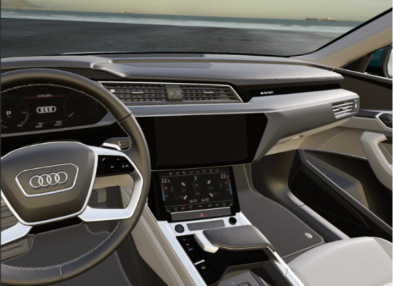
In phase 2, a within-subjects design was used for two technologies which basic function it is to visually communicate information: “Display on Demand” and “Holography”. The VR representations of the technolo- gies were experienced in a VR state-of-the-art vehicle interior (see fig. 1) in randomized order. To allow for cost-efficient technology assessment and to reduce possible influence of content on need fulfillment, the VR representa- tions of the technologies were implemented to show only the basic functions of the technologies: For each technology, the same globe was implemented as exemplary content.
Sample. 27 participants (33% female, 67% male) took part in the study. The mean age was 35.33 years (SD = 10.38, Min = 20, Max = 60). Each session lasted 100 to 130 minutes. Participants were company-internal due to confidentiality of the technologies and received no financial compensation.
Figure 1: Vehicle interior as represented to the participants in VR.Figure 2: Procedure carried out for each technology in the user study.
Procedure. After informed consent, demographic data and previous kno- wledge of the respective technology was obtained. Participants then fami- liarized themselves the VR environment using the interior of a series veh- icle (see fig. 1). Participants experienced the procedure shown in fig. 2 for both technologies. Verbal statements of participants were noted down by a minute-taker, as audio recording was forbidden by company regulations.
Coding the data. The first verbal question on need fulfillment potential (“What did you experience? Did you feel autonomous/ self-reliant/self- determined when experiencing the technology?”) was prepared as a yes/no- alternative, but participants often answered gradually. Therefore, partici- pants’ responses were categorized into a scheme by two independent raters for further analysis: “Yes” (experiencing the technology leads to need satisfa- ction), “No”(experiencing the technology does not lead to need satisfaction), and “Unable to assess” (could not assess need satisfaction in this form of experiencing the technology).
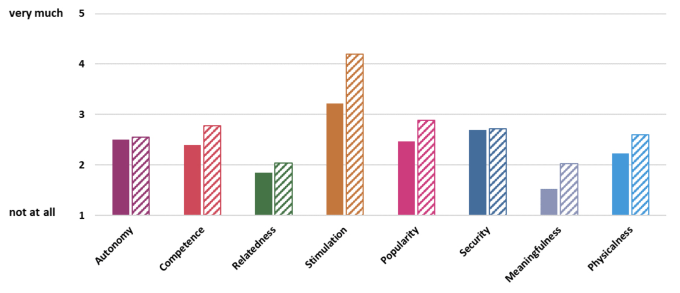
PRELIMINARY RESULTS This paper presents preliminary results of the first iteration of the Tech4UXNeeds method, especially regarding the first verbal question. A dee- per analysis of the data by qualitative content analysis is in preparation. 3 of the 30 participants overall had to be excluded due to missing data, resulting in 27 valid participants. Figure 3 shows descriptive results of the needs que- stionnaire (Sheldon et al., 2001) in the version translated by Diefenbach and Hassenzahl (2017).
Eliciting Potential for Positive UX Using Psychological Needs 63
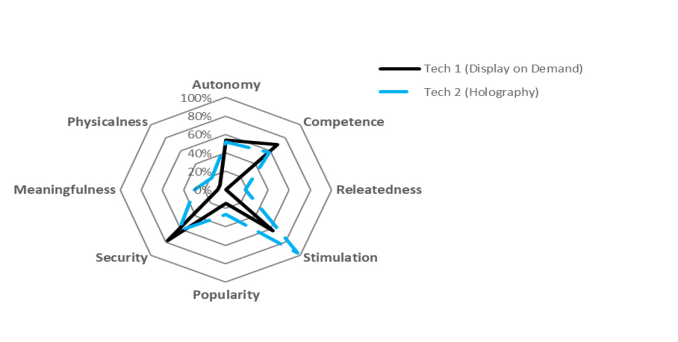
Figure 3: Need fulfillment while experiencing the technology, assessed using an ada- pted version of the translation by Diefenbach and Hassenzahl (2017), based on Sheldon et al. (2001).Figure 4: Satisfaction of respective need through experiencing the technology. Shown as percentage of “yes” responses to first verbal question. 100% = number of subjects able to assess experience.Table 1. Interrater reliability – Cohen’s Kappa κ with 95% confidence intervals (CI).
Reasons for need satisfaction or frustration while experiencing the tech- nologies (verbal question 1) will be further analyzed. Answers to verbal questions 2, 3 and 4 seem to differ distinctly between technologies and will be further investigated by means of a qualitative content analysis.
CONCLUSION & OUTLOOK Data reviewed so far indicates that the method Tech4UXNeeds provides a promising approach to assess PUX potential of technologies. Regarding RQ1, the method Tech4UXNeeds enables participants to describe whether experi- encing a certain technology has a potential to fulfill psychological needs for them: For all needs, at least 85% of participants were able to express their need fulfillment verbally. Four participants, however, mentioned that they would need to interact with the technologies to assess their degree of need ful- fillment for competence for Tech1: Display on Demand. As response patterns differ between technologies and needs, RQ 2 (Is the method Tech4UXNeeds specific enough to find differences in need fulfillment potential between tech- nologies described by participants, i.e., to differentiate between their PUX potential?) may be answered positively.
Next steps will include a qualitative content analysis of reasons for sati- sfaction or frustration of different needs per technology to better understand under which conditions a technology may fulfill a respective need. Partici- pant’s suggestions for technology optimization to better fulfill a need will be clustered to identify whether patterns emerge. Participants stated use cases in which the technology should be used to fulfill a particular need as well as possible. These will be analyzed to learn whether there are use cases in which a technology can fulfill a need particularly well for many users. Such technology-use case combinations would be promising for follow-up studies and for optimizing implementation and operation of technologies to enable fulfillment of a specific need. To optimize the Tech4UXNeeds method, rea- sons for “inability to assess degree of need fulfilment” will be examined, e.g., how a technology must be experienced to enable such estimation. Optimi- zation ideas include basic interaction for standard use cases or using a VR interior of a fully automated vehicle. Further studies will include a set of questions to assess conditions that further facilitate evaluation of need ful- fillment potential. Results are going to be discussed regarding applicability in development towards PUX with experts from industry and science to further streamline the Tec4UXNeeds method.
ACKNOWLEDGMENT
The authors want to thank Samuel Müller and Philipp Sawitzki for imple- menting the VR experience and Steffen Ross for connecting us with the VR professionals. The authors thank the participants of the study. The authors are grateful to Andrea Vogt for providing valuable feedback on data analysis.
Eliciting Potential for Positive UX Using Psychological Needs 65
REFERENCES
Ardilio, A. (2013). Eine Vorgehensweise zur strategischen Technologieentwicklungsplanung für Forschungseinrichtungen. Zugl.: Stuttgart, Univ., Diss., 2013. Schrif- tenreihe zu Arbeitswissenschaft und Technologiemanagement: Vol. 6. Fraunhofer- Verlag. http://www.bookshop.fraunhofer.de/buch/239553 Bauer, W., Braun, S., Ruess, P., & Schaufler, C. (2019). Mobility-in-Disruption:
Vorgehensmodell für nutzerzentrierte Technologievorausschau im Bereich urba- ner Mobilität bis 2049. In J. Gausemeier, W. Bauer, & R. Dumitrescu (Eds.), Verlagsschriftenreihe des Heinz Nixdorf Instituts: Band 390, Vorausschau und Technologieplanung: 15. Symposium für Vorausschau und Technologieplanung: 21. und 22. November 2019, Berlin (11-25). Heinz Nixdorf Institut Universität Paderborn. https://d-nb.info/1203710798/34#page=293 Bopp-Bertenbreiter, V., Rittger, L., & Diederichs, F. (2021). MatchUT: Matching Need-Based User Requirements and Technology Impacts to Create UX. In H. Binz, B. Bertsche, D. Spath, & D. Roth (Eds.), Stuttgarter Symposium für Produ- ktentwicklung SSP 2021: Stuttgart, 20. Mai 2021, Wissenschaftliche Konferenz. Fraunhofer-Institut für Arbeitswirtschaft und Organisation IAO. Deci, E. L., & Ryan, R. M. (2000). The “What” and “Why” of Goal Pursuits:
Human Needs and the Self-Determination of Behavior. Psychological Inquiry, 11(4), 227–268. https://doi.org/10.1207/S15327965PLI1104_01 Desmet, P. M. A. (2012). Faces of Product Pleasure: 25 Positive Emotions in Human- Product Interactions. International Journal of Design, 6(2). http://www.ijdesign.o rg/index.php/IJDesign/article/viewFile/1190/466 Diefenbach, S., & Hassenzahl, M. (Eds.). (2017). Die Wirtschaftspsychologie. Psych-
ologie in der nutzerzentrierten Produktgestaltung: Mensch-Technik-Interaktion- Erlebnis. Springer. https://doi.org/10.1007/978-3-662-53026-9 Eckoldt, K., Hassenzahl, M., Laschke, M., & Knobel, M. (2013). Alternatives: Exploring the Car’s Design Space from an Experience-Oriented Perspective. In Dppi ‘13: Proceedings of the 6th International Conference on Designing Pleasu- rable Products and Interfaces (p. 156). Association for Computing Machinery. https://doi.org/10.1145/2513506.2513523 Fronemann, N., & Peissner, M. (2014). User experience concept exploration. In
V. Roto (Ed.), Proceedings of the 8th Nordic Conference on Human-Computer Interaction: Fun, fast, foundational: Helsinki, Finland - October 26 - 30, 2014 (pp. 727–736). ACM. https://doi.org/10.1145/2639189.2641203 Haspel, C., Stockinger, C., Laib, M., & Burmester, M. (2020). Positive Erlebnisse bei der Interaktion mit Assistenzsystemen gestalten – Die Erlebnispotentialanalyse. In C. Hansen, A. Nürnberger, & B. Preim (Eds.), Mensch und Computer 2020 - Workshopband. Gesellschaft für Informatik e.V. https://doi.org/10.18420/MU C2020-WS116-003 Hassenzahl, M., Diefenbach, S., & Göritz, A. (2010). Needs, affect, and interactive
products – Facets of user experience. Interacting with Computers, 22(5), 353–362. https://doi.org/10.1016/j.intcom.2010.04.002 ISO International Organization for Standardization. Ergonomics of human-system interaction – Part 11: Usability: Definitions and concepts (ISO 9241-11:2018(E)). Geneva, Switzerland. ISO International Organization for Standardization. Knobel, M., Hassenzahl, M., Lamara, M., Sattler, T., Schumann, J., Eckoldt, K.,
& Butz, A. (2012). Clique Trip: Feeling Related in Different Cars. In Unknown (Ed.), Proceedings of the Designing Interactive Systems Conference: Dis 2012; Newcastle Upon Tyne, United Kingdom, June 11 - 15, 2012 (p. 29). ACM. https://doi.org/10.1145/2317956.2317963
Krüger, A. E., Kurowski, S., Pollmann, K., Fronemann, N., & Peissner, M. (2017).
Needs profile. In A. Soro (Ed.), ICPS, OzCHI 2017 - Human Nature: Proceedings of the 29th Australian Computer-Human Interaction Conference (OzCHI 2017): Brisbane 28th November -1st December, 2017 (pp. 41–48). The Association for Computing Machinery. https://doi.org/10.1145/3152771.3152776 Laib, M., Burmester, M., & Zeiner, K. (2017). Erlebnispotentialanalyse - Mit Systematik zu positiven Erlebnissen. In S. Hess & H. Fischer (Eds.), Mensch und Computer 2017 - Usability Professionals. Gesellschaft für Informatik e.V. https: //doi.org/10.18420/MUC2017-UP-0233 Landis, J. R., & Koch, G. G. (1977). The Measurement of Observer Agreement for
Categorical Data. Biometrics, 33(1), 159. https://doi.org/10.2307/2529310 Niederberger, M., & Renn, O. (2019). Delphi-Verfahren in den Sozial- und Gesundheitswissenschaften: Konzept, Varianten und Anwendungsbeispiele. Springer VS. https://doi.org/10.1007/978-3-658-21657-3 Pollmann, K., Fronemann, N., Krüger, A. E., & Peissner, M. (2018). Positec – How
to Adopt a Positive, Need-Based Design Approach. In A. Marcus & W. Wang (Eds.), Lecture Notes in Computer Science: Vol. 10920. Design, User Experience, and Usability: Users, Contexts and Case Studies: 7th International Conference, DUXU 2018, Held as Part of HCI International 2018, Las Vegas, NV, USA, July 15-20, 2018, Proceedings, Part III (Vol. 10920, pp. 52–66). Springer International Publishing. https://doi.org/10.1007/978-3-319-91806-8_5 Reynolds, T. J., & Gutman, J. (1988). Laddering theory, method, analysis, and interpretation. Journal of Advertising Research, 28(1), 11–31. Rittger, L., & Schrader, T. (2021). Novel experiences and human centered develo-
pment in the vehicle. In A. Riener, J. Myounghoon, & I. Alvarez (Eds.), Studies in Computational Intelligence: Vol. 980. User Experience Design in the Era of Auto- mated Driving (1st ed.). Springer International Publishing. https://www.springer.c om/gp/book/9783030777258#bibliographic Sheldon, K. M., Elliot, A. J., Kim, Y., & Kasser, T. (2001). What is satisfying about satisfying events? Testing 10 candidate psychological needs. Journal of Personality and Social Psychology, 80(2), 325–339. https://doi.org/10.1037/0022-3514.80.2. 325 Siegen University. Need Cards: Experience Design Tools. http://www.experienceandi
nteraction.com/tools/ Urban, G. L., Weinberg, B. D., & Hauser, J. R. (1996). Premarket Forecasting of Really-New Products. Journal of Marketing, 60(1), 47–60. https://doi.org/10. 1177/002224299606000105
LISTED IN THE AHFE DIGITAL BOOKSTORE CATALOGUE
Explore the complete digital volume
Usability and User Experience
Read this individual research paper free through the original publisher, or explore the full digital proceedings book.
ISBN 978-1-958651-15-5
Explore this ISBN in the AHFE Bookstore ↗Listed in the July 2026 bookstore catalogue; search by ISBN to confirm current availability · Digital book purchase optional