Consuelo Latorre-Sánchez, Juan Antonio Solves-Llorens, Joaquín Sanchiz-Navarro, Ricardo Bayona Salvador, José Laparra-Hernández, Nicolas Palomares Olivares, José Solaz Sanahuja (2022). Methodology Based on 3D Thermal Scanner and AI Integration to Model Thermal Comfort and Ergonomics. In: Digital Human Modeling and Applied Optimization. AHFE Open Access, vol. 46, pp. 25–34. https://doi.org/10.54941/ahfe1001896
The current pandemic situation due to the appearance of the coronavirus-2 or SARS-CoV-2 (COVID-19) has increased the demand and familiarization of the population with infrared cameras and their thermal interpretation. Infrared radiation and the technology behind it have become a necessity not only developing new applications for the present but also for the future. In the post-pandemic world, commercial solutions to existing problems are being developed with this technology and with very efficient approaches, reducing costs and complementing many areas.Institute of Biomechanics of Valencia (IBV) is constantly innovating in the field of infrared thermal imaging and its applications in the well-being of people through research, experimentation and user validation. 3D models have been developed merging anthropometric data and thermal information based on scanners, 3D reconstruction and imagen processing. Some of the algorithms for monitoring and reconstruction system are based on a FLIR A35 thermal camera and an INTEL RealSense D455 depth sensor, a low-cost, high-performance sensor.Artificial intelligence techniques applied to images, mainly in visible or RGB datasets, have undergone significant development in recent years, however there is a gap in the application in thermal images. The IBV has compiled a powerful database for years from many users, insulation in clothes, extreme scenarios and different poses and face orientations. Many networks, models and libraries of computer vision, have been explored and some AI techniques (machine and deep learning) have been applied to extract information from those images, although open solutions and networks do not work accurately. The thermal database has been used to retrain these network models and the results have been considerably better.Near real-time, low-cost 3D thermal reconstruction, with embedded AI techniques, has been applied in facemasks evaluation, face recognition, feature and key points extraction, segmentation and development of automatic thermal measure algorithms. From feature extraction and landmark information, aspects such as thermotype, age and sex, have been also determined, or even the effects of the emotions, rotations or artifacts like glasses, facemasks or beards on the identification of the user. IBV has a huge background in this technology and develops new innovative solutions in order to tackle with new challenges, from determining the effect a facemask has, in thermal comfort or breathing rate to helping physician to diagnose certain diseases, such as circulatory, vascular problems and the effect of therapies or cosmetic products. In this way, information on the thermoregulatory behavior of the human body is provided, allowing to relate changes in thermal maps, to certain pathologies or to the effect of a treatment, skin affections, varicose veins or joint injuries.
The aim of this study is to use the power of thermography to understand human behavior, applying very promising techniques of artificial vision and 3D reconstruction, to obtain information from thermal images about the user, features and propose a follow-up of treatments, help to diagnose or predict thermal sensation and thermal comfort.
Thermal comfort is a subjective psychological perception. It is defined as that condition of mind which expresses satisfaction with the thermal environ- ment (i.e., with the combined effect of air temperature, humidity, wind speed, and thermal radiation) and it is assessed by subjective evaluation (American Society of Heating, 2004). No thermal environment can satisfy everybody (Fanger, 1970), and individual differences, sex, age, nationality and other parameters have an effects on the subjective perception of the thermal com- fort. Reviewing the scientific literature, gender, age, nationality differences in
thermal comfort are considered to be small and insignificant (Fanger, 1970; Humphreys, 1976) at neutral temperatures. However, recent published stu- dies reveal significant differences between genders (Djongyang et al., 2010; Frontczak and Wargocki, 2011; van Hoof, 2008).
Moreover, without distinction for the sex variable, the perception of thermal comfort worsens with age.
Above neutrality, people regulate body temperature by vasodilatation and sweating. Sweat rates and sweat distribution are different in gender, age and thermotypes (Latorre-Sánchez et al., 2020). Sweat is distributed in females more heavily towards the lower body than males. (Smith and Havenith, 2012, 2011). When the body cools down, the first reaction to heat production is vasoconstriction, reducing blood flow through the skin, and increasing internal heat production by stimulating the muscles.
In presence of pathologies or injuries in skin, joints or muscles, the body’s thermoregulatory response presents localized and/or generalized changes. Acute and chronic pain can be a difficult medical problem to diagnose and treat and can be caused by symptoms such as tissue injury, inflammation, a surgical procedure, or disease. On many occasions the pain is associated with a variation in local temperature. Skin pathologies also show variations in the thermal pattern of a subject. For this reason, InfraRed Images (IR) provide additional and complementary information.
The current pandemic situation due to the appearance of the coronavirus- 2 or SARS-CoV-2 (COVID-19) has increased the demand and familiarization of the population with infrared cameras and their thermal interpretation. The Institute of Biomechanics of Valencia (IBV) has integrated thermal informa- tion to applications based on anthropometric scanners, allowing to combine shape, posture, movement and temperature variations. Thermography is a non-invasive, non-radiating technique particularly valuable for the explo- ration of the topography or pattern of skin temperature across the body (Fournet, D., 2013; James C et al., n.d.). Medical infrared thermography is used for analyzing physiological functions related to skin temperature. Technological advances have made it a reliable medical measurement tool (Hildebrandt et al., 2010).
Artificial Intelligence (AI) techniques applied to images, mainly in visible or RGB datasets, have undergone significant development in recent years, how- ever there is a gap in the application in thermal images. The IBV has compiled a powerful database for years from many users, insulation in clothes, extreme scenarios and different poses and face orientations.
Many networks, models and libraries of computer vision, have been explo- red and some AI techniques (Machine Learning and Deep Learning) have been applied to extract information from those images, although open solu- tions and networks do not work accurately. The thermal database has been used to retrain these network models and the results have been conside- rably better, being able to detect body silhouettes, faces, recognition and predict user’s characteristics such as age, gender or thermotype and achi- eve Thermal Comfort predictions useful to design intelligent self-adjustable
Methodology Based on 3D Thermal Scanner and AI Integration to Model Comfort 27
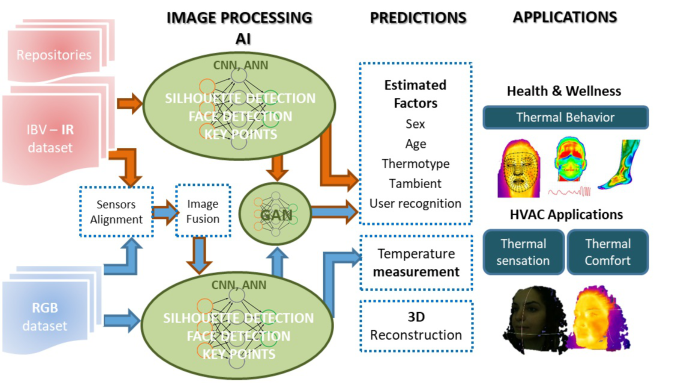
Figure 1: Scheme of the study: Global approach.
thermal systems. Algorithms that identify the subject and automatically mea- sure the temperature at predefined key points, also allow to track changes in the temperature of parts of the body and generate a multitude of Health applications.
METHODS
The methodology of this study of IR image processing began performing Image Fusion between visible and infrared images form a synchronized data- set in order to extrapolate feature extraction and key points from visible images to thermal ones.
The second part was testing AI techniques used for visible or RGB images on IR dataset. (See Fig.1). Silhouette or face detection models were retrai- ned with the thermal dataset, and key points were used to measure the temperature automatically.
Finally, these techniques were applied to 3D thermal scanner, with a low- cost, near real time system that integrates visible and thermal information in different layers.
Within the IVACE TERMO4D project, innovative methodologies based on IR have been implemented applying AI techniques in a database from a wide range of cameras, from high-cost and precision systems for labora- tory (< 0.02K) to low-cost solutions. This user database is made up of more than 300k thermographs and thermal sequences, in a temperature range from −5°C to + 40°C, with different clothing and postures. The dataset of this study is composed for IR images, NIR (Near IR) images and visible RGB (Red-Green-Blue) images from thermal cameras FLIR T650sc, FLIR A35, OPTRIX and the depth sensor Intel RealSense (Table 1). Open repositories have been also used (Nikisins et al., 2014).
Table 1. Camera, resolution, numbers of images, example Camera Images Format Resolution
FLIR A35 IR *.yml, *.gz 320x240 140 30 4200 OPTRIX IR *.yml, *.gz 382x288 random 150 >5000 Intel Real Sense D435
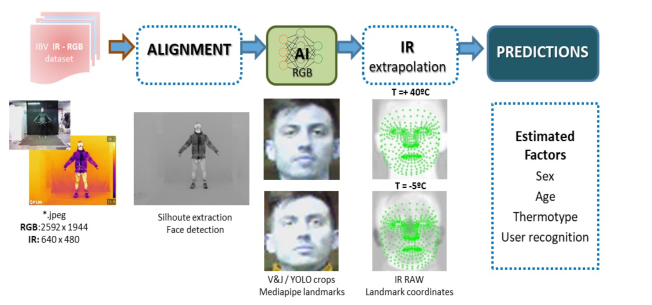
AI Applied on RGB Images and Extrapolation to IR Applying AI techniques to data conditioning was the first objective. Images and videos from FLIR T650sc dataset are encoded and must be converted before any usage. This camera provides IR images and RGB at simultaneous trigger.
In order to use the RGB-Thermal pairs, a transformation matrix was deve- loped to compensate the misalignment between the RGB and the thermal collections.
The preliminary approach was to perform data extraction from RGB ima- ges and extrapolate it to the thermal images. This result provides very good results although it is limited to datasets with synchronized RGB and thermal images.
Detection problems have become one of the most important tasks in arti- ficial vision scenarios, and mainly face detection. The Viola-Jones algorithm (Viola and Jones, 2001) and the YOLO (You Only Look Once) algorithm (Redmon et al., 2016) were selected. V&J is characterized by being robust, in real time, based on classical techniques and only for grayscale facial reco- gnition problems. In modern computer vision detection problems, robustness is one of the most important aspects to consider, as well as speed of inference. YOLO arose from mixing these two features, applying a single Convolutional Neural Network (CNN) to the entire image.
The problem of facial recognition has been extensively studied. Clas- sical algorithms have been proposed to solve this problem (Albiol et al., 2008; Heisele et al., 2001; Hildebrandt et al., 2010) and more recen- tly, deep learning approaches can achieve human-like performance in per- son recognition (Schroff et al., n.d.; Sun et al., 2015; Taigman et al., 2014). Those approaches use CNNs to derive feature vectors that are capable of identifying faces. Other solutions are based on landmarks. Keypoints have also been applied in an RGB body landmark convoluti- onal model (SimplePose (Li et al., 2020)) and with Mediapipe libraries (Lugaresi et al., 2019).
Points have been extracted using these models in the RGB dataset and overlaid with their corresponding thermal image. Several thermographs of
Methodology Based on 3D Thermal Scanner and AI Integration to Model Comfort 29
Figure 2: AI applied on RGB dataset and Mediapipe extrapolation to IR images.
each user were used at different ambient temperatures to estimate factors such as the user’s thermotype.
AI Applied on IR Images Focusing on the use of thermal imaging, algorithms were tested. PSPNet, ViolaJones or YOLO have been retrained with full body thermal data from FLIR T650sc and FLIR A35 cameras.
First step has been to detect the silhouette from IR images. For the segmen- tation of the human body in thermal images, a PSPNet (Zhao et al., 2017) with thermal images has been retrained to recognize two classes: human body and background. Second step has been to detect faces on IR ima- ges. Some Viola-Jones models and YOLO have been trained. Positive and negative samples have been extracted from VAP RGB-D-T Facial Database (Nikisins et al., 2014) using face bounding boxes for positive samples, and other parts of the image as negative samples. YOLO has been selected as a solution for the big number of false positives produced by Viola-Jones algorithm.
Over the detected faces, two methods have been considered for user recognition and soft biometric traits estimation.
Method I: based on using IN images as normal images to obtain fea- ture vectors that identify faces from different people. Some studies used CNNs trained in normal images (Kakarwal et al., 2020; Mostafa et al., 2013) and others retrained popular CNNs with thermal images (Kakarwal et al., 2020; Szankin et al., 2019). In this study a known CNN for image classification has been used: VGG16 (Simonyan and Zisserman, 2015), pretrained with the public dataset ImageNet (Russakovsky et al., 2015). Soft biometric traits from facial images has been estimated using feature vectors obtained from CNNs to directly guess biometric traits (Kurba- nov et al., 2019; Qawaqneh et al., 2017). The feature vectors from the modified VGG16 (used in facial identification) had been used for gender, age and thermotype estimation. A simple Feed-Forward Neural Network (FFN) and a Support Vector Machine (SVM) were utilized to obtain those
biometric traits, applying also a Principal Component Analysis (PCA) reduction to reduce the size of feature vectors and to short training time.
Method II: based on key points. The thermal measurement information at the located reference points is used to obtain data such as thermotype, age or gender. A RGB body landmark convolutional model (SimplePose (Li et al., 2020)) was preliminary retrained to detect facial landmarks. For the thermal face landmark dataset, some concrete point locations to measure the temperature were selected from Mediapipe (Lugaresi et al., 2019). An algorithm based on the probability of appearance, following a gaussian distribution, has been generated to reduce the number of landmarks from 468 to 12.
The study of artifacts in the thermal faces like beard or glasses, has made it possible to explore new lines of study such as the detection of the respiratory rate in facemasks or the presence or absence of certain personal protective equipment (PPE).
RESULTS AND DISCUSSION
A modular equipment has been developed with embedded software to faci- litate the protocol and methodology with several thermal cameras. Multiple systems have been installed in collaborating companies and some selected examples of end applications derived from this study are listed below: Human Detection and Face Recognition
The detection of the human body, gender, sex and user recognition have been estimated through IR images and through thermal information at selected reference points (landmarks).
Concerning to face detection, 23.000 images of 640x640 from the repo- sitory (Nikisins et al., 2014) have been trained and its corresponding facial bounding box in batches of 64 images for over 300 epochs. Data Augmenta- tion such as horizontal flip, random rotation and zoom has been used in order to give the model more generalization. SGD optimizer and a learning rate of 0.001 have been used to train the model. For user recognition, 637 thermal images from 45 different users, were used for training, and 52 thermals from 4 unknown different users. The same number of images and characteristics was used in biometric traits estimation.
One of the purposes of obtaining these factors is to be able to estimate ambient temperature and predict thermal sensation and thermal comfort in any scenario.
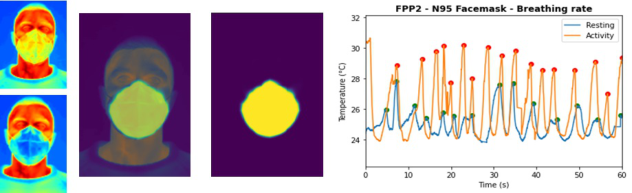
Facemask Detection Fitting on and Breathing Rate Estimation From infrared videos, the breathing rate could be estimate due to the range of temperatures between inhalation and exhalation is greater than ambient temperature at neutral conditions. An algorithm to estimate the respiratory frequency and fitting on the facemask, has been developed measuring the temperature on facemasks and around the face. For each thermal sequence the face and facemask have been detected with YOLO 5s (Ding et al., 2021)
Methodology Based on 3D Thermal Scanner and AI Integration to Model Comfort 31
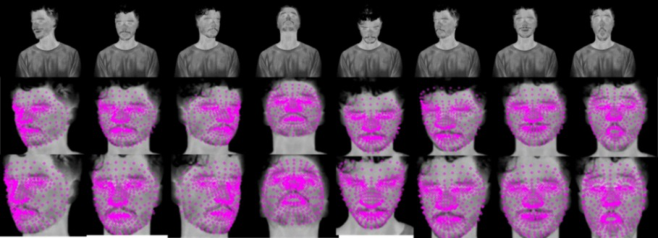
Figure 3: YOLO and Viola&Jones crops and mediapipe 468 landmarks on IR images with rotations and facial expresions. FLIR A35.Figure 4: Inhalation and exhalation detection through FFP2-N95 facemasks.Figure 5: 3D reconstruction.
version and the temperature values of a central ROI have been extracted. Detecting the peaks of the temperature signal, period, mean, minimum and maximum breath durations, the breath rates are measured.
This methodology permits to compare between different sizes and shapes of facemasks according to anthropometrics characteristics of the user and also evaluate the resistance to the breathing of different materials.
RGB-IR 3D Reconstruction The combination of 2D and 3D thermal and anthropometric information and Artificial Vision techniques has allowed real-time 3D reconstruction of an area of the body, with a simple and low-cost system, made up of a thermal artificial vision camera and a low-cost depth sensor (Intel RealSense 435). Two cameras were fixedly arranged and their spatial relationship was obtai- ned by geometric calibration (calibration target) based on the pinhole camera model. (Rangel and Soldan, 2014).
The integration of AI algorithms for face and feature recognition and tem- perature measurement with visible images has led to an improvement in 3D reconstruction.
A complete representation is obtained, where thermal, visual and depth information can be selected.
CONCLUSION
In the post-pandemic world, commercial solutions to existing problems with infrared technology are being developed from efficient approaches. Artifi- cial intelligence in medical imaging has gone mainstream in recent years. The application of AI in infrared thermography and automatic real-time tempe- rature measurement implies updating an already known technique with new solutions. Face identification, gender, age, and thermotype estimation were extracted from IR images by retraining RGB networks without the need to label or mask an IR dataset beforehand. AI algorithms to extract key points allow to measure temperature changes in the body and analyze the body’s thermoregulatory response. The thermal video sequences provide informa- tion on breathing under neutral conditions and distinguish temperature changes due to inhalation from exhalation.
It has also been possible to unify the thermal information of the infrared images with 2D and 3D anthropometric information with a low-cost, real- time system. This unification allows the future development of applications to evaluate the user-product interaction and the characterization of pathologies in patients by merging RGB and visible.
These results enhance the Digital Human Model, providing it with useful information for many applications.
Future Lines Improve detection and thermal facial recognition, detecting and correcting turns and rotations of faces. An important line to explore is the influence of emotions, ambient temperature or effort/activity on facial recognition and thermal patterns.
It is also exploring how to identify the person in the presence of PPE (Per- sonal Protection Equipment) such as a mask, goggles or a helmet, including detecting and removing them.
Finally, the automatic detection and measurement of temperature in motion (MOVE 4D) is the main milestone, for the monitoring of injuries, detection of pathologies or thermal behavior with different garments and activities.
ACKNOWLEDGMENT
This research activity has been supported by Instituto Valenciano de Compe- titividad Empresarial (IVACE): Project “TERMO4D” (IMDEEA/2022/48), within the framework of the program of grants directed to Technological Centers of the Valencian Community for the development of non-econocmic R&D projects for the financial year 2022, co-funded by European Union and
Methodology Based on 3D Thermal Scanner and AI Integration to Model Comfort 33
the Project “IBV 2022 R&D activities plan” ((IMAMCA/2022/7) funded by IVACE and Valencian Regional Government (GVA) funding.
REFERENCES Albiol, Alberto, Monzo, D., Martin, A., Sastre, J., Albiol, Antonio, 2008. Face recognition using HOG–EBGM, Pattern Recognition Letters, Volume 29, Issue 10, 2008, Pages 1537-1543, ISSN 0167-8655, https://doi.org/10.1016/j.patrec.2008. 03.017. American Society of Heating, R. and A.-C.E., 2004. The ASHRAE handbook CD:
2005 fundamentals. Ding, Y., Li, Z., Yastremsky, D., 2021. Real-time Face Mask Detection in Video Data.
arXiv preprint arXiv:2105.01816. Djongyang, N., Tchinda, R., Njomo, D., 2010. Thermal comfort: A review paper.
Renewable and Sustainable Energy Reviews 14, 2626–2640. https://doi.org/10. 1016/j.rser.2010.07.040 Fanger, P.O., 1970. Thermal comfort: analysis and applications in environmental engineering. R.E. Krieger Pub. Co, Malabar, Fla. Fournet, D., 2013. Skin temperature variations in the cold. Frontczak, M., Wargocki, P., 2011. Literature survey on how different factors influ-
ence human comfort in indoor environments. Building and Environment 46, 922–937. https://doi.org/10.1016/j.buildenv.2010.10.021 Heisele, B., Ho, P., Poggio, T., 2001. Face recognition with support vector machines: global versus component-based approach, Proceedings Eighth IEEE Internatio- nal Conference on Computer Vision. ICCV 2001, 2, 688–694. https://doi.org/10. 1109/ICCV.2001.937693 Hildebrandt, C., Raschner, C., Ammer, K., 2010. An overview of recent application
of medical infrared thermography in sports medicine in Austria. Sensors. https: //doi.org/doi:10.3390/s100504700 Humphreys, M.A., 1976. Field studies of thermal comfort compared and applied.
Applied Ergonomics 7, 230. https://doi.org/10.1016/0003-6870(76)90104-6 James C, C., Richardson, A., Watt, P., Maxwell, N., n.d. Reliability and validity of skin temperature measurement by telemetry thermistors and a thermal camera during exercise in the heat. PubMed ID: 25436963. https://doi.org/doi:10.1016/j. jtherbio.2014.08.010 Kakarwal, S.N., Chaudhari, K.P., Deshmukh, R.R., Patil, R.B., 2020. Thermal Face
Recognition using Artificial Neural Network, in: 2020 International Confere- nce on Smart Innovations in Design, Environment, Management, Planning and Computing (ICSIDEMPC). Presented at the 2020 International Conference on Smart Innovations in Design, Environment, Management, Planning and Com- puting (ICSIDEMPC), IEEE, Aurangabad, India, pp. 300–304. https://doi.org/10. 1109/ICSIDEMPC49020.2020.9299648 Kurbanov, E., Gordeev, A., Klyachin, V., 2019. Recognition of faces, head positions, gender, age, and emotions in real time using deep convolutional neural networks. Presented at the CEUR Workshop Proceedings. Latorre-Sánchez, C., Soler, A., Parrilla, E., Ballester, A., Laparra-Hernández, J.,
Solaz, J., 2020. Digital Human Updated: Merging the Thermal Layers with the 3D Anthropometric Model, in: Di Nicolantonio, M., Rossi, E., Alexander, T. (Eds.), Advances in Additive Manufacturing, Modeling Systems and 3D Pro- totyping, Advances in Intelligent Systems and Computing. Springer International Publishing, Cham, pp. 513–524. https://doi.org/10.1007/978-3-030-20216-3_48 Li, J., Su, W., Wang, Z., 2020. Simple pose: Rethinking and improving a bottom-up approach for multi-person pose estimation. Presented at the Proceedings of the AAAI conference on artificial intelligence, pp. 11354–11361.
Lugaresi, C., Tang, J., Nash, H., McClanahan, C., Uboweja, E., Hays, M., Zhang, F., Chang, C.-L., Yong, M.G., Lee, J., Chang, W.-T., Hua, W., Georg, M., Grun- dmann, M., 2019. MediaPipe: A Framework for Building Perception Pipelines. arXiv:1906.08172 [cs]. Mostafa, E., Hammoud, R., Ali, A., Farag, A., 2013. Face recognition in low resolu-
tion thermal images. Computer Vision and Image Understanding 117, 1689–1694. https://doi.org/10.1016/j.cviu.2013.07.010 Nikisins, O., Nasrollahi, K., Greitans, M., Moeslund, T.B., 2014. RGB-D-T Based Face Recognition, in: 2014 22nd International Conference on Pattern Recogni- tion. Presented at the 2014 22nd International Conference on Pattern Recognition (ICPR), IEEE, Stockholm, Sweden, pp. 1716–1721. https://doi.org/10.1109/ICPR .2014.302 Qawaqneh, Z., Mallouh, A.A., Barkana, B.D., 2017. Deep Convolutional Neural
Network for Age Estimation based on VGG-Face Model. arXiv:1709.01664 [cs]. Redmon, J., Divvala, S., Girshick, R., Farhadi, A., 2016. You Only Look Once: Unified, Real-Time Object Detection, in: 2016 IEEE Conference on Computer Vision and Pattern Recognition (CVPR). Presented at the 2016 IEEE Conference on Computer Vision and Pattern Recognition (CVPR), IEEE, Las Vegas, NV, USA, pp. 779–788. https://doi.org/10.1109/CVPR.2016.91 Russakovsky, O., Deng, J., Su, H., et al., 2015. ImageNet Large Scale Visual
Recognition Challenge. Int J Comput Vis 115, 211–252. Schroff, F., Kalenichenko, D., Philbin, J., n.d. FaceNet: A unified embed- ding for face recognition and clustering, 2015 IEEE Conference on Com- puter Vision and Pattern Recognition (CVPR), 2015, pp. 815–823, doi: 10.1109/CVPR.2015.7298682. Simonyan, K., Zisserman, A., 2015. Very Deep Convolutional Networks for Large- Scale Image Recognition. arXiv:1409.1556 [cs]. Smith, C.J., Havenith, G., 2012. Body Mapping of Sweating Patterns in Athletes:
A Sex Comparison. Medicine & Science in Sports & Exercise 44, 2350–2361. https://doi.org/10.1249/MSS.0b013e318267b0c4 Smith, C.J., Havenith, G., 2011. Body mapping of sweating patterns in male athletes in mild exercise-induced hyperthermia. Eur J Appl Physiol 111, 1391–1404. https: //doi.org/10.1007/s00421-010-1744-8 Sun, Y., Liang, D., Wang, X., Tang, X., 2015. DeepID3: Face Recognition with Very
Deep Neural Networks. ArXiv, abs/1502.00873. CoRR. Szankin, M., Kwasniewska, A., Rumininski, J., 2019. Influence of Thermal Imagery Resolution on Accuracy of Deep Learning based Face Recognition. Presen- ted at the 12th International Conference on Human System Interaction (HSI), pp. 1–6. Taigman, Y., Yang, M., Ranzato, M.A., Wolf, L., 2014. DeepFace: Closing the Gap to
Human-Level Performance in Face Verification. Presented at the IEEE Computer Society Conference on Computer Vision and Pattern Recognition. https://doi.org/ 10.1109/CVPR.2014.220. van Hoof, J., 2008. Forty years of Fanger’s model of thermal comfort: comfort for all? Indoor Air 18, 182–201. https://doi.org/10.1111/j.~1600--0668.2007. 00516.x Viola, P., Jones, M., 2001. Rapid object detection using a boosted cascade of sim-
ple features., in: IEEE Computer Society Conference on Computer Vision and Pattern Recognition. CVPR 2001. p. I–I. https://doi.org/10.1109/CVPR.2001. 990517 Zhao, H., Shi, J., Qi, X., Wang, X., Jia, J., 2017. Pyramid Scene Parsing Network, in: 2017 IEEE Conference on Computer Vision and Pattern Recognition (CVPR). Presented at the 2017 IEEE Conference on Computer Vision and Pattern Recogni- tion (CVPR), IEEE, Honolulu, HI, pp. 6230–6239. https://doi.org/10.1109/CVPR .2017.660
LISTED IN THE AHFE DIGITAL BOOKSTORE CATALOGUE
Explore the complete digital volume
Digital Human Modeling and Applied Optimization
Read this individual research paper free through the original publisher, or explore the full digital proceedings book.
ISBN 978-1-958651-22-3
Explore this ISBN in the AHFE Bookstore ↗Listed in the July 2026 bookstore catalogue; search by ISBN to confirm current availability · Digital book purchase optional