Qiaoling Zeng, Mingu Lee, Juhyun Eune (2022). Interactive Animation Design of Egyptian Totem Elements under the Digital Media Technology. In: Ergonomics In Design. AHFE Open Access, vol. 47, pp. 194–202. https://doi.org/10.54941/ahfe1001937
This paper is a record of the creation process based on the cross-over study of visual, animation, and interaction design of ancientEgyptian totemic elements with the use of digital media technology. Through an in-depth analysis of the creation process of theanimation interaction work from an art design perspective, this paper points out the importance of theme setting as well as thepotential problems during the process of visual, animation, and interaction design, and puts forward the corresponding solutions.In addition, a systematic summary of the design concept in the animation interaction as well as other additional concepts is madethrough the work Tutan, which is presented in the paper.Tutan consists of 22 groups of single-module elements derived from ancient Egyptian totems, which were dismantled and reorganizedto reconstruct the main picture. Through the use of animation and interaction design, the designer aspires to build a connectionbetween people and the work Tutan, in an attempt to promote the ancient Egyptian culture among the general public, entertain theviewers, and establish a connection between culture, technology, viewers, and the work itself.
The purpose of this paper is to explore the development and further possibi- lities of art works under the digital media technology and hopes to make the ancient Egyptian totem culture dynamic and interactive by the cross-research method through the cooperation of computer hardware and software under the study of ancient Egyptian totem culture. There have been many cases of using the cross-research design method in recent years, but few studies focus on the ancient Egyptian culture. Therefore, this work tries to study the anima- tion interaction of ancient Egyptian totem elements under the digital media technology, preserve the morphological characteristics of the original totems of ancient Egypt, combine the principles of ancient Egyptian art design with modern technology, systematically summarize the experimental steps, and finally express the author’s thoughts, emotions, and values. The structure of this paper is organized as follows: first, the basic design concept before the work is proposed, then the visual dynamic and interactive design pro- cess based on the ancient Egyptian totem culture is recorded, and finally the relevant conclusions and future problems to be solved are drawn.
CONCEPTUAL DEVELOPMENT Design Concept – Establishment of Characters and Visual Elements
Interactive Animation Design of Egyptian Totem Elements 195
Figure 1: Mummy mask of the Tutankhamun.
Figure available in the original PDF paper.
connotations of ancient Egyptian totems to form a mission image with anci- ent Egyptian exotic characteristics and make it dynamic. In the meantime, it also allows the audience to participate in and interact with the image’s action and audio. The viewer can not only understand a certain ancient Egy- ptian theological culture through the digital media interactive device, but also obtain an entertainment experience of interacting with the device.
First, character positioning. This work selects Tutankhamun shown in Figure 1 as the main reference image and collect the information related to him. Tutankhamun was a young king in the 18th Dynasty of Egypt’s New Kingdom era. The reason why he is known mainly comes from the discovery of Tutankhamun’s tomb. The discovery of the tomb became a major turning point in the history of world archaeology and pushed the process of Egy- ptian archaeology to its peak (Wang, 2010). With the continuous excavation of Tutankhamun’s tomb, more and more unsolved mysteries have been floo- ded with this topic, and the image itself is full of mystery. The design of the overall image of the character should be based on it and combined with other ancient Egyptian cultures for in-depth creation.
Second, the selection of local visual elements. After establishing the ove- rall reference image, selecting local visual elements is an attempt to establish a connection between the overall appearance and the interior elements. These connections aim to show the harmony of visual and cultural con- notations through the cultural commonality between them and create new visual symbols through reorganization and recreation. According to the method proposed above, the selection of totem elements is mainly limited to the images of the gods and totem symbols with theological significance in ancient Egyptian mythology. As the science and technology were extre- mely underdeveloped in ancient times, “myth” became an important way for ancient people to explain the natural world with sufficient flexibility. In particular, the ancient Egyptians believed that the gods were not omni- potent and had to perform their respective functions in each other’s body - called “syncretization” (Shaw, 2014). Therefore, the image of the gods was integrated into the main image as a local element, which was aligned with the vision mentioned above. The form and cultural connotation are consi- stent. Second, the viewer can understand the creation myth of ancient Egypt through this work and gain insight into the psychological state of the anci- ent Egyptians. Moreover, the interaction with Egyptian mythology can also enhance the entertainment of the work, bringing a pleasant experience to the viewer.
Figure 2: Protype and redesign of patterns.
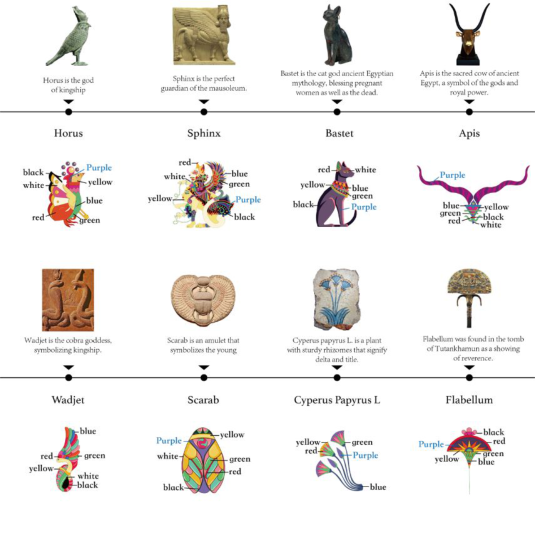
Based on the needs of visual presentation, the author chose the holy scri- pture form of the four gods and five kinds of theological symbols as local visual elements. Totem symbol. As shown in Figure 2, Horus is often depi- cted as an eagle in Egyptian theology, representing the symbol of kingship. Bastet is depicted as a cat, playing the role of the king’s divine mother. Apis is sometimes depicted as a bull to symbolize Abundance (Shaw, 2014). Wad- jet is a viper goddess in Egyptian mythology, also representing the kingship like Horus. Sphinx is a statue combining a human head with a crouch- ing lion and it is the guardian of the mausoleum (Fletcher, 2016). Scarab represents rebirth and sunrise. Cyperus papyrus L. is a slender, smooth reed and used by the Egyptians to make paper, and frequently featured in anci- ent Egyptian murals (Rawlinson, 1879). The Flabellum is a fan made of metal, leather, silk, sheepskin, or feathers. It is to protect the Eucharist from insect infestation in a respective way. It was found in the tomb of Tutankhamun.
The reason why the above elements are selected as the prototypes of local visual elements is that they cover all areas from animal, plant to human form. The proper use of those elements can make the visual effect signifi- cant with softness and rigidity. At the same time, these elements all contain the ancient Egyptians’ belief in gods and the concept of the afterlife to a cer- tain extent. The integration into the design can better convey the ancient Egyptians’ outlook on both world and life.
Interactive Animation Design of Egyptian Totem Elements 197
Exploration and Development – Redesign and Combination of Elements The art of ancient Egypt has made great contributions to the development of world art and formed its own basic rules of art creation with the continuous innovation. For example, in the view of theme, it mainly depicts “God” and “King” to increase the sanctity of the king. In terms of modeling methods, ancient Egyptian art usually adopts exaggerated techniques to enhance the visual mystery and cultural infectivity by combining people and animals. In terms of composition, it mainly follows the “frontal”, “symmetry”, “asti- gmatism”, “grid or scale-grid”, “level division”, “filling”, “image and text”. In terms of color application, ancient Egyptian art used rich and multiple colors, usually red, yellow, blue, green, white, black, etc. (Liu, 2008), as dif- ferent colors conveyed different meanings. The pattern design of this work is in accordance with the basic creation rules of ancient Egyptian art with redesign and combination of elements described above.
First, redesign of the prototype. As shown in Figure 2, Horus is redesigned but still retained its original shape. The crown on Horus’ head is transformed to have a shape like the sun. The closed wings are opened outwards. The eagle legs are titled 45 degrees outward. The elegant feathers are added to make the eagle’s shape more modern and dynamic. Compared to Horus, Sphinx has undergone many changes. The main concept of combining the lion’s body and the human face is kept, the elements of the lion’s head and the human hand are added, integrating together with a beaded necklace with a twisted grip to enhance the visual richness. The wings are raised to highlight the dynamic visual sense of getting up, jumping and flying. If the redesign of Sphinx was an addition, the morphological change of Apis used a subtraction. The shape of the bull’s head can be simplified to be a triangle with the initial visual sense, while the shape of the bull’s horns is still retained. The bull’s horns are extended to both sides in a streamlined manner, so that the whole has a combination of rigidity and flexibility. Wadjet’s original image is a viper that shows distance and aggression. To break this feeling, the imposing crown on the snake’s head is deleted and replaced by wings composed of geometric candies. Those redesigns added interest and cuteness to the original image of the poisonous snake, so that the distance with the viewer can be shorten. The static elements are also needed to balance those dynamic parts. Scarab adopts the static form of closed wings in the design process. The arc-shaped candy bar is also used to divide it layer by layer reducing its sense of danger and improve its softness. Bastet, and Flabellum basically keep their original shapes. For Cyperus papyrus L, the stem part is curved to show the swaying and softness.
Second, the use of color. As Garry J. Shaw said, “A certain substance was chosen by the Egyptians because of the symbolic meaning of the color of the substance: green is associated with life, prosperity, and Health; black is rela- ted to Duarte, abundance and resurrection...” (Shaw, 2014). Color-matching in this work is also basically carried out under the premise of considering the symbolism of colors in ancient Egypt. As shown in Figure 2, except for the lack of blue in the Scarab pattern, white and black in the Cyperus papyrus
Figure 3: Analysis plot for recombination of elements.
L. pattern, and white in the Flabellum pattern, the other five patterns include six commonly colors in the ancient Egyptian: red, yellow, blue, green, white, and black. Purple is also added to reconcile the color spectrum as that often used in ancient Egyptian art is a very saturated color.
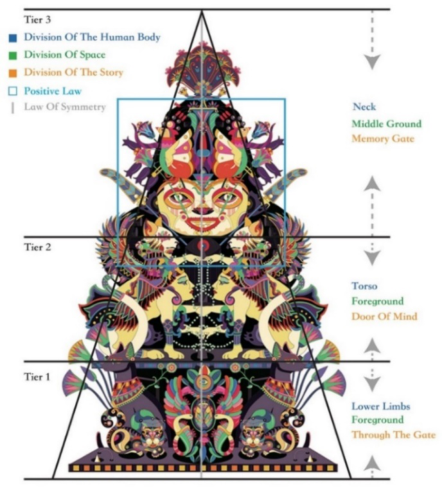
Third, the reorganization of elements. The basic rules of ancient Egyptian art creation, including the composition rules of “level division” is explained at the beginning of this section. It was often used in relatively flat reliefs and paintings by cutting the plane area that be carved or painted into several layers or columns to express different time, space, and changes of events, etc (Liu, 2008). For the reorganization of elements used in this work, this rule is also adopted by dividing the triangular plane into three levels as shown in Figure 3. It is divided into front, middle, and rear scenes in terms of spatial structure. In the view of story development, the first is the “Gate of Cros- sing” guarded by the goddesses Bastet and Wadjet. The second is the “Gate of Mind” guarded by Sphinx where people can explore the mind of Tutankh- amun after crossing it. The last is the “Gate of Memory” guarded by Horus to trace the legendary story of Tutankhamun’s life. In addition to the rule of “level division”, rules of “frontal”and “symmetry”are also considered in the reorganization of the overall elements. There two rules in this design are spe- cifically applied that the entire character image is facing the viewer, and the left and right are equally designed based on the central axis. In general, the integration of ancient Egyptian art creation rules into this design not only verifies the desirability of ancient Egyptian art creation rules through pra- ctice, but also highlights the ancient Egyptian cultural theme of this design in all aspects.
Interactive Animation Design of Egyptian Totem Elements 199
Figure 4: The beginning snapshot.
Figure available in the original PDF paper.
Figure 5: Snapshot A during the animation.
Figure available in the original PDF paper.
Figure 6: Snapshot B during the animation.
Figure available in the original PDF paper.
The Development of Dynamic Vision The design of the dynamic vision is explained in this section. The computer software “Adobe After Effects” is used in this work to produce the Computer Graphics Animation (CG animation) on the basis of the two-dimensional pattern.
First, the design of animation structure. The design follows the general division of the animation structure. The whole animation is divided into three parts: beginning, animation content and ending. Figure 4 is the beginning snapshot, Figures 5–7 are the snapshots during the animation, and Figure 8 is the ending snapshot. Second, the design of animation vision. As shown in Figure 4, the beginning image uses CC Ball Action to show a form of particle aggregation. The reason for using this as the opening is because in physics, everything in the universe is composed of particles. Figure 5 uses CC lens to create a meeting channel with Tutankhamun with a mysterious water droplet crossing effect, so as to naturally shows the whole image of Tutankhamun (as shown in Figure 6). Figure 7 uses the effect of displacement and rotation to create a scene of the resurrection of Tutankhamun, which also contains the
Figure 7: Snapshot C during the animation.
Figure available in the original PDF paper.
Figure 8: The ending snapshot.
Figure available in the original PDF paper.
prosperity of ancient Egypt. Figure 8, as the end of the animation, presents the vision of Tutankhamun gradually disappearing in the form of fragments. This effect indicates that prosperity will eventually become illusory, and disappea- rance will become a foregone conclusion. As it is written (Copenhaver, 1995), “All their holy worship shall be in vain, disappear without a sound, for the gods will return from earth to heaven, and Egypt will be abandoned...”. This design also contains the author’s lament and regret for the ending of ancient Egypt from its prosperity to its decline. Third, the design of sound effects: The integration of image and music in animation design is also one of the key points to be considered in dynamic visual design. The sound design of this animation mainly focuses on the beginning and ending. The beginning is the sound of the appearance, and the ending is the disappearing sound. These two mainly emphasize the appearance and disappearance of characters respectively.
RESULTS
The presentation of this design is mainly by an interactive multimedia instal- lation composed of five display screens. They play the five images shown in Figure 3-7, respectively. It represents Rebirth, Traveling, Meeting, Prosperity, and Disappearance one by one. The interaction forms of each display screen are different. For the first one, when the audience jumps in place with their limbs, the screen will also play the particle-jumping, thus establishing the interaction between human and machine forms. For the second one, when the viewer walks into the range and touch the screen, the image will change to be a scene, directly facing Tutankhamun through the effect of water dro- plets, to realize the tactile interaction between the viewer and the machine.
Interactive Animation Design of Egyptian Totem Elements 201
For the third one, it is to provide the viewer with a small space for immersive visual experience, so the screen will perform a full animation loop. For the fourth one, when the audience uses the microphone connected to it to emit audio with a high decibel law, the movement in the picture will also accelerate with the increase of the audio frequency, thereby realizing audio interaction. For the last screen, when people push forward with their arms in front of the screen, the animation will have the effect of fragmentation realizing the interaction of body sensing.
In order to realize the animation design explained in section 3.1, the com- bination of open-source software and hardware is required. First, the time period of particle-jumping is set in advance using TouchDesigner. Then the Kinect sensor is connected to the first display screen. Once the Kinect sen- sor receives the signal of human-body-jumping, it will be transmitted to the controller, thus completing the first Interactive operation. The touchpad is connected to the second display screen and the contact point is also set by the TouchDesigner. When the touchpad senses external touch, the second display screen will show the interactive feedbacks. The frequency of sound from the microphone is recognized by TouchDesigner and drive the movement of the pattern shown in the fourth screen. The last interactive job also uses Tou- chDesigner to set the nodes where the animation fragmentation dissipates. The display screen is connected to Leap Motion, and each joint is accurately identified through the somatosensory controller to complete the interactive effect.
CONCLUSION
This paper attempts to reveal the design process of multimedia interactive animation in the context of the scientific era, taking the ancient Egyptian cultural heritage as the cornerstone, combining the aesthetics and presenta- tion methods of modern contexts, with the aim of exploring more possibilities of multimedia interactive art. The theological culture of ancient Egypt, the rules of artistic creation in ancient Egypt, and the color-matching habits commonly used by ancient Egyptians have been successfully integrated into this creation. More delicate ancient Egyptian culture can be felt by per- sonal appreciation and experience. At the same time, through the mutual cooperation of hardware and software, this interactive installation realizes a series of interactive forms of homology with multiple types, which can bring viewers a more comprehensive visual and interactive experience. It can be said that on the basis of inheriting the excellent traditional culture, the synthesis of “digital technology level” and “cultural level” has opened up a wider space for the development of art design and the way things are presented.
However, the digital technology and human needs are not static. With the continuous maturity of hardware and software, the design of digital inte- ractive animation will also accept new tasks and challenges. Therefore, the author will continue to accumulate the digital technology and participate in the exploration of more fields.
REFERENCES
Copenhaver, Brian P. (1995) Hermetica: The Greek Corpus Hermeticum and the Latin Asclepius in a new English translation, with notes and introduction. Cambridge University Press. Fletcher, Joann. (2016) The story of Egypt. Simon and Schuster, 2016. Liu, Wenpeng. (2008) Egyptian Archaeology. Sanlian Publishing House. Rawlinson, George. (1879) “History of ancient Egypt. Vol. IV-Part II.” Shaw, Garry J. (2014) The Egyptian myths: a guide to the ancient gods and legends.
Thames & Hudson. Wang, haili. (2010) Pharaohs and Scholars: A History of Egyptology. Beijing Normal University Press.
LISTED IN THE AHFE DIGITAL BOOKSTORE CATALOGUE
Explore the complete digital volume
Ergonomics In Design
Read this individual research paper free through the original publisher, or explore the full digital proceedings book.
ISBN 978-1-958651-23-0
Explore this ISBN in the AHFE Bookstore ↗Listed in the July 2026 bookstore catalogue; search by ISBN to confirm current availability · Digital book purchase optional