Wang Haining, Tong Z, K Liu (2022). Development of 3D Reference Headforms for Chinese Adults. In: Ergonomics In Design. AHFE Open Access, vol. 47, pp. 113–119. https://doi.org/10.54941/ahfe1001927
To improve the fit of head worn products for Chinese adults, this study utilized the principal component analysis (PCA) panel on 15 facial measurements extracted from 3,358 3D Chinese adult head scans. The PCA panel covers 95.80% of Chinese population. All samples were divided into 5 size categories based on the differences among eye and facial morphology, and 3D reference headforms were developed respectively based on the statistics of these measurements. The headforms can be used for head-worn products like eyewear, VR headsets, eye and face PPE and etc.
In recent years, virtual reality (VR) and augment reality (AR) glasses are beco- ming increasingly popular in exercise, gaming and entertainment spheres, as people try to improve their health and well-being. Customers’ requirements for the comfort of the experience during daily wear has grown significantly. Smart wearables such as VR glasses requires proper fit to stop light leakage around nose to achieve good immersion, as well as avoiding local pressure that causing discomfort or even pain.
However, VR/AR glasses on market were mainly designed by western com- panies based on western facial measurements from anthropometric surveys like Civilian American and European Surface Anthropometry Resource (CAESAR) or 3D reference headforms produced by the National Institute for Occupational Safety & Health (NIOSH) (Jin and He, 2021). Many stu- dies have shown that the difference between Chinese and Western on head shape and size is significant (Zhuang et al., 2013; Ball et al., 2010), which creates the nonnegligible problem of poor fit. A number of product sizes are developed to fit subgroups of the targeted population (Dlab, C. et al., 2020).
It is crucial to create a sizing system based on Chinese head anthro- pometry for head worn products such as VR/AR glasses to fit Chinese population. NIOSH developed a principal component panel based on the data from the survey of 3997 respirator users (2,543 males and 1,454 fema- les) across the United States in 2003 (Zhuang et al., 2007). The PCA panel was developed using the first two principal components obtained from 10 most representative facial dimensions. NIOSH’s research was subsequently
used as a reference for the ISO/TS 16976-2 Respiratory Protective Devices - Human Factors-Part 2: Anthropometrics (ISO, 2015). The PCA panel has been applied to design and evaluation for respirators.
After the size system was established, 3D digital headforms for each group were generated and considered as an effective method to incorporate 3D anthropometry in product sizing by offering 2D/3D knowledge of the shape and size on the eye and face area. There are several studies on 3D statistic head shape models for Chinese population. (Ball, 2009) divided the samples into 10 size categories using head circumference from 2000 Chinese head scans in SizeChina project, and created 10 digital headforms without facial features for headwear design and inspection for Chinese. (Yu et al., 2012) developed 3D headforms specifically for Chinese civilian workers based on the traditional and 3D measurements from 3000 Chinese workers database established in 2006. (Wang et al., 2018) proposed 5 a progressive scanning algorithm based on differential approximation to create 5 3D reference head- forms with different percentiles using 1900 Chinese head scans from the Chinese Headbase, which was enriched to the sample size of 3400 in 2020.
The aim of this study was to develop 3D representative headforms for Chinese adults from the Chinese Headbase survey, a large 3D head anthro- pometric database developed using state-of-art 3D scanning technologies by (Wang et al., 2018). PCA panels proposed by (Zhuang et al., 2010) was ado- pted for the establishment of the sizing system. The headforms created in this study can be used for the design of VR/AR glasses, eye and face PPE and other head mounted devices to improve the fit and comfort for Chinese customers.
MATERIALS AND METHODS
Subjects The 3D head scans used in this study were from the Chinese Headbase survey established and enriched from 2017 to 2020. Stratified sampling approach of four age groups (18–29, 30–39, 40-49, 50+) and two gender groups was implemented. A total of 3400 subjects (1660 males and 1740 females) were recruited and measured by traditional measurement and high-resolution 3D scanning. 3358 subjects (1639 males and 1719 females) were chosen from the dataset for the analysis in this study.
Date Collection The Artec Spider (Artec Group, Luxembourg) 3D scanner was used to capture the 3D geometry of head models. Traditional measurements inclu- ding height, weight and three head dimensions were also recorded. Artec Studio 12 (Artec Group, Luxembourg) was adopted for point cloud pro- cessing, including noise elimination, global registration, sharp fusion, mesh simplification, hole filling, mesh smoothing, texture mapping, and coordinate system unification.
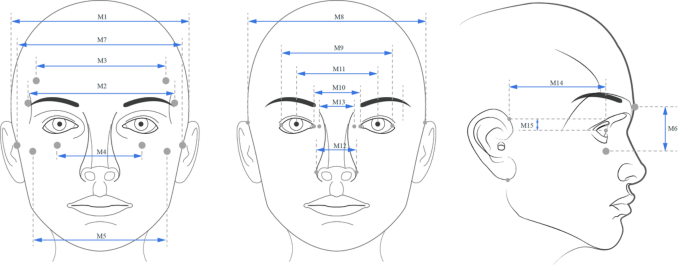
According to ISO DIS 18526-4-2018 and head anthropometry related literature, 15 facial measurements and 24 anatomical landmarks related to VR/AR glasses and eye&face PPE design were chosen and identified
Development of 3D Reference Headforms for Chinese Adults 115
Figure 1: Facial landmarks and measurements: M1: Head breadth, M2: Zygofrontale Distance, M3: Frontotemporale Distance, M4: Infraorbitale Distance, M5: Bizygomatic Breadth, M6: Glabella - Infraorbitale Distance, M7: Tragion distance, M8: Otobasion Superius Distance, M9: Biocular Diameter, M10: Interocular Diameter, M11: Interpupil- lary Distance, M12: Alare Distance, M13: Nasal Root Breadth, M14: Eye Apex to Ear (Horizontal), M15: Eye Apex to Ear (Vertical).Table 1. Principal component eigenvectors for the first two PCs.
(Figure 1). Geomagic Wrap 2017 (3D Systems, Rock Hill, SC, US) was used for facial landmark identification and facial dimension extraction.
Principal Component Analysis Panel PCA is a widely adopted approach for reducing the dimension of large data- sets, increasing interpretability but minimizing its information loss at the same time (Lacko et al., 2017). In this study, PCA was performed on 15 measurements to generate 15 principal components (PCs). The first two PCs explained 61.58% of the total variation (Table 1). The first principal compo- nent, PC1, represents the largest percentage of explained variance (50.27%), and PC2 explained 11.31%. These two principal components contain most
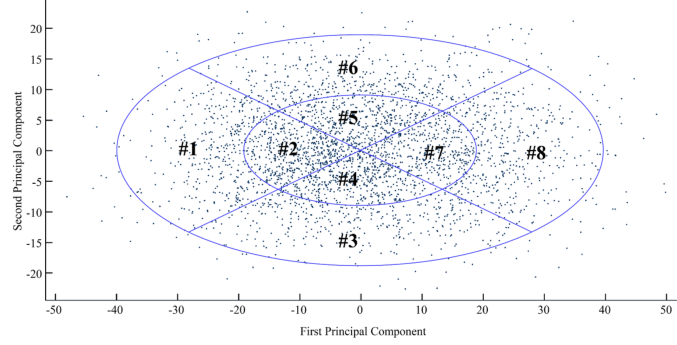
Figure 2: PCA panel with scatter plots based on two principal components.
of the information of the original index, which can replace the original 15 variables to measure the characteristics of the heads.
The value of each principal component was calculated as follows.
Taking the first principal component (PC1) as the x-axis and the second principal component (PC2) as the y-axis, then the scatter plots of principal components scores of 3358 subjects were shown in Figure 2. The PCA panel was developed using Matlab based on the algorithm description of the PCA panel in ISO TS 16976-2015.
RESULTS AND DISCUSSION
The frequency obtained in each of the cells and the relative percentage of that frequency for the total sample are presented in Table 2. It can be observed
Development of 3D Reference Headforms for Chinese Adults 117
Table 2. Percentage of Chinese population in the PCA panel.
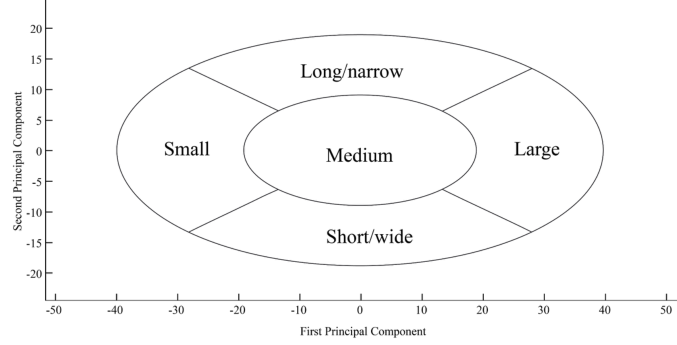
that the overall match is 95.8% and a match of 94.57% and 96.97% for male and female subjects, respectively. Each cell contains at least 10% of the population. As can be seen in Figure 2, subjects are mainly scattered at the central section (cell 2, 4, 5, 7) of the PCA panel, which matches 50.27% of subjects. According to the definition of NOISH for the size category of the PCA panel, the cell 2, 4, 5 and 7 were merged into the medium size. Finally, the panel was divided into 5 size categories (small, medium, large, long-narrow and short-wide), as shown in Figure 3. For each size category the mean values for the 15 facial dimensions were calculated based on subjects whose PC1 and PC2 scores fell in the category.
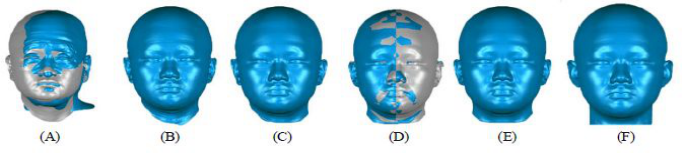
Based on the five size categories and 15 facial dimensions, 5 subjects in each category were chosen based on PCA scores calculated from 3D scans and averaged together Geomagic Wrap 2017 to construct a representative
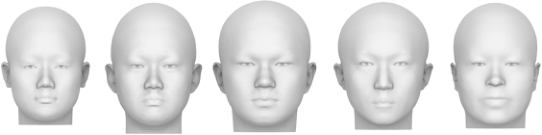
Figure 3: Five head size categories in the PCA panel.Figure 4: The design procedures of the headforms: (A) model alignment of five selected subjects using the Frankfort horizontal plane, (B) the headform after the ave- raging, (C) the headform after surface smoothing, (D) the headform after mirroring, (E) symmetric average of the headform, and (F) final average headform with ears and neck attached.Figure 5: Five 3D headforms representing size categories for Chinese adults: small, medium, large, long/narrow, and short/wide, from left to right.
headform for each size category. The processing procedures are shown in Figure 4. All 5 headforms are showed in Figure 5.
CONCLUSION
In this paper, a PCA panel for Chinese population was established based on facial dimensions extracted on 3358 head scans from the Chinese Headbase survey. Five digital 3D headforms were developed from 5 size categories. These headforms can represent the anthropometric distribution of Chinese
Development of 3D Reference Headforms for Chinese Adults 119
face shape and size and be used for the research and development of head worn products including VR/AR, eye and face PPE for Chinese customers.
REFERENCES
Ball, R. (2009). 3-D Design Tools from the SizeChina Project. Ergonomics in Design: The Quarterly of Human Factors Applications, 17(3), pp. 8–13. Ball, R., Shu, C., Xi, P., Rioux, M., Luximon, Y. and Molenbroek, J. (2010). A
comparison between Chinese and Caucasian head shapes. Appl Ergon, 41(6), pp. 832–839. Jin, W. and He, R. (2021). An exploratory study of fit assessment of the virtual reality glasses. Journal of Ambient Intelligence and Humanized Computing. Lacko, D., Huysmans, T., Vleugels, J., De Bruyne, G., Van Hulle, M. M., Sijbers, J.
and Verwulgen, S. (2017). Product sizing with 3D anthropometry and k-medoids clustering. Computer-Aided Design, 91, pp. 60–74. Wang, H., Chen, W., Li, Y., Yu, Y., and Ball, R. (2018). A 3D Head Model Fitting Method Using Chinese Head Anthropometric Data. In International Conference on Cross-Cultural Design, 10911, pp. 203–215. Springer, Cham. Wang, H., Yang, W., Yu, Y., Chen, W., and Ball, R. (2018). 3D digital anthropometric
study on Chinese head and face. In Proceedings of 3DBODY. TECH 2018–9th Int. Conference and Exhibition on 3D Body Scanning and Processing Technologies, pp. 287–295. Yu, Y. Y., Benson, S., Cheng, W. J., Hsiao, J., Liu, Y. W., Zhuang, Z. Q. and Chen, W. H. (2012). Digital 3-D Headforms Representative of Chinese Workers. Annals of Occupational Hygiene, 56(1), pp. 113–122. Zhuang, Z., Benson, S., and Viscusi, D. (2010). Digital 3-D headforms with
facial features representative of the current US workforce. Ergonomics, 53(5), pp. 661–671. Zhuang, Z., Bradtmiller, B. and Shaffer, R. E. (2007). New respirator fit test panels representing the current U.S. civilian work force. J Occup Environ Hyg, 4(9), pp. 647–659. Zhuang, Z., Shu, C., Xi, P., Bergman, M. and Joseph, M. (2013). Head-and-face
shape variations of U.S. civilian workers. Appl Ergon, 44(5), pp. 775–784.
LISTED IN THE AHFE DIGITAL BOOKSTORE CATALOGUE
Explore the complete digital volume
Ergonomics In Design
Read this individual research paper free through the original publisher, or explore the full digital proceedings book.
ISBN 978-1-958651-23-0
Explore this ISBN in the AHFE Bookstore ↗Listed in the July 2026 bookstore catalogue; search by ISBN to confirm current availability · Digital book purchase optional