Dongfang Yang (2022). The application of Life Cycle Assessment in sustainable furniture system design. In: Ergonomics In Design. AHFE Open Access, vol. 47, pp. 590–600. https://doi.org/10.54941/ahfe1001987
Life Cycle Assessment (LCA) is a quantitative methodology to assess the environmental impacts of products, services, and systems. Considering the sustainable furniture production and consumption system is one of the challenges that should be addressed and improved for a better quality of life for residents and lower pollution levels for the environment. The International Reference Life Cycle Data System (ILCD) Handbook by the European Commission has defined 23 LCA applications within which developing design strategies is one. Considering 80% of environmental impacts are decided in the design stage, the research explores LCA's application in sustainable furniture system design by reviewing former articles. The study aims to define furniture design strategies based on LCA analysis. Methods: This research presents a systematic review of 165 articles and books (2000 - 2021) of Life cycle assessment research on furniture. These articles are chosen from Scopus and Google scholar, based on the relation to furniture LCA and impact factor, to make the literature review reliable. It analyses papers in the following three aspects—first, the assessed object(s) and the LCA objectives; second, LCA methods used in articles; and third, the recommended design strategies. The main findings: Reviewed articles generally belong to two categories, case study research and literature review. The exploration provides an overview of LCA supporting sustainable furniture design in 4 different levels: material level, product life cycle level, product service system level and company level. As a result, the research proposes a framework and maps the reviewed furniture design strategies onto this framework. The proposed framework shows design strategies in these four levels: material design, furniture life cycle design, product service system design, and value chain management. The framework also shows how various design strategies contribute to sustainable furniture design and visualizes linkages, overlaps and complementarities between these strategies based on quantitative LCA results.Discussion: Even though these articles proposed many strategies, we are unsure whether some strategies are missing. What is more, if we want to use these design strategies to support practical design activities, an important step is to define the priorities of different strategies in these four levels. This framework needs further assessment and confrontation among experts to make the framework comprehensive and meaningful in real work.
Around 80% of environmental impacts are decided in the design stage (European Commission, 2020; Charter and Tischner, 2001). Design, as a pri- mary function for innovation, has been engaged with sustainability research and practice. Many researchers and companies have come up with design strategies from different aspects to reduce the environmental impacts of furni- ture. The systematic engagement started with the emergence of active interests from industry in environmental issues. Despite these trials, it is difficult to say whether these design strategies result in burden-shifting. For example, redu- ced dimension of a piece of furniture may compromise function time. LCA is a consolidated method to deal with this situation and propose strategies for effective and efficient design intervention based on quantitative life cycle data. This research was conducted to collect and analyze design strategies which were originally from LCA research.
The Application of Life Cycle Assessment in Sustainable Furniture System Design 591
carried out to explore sustainable furniture design strategies as promising ways towards sustainable furniture systems. 165 articles and books (from 2000 - 2021) were chosen from Scopus and Google scholar to analyze the assessed object(s) and the LCA objectives. 60 articles were highly relevant, and 12 were middle relevant to the furniture industry (different types of fur- niture, materials, processes, business models), so these 72 articles (LCAs for furniture from 28 countries) were thoroughly analyzed for promising design strategies.
RESULTS
The Environmental Profile of Furniture Many researchers have divided products’ life into five stages: pre-production, production, distribution, use, and disposal. The literature review reached a detailed insight on the sources of environmental burdens along furniture’s life cycle.
In the pre-production stage, furniture’s environmental impacts come mainly from materials consumption (e.g. wood-based materials, metals, pla- stics, fabrics, leather, glass, various chemicals and so on (Renda et al., 2014)). For example, for an average production of 1 m3 particleboard (around 650 kg), it consumes dry wood-based materials around 687 kg, Urea-formaldehyde resin (100% solid content) around 72 kg, lubricants around 18 g, and comprehensive energy of about 507 MJ with other resou- rces (González-García et al., 2019; Ministry of Ecology and Environment of China, 2010). Wood-made furniture takes a high percentage for the furni- ture sector, while wood-based panels (e.g. MDP, MDF, etc.) production is a critical source of hazardous emissions due to the use of formaldehyde emit- ting resins to bind together the wood chips or fibres (Donatello, Moons and Wolf, 2017). Formaldehyde is a common indoor air contaminant known as a sensory irritant and, depending on the concentration in the environment and exposure time. It can cause health problems, such as eye, skin and respiratory allergic reactions (Liu et al., 2012).
In the production stage, manufacturing, assembly and treatment of com- ponents are weighty sources of environmental impacts due to the generation of residues, consumption of chemical mixtures and electricity (Donatello, Moons and Wolf, 2017) which could generate solid waste, air and water pollution. For example, the cutting, punching (or drilling) and sanding (or trimming) process will generate solid waste such as sawdust, metal and pla- stic residues. The edge banding process applies adhesives like Ethylene Vinyl Acetate (EVA) to the band edge and board. The painting and finishing process for solid wood/metal components consumes coating. The plastic components’ injection/extrusion/blow molding process consumes resin particles and addi- tives (e.g. blow agent for foaming). The application of adhesives and coatings - which consist of resins, pigments, solvents, additives and diluents – could generate Volatile Organic Compounds (VOC) emissions such as alcohols, olefin, ethers, alkane and aldehyde, and wastewater which contains sulfide, chlorine (Cl), alcohols, olefin, alkane (Cheung, Leong and Vichare, 2017).
592 Yang
These will cause damage to the environment and human health (Berrios et al., 2005). Environmental impacts for distribution come mainly from transportation, packaging, and storage facilitates, such as resources for transportation, the life cycle impacts for packaging materials and warehouses.
Although the use phase is not crucial in terms of environmental impacts (Donatello, Moons and Wolf, 2017; Donatello et al., 2014), it still has to be considered. Potential environmental impacts arise from the operation and cleaning of products. Electrically adjustable furniture consumes electricity. The cleaning process of furniture typically comprises wiping surfaces with a damp cloth, vacuum cleaning the upholstery parts and machine washing of the textile cover. All these cleaning processes may consume water, detergent and electricity.
The disposal stage includes different scenarios. In the EU, furniture waste accounts annually for more than 4% of the total municipal solid waste (MSW), within which 80-90% is incinerated or dumped in landfills, whereas the remaining part is recycled (Donatello et al., 2014). Much furniture beco- mes obsolete before the actual end of its functional lifetime, which results from different reasons such as office relocation, furniture inadequacy after renovation, an extension of premises or new staff, changes in the interior or corporate design –resulting in perfectly functional furniture being disposed of for aesthetic reasons. Frequent replacement of office furniture contribu- tes to the increasing solid waste production, leading to more landfill space (Besch, 2005). Landfill disposal may generate methane and groundwater pol- lutants, and incineration will generate air pollution and toxic ash (Ulrich and Eppinger, 2012).
Last but not least, the consumption of non-renewable fossil fuels such as coal, natural gas, diesel oil happens along furniture’s life cycle for either raw materials production, transportation or electricity generation releases CO2, CH4, CF4, C2F6, SO2, HF, NOx, CO, particulate matter (PM), etc., which may contribute to Global Warming (CO2, CH4, CF4, C2F6), Acidification (SO2, HF, NOx), Photochemical Ozone Creation (SO2, CO, NOx), human toxicity (NOx).
In conclusion, The furniture production and consumption system is one of the challenges that should be addressed and improved for a better quality of life for residents and lower pollution levels for the environment.
Sustainable Furniture Design Strategies To address the aforementioned environmental issues, many researchers con- ducted LCA and proposed design strategies that could be classified into three levels of innovation. 1) Strategies in single indicator level, 2) Strategies in fur- niture life cycle level, and 3) strategies in Furniture Product-Service System (PSS) or service design level.
Single Indicator Level Innovation A widely applied strategy is to choose low-environmental impact raw mate- rials, while this is a complicated issue that needs to consider different factors.
The Application of Life Cycle Assessment in Sustainable Furniture System Design 593
Wood is commonly classified as a sustainable material, and it is assumed that increasing wood use for furniture could lead to reductions in environ- mental impacts (via carbon storage, material and fuel substitution) (Kayo et al., 2019). However, some authors argue that real sustainability depends on appropriate forest management like fertilizers use (Cambria and Pieran- geli, 2012; Cortez et al., 2015), manufacturing methods and site assembly, transportation distance and glues use (Asdrubali et al., 2017).
In terms of glues, González-García et al. (2009) proved the environmen- tal benefits of using novel binding agents for the wood panel industry as a substitute for the currently used formaldehyde-based binders. González- García et al. (2011) recommended using a two-component bio-adhesive based on phenolic wood material and a phenol-oxidizing enzyme to replace the conventional phenolic resin. It is also beneficial the reduce or replace urea-formaldehyde resin (UF) resin, e.g. by Melamine formaldehyde (MF) resin (Bovea and Vidal, 2004; Piekarski et al., 2017). Research also proved that standard particleboard had 72% lower environmental impact than stan- dard fibreboard, and for surface and edge finishes, a low-density laminate is preferred (36% lower) to a high-density laminate (Çinar, 2005).
New materials are proposed through LCA. Smoca (2019b) proposed a biodegradable composite material made from hemp fibre and polylactide (polymerized corn starch), which has high mechanical properties and fewer materials variety. Leather is another high impact raw material. The resultant wet-white leathers have reasonable good physical properties that can meet the standard requirements for furniture leather without containing hazar- dous Cr(VI) and formaldehyde (Shi et al., 2016). Li et al. (2019) assessed the environmental performance of a wardrobe made from hybrid modified ammonium lignosulfonate/wood fibre composites (HWC) and recommended using wood waste and an appropriate amount of unmodified lignosulfonate as a binder aids in efficient HWC production for wardrobes.
For coating materials, Askham (2011) proved that the substitution of the epoxy-based coating by a polyester-based alternative with the powder coa- ting leads to reduced potential environmental impacts. Garcia Gonzalez, Levi and Turri (2017) re-designed polyester binder for PU coatings using a selection of monomers derived from biorefinery which was confirmed to have a 75% reduction of the total Green House Gas (GHG) and 35% less non-renewable energy use (NREU) without compromising significantly other physical properties like wettability, adhesion and hydrolytic stability.
LCA results also indicate that 100% UV lacquers have better environ- mental performance than two wax-based coatings and water-based lacquers. Gustafsson and Börjesson (2007) suggested reducing the toxicity by intro- ducing biocatalytic processes and producing epoxides and diacrylates from renewable raw material instead of the fossil-based ones produced with conventional chemical methods in use today. Adi Wicaksono and Ahmad Kadafi (2020) suggested substituting acrylic varnish with wood stain-water based ones.
Aluminium is another material widely used in office furniture, which has good structure performance but poor environmental performance, the impact
594 Yang
could be reduced through choosing recycled aluminium (Babarenda Gamage et al., 2008).
Life Cycle Design (LCD) Level Innovation Apart from sustainable design strategies in single indicator, especially mate- rial innovation, many researchers propose strategies that affect all life cycle stages.
Materials reduction. Reduction of materials consumption for furniture is one design strategy. When designing furniture, it is essential to define the most impacting components, like seatback for chair, and reduce the dimension (Laemlaksakul and Sangsai, 2013), e.g. reducing the thickness by conducting Finite Element Analysis (Wang, Su and Zhu, 2016). Adva- nced technology in the production processes could improve eco-efficiency by minimizing raw materials (Ika Rinawati et al., 2018). Besides materials for furniture, materials reduction for packaging is also worth considering (González-García et al., 2012).
Material life extension. Another critical strategy is to extend the lifespan of material through material recycling or reuse (Medeiros et al., 2017), reducing the need for new raw materials extraction and avoiding disposal impacts from landfills or incineration. It is found that a substantial reduction in the GWP impact would occur if chairs are recycled rather than landfilled, assuming an expanding market for materials (Gamage et al., 2008). Recycling wood waste for particleboard manufacture seems more favourable from an envi- ronmental perspective than energy generation through incineration (Gamage and Boyle 2019). Another thing is to avoid waste during the life cycle using cascading approach (Höglmeier et al., 2014), which creates fewer environ- mental impacts than the primary wood systems by reusing waste wood residue.
Energy reduction. Reducing energy consumption along the life cycle is vital. One common way is to improve production efficiency. During wood components production, the mill saw step has a higher potential for energy consumption reduction than plantation, felling, finger joint, and lamination (Phungrassami and Usubharatana 2015), and thus worthen being conside- red. However, new technologies are not always the best choice, so designers are recommended to choose the best technological options based on a site-specific and context-related assessment (Mirabella, et al., 2014).
Transportation is also worth considering to reduce energy consumption. A short supply chain is preferred to reduce impacts associated with long- distance transport (Mirabella et al., 2014b). The use of two transport modes (truck and ship) (Medeiros et al., 2017) and prioritization of the use of Euro V vehicles in all the transport activities (González-García et al., 2012) are beneficial.
Resources renewability. Resources conservation/renewability means using renewable materials and energy during the furniture life cycle. Renewable materials do not exceed the natural growing speed like wood, bamboo or national fibres (González-García et al., 2011). Another is biodegradable materials that are developed with new technology, such as the material men- tioned before which is made from hemp fibre and polylactide (Smoca, 2019).
The Application of Life Cycle Assessment in Sustainable Furniture System Design 595
Energy from renewable and biogenic resources can reduce greenhouse gas emissions significantly (Linkosalmi et al., 2016). For example, ener- gies from photovoltaic cells (S. González-García et al., 2011) bio-fuels (e.g. wood residues) can represent an alternative to traditional diesel (Cambria and Pierangeli, 2012).
Furniture life extension or furniture use intensification. The durability of furniture can also significantly influence the life cycle impacts per functional unit. Furniture life extension and use intensification are essential strategies.
Designers and engineers could start by choosing high resistant materials. For example, densified hardwood is a viable option as local reinforcement where high compressive or tensile strength is needed (Müller et al., 2020). During the production process, it is crucial to reduce the number of defective products, especially in the finishing stage, to improve furniture product relia- bility (Hartini et al., 2019). It is also worthwhile to consider multifunctional furniture to intensify furniture use (Kutnar and Tavzes, 2011).
What is more, reuse (Castellani et al., 2015), refurbish and remanufa- cturing are good choices for furniture life extension. Remanufacturing of products avoids expending the energy required to produce new products (Michelsen et al., 2006), and even avoids the use of raw materials. Adaptive remanufacturing requires the ability to update, reconfigure and customize previously obsolete products to meet present market demands and enables life cycle extension beyond what is achievable with traditional remanufactu- ring, which is both an environmentally preferable and economically viable business strategy (Krystofik et al., 2018).
Product Service System (PSS) Level Innovation Some researchers realized the limits of LCD on a single piece of furniture and proposed furniture PSS design ideas that provide an integrated mix of furniture and services to fulfil consumers demands based on innovative interactions between the stakeholders of the value production system (satisfa- ction system). In this system, the ownership of the furniture and the life cycle services costs/responsibilities remain with the provider/s, so that the same provider/s continuously seek/s environmentally and socio-ethically beneficial new solutions, with economic benefits (Vezzoli and Yang, 2021).
A service model including inventory allocation, delivery, on-site maintena- nce, and take back service following the LCD concepts of designing energy efficient, low-impact materials used, reusable and recyclable, easily replaced, renewed, even functionally upgraded furniture (Huang et al., 2014). Beyond this, the ‘Pay per use/period’ without ownership model shifts the responsi- bility to the provider, which in turn benefits from using durable, efficient, recyclable, and reusable products (e.g. furniture) and components (Stephan, 2020). Some other examples of this could be seen from shared use of furniture in co-housing projects (Khajehzadeh and Vale, 2017) or providing take-back service based on PSS and LCD to extend the furniture system lifetime (Costa et al., 2015).
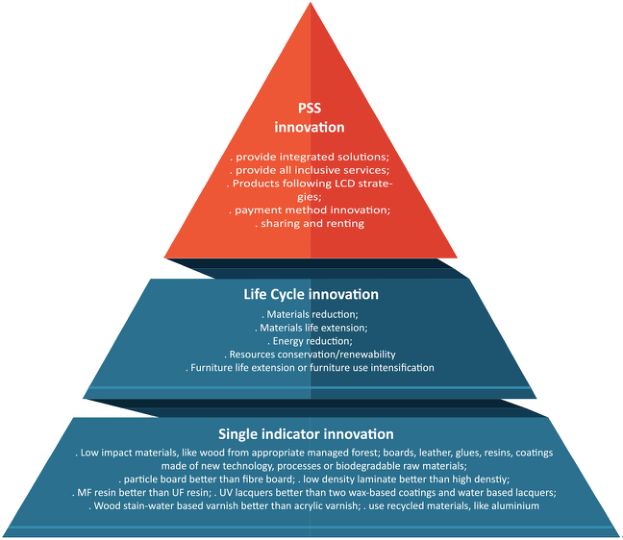
Based on former results, the research proposes a framework (fig.1) to map the reviewed furniture design strategies in three levels: single indicator level,
596 Yang
Figure 1: A framework to map the reviewed furniture design strategies in three levels.
furniture LCD level, PSS design level. In this framework, the single indicator level and LCD level represent the fundamental innovation, without which PSS level innovation will not be valid. On the other hand, PSS innovation can facilitate the other two levels of innovation.
CONCLUSION
This paper contributes to sustainable furniture system design specifically by providing an overview of design strategies proposed after quantitative LCA, as solutions to sustainability problems in the furniture industry, as well as by proposing a framework that synthesizes the various levels of design interven- tions. The framework demonstrates how design has evolved the focus from single indicator innovation towards life cycle perspective and even system level changes. The framework also shows that different levels innovations are not independent but rather coherent. Single indicator innovation is fun- damental for furniture system, while higher levels innovations contributes to radical improvements.
This framework may contribute to further academic research, education activities and design practice in the field of furniture design. For academic purpose, this framework contributes to the sustainable furniture system scope discourse and engage researchers in the discussion of how design for sustai- nability can be incorporated into the system. For education purposes, the framework can be used as a reference to design the structure of sustainable furniture system design related courses, as well as to discuss different design
The Application of Life Cycle Assessment in Sustainable Furniture System Design 597
strategies and their influences on the furniture system. Finally, for practiti- oners, the framework may aid in the definition of appropriate intervention approaches for specific company/furniture products and services.
It is not necessary these strategies cover every possible scenario. Further research could be envisioned to enlarge the scope of sustainable furniture system and go into greater detail on each strategy.
REFERENCES
Adi Wicaksono, P. and Ahmad Kadafi, C. (2020) ‘The Improvement of Production Process Impact in Furniture Industry Toward Circular Economy’, in. E3S Web of Conferences. doi:10.1051/e3sconf/202020207052. Asdrubali, F. et al. (2017) ‘A review of structural, thermo-physical, acoustical, and
environmental properties of wooden materials for building applications’, Building and Environment, 114, pp. 307–332. doi:10.1016/j.buildenv.2016.12.033. Askham, C. (2011) ‘Environmental product development: Replacement of an epoxybased coating by a polyester-based coating’, International Journal of Life Cycle Assessment, 16(8), pp. 819–828. doi:10.1007/s11367-011-0302-x. Babarenda Gamage, G. et al. (2008) ‘Life cycle assessment of commercial furni-
ture: A case study of Formway LIFE chair’, International Journal of Life Cycle Assessment, 13(5), pp. 401–411. doi:10.1007/s11367-008-0002-3. Berrios, I. et al. (2005) ‘Volatile Organic Compounds (Vocs) Emissions From Sources In A Partitioned Office Environment And Their Impact On IAQ’, Indoor Air, p. 6. Besch, K. (2005) ‘Product-service systems for office furniture: barriers and oppor-
tunities on the European market’, Journal of Cleaner Production, 13(10–11), pp. 1083–1094. doi:10.1016/j.jclepro.2004.12.003. Bovea, M.D. and Vidal, R. (2004) ‘Materials selection for sustainable product design: A case study of wood based furniture eco-design’, Materials and Design, 25(2), pp. 111–116. doi:10.1016/j.matdes.2003.09.018. Cambria, D. and Pierangeli, D. (2012) ‘Application of a life cycle assessment
to walnut tree (Juglans regia L.) high quality wood production: A case study in southern Italy’, Journal of Cleaner Production, 23(1), pp. 37–46. doi:10.1016/j.jclepro.2011.10.031. Castellani, V., Sala, S. and Mirabella, N. (2015) ‘Beyond the throwaway society: A life cycle-based assessment of the environmental benefit of reuse’, Integrated environmental assessment and management, 11(3), pp. 373–382. Cheung, W.M., Leong, J.T. and Vichare, P. (2017) ‘Incorporating lean thin-
king and life cycle assessment to reduce environmental impacts of plastic inje- ction moulded products’, Journal of Cleaner Production, 167, pp. 759–775. doi:10.1016/j.jclepro.2017.08.208. Çinar, H. (2005) ‘Eco-design and furniture: Environmental impacts of woodbased panels, surface and edge finishes’, Forest Products Journal, 55(11), pp. 27–33. Cortez, C.V., Jr. et al. (2015) ‘Life cycle assessment of manila hemp in Catandu-
anes, Philippines’, Journal of Environmental Science and Management, 18(2), pp. 53–61. Costa, F. et al. (2015) ‘Sustainable Product-service Systems for an Office Furniture Manufacturer: How Insights From a Pilot Study can Inform PSS Design’, Procedia CIRP, 30, pp. 66–71. doi:10.1016/j.procir.2015.02.109.
598 Yang
Donatello, S. et al. (2014) Revision of EU ecolabel and EU green public procurement criteria for furniture products: preliminary report. ISBN 978-92-79- 63494-9, doi:10.2791/075599, JRC103217. Luxembourg: Publications Office of the European Union. Available at: https://data.europa.eu/doi/10.2791/075599 (Accessed: 21 October 2021). Donatello, S., Moons, H. and Wolf, O. (2017) Revision of EU Ecolabel cri-
teria for furniture products: final technical report. ISBN 978-92-79-71863-2, doi:10.2760/14246, JRC107824. Luxembourg: Publications Office of the Euro- pean Union. Available at: https://publications.jrc.ec.europa.eu/repository/handle/ JRC107824 (Accessed: 20 October 2021). European Commission (2020) Circular economy action plan: for a cleaner and more competitive Europe. LU: Publications Office of the European Union. Available at: https://data.europa.eu/doi/10.2779/05068 (Accessed: 5 October 2021). Garcia Gonzalez, M.N., Levi, M. and Turri, S. (2017) ‘Development of polyester
binders for the production of sustainable polyurethane coatings: Technological characterization and life cycle assessment’, Journal of Cleaner Production, 164, pp. 171–178. doi:10.1016/j.jclepro.2017.06.190. González-García, S. et al. (2009) ‘Environmental performance assessment of hardboard manufacture’, International Journal of Life Cycle Assessment, 14(5), pp. 456–466. doi:10.1007/s11367-009-0099-z. González-García, S. et al. (2011) ‘Assessing the global warming potential of wooden
products from the furniture sector to improve their ecodesign’, Science of the Total Environment, 410–411, pp. 16–25. doi:10.1016/j.scitotenv.2011.09.059. González-García, Sara et al. (2011) ‘Environmental assessment of green hardboard production coupled with a laccase activated system’, Journal of Cleaner Production, 19(5), pp. 445–453. doi:10.1016/j.jclepro.2010.10.016. González-García, S. et al. (2012) ‘Eco-innovation of a wooden childhood furniture
set: An example of environmental solutions in the wood sector’, Science of the Total Environment, 426, pp. 318–326. doi:10.1016/j.scitotenv.2012.03.077. González-García, S. et al. (2019) ‘Cross-country comparison on environmental impacts of particleboard production in Brazil and Spain’, Resources, Conservation and Recycling, 150, p. 104434. doi:10.1016/j.resconrec.2019.104434. Gustafsson, L.M. and Börjesson, P. (2007) ‘Life cycle assessment in green chemistry:
A comparison of various industrial wood surface coatings’, International Journal of Life Cycle Assessment, 12(3), pp. 151–159. doi:10.1065/lca2006.11.280. Hartini, S. et al. (2019) ‘The Environmental Impact Assessment of Furniture Production Process Using the Life Cycle Assessment’, in. IOP Conference Series: Materials Science and Engineering. doi:10.1088/1757-899X/598/1/012078. Höglmeier, K., Weber-Blaschke, G. and Richter, K. (2014) ‘Utilization of recove-
red wood in cascades versus utilization of primary wood—a comparison with life cycle assessment using system expansion’, The International Journal of Life Cycle Assessment, 19(10), pp. 1755–1766. doi:10.1007/s11367-014-0774-6. Huang, P.C.-H. et al. (2014) ‘Employing logistic service model in eco-design modular furniture system’, in. Innovation, Communication and Engineering - Procee- dings of the 2nd International Conference on Innovation, Communication and Engineering, ICICE 2013, pp. 529–532. Ika Rinawati, D. et al. (2018) ‘Eco-efficiency Analysis of Furniture Product Using
Life Cycle Assessment’, E3S Web of Conferences. Edited by Hadiyanto, Sudarno, and Maryono, 31, p. 08005. doi:10.1051/e3sconf/20183108005. Jia, L. et al. (2019) ‘Life Cycle Assessment of Plywood Manufacturing Process in China’, International Journal of Environmental Research and Public Health, 16(11), p. 2037. doi:10.3390/ijerph16112037.
The Application of Life Cycle Assessment in Sustainable Furniture System Design 599
Kayo, C. et al. (2019) ‘Environmental Impact Assessment of Wood Use in Japan through 2050 Using Material Flow Analysis and Life Cycle Assessment’, Journal of Industrial Ecology, 23(3), pp. 635–648. doi:10.1111/jiec.12766. Khajehzadeh, I. and Vale, B. (2017) ‘The share of furniture and appliances in the life
cycle energy of New Zealand houses’, in. Proceedings of 33rd PLEA International Conference: Design to Thrive, PLEA 2017, pp. 3555–3562. Krystofik, M. et al. (2018) ‘Adaptive remanufacturing for multiple lifecycles: A case study in office furniture’, Resources, Conservation and Recycling, 135, pp. 14–23. doi:10.1016/j.resconrec.2017.07.028. Kutnar, A. and Tavzes, C. (2011) ‘Sustainable development in wood industry’,
in. 22nd International Scientific Conference: Wood is Good - EU Preaccession Challenges of the Sector, Proceedings, pp. 83–88. Laemlaksakul, V. and Sangsai, N. (2013) ‘A study of ecological products by life cycle assessment in thai furniture industry’, Applied Mechanics and Materials, 431, pp. 344–349. doi:10.4028/www.scientific.net/AMM.431.344. Li, S. et al. (2019) ‘Do novel wooden composites provide an environmentally favo-
rable alternative for panel-type furniture?’, BioResources, 14(2), pp. 2740–2758. doi:10.15376/biores.14.2. 2740–2758. Linkosalmi, L. et al. (2016) ‘Main factors influencing greenhouse gas emissions of wood-based furniture industry in Finland’, Journal of Cleaner Production, 113, pp. 596–605. doi:10.1016/j.jclepro.2015.11.091. Liu, W. et al. (2012) ‘Indoor decorating and refurbishing materials and furniture
volatile organic compounds emission labeling systems: A review’, Chinese Science Bulletin, 57(20), pp. 2533–2543. doi:10.1007/s11434-012-5208-x. Medeiros, D.L. et al. (2017) ‘Life cycle assessment in the furniture industry: the case study of an office cabinet’, The International Journal of Life Cycle Assessment, 22(11), pp. 1823–1836. Michelsen, O., Fet, A.M. and Dahlsrud, A. (2006) ‘Furniture Remanufacturing and
Energy Savings’, Journal of Environmental Management, 79(3), pp. 290–297. doi:10.1016/j.jenvman.2005.07.007. Ministry of Ecology and Environment of China (2010) Clean Produ- ction Standard-Wood-based Panel Industry (Particle Board). Available at: https://www.mee.gov.cn/gkml/hbb/bgth/201009/W020100930719561859100.pdf. Mirabella, N., Castellani, V. and Sala, S. (2014a) ‘Forestry operations in the alpine context. Life cycle assessment to support the integrated assessment of forest wood short supply chain’, International Journal of Life Cycle Assessment, 19(8), pp. 1524–1535. doi:10.1007/s11367-014-0756-8. Mirabella, N., Castellani, V. and Sala, S. (2014b) ‘LCA for assessing environmental
benefit of eco-design strategies and forest wood short supply chain: A furniture case study’, International Journal of Life Cycle Assessment, 19(8), pp. 1536–1550. doi:10.1007/s11367-014-0757-7. Müller, K. et al. (2020) ‘Mechanical characterization of densified hardwood with regard to structural applications’, Journal of Renewable Materials, 8(9), pp. 1091–1109. doi:10.32604/jrm.2020.09483. Piekarski, C.M. et al. (2017) ‘Life cycle assessment of medium-density fiberboard
(MDF) manufacturing process in Brazil’, Science of the Total Environment, 575, pp. 103–111. doi:10.1016/j.scitotenv.2016.10.007. Renda, A. et al. (2014) The Eu Furniture Market Situation And A Possible Furniture Products Initiative. Brussels: European Commission, Centre for Industrial Stu- dies (CSIL), Centre for European Policy Studies (CEPS), Demetra and Economisti Associati, p. 307. Available at: https://www.ceps.eu/wp-content/uploads/2015/04/ Final%20report_en.pdf (Accessed: 20 October 2021).
600 Yang
Shi, J. et al. (2016) ‘A comprehensive evaluation of physical and environmental performances for wet-white leather manufacture’, Journal of Cleaner Production, 139, pp. 1512–1519. doi:10.1016/j.jclepro.2016.08.120. Smoca, A. (2019a) ‘Hemp fibres reinforced bio-composites for sustainable design’, in. International Multidisciplinary Scientific GeoConference Surve- ying Geology and Mining Ecology Management, SGEM, pp. 471–478. doi:10.5593/sgem2019/6.2/S27.060. Smoca, A. (2019b) ‘Water absorption properties of hemp fibres reinforced PLA bio-composites’, in. Engineering for Rural Development, pp. 1079–1083. doi:10.22616/ERDev2019.18.N522. Stephan, A. (2020) ‘Analyzing material and embodied environmental flows of an
Australian university — Towards a more circular economy’, p. 12. Ulrich, K.T. and Eppinger, S.D. (2012) Product Design and Development. McGraw-Hill/Irwin. Vezzoli, C. and Yang, D. (2021) ‘A Case Study Analysis of the Furniture System From Sustainable Product-Service System Design Perspective’, in. ISDRS 2021: The 27th International Sustainable Development Research Society con- ference, Sweden: Mid Sweden University. Available at: https://www.diva- portal.org/smash/get/diva2:1608600/FULLTEXT01.pdf. Wang, S., Su, D. and Zhu, S. (2016) ‘A comparative study on life cycle assessment of typical wood base furniture’.
LISTED IN THE AHFE DIGITAL BOOKSTORE CATALOGUE
Explore the complete digital volume
Ergonomics In Design
Read this individual research paper free through the original publisher, or explore the full digital proceedings book.
ISBN 978-1-958651-23-0
Explore this ISBN in the AHFE Bookstore ↗Listed in the July 2026 bookstore catalogue; search by ISBN to confirm current availability · Digital book purchase optional