Margarida Gamito, Fernando Moreira Da Silva (2022). UrbanCroma, Methodology Applied to Oeiras Municipality, Portugal. In: Ergonomics In Design. AHFE Open Access, vol. 47, pp. 673–678. https://doi.org/10.54941/ahfe1001997
This paper presents a research work, inserted in the post-Doctoral applied investigation which aims to test and validate this new methodology. UrbanCroma, the chromatic planning methodology for urban furniture which was applied in Oeiras Municipality, is part of a theoretical and practical work carried out during the research for a PhD thesis, in which the present methodology was developed. Thus, UrbanCroma is mainly intended to be applied into the elaboration of chromatic plans for urban furniture, whose needs do not completely correspond to those proposed by other existing methodologies, destined almost exclusively to be applied to the built environment, i.e., to architecture. These chromatic plans, allow the full performance of Urban Furniture functions, improving its use, and transforming it in a factor of inclusivity, as its elements will become more visible and legible as they stand out from the surrounding environment, whether being built or landscape. Likewise, this methodology has an identification and orientation function, since its elements will constitute harmonic chromatic sets that, although they establish a strong contrast with the surrounding environment, respect the local chromatic traditions, identify the neighborhoods or urban areas and, by their variation, constitute orientation landmarks throughout the city. In this case study ─ Oeiras Municipality ─ that have settlements both on the interior and on the sea front, and is at the same time a miscellanea of old and contemporary, were chosen three different localities: Laje, Carnaxide Historic Center, and a new urban area of Carnaxide. These locals, that encompass social neighborhoods, traditional settlements and modern building urbanizations, inevitably have several characteristics that allow the application of this methodology to a wide range of neighborhoods. So, UrbanCroma application starts by choosing samples areas, which will encompass the case study most representative zones, applying there the new methodology to all furniture elements, in order to increase their potentiality as relevant issues for city color planning. In all these intervention areas, all the colors present in the environment are recorded, being it built or landscape, taking in account all the changes due to climatic variations and the non-permanent colors, whose presence has enough importance to be considered as environmental colours. All these colors were, then, registered in files and maps, in order to create a data-base allowing the identification of all environmental colors. The set of these colors permitted the establishment of the local dominant colors and, these ones, along with the contribute of the local history and culture, constitute the scientific basis upon which, it was established a very comprehensive urban furniture chromatic plan, with scientific rigor, for Oeiras Municipality case study.
the research for a PhD thesis. Posteriorly, the same methodology was inser- ted in the post-Doctoral applied investigation with the aim of being tested and validated, so that it may be applied whenever there is a need to create a chromatic plan for Urban Furniture, at a National or even International level. With this intention, UrbanCroma, was tested in two municipalities near Lisbon, of which, Oeiras is the subject of this paper.
UrbanCroma, has the particularity of being mainly intended to be used in the elaboration of chromatic plans for urban furniture, whose needs do not completely correspond to those proposed by other existing methodo- logies, destined almost exclusively to be applied to the built environment, i.e., to architecture. These chromatic plans, allow the full performance of Urban Furniture functions, improving its use, and transforming it in a factor of inclusivity, as its elements will become more visible and legible inasmuch as they stand out from the surrounding environment, whether being it a built or a landscape. Likewise, this methodology has an identification and orienta- tion function, since its elements will constitute harmonic chromatic sets that, although they establish a strong contrast with the surrounding environment, respect the local chromatic traditions, identify the neighborhoods or urban areas and, by their variation, constitute orientation landmarks throughout the city.
UrbanCroma, the Methodology Steps In order to identify the existing or present colors in each urban area and con- sequently identify the best chromatic contrast, the methodology establishes the following steps:
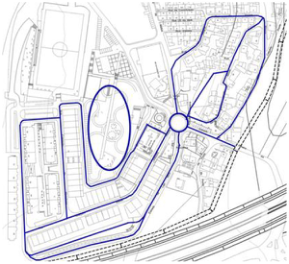
1. Definition of a sampling route (Figure 1) for the chosen urban area, inclu- ding the main streets and squares, and also some secondary streets, with the intention of encompassing the most representative areas of the above- mentioned. On the defined route, an extensive direct observation must be carried out, in order to estimate the presence of elements of urban fur- niture and signage, and to evaluate their visibility and legibility, as well as their chromatic applications (Gamito 2012).
UrbanCroma, Methodology Applied to Oeiras Municipality, Portugal 675
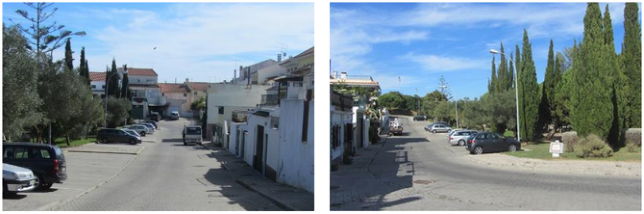
Figure 2: Record of existing colors (Gamito 2020).Figure 3: Panoramic views (Gamito 2022).
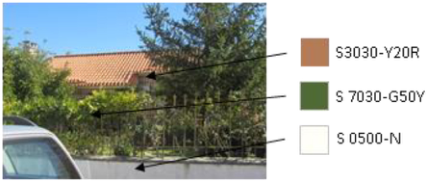
2. Then, along this route, an exhaustive survey of all the colors from the built or landscape environment is carried out, as well as all the colors of the existing materials and textures (Figure 2). In these records, are also included samples of the chromaticism of the pavements, vegetation and all other elements present in the urban environment, with a relative permanence, which constitute the non-permanent colors, that must be considered for the chromatic reading of the space. In addition, are taken in account all the changes due to climatic variations (Gamito 2012).
Considering the possibility of human error, due to the subjectivities of each observer’s vision, and in order to achieve a greater objectivity and rigor in the collection, the chromatic survey must be performed by more than one observer, crossing the various observations. 3. All these photographically registered and, simultaneously, identified according to the Natural Color System (NCS) notations, the system cho- sen for this methodology, as it allows the easy identification of any color without using additional equipment, even if it is not easily accessible.
We must also underline that the registered colors are perceived colors, not always coincident with the inherent colors and that, in the particu- lar cases of different varieties of vegetation and tiles covered walls, the perceived colors are partitive syntheses of the present colors. 4. As a complement, and for a better chromatic identification of the case study, photographs of the surrounding elements and panoramic views of the different blocks (Figure 3) are used whenever justified, as components of the environmental color.
All these collections are methodically indexed in files, designed expressly for this methodology, in order to create a scientific base where
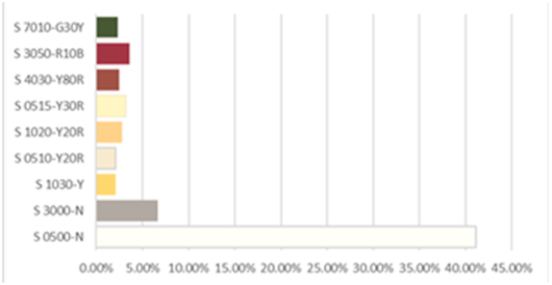
all the colors present in each street, area or square of the sample route are indexed, with the percentages corresponding to their presence, which makes it possible to identify all the environment colors and, then, deter- mine a dominant chromatic palette for each urban zone. We must highlight that the designed file is an important part of the methodology, since it allows the identification and visualization of all the chromatic information, allowing an easy analysis and interpretation of all the data collected (Figure 4). 5. The dominant chromatic palettes of each neighborhood, or urban area, in turn, lead to the establishment of a coherent chromatic plan that should be applied to the urban furniture of the city (Figure 5).
This chromatic plan, which is different for each neighborhood or urban area, must respect the local history and tradition, and establish a chromatic contrast with the surroundings that will allow urban furni- ture to stand out and contribute to a better legibility of its elements, that will become identifying factors, which will facilitate orientation within the city (Gamito 2012).
UrbanCroma, Methodology Applied to Oeiras Municipality, Portugal 677
In order to achieve a scientifically well-founded color plan with chroma- tic coherence, it is considered essential, at this stage of the work, to have the collaboration of Specialists in Color Symbolism, Historians, City Cou- ncilors, among others, who will be responsible for the decisions concerning the application of this methodology, given that it is a multi-disciplinary work (Gamito, 2017).
Oeiras Municipality, an UrbanCroma Case Study This case study — Oeiras Municipality — was chosen because it is a miscel- lanea of old and contemporary settlements that are both situated on the interior and on the sea front near Lisbon. In order to apply the methodology UrbanCroma, were chosen three different localities of this municipality: Laje, Carnaxide Historic Center, and a new urban area of Carnaxide. These locals, that encompass social neighborhoods, traditional settlements and modern building urbanizations, inevitably have several characteristics that allow the application of this methodology to a wide range of neighborhoods. So, Urba- nCroma application starts by choosing sample areas, which will encompass the case study most representative zones, applying there the new methodo- logy to all furniture elements, in order to increase their potentiality as relevant issues for city color (Gamito 2019).
The locality of Laje is the more complex, because it is composed by three different urban zones: social housing, an urban zone constituted by several buildings, all similar and belonging to the municipality, to whom the inh- abitants pay a rent; own housing, a group of plots that were sold to the residents by the municipality with the architectural project included; and AUGI, which means that those are plots without a municipal permit were the population built their residences and, then, were recognized as urban areas (Gamito 2019).
CONCLUSION
The case studies diversity, allowed the possibility to cover a great extent of possibilities for the UrbanCroma application. We verified that the methodo- logy was perfectly suited to create chromatic plans for any urban zone, being it a modern one, an antique city, or a simple rural town. Therefore, we can state that the methodology was validated, which was the main propose of our research.
Although UrbanCroma was created to be applied to urban furniture, the- refore, in outdoor spaces, its malleability allows it to be applied in interior spaces and whenever it is intended to create a contrast or chromatic harmony with its surroundings.
ACKNOWLEDGMENT
The authors would like to acknowledge CIAUD, Research Centre for Arch- itecture, Urbanism and Design, Lisbon School of Architecture, Universidade
678 Gamito and da Silva
de Lisboa and this work is financed by national funds through FCT - Funda- ção para a Ciência e a Tecnologia, I.P., under the Strategic Project with the references UIDB/04008/2020 and UIDP/04008/2020.
REFERENCES
Gamito, M., Moreira da Silva, F. (2012) “Color in urban furniture: A methodology for urban mapping and wayshowing”. In Advances in Usability Evaluation Part II Section IV, 620–627. USA: CRC Press. 10.1201/b12324-69 Gamito, M., Sousa, J. “Urban Furniture’s Chromatic Planning Methodology: Buce-
las, a Case Study”. In Advances in Intelligent Systems and Computing, 333–343. USA: Springer International Publishing, 2017. Published · 10.1007/978-3-319- 60597-5_31 Gamito, M., Sousa, J. (2019) “Methodology for colour planning in urban furniture: Laje, a case study”. In Intelligence, Creativity and Fantasy, editado por Kong, Mário; Monteiro, Maria; Neto, Maria João, 234-238. London, UK: CRC Press, 2019. Published · 10.1201/9780429297755-40
LISTED IN THE AHFE DIGITAL BOOKSTORE CATALOGUE
Explore the complete digital volume
Ergonomics In Design
Read this individual research paper free through the original publisher, or explore the full digital proceedings book.
ISBN 978-1-958651-23-0
Explore this ISBN in the AHFE Bookstore ↗Listed in the July 2026 bookstore catalogue; search by ISBN to confirm current availability · Digital book purchase optional