Naomi Y Mbelekani, Klaus Bengler (2022). Interdisciplinary industrial design strategies for human-automation interaction: Industry experts’ perspectives. In: Interdisciplinary Practice in Industrial Design. AHFE Open Access, vol. 48, pp. 132–141. https://doi.org/10.54941/ahfe1002025
Abstract. Highly automated vehicles are the next generational stage in a long evolutionary process of transport technology. Thus, it is important to consider human factors and ergonomic (HFE) issues that challenge the success of this coming wave of automation technology. Hence, careful consideration of industries’ design differences and similarities for real-world use cases is important. Additionally, a better understanding of the technological, infrastructural, social, and legal aspects that govern human-automation interaction needs to be examined on a comprehensive level, irrespective of industry. In retrospection, an industry-centred approach will help us uncover nuances of understanding on human aspects of advanced manufacturing. Thus, N=20 industry experts were invited to contribute their knowledge. The lessons learned based on different industry experts’ levels of understanding are crucial to consider, mainly for principles or strategies that are aligned with safe and risk-free interaction longevity.
Automated vehicle (AV) have become a hot topic, concerning how humans will adopt and interact with them on public spaces of mobility. As a result, we have seen the development of new interactive system designs that are useful and capable, yet tussle with some factors, such as long-term effects. Nonethe- less, there is still high hopes for a new normal where humans and automation can collaborate in performing some of the operations’ tedious tasks free from risk. Hence, the automotive industry announced their venture in advance automated driving (Chan, 2017), for example, Daimler and Mercedes Benz revealed that their level three system (L3 based on the Society of Automotive Engineers’ levels of automation taxonomies) would soon hit the market and public roads, and the new mobility projects towards higher automated veh- icles (HAV). Volvo Trucks is testing advanced automated systems integrated with Aurora Driver Technology. In agriculture, ACGO/Fendt announced a more advanced system called FendtONE for more smart farming. In the air vehicle industry, Airbus and Boeing are implementing artificial intelligence
Interdisciplinary Industrial Design Strategies for Human-Automation Interaction 133
(AI) to advance automated flight in order to support pilots. Granting, these are a few examples in the quest for more AV. However, what is left unsaid is how the interaction with such systems will be received by real world users, thus the experiences of the human in the interaction loop. This is because the discussion surrounding automation success centres on the success of the designed interaction that takes place between the human and the system, in making sure that those at the receiving end are catered for and their expecta- tions are met. Thus, interaction design strategies (IxDS) aim to explore use case scenarios to synthesize how the user might interact with the system and their behaviour onwards.
The interaction is somewhat hinged on the human-machine interface (HMI) and user interface (UI), which is the medium through which the user meets the automation and vice versa. For AV to interact with humans in a fruitful manner, their interactive architecture should be intuitive. Thus, we consider varied IxDS as a way to fathom long-term HAI. The relation- ship between systems and users helps us understand the intersection between design and interaction outcomes. Hence, it can be argued that as specific systems become ubiquitous, the possibility of costly and catastrophic inte- ractions rises due to poor cooperation between users and automation (Lee and See, 2004), for example Tesla crashes, etc. Thus, a meticulous account of IxDS includes HAI that is useful, efficient, comfortable, transparent, safe and risk-free in a specified context of use. Importantly, calibrated trust in auto- mation as a vital element for acceptance (Körber, Baseler, and Bengler, 2018; Lee and See, 2004).
Ground and air automated vehicle systems are two sides of the same coin of vehicle technology that considers the humans as a common denomina- tor. In part, how well human expectations matches the systems’ capabilities is vital. Thus, the interaction infers phenomenological meanings, with phe- nomenology being “the study of human experience and of the ways things present themselves to us in and through such experience” (Gallagher, 2012).
METHOD
We employed N=20 air and ground vehicle industry experts from Europe and North America using expert sampling. Further, with an understanding of the wider practice, environmental, economic, technical and social systems linked to AVs. Experts were asked to consider national and global effects as they see fit. Throughout, experts were encouraged to consider how future events may unfold and potential sources of vulnerability. The interviews were analy- sed using comparative and content analysis in order to uncover nuances of understanding. The information topics achieved were subsequently formed into coherent levels of understanding. As the experts work for internatio- nal organisations (e.g. AGCO/Fendt, Volvo trucks, GM, BMW, Volvo car, Renault, Continental, Silicon Valley, Airbus, Lufthansa, etc.), pseudonyms were used to maintain confidentiality. These pseudonyms are however indi- cative of which industry (ground/air) each expert belongs, for example, Car Experts (CEs), Truck Experts (TEs), Smart Farming Experts (SFEs), and Aircraft Experts (AEs).
134 Mbelekani and Bengler
RESULTS
We asked experts about the type of interaction design strategies (IxDS) they consider when aiming for long-term HAI. Essentially, user experience (UX) and interaction design (IxD) factors were highlighted. They were in consen- sus that there are a variety of overarching factors that contribute to successful HAI and long-term acceptance, for example, intuitiveness and efficiency were mentioned, among others. Moreover, user types, culture, and experience were seen as important human factors to consider, among others. Thus the KISS method – Keep It Simple and Simpler, was understood as a good strategy for both the UX community and safety community when aiming to avoid risk/safety challenges and achieve user satisfaction. Furthermore, experts argued that developers/designers’ understandability of how the system works should be equivalent to how the user understands it, with ‘easy’ being a topic of interest. They however expressed that ‘easy’ might be perceived and understood differently amongst different users, thus resulting in dis- satisfaction. In order to foster system trustability and acceptability, it was encouraged to conduct more studies that investigate different user behaviours based on different user physiognomies, user journey, cognition, personality, age, gender, and intelligence. However, this begs the question on how do we incorporate all these user characteristics when aiming a ‘one for all’ design strategy.
Driver-monitoring systems were emphasised in conjunction with driver behaviour. Additionally, automation levels and mode awareness were also noted. Furthermore, experts felt that the guide to design systems that are easy to learn, easy to understand, easy to use should pay attention to principles that infer the different types of operation ergonomics (physical, cognitive, visual, emotive), user satisfaction, transparency, skilfulness and abilities. Mostly experts in aviation and agriculture alluded that user training and intuitive user interfaces are crucial approaches to consider. Operation ergo- nomics issues such as workload and complacency were noted as a result of the shape shifting task of operating vehicles, from physical to mental opera- tion. Experts compared the different situational dimensions between ground and air vehicles, and noted that the move to higher automation in air travel are concerning, as automation is prone to error and the aircrafts environment is not conducive for system failure.
Automotive Industry Experts Views When it comes to users, CE1 noted that there are two groups of people that developers need to pay attention to, the ones that are tech savvy, for example, they “are very quick, they just glance, click and go,” and the tech ignorant, for example, they “look to the side and say there is a button and now I am pressing the button, now pressing the button, and now I am back on the road.” CE1 expressed that they “have no way of forcing people to behave optimally or correct,” as a result, they “can provide a system that is possible to use easily and well, and we can guarantee that people will do that. So we will always have to assume that mistakes will be made, misinterpretations will be made, but we need to stay robust from consequences of failure, to use
Interdisciplinary Industrial Design Strategies for Human-Automation Interaction 135
the systems correctly.” TE2 described that there are variations between dri- vers depending on “what they do and in what context.” CE4 noted that most research studies often have just students as participants and as test drivers, and this does not represent everyone, thus “elderly people are not invited, or super young people are not invited to develop a project together with a team or to participate, and the same with different cultural backgrounds.” Experts highlighted that cultural differences have an effect on simplicity and easy, with some alluding that they aim to design for a ‘homely feeling’, thus mental states and emotions were seen as vital. TE2 mentioned that it is impe- rative to know the business case and also the user, for example, stated that they “have truck drivers, they are not always the customer, sometimes they both drive and buy the truck, sometimes there is a completely different per- son buying the trucks, like FedEx or big companies like that.” The first thing is to understand the customers’ business, thus “do they drive construction, do they drive in the ports, do they drive long haul distribution, etc.” (TE2). For instance, “if you drive timber, you drive in the woods and with a crane, and on a highway on your way to sawmill, and so you need to understand the whole user journey”(TE2). TE1 emphasised that truck drivers have down to earth needs, “they need basic stuff, like being able to drive, getting from one point to another, being there on time, and having somewhere to eat, use the toilet, etc.” However, when it comes to automation, “like the featu- res, everything becomes much more complex with professional truck drivers because they use it as a tool. (…) and so you really need to understand the user” (TE2). Moreover, stated the need to understand what the drivers’ pains are, and also define the whole flow of events from A to B, thus “under- stand all the pain points, what is he struggling with; distraction could be one during this highway drive, so we should support him with some auto- mation there” (TE2). Experts felt it is noteworthy to consider factors that are usually neglected, thus try to read between the lines of what users are saying is of value to them and to design for that. CE4 expressed that, even though their company is international with offices and development teams in Asia, Singapore and Shanghai, they however develop different products, and this is not only “about how design elements look, or how acoustic or air-con sounds, but also the system design is really different, when a product is developed and compared to when it is developed here in Frankfurt.” How- ever, CE4 noted that what is similar for different developers is how vision works or how seeing works, how memories work, feelings and emotions, for example, “elderly people reaction times are different or vision is a bit impaired.”
With regards to the system of use, CE6 noted that “it has to be intuitive as possible.” CE1 noted that their key design principles are “make it simple, make interactions short, and do not complicate. If it takes too long, or if it is hard to get through any individual step, then you made it too complica- ted.” As a result, with very simple design guidelines, “you satisfy the needs of both the UX community and the safety community at the same time” (CE1). In addition, a linear relationship between, “how long enough to spend on a secondary task and how unsafe or unintuitive or not user friendly” the system may be was noted by CE1. CE1 pointed out that they have realized
136 Mbelekani and Bengler
not to expect too much from their users, as a result, it is better planning “for decent average usage and graceful failure (…) given the sheer normal human reliability.” Further explained that it is hard to design a full proof system for so many people, because it is hard to guarantee that, thus “you need to work with a system to make it possible to use efficiently, fast and intuitively” (CE1). CE7 mentioned that they did a lot of research on basic psychologi- cal backgrounds on system design, like what is the difference between the devices in the car and so on, and why automotive interactions are someti- mes different from aircraft interactions and explained that “for an airplane, the user is a trained operator, which is a major difference to cars. For the car, the biggest issue is the fact that customers are expected to understand the system without special training, which is a big challenge and has to be considered.”
When considering safety, experts felt it is vital to pay attention to what constitute OEM’s idea of risk and safety juxtaposed with user experience and their perceptions of risk and safety. CE1 revealed that there is a rela- tionship between safety and user experience, as safety experts “are directly involved in the UX stuff” for example crash-warning types, and also when considering the general user experience, it also considers “not only crashing, but rather all your normal driving” activities. Also, CE1 described that “peo- ple have a good perception of risk, and there is some simple rules for what they judge to be inconvenient and at the same time unsafe.” CE2 noted that their goal is actually to change the driver’s behaviour, as a result, “all other features in the vehicle, at best, we understand the drivers’ behaviour and change how the feature operates, so they work together well. We actually aim to and actually succeed in dynamically changing the drivers’ behaviour, and in particular, we prevent them from engaging in secondary tasks.” CE2 noted that they afford users the ability to supervise the feature and its per- formance. CE6 felt that driver monitoring systems (DMS) are essential, and “are that you touch a steering wheel, which is not that effective probably and actually annoying, and the others are scanning your gaze, your perspe- ctive and all of that, which might not work that reliably, but that is what is needed for L2.” CE6 highlighted that, the challenge is in a way the same with driver distraction, thus “what can you still allow versus what is distra- cting, and should not be done while driving.” CE5 noted that they “aim at being careful with where the driver eyes look, and where his hands and his feet are, just to be able to take back control when needed, even for low level automation.” Industry was seen as having a challenge with trying to offer advanced products and being perceived as technological leaders, however needing “to limit this in the interest of safety”, which was seen “the same with these driver-monitoring systems, you don’t want an annoying thing that every 30 seconds, sometimes even more, often needs to remind you that you have to do something, that’s annoying” (CE6). CE6 noted that customers don’t like when it annoys them with information “that is when you see situ- ations where people say I can just put a can of beer or a cup, while holding on the steering wheel.” CE6 noted that this was seen as tough for companies today to navigate out, because they have to be perceived as innovative and advanced technologist. CE5 expressed that their L2 does longitudinal and
Interdisciplinary Industrial Design Strategies for Human-Automation Interaction 137
lateral help, which means you could have Lane Keeping Assist merged with an ACC, for example, “so that means the driver is only in charge of supervi- sing, but needs to have his feet on pedals, his manual steering wheel, and has to monitor” and due to regulation they are incorporating DMS, “to be sure he is watching the road always and not sleeping. As the driver is still in charge of monitoring the situation” (CE5). When it comes to automation, experts stressed the importance between hands-off and hands-on, and not necessary between L2 and L3. CE5 explained that, “what we call L2, needs to have hands on the steering wheel, because actually the step is not between L2 and L3, the step is between hands-off and hands-on. As soon as you give the dri- ver authorization to take his hands-off, then you take responsibility and you need to be able to deal with that entire complex situation.” CE3 highlighted that it’s important not to solve a problem that does not exist, for instance, encouraged “use cases where you can add a value” and solving real problem in that sense.
In relation to HMIs and user interfaces (UI), CE1 stated the idea of “single button interface to activate a function with the idea that if you just need to click one button, you do not need to take your eyes off the road for very long.” Moreover described that they try to provide clear direction on the road, and to put all their screens at the highest position possible, as well as put button (press to activate or deactivate ADAS) behind the steering wheel, as “we tried to provide them really near the steering wheel, or at some place where you don’t have to move yourself, you don’t have to put your shoulders in front or anything, so just physical ergonomics” (CE5). CE7 noted that mode aware- ness is an important topic, “so the driver should always know in which mode she or he is in, and what does that mean regarding the system behaviour.” When describing the instrument cluster display, CE7 stated that the UI should be easy to understand and “should show the user what is going on, give a sta- tus regarding what they see, what they can do, and how the system is making sense of the world around it.” Some experts considered the idea of making the entire hardware an interface and feedback loop. TE2 noted that “When both external and internal interface people say we should design an HMI, it is not like a noun, it is more like a verb” in order to design good interaction. They noted designing emotional interfaces with an augmented feeling and not only physical interfaces. TE2 felt that when people talk about HMI, they talk about physical interfaces, “but the best interface is when you do not feel an interface, so it is basically something just there to support you, you just feel empowered. It should be like the exoskeleton, just like your body, it just has like the extra sense sensors and you do not have to hold so hard on your ste- ering wheel, you can get help when it gets critical on the road environment.” TE2 felt this should be the goal and not designing an in-vehicle ‘Christmas tree’ effect but rather an augmented feeling. TE2 viewed design principles as functional human factors recommendations, based on user agent state, automation state, vehicle state, environmental state, and then awareness, arbitration and action. Thus, explained that “you need to find the correct balance between driver state and system ability”, as a result “if the system is not able, then the driver needs to be in charge, and if the system is very
138 Mbelekani and Bengler
able then you are supervising” (TE2). Communication modalities and tran- sparency for inputs and outputs were considered critical, and also felt that the system’ agility is essential. TE1 noted that there are requirements for HMI design, and that they “have principles that apply for transparency, to know who is in control, who is driving right now, is it you or me, it is super impor- tant. Alternatively, if there is kind of a shared control feeling, you need to communicate that as well.” TE1 stated that there are legal requirements that they strictly follow, as “there are vehicle messages coming to the driver (…) to prompt the driver to take back control and focus on driving” but in the end, the system will disengage. TE1 described that they monitor the steering input and use that for driver alert support. Giving user support was seen as crucial, and to “understand that you can have automation and that you can interact with the driving if you like”(TE1). CE7 noted that user interface are partially regulated, so “there are regulations which have to be fulfilled for the user interface and also standards, (…) safety assessment, (…) all those require- ments that have to be taken into account when designing the overall system of a car.”
Tractor Industry Experts Views With reference to efficiency and intuitiveness, SFE7 stipulated that they plan- ned their off-board application, in a way “that when you are at home on your computer, you can create the tasks you want to do in the field.” SFE5 stated that “the automation should do it by itself, and not so many interacti- ons by the controller.” Moreover, in cases where the user has questions, “it needs to help him fast and offer possibilities” (SFE7). SFE6 noted that the system design should induce that a user “feels comfortable, feels at home”. SFE6 noted that colour ought to be used efficiently, as “It is visible for the driver to know that here we have these patterns for that and to find it easy.”
Safety and user workload were fathomed as important factors, especially for new automated systems, “because the systems we already have in modern agricultural machines are very complex, and the users have to really learn it. So, what we do not want is to make it even more complicated within the next years” (SFE1). As a result, SFE1 encouraged that developers should not over populate the machine with different types of systems, because this may cause confusions and challenges.
Most experts alluded the significance of simplicity and usability, for exam- ple, SFE7 noted these are prevalent factors, as “we want to make sure that the user does not need to read any instructions or watch tutorials before using it. It needs to be easy to use.” The easiness of use and workload redu- ction were seen as key factors, “because there is no sense in developing automated systems where the interaction is more complicated than doing it on your own”, however this is seen as a challenge to achieve as agricul- turalists have different views (SFE1). SFE5 noted that “it has to be easily handled in the best way by an unskilled worker, so it should be easy to handle on the field.” Less function were seen as better than too much, as a result easy to use.
Interdisciplinary Industrial Design Strategies for Human-Automation Interaction 139
Concerning UI design, SFE5 noted that they aim for an interface with clear identified icons, “so when a user has to read it, it does not take too long”, and highlighted that functionality is important for them, thus “can I understand on the first time, do I know what the functionality is for, it is working, and are you satisfied with the user interface” (SFE5). SFE3 described that they do a typical engineering process, so first, they “think about defining the scope, the right functionality, and then thinking about the possible user interface.” With reference to system agility, SFE3 enlightened that “when you have an automated steering, the driver can still set up the steering of the check to be more agile, or a bit slower reacting. (…) It is like a smooth transition from operator orientated to automation.” SFE3 noted that they “try to give the operator a chance, he can still stop the system easily, he can tune it and adapt to his needs. Have the option to switch the system off and drive on your own, if you want.” SFE3 described that they follow a process, from a product per- spective, and that they “first raise questions like what are requirements from Mr. Customer and then we will try to find a solution for this requirement.” SFE1 stipulated that this mostly works together with product management and marketing teams, as “They do many interviews with different farmers from different operations and different regions of the world. A global team works on those requirements.” SFE1 noted that the agriculturalists are given storyboards and predefine the use cases to consider, in order to understand very simplistic function that you mostly use during this specific operation, “so that you know that this function is very important, it needs to be easy to use” (SFE1). On the other hand, agriculturalists are asked “how many times have you done this specific setting in a machine, if the person says, Oh, I just do it once a year, then you do not need to have it in the first menu, you can have it in a second menu” (SFE1). It was noted that they use experie- nced product managers that are also farmers, in order to provide a function concerning, “what is the prioritization, the location of every button that you need to have on your armrest, on your operating post,” so the first concept comes from product management and then gets refined by agriculturalists globally (SFE1) .
Aircraft Industry Experts Views AE1 enlightened that with safety in mind, back in 1970s/1980s one manu- facturer tried to design an airplane system that could efficiently correct pilot errors, but they put a hold on the idea because “they learned that it is not always going to work”, as a result “what we see now is very intensive flight crew training, and HMIs that are intuitive as they can be.”AE1 explained that aircraft automated systems need to act and react in ways that pilots would expect, thus “If I want to fly the approach in this mode, I expect my airplane to do this. (…) the intuitive operation of the autopilot is very important.” Reliability, was perceived as quite important. AE4 reasoned for a human- cantered approach for high automation flying, thus the system should “find it easy to understand what is going on, it should help to solve the required tasks, and if the system cannot cover the tasks, there should be an appro- ach for human takeovers.” Regarding efficiency, it was highlighted that “the
140 Mbelekani and Bengler
system should be designed so there is sufficient time for human takeover and it should be clear what the system is capable of. It should be clear to the operator what the limits of the system are” (AE4). When comparing different OEM designs, AE2 noted that the basic functions of the autopi- lot flight systems “are essentially the same on all the aircraft and that is because of the standardization required for certification.” Further mentio- ned that all the passenger aircraft that are in service “have a function that is used to execute altitude. The modes are sometimes named a bit different on a Boeing aircraft to an Airbus aircraft, but the automated functions that are offered are at the basic level of the FAA task, because of the regulation standards” (AE2).
Relating to automation effects, AE1 stated that one of the big issues in avi- ation is complacency, thus some manufacturers have suggested “to entertain the pilot” as a possible tactic, for example, “create tiny little arrows, just to keep them awake”, for example the system states “Hello, here I am…” and “Okay, I’m gone again.” AE1 deduced that they do not have ‘attention get- ters’ in boring situations, as well as “any kind of pilot entertainment, and we do not interact with the automation to raise the attention.” Regarding skill atrocity, experts were in favour of Inflight Decision Making (IDM) training, for example “look at your destination, figure out the threats and always have a valid Plan B or valid Plan C” (AE1).
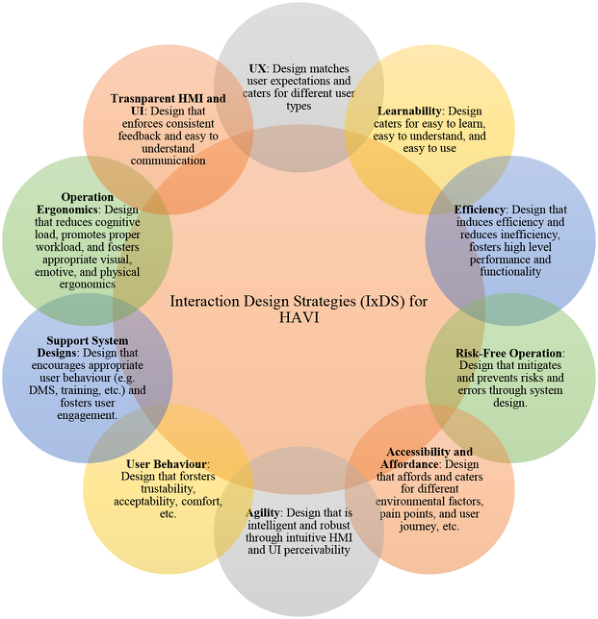
DISCUSSION AND CONCLUSION During the intense discussion with experts, we weighed different issues surrounding IxDS that cater for user experiences, acceptance and useful- ness, among others. There was a consensus among the experts that for automation to be successful, humans will need to find value in it, and for OEM designers to encompass the KISS method (Keep It Simple and Simpler). All industry experts were in consensus that automated systems need to be designed in a way that mitigate misbehaviours and promote acceptable user behaviours, especially for AVs that still require human invo- lvement. The common interest for experts was the move towards higher LOA systems (L4/L5), but also paying attention to HFE issues, as both air and ground industries cater for humans and fall under the umbrella of human-centred designs. Even though most experts projected a future with HAVs, they however proposed that IxDS should be highly stressed, including agreements in regulatory and standardisation matters. Granted, comparing IxDS from these two worlds (ground and air) is a bit com- plex, and more like comparing a iRobot roomba cleaner to a Tesla, as these automated systems operate in different spaces and influenced by dif- ferent situational factors. Even so, these are important lessons, especially for applied IxD issues, as the common interest is the human, mitigating risks and promoting safe and risk-free operations. Experts introduced different IxDS grounded on the KISS method (see Fig. 1). All of these factors are appli- cable to different vehicle industries to satisfy long-term HAI. For example,
Interdisciplinary Industrial Design Strategies for Human-Automation Interaction 141
Figure 1: IxDS grounded on the KISS method for Human-Automated Vehicle Intera- ction (HAVI) automated driving, automated trucking, automated flying, and automated farming.
ACKNOWLEDGMENT
The authors would like to acknowledge the industry partners for their contri- butions, and funding from Marie Skłodowska-Curie ITN, SHAPE-IT [grant number: 860410].
REFERENCES
Chan, C. Y. (2017). Advancements, prospects, and impacts of automated driving systems. International journal of transportation science and technology, 6(3), 208–216. Gallagher S. (2012). What Is Phenomenology? In: Phenomenology. Palgrave
Philosophy Today. Palgrave Macmillan, London. https://doi.org/10.1057/ 9781137283801_2 Lee, J.D., & Katrina A See, K.A. (2004). Trust in Automation: Designing for Appropriate Reliance. Human Factors: The Journal of the Human Factors and Ergonomics Society 46(1), 50–80. Körber, M., Baseler, E., & Bengler, K. (2018). Introduction Matters: Manipulating
Trust in Automation and Reliance in Automated Driving. Applied Ergonomics, 66, 18–31.
LISTED IN THE AHFE DIGITAL BOOKSTORE CATALOGUE
Explore the complete digital volume
Interdisciplinary Practice in Industrial Design
Read this individual research paper free through the original publisher, or explore the full digital proceedings book.
ISBN 978-1-958651-24-7
Explore this ISBN in the AHFE Bookstore ↗Listed in the July 2026 bookstore catalogue; search by ISBN to confirm current availability · Digital book purchase optional