Apiwat Thongprasert, Arisara Jiamsanguanwong, Uthai Tanlamai (2022). Design-for-user Acceptance of IOT Home use medical device: A design process for IOT home use medical device. In: Healthcare and Medical Devices. AHFE Open Access, vol. 51, pp. 186–195. https://doi.org/10.54941/ahfe1002115
Medical devices are migrating from hospital use to home use along with health professional users to lay users. New technologies, including Internet-Of-Things, lead home use medical devices to a new generation of easy to use, smart, portable, and communicable from anywhere. IOT technology enables the home use medical devices to seamlessly detect and connect home patient health status and health activities allowing the patients to remotely connect and share their health data to friends, family, and healthcare staff. Thus, home use medical devices with IOT connectivity play an essential role in assisting home patients to continue their medical care at home and monitor health activities, reducing the risk associated with non-communicable diseases (NCDs) in the first place. The devices empower the home patients to actively manage their health treatment and activities by themselves, either without or with minimum training experience and support. The targeted users of such devices are not limited to patients with chronic diseases but consumers who want to prevent them from serious illness and maintain good health. Accordingly, the success of the IOT home use medical devices also depends on the acceptance and adherence of the users to use the device as a part of their everyday lives. Developing medical devices concerning human factors to be safe and effective is crucial. Many studies contribute to providing design processes and methodologies in this regard. Furthermore, in the case of the IOT home use medical device development, engineers or designers must also understand the acceptance and adherence of the users toward the use of the devices in their daily life routine. Several studies coined the term as consumer medical devices bringing the consumer product development concept to use in this home use medical device development. Though several studies revealed factors influencing user acceptance of the devices such as convenience, ease-of-use, or usefulness, it still is difficult for engineers or designers who do not have expertise or experience in human factor research to integrate the knowledge with existing device development processes. This study proposes a T-A-C-V-I-U model linking relationships from IOT functions to device attributes, consequence, personal values, attitude toward using, and behavioral intention. The model aimed to analyze how device attributes would affect user acceptance. It was constructed from literature reviews on IOT functions, wearable and IOT device attributes, and factors influencing personal value and user acceptance based on Technology Acceptance Model (TAM), Health Belief Model (HBM), and Hierarchical Value Map (HVM). The model would assist non-user research or less-experienced human factor designers to consider which IOT functions should be embedded on a home use medical device to gain user acceptance. Vice versa, it would help assess how determined IOT functions would influence targeted users' acceptance. Finally, the Design-for-user Acceptance of IOT Home use medical device (DfAIH), a design process dedicated for IOT home use medical device development, is proposed. The design process is constructed following the design-for-x framework. It provides a step-by-step design process to convey product development and validation using the T-A-C-V-I-U model to gain user acceptance.
Medical devices are migrating from hospital use to home use along with health professional users to lay users. Discharging from hospital to conti- nue medical care at home benefits the quality of life of the patient, possibly enhancing the health of the patient because they are in familiar and comfor- table location, helping the public to reduce cost of care, and free up medical services to other people (Holekamp, 2018; FDA, 2010). Since the Covid-19 pandemic, the demand for home healthcare has increased more than ever. Home healthcare helps to support non-severe Covid-19 patients when hospi- tals face bed and medical staff shortages or chronic condition patients who choose to stay receiving care at home until a vaccine is found (Rusch et al., 2021). Further, the situation has accelerated the adoption of digital health
Design-for-User Acceptance of IOT Home Use Medical Device 187
technologies by healthcare systems such as telemedicine and Internet-Of- Things (IOT) (Rusch et al., 2021). IOT is presently integrated with smart home and home use medical devices to monitor and communicate patients’ health conditions, engaging and motivating patients to actively care for their health and well-being (Spanakis et al., 2018). IOT devices are typically small, fast, and easy-to-operate, assisting in reducing cost and time compared to testing at central laboratories, and the number of hospital visits.
However, developing a home use medical device is complicated and chal- lenging. In home setting, the home-use environment is not controlled as in a laboratory or healthcare facility. Ambient light, sound, or noise can distort the alarming sound or display of the device (FDA, 2010). Home users with different backgrounds and experiences in medical devices and self-care may differ in physical, sensory, emotional, cognitive capabilities, preference, and lifestyle (FDA, 2010; Aydin, 2014). Furthermore, home patients, not the doctor, are responsible for their self-care, taking an active role in enga- ging their daily health activities (Burton and Hudson, 2001; Swan, 2012; Thongprasert and Jiamsanguanwong, 2021).
The Role of Patient as a Consumer in Existing Medical Device Development Some studies in medical device development (MDD) were dedicated to under- standing safe and effective use of medical devices by lay-users in home settings (Rajkomar et al., 2014; Pounder et al., 2016). Some studies pointed out that user acceptance plays a significant role in medical device adoption and benefits to chronic disease patients who showed a high interest in using the devices (Gao et al., 2015; Li et al., 2019). The findings suggested that the next generation of home use medical devices must be safe and effective use and encourage home patients to have more self-determination in pur- suing, taking responsibility for their medical treatment (Swan, 2012). Hence, recognizing home patients as consumers who have their own in making deci- sions is a shifting paradigm of MDD. Many studies proposed the concept as “consumer medical devices,” bringing the consumer product development concept to use in MDD and empowering lay users to engage more in self-care (Garge et al., 2017).
Moreover, several design processes applied human factor engineering (HFE) to help analyze how users interact with the device. However, the appli- cation of HFE in existing MDD was still limited only when it is mandatory by regulating agencies (Money et al., 2011), and in improving safe and effe- ctive use (Rajkomar et al., 2014; Pounder et al., 2016). Nevertherless, how to develop a device to increase user acceptance was not primarily mentioned in the existing design process (Thongprasert and Jiamsanguanwong, 2021). Therefore, this study proposed a concurrent design process constructed based on Design-for-X (DfX) (Huang, 1996), which employed a consumer product development concept with Means-End chain (Russell et al., 2004; Rey- nolds and Gutman, 1988; Gutman, 1982) for IOT home use medical device development.
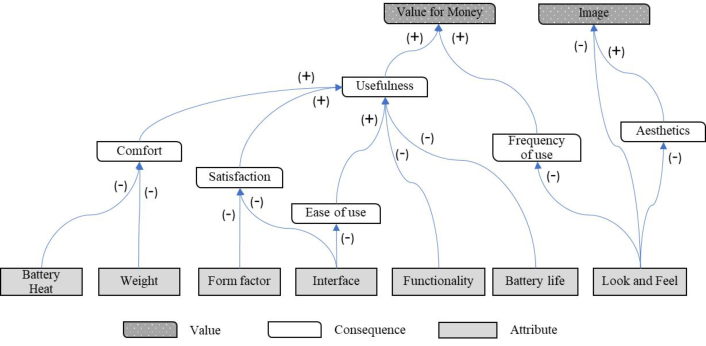
Figure 1: HVM of Smartwatch inhibiting factors for working group users (Adapa et al., 2018).
Means-End Chain for Consumer Product Development Means-End Chain (MEC) theory is a methodology based on cognitive the- ory explaining that consumers will choose products containing attributes (A) that stimulate motivation for the behavioral response, consequence (C), to achieve their personal value (V) (Russell et al., 2004; Reynolds and Gutman, 1988; Gutman, 1982). The individuals’ A-C-V ladder chains are aggrega- ted and summarized as a hierarchical value map (HVM). The theory and its applications are useful for a new product or service development in eli- citing the meaning behind its essential attributes and motivation to choose the product or service. The MEC is applied in several consumer products and services, such as food, smartphones, and wearable devices to monitor patients’ health data and maintain their good health behaviors (Adapa et al., 2018). Previous studies (Basoglu et al., 2009; Chiu, 2005) had extended the hierarchical value map (HVM) to combine with the Technology Acceptance Model (TAM), targeting the intention to use. Further studies adapted MEC by adding technological level as ideation of attributes to extend the model to T-A-C-V-I-U model (Basoglu et al., 2009; Chiu, 2005). The model provided a construct to understand the technology functions, attitudes, consequences, and values that lead from technology characteristics to attitude and inten- tion to use the system. This can assist device developers to match a device or system with user goals at the lower end of the MEC, which are generally less complex and easier to elicit. An example of the HVM of Smartwatch in working group users is exhibited in Figure 1.
Though the previous studies illustrated a potential to elicit the linkage beh- ind the consumer decision process, the methodologies were not yet applied or integrated with a design process. This study aims to explore a new design process and design model that can provide a guideline to consider how IOT functions and IOT device attributes can improve targeted positive factors or reduce the unwanted negative factors resulting in gaining user acceptance. Consequently, the device can encourage patients to have more autonomy in
Design-for-User Acceptance of IOT Home Use Medical Device 189
pursuing, taking responsibility for their health activities. The next session will explain the process and methodology to construct the design process proposed in this study.
SYNTHESIS METHODOLOGY Construct DfAIH Design Process
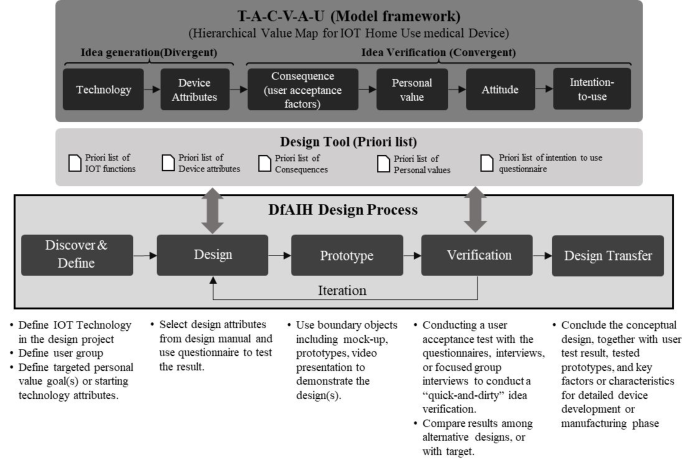
Result from previous study (Thongprasert and Jiamsanguanwong, 2021), the target of the proposing design process and design model should pro- vide a comprehensive guideline with manual, and methodology to verify or validate the idea prototype in the conceptual design phase. Therefore, this study applied the T-A-C-V-I-U model to link IOT functions to user accepta- nce of IOT home use medical devices and followed a Design for X (DfX) framework (Huang, 1996) to construct as a design process. First, a systema- tic literature review was conducted of new product development processes, design processes, and design methodologies for IOT home use medical devices (Thongprasert and Jiamsanguanwong, 2021). Then in this study, following the DfX shell (Huang, 1996), further literature reviews were included to cre- ate priori lists of IOT functions, device attributes, consequences, and values. Information was gathered and synthesized. Finally, a design for user acce- ptance of IOT home use medical device (DfAIH) was proposed, as exhibited in Figure 2. The process consists of five stages: Discover & Define, Design, Prototype, Verification, and Design transfer.
A) Discover & Define. The first stage involves understanding the product, its context of use, its intended user, and IOT technology embedded or will be embedded in the device. A device developer team will gather informa- tion about the project and define needs and elements to conduct a DfAIH process. The design team can use the DfAIH to consider which IOT functi- ons will affect target personal value or how specific IOT functions affect the user. A basic project charter can be used to describe relevant detail of the product development to prepare all tasks to conduct the design process, inclu- ding where and when to conduct user research, number of lead users needed, where to find groups of lead users, duration, and resources needed.
B) Design. The second stage will focus on the conceptual design of the product. Priori lists of IOT functions presented in a morphological chart (Börekçi, 2018; Dragomir et al., 2016) is proposed as a guideline for less experienced designers to select available IOT functions for the new device development. The design team can enhance the list by adding or removing parameter(s) specific to their device, technology, or target users. Design(s) will be selected for the next stage.
C) Prototype. In the third stage, a rapid prototype can be used to convey the conceptual design ideas. In a broader interpretation, a prototype can be concrete or abstract objects or pictures, engineering sketches, or presenting a partial function or attribute from existing devices. For instance, in the case of Bluetooth technology selected in the new design, a demonstration of Blu- etooth pairing and usage from existing devices with similar performance can be used as a prototype if it can communicate the idea design.
Figure 2: exhibits the Design-for-user Acceptance of IOT Home use medical device, DfAIH, proposed in this study.
D) Verification. The verification stage involves user research to demon- strate the prototypes to intended users. A questionnaire, in-depth interview, or focused group interview will be conducted to elicit factors and relation- ships among them laddering up to intention to use. Priori lists of device attributes, consequences, personal values, and questions related to intention to use were proposed as a design tool in the form of manual checklists. Desi- gners can also modify the lists depending on specific project requirements. The construction of priori lists, questionnaire of consequences, values, and subjective questions regarding user acceptance measures will be described more later in this paper. If the results do not meet the target requirements, the design team can go back to the Design stage, re-design the device using different combinations of the IOT functions and iteratively repeat the process.
E) Design transfer. The final stage is to wrap up the design proposed to the back-end new product development process. Product verification, suggesti- ons, and improvement areas in each step will be documented. Prototypes of the verified design will be transferred to the engineering/design team in the next phase to ensure that the key concepts, the attributes, technology sele- cted, and acceptance results will be considered in the product development in the manufacturing and commercial phase.
Develop the Priori Lists The five stages of DfAIH provides a step-by-step framework to design and verify IOT home use medical device. The core design concept to gain user acceptance is based on the extended Hierarchical Value Map, T-A-C-V-A- U. DfAIH provides precoded priori lists of IOT functions, device attributes,
Design-for-User Acceptance of IOT Home Use Medical Device 191
Table 1. Priori lists precoded with the DfAIH and its references.
Table available in the original PDF paper.
Reference Priori lists Number of items proposed
IOT Functions 29 items (Adapa, 2018; Bhuvaneswari and Porkodi, 2014; Samie et al., 2016; Yin et al., 2016) Device Attributes
14 items (Adapa et al., 2018; Sun and Rau, 2015; Ten Haken et al., 2018; Dicianno et al., 2017; Baudier et al., 2019; Peruzzini and Germani, 2014; Alppay and Hedge, 2015; Papetti et al., 2016) Consequences 17 items (Gao et al., 2015; Zhang et al., 2017; Davis, 1989; Li et al., 2019; Gao and Bai, 2014; Venkatesh and Davis, 2000; Pal et al., 2018; Kim et al., 2019) Personal value 9 items (Kahle and Kennedy, 1988) Intention to use 2 items (Davis, 1989)
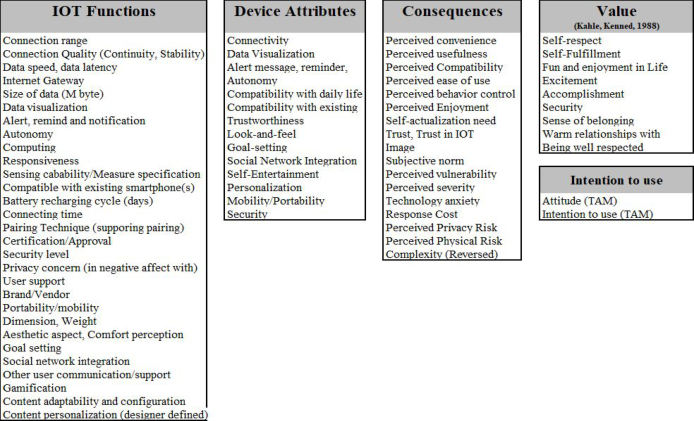
Figure 3: Exhibited priori lists of T-A-C-V-A-U model.
consequences, values, and intention to use. The priori lists will help desi- gners with less experience in user research conduct a user acceptance test by laddering up to assembling the T-A-C-V-A-U model. The priori lists can be a starting point for soft- and hard-laddering. In addition, the designers can add more items from literature review, experience, or items elicited from an interview. This study reviewed related literature in IOT, medical device deve- lopment, factors influencing user acceptance, technology acceptance model, and health belief model, then synthesizing to five (5) priori lists as shown in Table 1.
CONCLUSION
This study proposed a design process to ensure that user acceptance will be considered in the early phase of IOT home use medical device product development, termed “Design for user Acceptance of IOT Home use medical device,” DfAIH. The process aimed to be: 1) easy to understand and imple- ment by a design team with low resources and less experience in user research, such as by technology startup companies. Further, the process must provide 2) a quick and dirty framework to create a linkage from IOT functions up to user acceptance of an IOT home use medical device and, 3) a guideline for divergently idea generation from IOT functions using a morphological chart to match user goals at the device attributes level, and 4) a measure results based on human factor methodology.
For the number of IOT and device characteristics in a new design, DfAIH suggested concentrating on 4-5 functions and attributes as successful innova- tive medical devices had innovation on an average of 3.2 categories, which is mainly improving features of the devices in the area of architecture, environ- mental interactions, and user interactions (Holtta-Otto et al., 2010). DfAIH will benefit a new design or re-design of existing home use devices by adding IOT communication and improving user acceptance. Accordingly, the appli- cations of DfAIH aim to either be used for the development of newly IOT home use medical devices that ensure the technology will be accepted by home users or re-design a new version of devices to improve user accepta- nce. In DfAIH, though presented in sequential and linear steps, the designer is encouraged to conduct the design iteratively and comparatively. As the most effective design process will involve several rounds of design and test, this design process also endorses the iterative steps when conducting a design generation and user test. The number of iterative rounds would depend on time, budget, resources, and target of the product development defined in the first stage. In a comparative scheme, this design process recommends that a design team have 2-3 versions of product designs to compare product preference and use triadic sorting approaches (Reynolds and Gutman, 1988).
The proposed design process and design model are still at the theoretical level. It does not yet be verified or validated with actual device development. Further empirical studies should be conducted to validate the concept with actual devices and users. In addition, more detailed methodologies, tools, manuals, or instructions should be added to ensure that the design process will be effective and easy to use, resulting in gaining user acceptance of the IOT home use medical device.
REFERENCES
Adapa A. et al., (2018) “Factors Influencing the Adoption of Smart Wearable Devices,” Int. J. Human -Computer Interact., vol. 34, no. 5, pp. 399 -409. Alppay C. and Hedge A., (2015) “Development of an Ergonomics Checklist for the
Evaluation of Medical Tablet Personal Computers,” Procedia Manuf., vol. 3, no. Ahfe, pp. 21 -28. Aydin M., (2014) “Context of use of home use medical devices: a study on the identidication of contextual factors of CPAP devices,” Middle East Technical University.
Design-for-User Acceptance of IOT Home Use Medical Device 193
Basoglu N., Daim T. U., and Sofuoglu E., (2009) “A decision methodology for customising software products,” Int. J. Ind. Syst. Eng., vol. 4, no. 5, pp. 554 -576. Baudier P., Ammi C., and Lecouteux A., (2019) “Employees ‘ Acceptance of the Heal-
thcare Internet of Things : A Source of Innovation in Corporate Human Resource Policies,” J. Innov. Econ. Manag., vol. 3, pp. 89 -111. Bhuvaneswari V. and Porkodi R., (2014) “The internet of things (IOT) applications and communication enabling technology standards: An overview,” Proc. - 2014 Int. Conf. Intell. Comput. Appl. ICICA 2014, pp. 324 -329. Börekçi N. A., (2018) “Design Divergence Using the Morphological Chart,” Des.
Technol. Educ., vol. 23, no. 3, pp. 62 -87. Burton R. P. D. and Hudson T., (2001) “Achieving individually sustained commitment to treatment through self-constructed models of medical adherence,” Sociol. Spectr., vol. 21, no. 3, pp. 393 -422. Chiu, (2005) “Applying means-end chain theory to eliciting system requirements and
understanding users perceptual orientations,” Inf. Manag., vol. 42, no. 3, pp. 455 -468. Davis D., (1989) “Perceived Usefulness, Perceived Ease of Use, and User Acceptance of information technology,” MIS Q., vol. 13, no. 3, pp. 319 -340. Dicianno B. E., Henderson G., and Parmanto B., (2017) “Design of Mobile Health
Tools to Promote Goal Achievement in Self-Management Tasks,” JMIR mHealth uHealth, vol. 5, no. 7, p. e103. Dragomir M., Dragomir D., Popescu F., and Criste A., (2016) “Efficiency and resilience in product design by using morphological charts,” in Energy Procedia, vol. 85, no. 2016, pp. 206 -210. FDA, (2010) “Medical Device Home Use Initiative”. Gao L. and Bai X., (2014) “A unified perspective on the factors influencing consumer
acceptance of internet of things technology,” Asia Pacific J. Mark. Logist., vol. 26, no. 2, pp. 211 -231. Gao Y., Li H., and Luo Y., (2015) “An empirical study of wearable technology acceptance in healthcare,” Ind. Manag. Data Syst., vol. 115, no. 9, pp. 1704 -1723. Garge G. K., Balakrishna C., and Datta S. K., (2017) “Consumer health care: Current
trends in consumer health monitoring.,” IEEE Consum. Electron. Mag., vol. 7, no. 1, pp. 38 -46. Gutman J., (1982) “A Means-End Chain Model Based on Consumer Categorization Processes,” J. Mark., vol. 46, no. 2, pp. 60 -72. Holekamp N. M., (2018) “Moving From Clinic to Home: What the Future Holds
for Ophthalmic Telemedicine,” Am. J. Ophthalmol., vol. 187, pp. xxviii -xxxv. Holtta-Otto K., Saunders M., and Seepersad C., (2010) “The Characteristics of Innovative, Medical Devices.,” in Transactions of the ASME-W-Journal of Medical Devices, vol. 4, no. 2, p. 027519. Huang G. Q., (1996) Design for X: concurrent engineering imperatives. Kahle R. and Kennedy P., (1988) “Using the List of Values (LOV) to Understand
Consumers,” J. Serv. Mark., vol. 2, no. 4, pp. 49 -56. Kim D., Park K., Park Y., and Ahn J., (2019) “Computers in Human Behavior Willingness to provide personal information : Perspective of privacy calculus in IoT services,” Comput. Human Behav., vol. 92, no. November 2018, pp. 273 -281. Li J., Ma Q., Chan A. H. S., and Man S. S., (2019) “Health monitoring through
wearable technologies for older adults : Smart wearables acceptance model,” Appl. Ergon., vol. 75, pp. 162 -169.
Li J., Ma Q., Chan A. H., and Man S. S., (2019) “Health monitoring through wearable technologies for older adults: Smart wearables acceptance model,” Appl. Ergon., vol. 75, pp. 162 -169. Money A.G., Barnett J., Kuljis J., Craven M. P., Martin J. L., and Young T., (2011)
“The role of the user within the medical device design and development process: medical device manufacturers’ perspectives,” BMC Med. Inform. Decis. Mak., vol. 11, no. 1, p. 15. Pal D., Funilkul S., Charoenkitkarn N., and Kanthamanon P., (2018) “Internet-of- Things and Smart Homes for Elderly Healthcare : An End User Perspective,” IEEE Access, vol. 6, pp. 10483 -10496. Papetti A., Capitanelli A., Cavalieri L., Ceccacci S., Gullà F., and Germani M., (2016)
“Consumers vs Internet of Things : a systematic evaluation process to drive users in the smart world,” Procedia CIRP, vol. 50, pp. 541 -546. Peruzzini M. and Germani M., (2014) “Designing a user-centred ICT platform for active aging,” in 2014 IEEE/ASME 10th International Conference on Mechatronic and Embedded Systems and Applications (MESA), pp. 1 -6. Pounder N. M., Jones J. T., and Tanis K. J., (2016) “Design evolution enhances pati-
ent compliance for low-intensity pulsed ultrasound device usage,” Med. Devices Evid. Res., vol. 9, pp. 423 -427. Rajkomar, Farrington K., Mayer A., Walker D., and Blandford A., (2014) “Patients’ and carers’ experiences of interacting with home haemodialysis technology: implications for quality and safety.,” BMC Nephrol., vol. 15, no. 1, pp. 1 -12. Reynolds T. J. and Gutman J., (1988) “Laddering theory, method, analysis, and
interpretation,” J. Advert. Res., vol. Feb/March. Rusch E., Brocard E., Antoine P., and Pascal M., (2021) “The Lancet Regional Health
- Europe COVID-19’s impact on home health services, caregivers and patients: lessons from the French experience,” Lancet Reg. Heal., vol. 81. Russell G., Busson A., Flight I., Bryan J., Van Pabst J. V. L., and Cox D. N., (2004) “A comparison of three laddering techniques applied to an example of a complex food choice,” Food Qual. Prefer., vol. 15, no. 6, pp. 569 -583. Samie F., Bauer L., and Henkel J., (2016) “IoT Technologies for Embedded Com-
puting: A Survey,” in 2016 International Conference on Hardware/Software Codesign and System Synthesis (CODES+ ISSS), 2016, pp. 1 -10. Spanakis E. G., Santana S., Tsiknakis M., Marias K., Sakkalis V., and Teixeira C., A., ... & Tziraki, (2018) “Technology-Based Innovations to Foster Personalized Healthy Lifestyles and Well-Being : A Targeted Review,” J. Med. Internet Res., vol. 18, no. 6, pp. 1 -26. Sun N. and Rau P. P., (2015) “The acceptance of personal health devices among
patients with chronic conditions,” Int. J. Med. Inform., vol. 84, no. 4, pp. 288 -297. Swan M., (2012) “Health 2050: The realization of personalized medicine through crowdsourcing, the quantified self, and the participatory biocitizen,” J. Pers. Med., vol. 2, no. 3, pp. 93 -118. Ten Haken I., Ben Allouch S., and Van Harten W. H., (2018) “The use of advanced
medical technologies at home: A systematic review of the literature,” BMC Public Health, vol. 18:284, no. 1, pp. 1 -33. Thongprasert A. and Jiamsanguanwong A., (2021) “New product development processes for iot-enabled home use medical devices: A systematic review,” Eng. J., vol. 25, no. 2, pp. 15 -48.
Design-for-User Acceptance of IOT Home Use Medical Device 195
Venkatesh V. and Davis, (2000) “A Theoretical Extension of the Technology Acceptance Model: Four Longitudinal Field Studies,” Manage. Sci., vol. 46, no. 2, pp. 186 -204. Yin Y., Zeng Y., Chen X., and Fan Y., (2016) “The internet of things in healthcare :
An overview,” J. Ind. Inf. Integr., vol. 1, pp. 3 -13. Zhang M., Luo M., Nie R., and Zhang Y., (2017) “International Journal of Medical Informatics Technical attributes , health attribute , consumer attributes and their roles in adoption intention of healthcare wearable technology,” Int. J. Med. Inform., vol. 108, no. April, pp. 97 -109.
LISTED IN THE AHFE DIGITAL BOOKSTORE CATALOGUE
Explore the complete digital volume
Healthcare and Medical Devices
Read this individual research paper free through the original publisher, or explore the full digital proceedings book.
ISBN 978-1-958651-27-8
Explore this ISBN in the AHFE Bookstore ↗Listed in the July 2026 bookstore catalogue; search by ISBN to confirm current availability · Digital book purchase optional