Okan Yilmaz, Armin Janß, Klaus Radermacher (2022). Applying User Interface Profiles to Ensure Safe Remote Control within the Open Networked Operating Room in accordance with ISO IEEE 11073 SDC. In: Healthcare and Medical Devices. AHFE Open Access, vol. 51, pp. 24–30. https://doi.org/10.54941/ahfe1002094
mediTEC - Chair of Medical Engineering, Helmholtz-Institute for Biomedical, Engineering of the RWTH Aachen University, Pauwelsstrasse 20, 52074 Aachen, Germany ↗
The ISO IEEE 11073 SDC Standard family enables manufacturer independent device connectivity and therefore interoperability in the OR and hospital. Supplementary standards like the Devices Specializations (IEEE 11073-107XX) describe how medical devices present themselves in the network and the requirements other network participants must comply with in order to interact in the sense of a plug-and-play approach. However, these device models and requirements do not include information about Human Machine Interaction (HMI) characteristics like visualization, control types or any other user interface related specifications and guidelines, which are necessary to create a safe and usable remote user interface. This will be relevant for central or mobile OR/ICU cockpits/units. Additional device-based UI specifications and rules are necessary for medical device manufacturers and clinical operators to allow safe and usable remote interfaces, and future-proof plug-and-play solutions.The question of liability in the operation of openly networked medical devices is of course an interesting and important aspect for medical device manufacturers. Here, on the one hand, technical interoperability and, on the other hand, safe HMI in the combined use of medical devices must be guaranteed.A systematic approach to create a safe and usable UI in open networked ORs by providing UI requirements to the network participants within a SDC complemental UI standard (e.g., in DevSpecs or KeyPurposes) would greatly facilitate the conformity assessment process for manufacturers, especially for the controlling network participant (SDC service Consumer), who needs to perform a comprehensive usability evaluation and human-induced risk analysis in a new context of use.The Chair of Medical Engineering (mediTEC) at RWTH Aachen University has addressed these issues and has developed a methodological approach to create a specific User Interface Profile for each medical device type and corresponding HMI design rules, considering risk- and process-related requirements for medical device functions and for input and output devices. This approach defines a set of rules, requirements, and specifications regarding Human Machine Interactions a network subscriber must fulfill to display or operate device properties.The User Interface Profile contains among other things: a list of device properties, grouping information, additional applicable standards, user profile, input and output devices that are suitable and/or required from a risk analysis point of view, screen parameters according to DIN 6868-157 and speaker parameters. In addition, for every device property the following properties must be defined: visibility level, elementary task, criticality, and necessary labeling information.These initial implementations have been integrated and validated by a representative user group (neurosurgeons, orthopedic surgeons and ENT surgeons of the University Clinic RWTH Aachen) within a surgical SDC workstation as a part of a surgical SDC demonstrator (Yilmaz et al. 2020). Looking ahead, parts of the User Interface Profiles will be applied and implemented into the ISO IEEE P11073-10721 draft (using the example of high frequency cutting devices) in collaboration with the leading enterprises in Germany.
Applying User Interface Profiles to Ensure Safe Remote Control 25
INTRODUCTION
Current proprietary interconnected solutions in the OR provide compreh- ensive risk analysis for closed systems with a limited number of previously known devices and manufacturers. The application of an open communi- cation standard such as SDC (Service oriented Device Connectivity) enables interoperability, increases flexibility for clinical operators and has the poten- tial to improve clinical processes and costs as well as patient safety. Risk analysis must consider all possible reasonable hazards. Currently, the bot- tleneck in open networks is that medical devices do not have sufficient information available about the use context of other network participants (SDC consumer) and are not able to predict possible risks, the consumer might need to consider while controlling or displaying their device properties.
The SDC Device Specialisation IEEE 11073-107XX series describes how medical devices should be modeled in an SDC-Network. It contains technical machine-readable descriptions of the device properties, e.g., a patient monitor should contain a property called SpO2-level but it lacks attributes concerning Human Machine Interactions and User Interfaces.
In an ideal world, all manufacturers would show all network participants their complete risk analysis and their usability file and together they could evaluate and prevent the resulting hazards for all user interfaces and combi- ned system functions. But this scenario is unlikely since this information is very sensitive and must remain within the company.
This paper proposes a methodology for network participants to pro- vide their HMI information to other participants in a standardized form, and thereby reduce potential risks and create safe and usable interfaces. Having additional information on the User-Interface level will support the risk analysis and reduce hazards.
CURRENT STANDARDS OR.NET - ISO IEEE 11073 SDC The German research project/initia- tive OR.NET developed, implemented, and standardized concepts for manufacturer-independent medical device interoperability. As part of the ISO IEEE 11073 SDC Standard series the Domain Information and Service Model (-10207) defines the transport mechanism for the exchanged data. The Medical Devices Communication Profile for Web Services (-20702) ena- bles the secure exchange of data in distributed systems and the dynamic finding of networking partners, and the Service-Oriented Medical Device Exchange Architecture and Protocol Binding (-20701) describes the intera- ction between the previously mentioned standards as well as the medical device architecture. Those three standards create the essential SDC “Core Standards”. In addition, the ISO IEEE 11073-10701, -10702, -10703 and -10700 define the syntax and other communication requirements for parti- cipants in an SDC system to exchange data (metric, alerts, external control). (Kasparick et al. 2018; Andersen et al. 2020).
Finally, the SDC supplementary standard Device Specialisations IEEE 11073-107XX describes how medical device types should be modeled in an SDC network from a technical point of view (Medical Device Information
Base - MDIB). The manufacturer of a certain device type has to agree on a commonly usable and thus machine-readable device presentation. This is already one of the missing pieces for implementation and approval processes (Andersen et al. 2019).
The ISO 9241 is a multi-part ISO standard, covering the Ergonomics of human-system interaction. Especially for the UI-design and evaluation the following parts are fundamental: 9241-110: Interaction principles, -112 Principles for the presentation of information, -303: Requirements for ele- ctronic visual displays and -420: Selection of physical input. (DIN EN ISO 9241-110:2020-10). mAIXuse - Studies showed that non-usable interfaces cause deficiencies and therefore potential harm for the patient and third parties. This is due, among other things, to the lack of suitable methods for interlinking usabi- lity engineering and human-centered risk management. In particular, medical device manufacturers and developers need to be supported in the early dete- ction of human-caused errors and the systematic control thereof to ensure reliable design and error-tolerant human-machine interfaces (HMI). In this context, the HiFEM methodology and a corresponding software tool (mAI- Xuse) for model-based human risk analysis has been developed at mediTEC. Results of a comparative study with the HiFEM method and a classical fai- lure mode and effects analysis (process FMEA) showed that the new modeling and analysis technique is significantly superior to FMEA (Janß et al. 2016).
FMEA - Failure Mode and Effects Analysis By using a FMEA, which is recommended by DIN EN IEC 62366-1, it is possible to identify potential failure modes and provide corrective actions. There are different types of the FMEA with different purposes: system, design, process and service. The failure causes and failures as well as the severity can be analyzed and then be reduced by design changes (Stamatis 2003; DIN EN 62366-1:2021-08).
PROPOSED METHOD TO ADD USER INTERFACE RELATED INFORMATION TO THE DEVICE PROFILE The following method uses generally applicable HMI and risk-related requi- rements for input- and output devices with the aim to create user interfaces for medical devices. These requirements enable a usable, risk-minimized, safe and secure interaction via an SDC network and can be standardized in the future in order to harmonize them and make it easier for medical device manufacturers to provide such information (Janß et al. 2014).
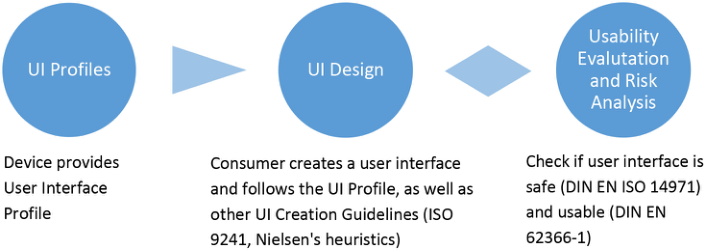
This approach to create User Interfaces consists of three parts: User Interface Profile definition, UI-Design creation, and evaluation and risk analysis (Figure 1). The term User Interface Profiles will be defined as: A device-specific set of requirements and specifications regarding Human Machine Interactions a network subscriber must fulfill in order to ope- rate medical device functions or to display medical device properties. Those requirements contain information regarding the function visibility, grouping, elementary task, criticality, labeling, feedback, display, alerts and input- and output-devices. It is static and can be provided from a medical device (SDC Provider).
Applying User Interface Profiles to Ensure Safe Remote Control 27
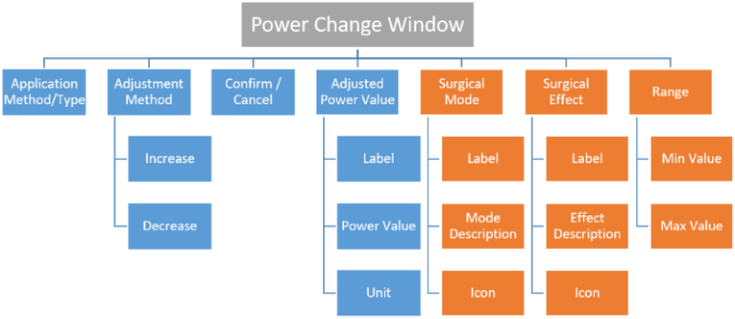
Figure 1: Steps to include user interface profiles into medical device interface design.Figure 2: UI grouping tree for “Power Change Window” of a HF-cutting device. Orange: optional UI-features, Blue: necessary UI-Features.
Parts of the UI-Profile are listed below:
List of device properties (part of IEEE 11073-10101, IEEE 11073-107XX DevSpecs or any other nomenclature)
List of necessary properties and controls for each interface (Figure 2)
Additional applicable standards regarding UI requirements (example: DIN EN IEC 60601-2-2 for High Frequency Cutting Devices)
User profile (required education, skills, trained users, untrained)
From a risk assessment point of view, suitable and essential/required input and output devices (examples: HF-Device: requires footswitch or hardw- are button (manual use) for activation, speech control or touch screen are not sufficient; OR-Table: tactile buttons for table movement are required, touch screen is not sufficient, emergency off is required and always has to be available and visible; Pulse oximetry: demands audible alarm from display monitor if placed out of earshot; Universal Footswitch: demands permanent display (icon, text) of assigned release functions and status prior and while in usage (HF- or C-Arm activation)
Screen parameter (examples: DIN 6868-157: Quality Assurance of Diagnostic Displays, resolution, size, color depth, color authenticity, frequency)
Speaker parameter (frequency, duration, volume of acoustic signals) Also, for each property the following items have to be specified:
Visibility level (examples: always perceivable (visual, auditive or haptic), always executable (reachable), only visible when active, short presentation when active, hidden)
Elementary task (examples: fast or accurate pointing, numeric entry, selection, monitoring)
Criticality: evaluation of possible risks due to incorrect operation (ISO 14971: risk is defined as the combination of the probability of occur- rence of harm and the severity of that harm) – high criticality means explicit mentioning/attention during the risk analysis (DIN EN ISO 14971:2020-07)
Necessary labeling of device property (text, image, sound) – Enforce consistent color usage for provider and consumer metrics, if at the same location or demanded by standards, display unit on the consumer: use the same unit as on the provider device to prevent confusion
Feedback mechanisms during activation (visual, haptic, auditory) The UI-Design creation and evaluation and risk analysis are the second and third part of the presented methodology. They have to be repeated iteratively. The objective is to create a user interface which allows a safe and usable device usage with constraints resulting from human factors, the selected use-cases/process steps as well as the UI profiles from the devices itself.
The first step in the UI-Design creation is to choose physical input and output devices that will be used to control and/or represent (auditive, haptic or visual) device properties. Examples could be a touchscreen, a footswitch, a voice control unit, a keyboard or a numpad. In the second step, it is deter- mined for each property, whether it is only displayed (e.g., oxygen level) or presented and controlled (e.g., OR-Table height). After that, an appropriate visual input/display element must be selected, considering the already defined User Interface Profile and environmental variables such as external and inter- nal performing shaping factors e.g., sterile surroundings, gloves, distance to the devices, alarm mechanism and user capabilities.
After creating an initial user interface, it needs to be validated using requi- rements and usability criteria (effectiveness, efficiency, user satisfaction and learnability) from standards e.g. ISO 62366-1 (Application of usability engi- neering to medical devices), ISO 9241 (Ergonomics of human-computer interaction) and further UI-guidelines. In parallel, a process model and a risk analysis (mAIXuse & FMEA) are performed and the results are documented.
After an analysis of potential risks, situations with resource conflicts and overload within the process model provides new input for the UI- design creation phase and changes are implemented within the user interface and, if necessary, the chosen input- and output devices are changed or replaced.
Applying User Interface Profiles to Ensure Safe Remote Control 29
CONCLUSIONS AND OUTLOOK Parts of the described approach have already been implemented into a surgical, anesthesia and OR management workstation in the PriMed rese- arch project. The presented approach for developing generally applicable safe and usable Human-Machine-Interfaces for remote control within open- networked medical IT-Systems must be further validated with manufacturers and their devices. In the PoCSpec research project, manufacturers agreed on generally applicable standardized device functions for HF-devices that have been implemented in a draft of the IEEE 11073-10721 (DevSpecs) (Kaspa- rick et al. 2021; IEEE 11073-10721:2019). Looking ahead, the concept of User Interface Profiles will be applied to and implemented in this draft in collaboration with former participants of the PoCSpec project and leading HF-device manufacturers in Germany. Therefore, the presented methodology will be elaborated, tested and the proof of concept shall be shown.
In an initiative launched by OR.NET e.V. and mediTEC, a working group has been established with the IGNB to develop manufacturers’ guidelines for the conformity assessment procedure and along the V-model of the deve- lopment process, the technical file/design dossier is reviewed and adapted regarding the delta of an SDC integration. The results of the UI profiles and the presented methodology as well as the transfer to the supplementary stan- dards DevSpecs and KeyPurposes will be included and evaluated in the work with the IG-NB.
As soon as UI profile requirements become part of a medical device stan- dard, manufacturers can invoke compliance and minimize risks during the use of their device, especially if an SDC Participant (Consumer) needs to per- form a comprehensive usability evaluation and human-induced risk analysis in a new context of use. To generalize the concept of UI profiles for any medical device, the existing SDC data model (IEEE 11073-10207) has to be extended or a new UI-based data model has to be created. This enables medi- cal devices to model UI-related information in a standardized manner and provide it for other SDC participants.
ACKNOWLEDGEMENT
This research work has been funded within the project “PriMed - Workflow optimization by integrated medical devices in the OR and clinic” (State of North-Rhine Westphalia and the European Commission - European Regional Development Fund; grant no.: EFRE-0801369).
REFERENCES
Andersen, Björn; Bandel, Paulinka; Bartlog, Jens; Feiler, Anna; Gisch, Simon; Janß, Armin et al. (2020): Technical report “Medical device approval based on the SDC Participant Key Purpose standards for safe interoperability”. Available online at https://ornet.org/wp-content/uploads/2020/10/PKP-technical-report-v1.1.pdf. Andersen, Björn; Baumhof, Simon; Ingenerf, Josef (2019): Service-Oriented Device
Connectivity: Device Specialisations for Interoperability. In Studies in health technology and informatics 264, pp. 509–511. DOI: 10.3233/SHTI190274.
DIN EN 62366-1:2021-08, 2/14/2022: Anwendung der Gebrauchstauglichkeit auf Medizinprodukte. IEEE 11073-10721:2019: Device Specialization - High Frequency (200 kHz to < 5
MHz) Surgical Equipment. DIN EN ISO 9241-110:2020-10: Ergonomie der Mensch-System-Interaktion - Teil 110: Interaktionsprinzipien. Janß, Armin; Benzko, Julia; Merz, Paul; Dell’Anna, Jasmin; Strake, Melanie; Rade-
macher, Klaus (2014): Development of Medical Device UI-Profiles for Reliable and Safe Human-Machine-Interaction in the Integrated Operating Room of the Future. In Proceedings of the 5th Conference on Applied Human Factors and Ergonomics 2014, pp. 1855–1860. Janß, Armin; Plogmann, Simon; Radermacher, Klaus (2016): Human-centered risk management for medical devices - new methods and tools. In Biomedizinische Technik. Biomedical engineering 61 (2), pp. 165–181. DOI: 10.1515/bmt-2014- 0124. Kasparick, Martin; Köny, Marcus; Andersen, Björn; Riech, Kathrin; Keller, Anton;
Kämmer, Sven et al. (2021): Service-Oriented Medical Device Connectivity: Par- ticular Interoperability Standards for High Frequency Surgical Equipment and External Control Devices. In Current Directions in Biomedical Engineering 7 (2), pp. 523–526. DOI: 10.1515/cdbme-2021-2133. Kasparick, Martin; Schmitz, Malte; Andersen, Björn; Rockstroh, Max; Franke, Stefan; Schlichting, Stefan et al. (2018): OR.NET: a service-oriented architecture for safe and dynamic medical device interoperability. In Biomedizinische Technik. Biomedical engineering 63 (1), pp. 11–30. DOI: 10.1515/bmt-2017-0020. DIN EN ISO 14971:2020-07: Medizinprodukte_- Anwendung des Risiko- managements auf Medizinprodukte (ISO 14971:2019); Deutsche Fassung EN_ISO_14971:2019. Stamatis, D. H. (2003): Failure mode and effect analysis. FMEA from theory to
execution. 2nd ed., rev. and expanded. Milwaukee Wisc.: ASQ Quality Press. Yilmaz, Okan; Wieschebrock, Dario; Heibeyn, Jan; Radermacher, Klaus; Janß, Armin (2020): Development and Evaluation of a Platform-Independent Surgi- cal Workstation for an Open Networked Operating Theatre Using the IEEE 11073 SDC Communication Standard. In Vincent G. Duffy (Ed.): Digital Human Modeling and Applications in Health, Safety, Ergonomics and Risk Management. Posture, Motion and Health, vol. 12198. Cham: Springer International Publishing (Lecture Notes in Computer Science, 12198), pp. 79–92.
LISTED IN THE AHFE DIGITAL BOOKSTORE CATALOGUE
Explore the complete digital volume
Healthcare and Medical Devices
Read this individual research paper free through the original publisher, or explore the full digital proceedings book.
ISBN 978-1-958651-27-8
Explore this ISBN in the AHFE Bookstore ↗Listed in the July 2026 bookstore catalogue; search by ISBN to confirm current availability · Digital book purchase optional