Christina Mayer, Marisa Schirmer, Thushayanthini Sivatheerthan, Susanne Mütze Niewöhner, Verena Nitsch (2022). Participative leadership in healthcare: Which situational contextual factors influence managers’ decision to involve employees?. In: Human Factors in Management and Leadership. AHFE Open Access, vol. 55, pp. 53–60. https://doi.org/10.54941/ahfe1002232
Today’s technological and societal developments are creating new possibilities for designing an economical, flexible and human-oriented work organization e.g. by facilitating more agile management concepts. Research has been concerned with participative leadership styles for many decades, and these have recently been gaining renewed relevance in meeting the demands placed on leadership in modern management settings. Therefore, existing concepts of participative leadership need to be put to test for today’s work organization.An established concept of participative leadership is the model by Vroom (2000, based on Vroom & Yetton, 1973 and Vroom & Jago, 1988), which distinguishes between different degrees of employee participation in decision-making processes depending on situational contextual factors. Empirical studies show that managers who use a participative decision-making style consistent with the model by Vroom have more productive and satisfied employees as well as higher decision quality (e.g. Paul & Ebadi, 1989, Pasewark & Strawser, 1994). Because this model outlines clear implications for employee participation in decision-making based on if-then operations, it can help young managers in particular to structure decision-making processes and to reflect on how to involve employees depending on specific situational contextual factors.As in other sectors, healthcare is affected by the challenges of today's work organization. As far as leadership is concerned, managers usually learn leadership behavior implicitly and there is a high demand of leadership development and the teaching of useful leadership models (McAlearney, 2006). Therefore, this study focuses on the application of the model on employee participation in decision-making processes in healthcare context and poses the following research question: Which situational contextual factors influence managers’ decision to involve employees?As a first step, literature and semi-structured interviews with healthcare managers were used to identify relevant situational contextual factors in decision-making for healthcare: time pressure, information availability, employee acceptance, employee expertise and employee engagement.In a second step, assumptions about the degree of participation depending on given situational factors in healthcare were formulated, based on empirical findings on the model by Vroom.In a third step, healthcare managers (N=30) were asked to complete a questionnaire indicating what level of participation they would choose for different combinations of the given situational contextual factors in decision-making. Following assumptions regarding participation depending on situational contextual factors were confirmed by the healthcare managers: -If there is time pressure, the manager would make decisions without employee participation. -If employee acceptance is important, there would be a group decision-making process. -If an employee has more knowledge or expertise on a decision problem than the manager, the person would be involved in the decision-making process. -If employees share the organization's goals, they can participate in the decision-making process.The findings show consistency with the decision-making model by Vroom and support the relevance of participative leadership in healthcare. Possibilities for the next step of developing a decision tree that links situational factors with if-then operations and lead to a recommended level of employee participation in decision-making processes in the healthcare context are discussed.
Today’s technological and societal developments are creating new possi- bilities for designing an economical, flexible and human-oriented work organization e.g. by facilitating agile management concepts that lead to more self-organized teamwork (Mütze-Niewöhner and Nitsch, 2020). Research has been concerned with participative leadership styles for many decades, and these have recently been gaining renewed relevance in meeting the demands placed on leadership in modern management settings (Rybnikova and Lang, 2020). Therefore, existing concepts of participative leadership need to be put to test for today’s work organization.
Participative leadership describes the efforts by a leader to involve subor- dinates, peers, superiors or outsiders in a decision-making process depending on the leader’s objective (Yukl, 2013). Involving subordinates may lead to a higher decision quality (Yukl and Fu, 1999) and subordinate’s satisfaction (Chan, 2019). Not sufficient or consistent results in older studies on the effe- cts of participative leadership were explained by the missing consideration of situational contextual factors (Yukl, 2013). Therefore, the established normative decision model by Vroom (2000), based on Vroom and Yetton
(1973) and Vroom and Jago (1988), recommends different ways of employee participation in decision-making processes depending on situational contex- tual factors. There are different degrees of participation that can be ordered along a continuum, starting with making the decision on his/her own, asking for consultation, finding a decision as a team or delegating it completely to the subordinates (Vroom, 2000; Tannenbaum and Schmidt, 1958).
Vroom proposes following situational contextual factors that should be considered when choosing the right degree of participation, starting with the factor whether or not the decision has to be made under time pressure (Vroom, 2000). In addition to time pressure, decision significance influences whether employees should be more involved in the decision-making process. Other relevant factors are leader’s expertise and if it is important to obtain more information from employees, which is associated with the employees’ knowledge of a particular problem (ebd.). Further factors to consider when involving employees in decision making include the importance of emplo- yee engagement and the likelihood of their commitment. Whether problem solving can be delegated to the team also depends on their goal alignment and the team’s competence, i.e., its ability to work together (ebd.).
Based on these situational contextual factors, Vroom developed a nor- mative model from which he derived decision rules for participation. For example, the information rule states that if there is a lack of information, an autocratic decision is not appropriate or the goal congruence rule, which describes that if subordinates do not share the leader’s task objectives, they cannot be fully participated in the decision-making process (Vroom and Yet- ton, 1973). Empirical studies show that managers who use a participative decision-making style consistent with the normative model by Vroom have more productive and satisfied employees as well as higher decision quality (Paul and Ebadi, 1989; Pasewark and Strawser, 1994).
Depending on the decision problem, decision-making can be routine for managers or require a reflective process to find the right solution. A rou- tinized decision allows managers to draw on experience while filtering the possible options. But particularly for complex decision-making processes, which are usually characterized by uncertainty, reflective decision-making is essential, in which the manager chooses an evaluation process after which he or she makes the decision (Pfister et al., 2017). A normative decision model supports reflective decision-making and it can help unexperienced managers in particular to structure decision-making processes and to reflect on when to involve employees depending on specific situational contextual factors.
As in other sectors, healthcare is affected by the challenges of effective work organization, and dealing with decision-making processes has a high relevance, especially when it comes to ensuring patient care. Middle managers experience decision-making pressure in their organizations from above and below. In addition to patient care, they face the challenge of meeting the needs of their employees, upper management as well as health insurance companies and policies. In terms of the resulting leadership demands, managers usually learn leadership behavior implicitly and there is a high demand of leader- ship development and the teaching of useful leadership models (McAlearney, 2006).
Participative Leadership in Healthcare 55
Therefore, in a current research project, an e-learning app is being develo- ped for middle managers in the healthcare sector. The aim of the e-learning app is for managers to experience difficult decision-making situations in a playful way, to reflect on them and to be able to take away ideas for imple- menting them in work life. One part of the e-learning app is to raise awareness of how managers can involve their employees in decision-making, taking into account situational contextual factors. In the course of implementing lear- ning content on participative leadership in healthcare based on the insights of the normative decision-making model by Vroom, the following research question is posed: Which situational contextual factors influence healthcare managers’ decision to involve employees?
METHOD
To answer the research question, a three-step methodological approach was chosen. The first step was to select situational contextual factors relevant to healthcare from the factors proposed by Vroom. The selection was supported by statements of healthcare managers in interviews in which they spoke about leadership challenges.
In a second step, assumptions were formulated about the degree of par- ticipation in decision-making under given situational circumstances based on decision rules, Vroom derived from his normative model (Vroom, 2000; Vroom and Jago, 1988; Vroom and Yetton, 1973).
In a third step, 34 managers, who work in medical or nursing professions in Germany (22 are female, 11 are male and 1 is diverse; Age: M = 40,9, SD = 9,74) completed a questionnaire indicating the level of participation they would choose in decision making for different combinations of given situational contextual factors. The survey presented 13 relevant combinati- ons of factors and participants rated their choice of employee participation for every combination.
One example of a combination of situational contextual factors presented in the survey is: Imagine you have enough information and enough time to make a decision and it is important your employees are committed to the deci- sion being made, but the employees themselves would not make a decision aligning to the organization’s goals.
The participants were asked what degree of participation they would cho- ose under the circumstances described. Multiple responses were possible, because more than one degree of participation could be suitable (Yukl, 2013). Based on the model by Vroom and the current understanding of employee participation in leadership tasks (Rybnikova and Lang, 2020; Vroom, 2000), they were able to choose from the following degrees of participation: A) Alone: Making the decision alone; B) Alone – Information: Making the decision alone, but obtaining informa- tion from individual team members in advance; C) Alone – Consultation: Making the decision alone, but asking team members for consultation in advance; D) Delegation to One: Delegating decision-making to a person with high experience;
E) Group - Preparation: Letting the team develop solution proposals toge- ther and based on this, making the decision; F) Group – Delegation: Delegating decision-making completely to the team.
The responses were analyzed to determine whether the participants’ response behavior confirmed the previously derived assumptions made about participation in decision-making.
Situational Contextual Factors To reduce complexity for the application of the model in the e-learning app the eight situational contextual factors considered in the normative decision model by Vroom (2000) are reduced to five factors that have high importance for decision-making in healthcare.
First decision significance is not considered because only decision-making problems with a high significance will be covered in context of the e-learning app. In return, time pressure is evaluated as one of the most critical factors which mainly influence work organization in healthcare and is also one of the main reasons which lead to employees’ turnover (Estryn-Behar et al., 2010). This was supported by the assessment of a healthcare manager who emph- asized during an interview on leadership challenges that their work always holds the unexpected so they must embrace and stay open to spontaneity (Sorge et al., 2021).
Further, for good decision-making it is fundamental to have as much infor- mation as possible, especially in healthcare on a professional level (Kerr, 2019). Regarding the importance of information availability at the leader- ship level, one healthcare manager pointed out the importance of having a sense of what is on the team’s mind in their daily work and getting involved, even if it is just a brief conversation in the hallway (Sorge et al., 2021).
The importance of employee commitment in decision-making processes is one of the relevant factors that has a great impact on employee acceptance of a decision (Yukl, 2013). The relevance of this situational contextual factor for healthcare context was supported by a healthcare manager, who pointed out that when it comes to decisions regarding the way to organize work, the person always tries to involve the team, saying it is a necessity to do if you want a decision to be supported by everyone (Sorge et al., 2021).
Instead of considering knowledge and competences in a team as two factors, as Vroom (2000) does, in this study there is only one factor for this field, namely employees’ expertise, which is highly relevant especially when deciding whether to delegate decisions to one or more people in a team.
This factor is supplemented by the factor goal alignment, meaning involved employees would share the organization’s goals, which is an important requi- rement for the possibility to delegate decision-making fully to team members (Vroom, 2000) Therefore, the situational contextual factors considered for a straightfo- rward application of a model to participate employees in decision making in healthcare are:
time pressure (T),
information availability (I),
Participative Leadership in Healthcare 57
importance of employee commitment (C),
employees’ expertise (E), and
goal alignment (G).
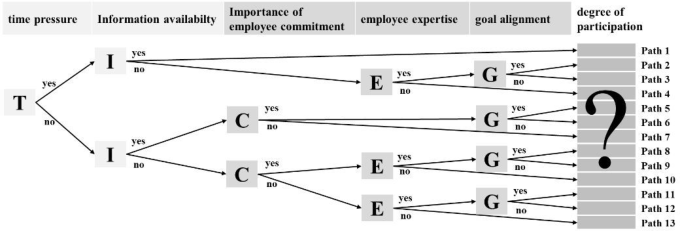
Based on the selected situational contextual factors, relevant combinations of the factors were derived and illustrated a kind of decision tree (see Figure 1).
Figure 1: Relevant combinations of situational contextual factors taking into account for deciding the level of participation for decision-making in healthcare.
Assumptions on the Degree of Participation Based on decision rules derived from the empirically supported normative decision model by Vroom (1973), the following five assumptions for the con- sidered situational contextual factors for this study were made and need to be empirically evaluated for healthcare in order to convey them in the e-learning app:
1. If there is time pressure, the manager would make decisions without employee participation. 2. If there is a lack of information, the manager would not make the decisions without employee participation. 3. If employee commitment is important, employees would be involved in the decision-making process. 4. If at least one employee has high expertise on a decision problem, the person would be involved in the decision-making process. 5. If employees share the organization’s goals, they could participate fully in the decision-making process.
RESULTS
In the following, the results of the questionnaire are presented and evaluated with regard to the assumptions.
Middle managers (n = 34) from healthcare rated the extent to which they would involve their employees in decision-making for the 13 combinations of situational contextual factors described (see Figure 1). Their decisions on degrees of participation are presented in Table 1.
In the following, the response behavior is presented with regard to the assumptions made. The assumption that the manager would make decisions
Table 1. Responses on degrees of participation for every path in the decision tree (n = 34; multiple responses possible).
Table available in the original PDF paper.
Possible degrees of participation (most mentions marked in bold) A – Alone
without employee involvement when time pressure is present can be suppor- ted by the participants’ response behavior. For combinations of situational contextual factors including given time pressure, the majority of healthcare managers chose to make the decision alone, distributed between making deci- sions completely alone or obtaining information before making the decision (e.g. path 1 or 4, see Table 1).
Assuming if there is a lack of information, the manager should not make the decisions without employee participation could also be supported by the present data. For cases where not enough information is available the option to make the decision on his/her own was barely chosen (e.g. path 8 or 9, see Table 1).
If high experience of a team member was given for a decision problem (e.g. path 2, see Table 1), the majority of managers decided to delegate the decision-making to the experienced team member. This supports the third assumption that if an employee has high expertise on a decision problem, the person would be involved in the decision-making process.
The assumption that if employee commitment is important, a group decision-making process would take place can also be supported by the par- ticipants’ response behavior. For all combinations of situational contextual factors where employee commitment was important, participants most fre- quently indicated that they would have the team jointly develop proposed solutions and make the decision on that basis (e.g. path 5,6, 8 and 9, see Table 1).
The last assumption, that if employees share the organization’s goals, they could participate fully in the decision-making process, cannot be supported by the present data. If the situational contextual factors included that the
Participative Leadership in Healthcare 59
employees would decide in terms of the organization, the delegation of the decision to the team was only mentioned seven or less times (e.g. path 5, 8 or 11, see Table 1).
DISCUSSION AND CONCLUSION The present study shows which situational contextual factors influence heal- thcare managers’ decision to involve employees in decision-making processes. The assumptions about when managers involve their employees in decision- making processes depending on given situational contextual factors could be confirmed for the most part. Only the last assumption, that managers could fully delegate decision-making to employees if they share the organization’s goals, could not be confirmed. One reason for this could be the cultural context in healthcare, that is usually characterized by a hierarchical work organization in which responsibilities are clearly distributed. Further inve- stigation to support this thesis would be necessary. Another reason for the surprising low number of selections of the option to delegate a decision fully to the team, could be on methodological level, because the last two options, the degree of letting the team develop solution proposals and of delegating the problem solving to the team, might not have been well separable for the respondents. According to this, the results have to be evaluated with caution. It should be taken into account that the response behavior is based on subje- ctive assessments and the sample should be much larger for valid statements. Moreover, effects of social desirability and fatigue cannot be ruled out when responding to the survey.
Based on the study results, proposals for suitable degrees of participation for each path of the combinations of situational contextual factors could only be derived to a limited extent, as Vroom (2000) does in his norma- tive decision model. To give valid proposals for the degree of participation for combinations of factors, a higher sample and therefore more empirical studies for healthcare context would be necessary. So this study only focu- ses on assumptions on employee participation based on single situational contextual factors. However, the evaluation of how five relevant situational contextual factors influence leaders’ decisions to involve employees covers suitable content complexity, as it is just one learning unit of an e-learning app for healthcare leaders to reflect on difficult decision problems.
To conclude, this paper gives a selection of relevant situational contextual factors that should be considered when deciding to what degree managers in healthcare should participate their employees in decision making. The assumptions derived from the decision model by Vroom could mostly be sup- ported by the response behavior of 34 managers in healthcare. This gives a well-structured basis for the e-learning app to reflect difficult decision- making processes and can be helpful especially for unexperienced managers to support their reflective decision-making. This study goes along with research on participative leadership concepts for today’s work organization (Rybnikova and Lang, 2020). For the future, participative leadership appro- aches and their findings should be evaluated and possibly developed further for the design of a participative work organization in healthcare.
ACKNOWLEDGMENT
The research and development project LUTZ is financed with funding pro- vided by the German Federal Ministry of Education and Research (BMBF) and the European Social Fund (ESF) under the “Future of work” program (funding number: 02L18B535) and implemented by the Project Management Agency Karlsruhe (PTKA). The authors are responsible for the content of this publication. The authors would like to express their gratitude for this support.
REFERENCES
Chan, S. C. (2019). Participative leadership and job satisfaction. Leadership & Organization Development Journal, 40(3), pp. 319-333. Estryn-Behar, M., Van Der Heijden, B. I., Fry, C., Hasselhorn, H. M. (2010). Lon-
gitudinal analysis of personal and work-related factors associated with turnover among nurses. Nursing research, 59(3), pp. 166–177. Kerr, K. (2019). Data Quality, Health Care Planning and Delivery on Data management. Finance and Management Engineering Journal of Africa, 1(5), pp. 47–68. McAlearney, A. S. (2006). Leadership development in healthcare: a qualitative study.
Journal of Organizational Behavior, 27(7), pp. 967-982. Mütze-Niewöhner, S. and Nitsch, V. (2020). Arbeitswelt 4.0. In: Frenz, W., eds.
Handbuch Industrie 4.0: Recht, Technik, Gesellschaft. Berlin, Heidelberg: Sprin- ger, pp. 1187–1217. Pasewark, W. R. and Strawser, J. R. (1994). Subordinate participation in audit budgeting decisions: A comparison of decisions influenced by organizational factors to decisions conforming with the Vroom-Jago mode. Decision Sciences, 25(2), pp. 281–300. Paul, R. J. and Ebadi, Y. M. (1989). Leadership decision making in a service organiza-
tion: A field test of the Vroom-Yetton model. Journal of Occupational Psychology, 62(3), pp. 201–211. Pfister, H. R., Jungermann, H., Fischer, K. (2017). Die Psychologie der Entscheidung.
Berlin, Heidelberg: Springer. Rybnikova, I. and Lang, R. (2020). Partizipative Führung: Auf den Spuren eines Konzeptes. GIO - Zeitschrift für Angewandte Organisationspsychologie, 52(2), pp. 141–154. Sorge, M., Mayer, C., Schöner, J., Kummer, R., Rentzsch, M. (2021). Requirements
for a Game-Based Approach to Strengthen Leadership in Health Care, In: Duffy, V. G., eds. Digital Human Modeling and Applications in Health, Safety, Ergonomics and Risk Management: AI, Product and Service, Cham: Springer, pp. 152–164 Tannenbaum, R. and Schmidt, W.H. (1958). How to choose a leadership pattern.
Harvard Business Review, 36 (2), pp. 95–101. Vroom, V. H. (2000). Leadership and the decision-making process. Organizational dynamics, 28(4), pp. 82–94. Vroom, V. H. (2003). Educating managers for decision making and leadership.
Management Decision, 41(10), pp. 968–978. Vroom, V. H. and Jago, A. G. (1988). The new leadership: Managing participation in organizations. New Jersey: Prentice-Hall, Inc. Vroom, V. H. and Yetton P. W. (1973). Leadership and decision-making. University
of Pittsburgh Press: Pittsburgh. Yukl, G. (2013). Leadership in organizations. Essex: Pearson. Yukl, G. and Fu, P. P. (1999). Determinants of delegation and consultation by manager. Journal of Organizational Behavior, 20(2), pp. 219–232.
LISTED IN THE AHFE DIGITAL BOOKSTORE CATALOGUE
Explore the complete digital volume
Human Factors in Management and Leadership
Read this individual research paper free through the original publisher, or explore the full digital proceedings book.
ISBN 978-1-958651-31-5
Explore this ISBN in the AHFE Bookstore ↗Listed in the July 2026 bookstore catalogue; search by ISBN to confirm current availability · Digital book purchase optional