Kimi Ueda, Kohei Yumura, Hirotake Ishii, Hiroshi Shimoda, Fumiaki Obayashi (2022). An Analysis of the Effect of Integrated Thermal Control on Cognitive Task Performance Using Time-Series Changes in Intellectual Concentration. In: Human Factors, Business Management and Society. AHFE Open Access, vol. 56, pp. 205–210. https://doi.org/10.54941/ahfe1002270
In today’s developed information society, improving the performance of intellectual work is considered important not only for increasing corporate profits but also for improving occupational health, including improving work-life balance. Therefore, various methods have been attempted to improve intellectual work performance. Since the workplace environment during intellectual work is known to affect performance, many efforts have been made to improve intellectual work performance by devising the workplace environment. Based on the knowledge from many studies which have focused only on the environment during working or only on the environment during breaks, the authors have proposed integrated thermal control, which combines and controls both the environments during working and breaks, and have examined the effect of this proposed control on the performance of intellectual work.In our previous studies [1-3], we have shown the performance-enhancing effect of integrated thermal control throughout the day using the concentration time ratio (CTR), which is a performance evaluation index of the ratio of time when workers concentrated on their work during their working time. However, although performance during work changes moment by moment due to accumulation of fatigue and other factors, time-series changes in intellectual performance during work was not examined, and the details of the effects of integrated thermal control on performance remain unclear.Therefore, the purpose of this study was to analyze and evaluate the effects of integrated thermal control on work performance in more detail by focusing on the time-series changes in concentration on intellectual work. For the analysis, the answering time data of the cognitive task for intellectual concentration evaluation [4], which was obtained by 44 participants performing 4 sets of 30 minutes each in the integrated thermal control condition using airflow and control conditions, was used to calculate the time-series changes of intellectual concentration based on the idea of conventional CTR calculation method. The calculated time-series data was separated by Ward’s method of clustering. As a result of clustering, for example, the number of data included in the cluster that tended to decrease in concentration during the 30-minute work period decreased in the integrated thermal control condition compared with the control condition. Results suggested the possibility that the integrated thermal control improved intellectual performance throughout the day by suppressing the decline in concentration during each working period.[1] Kimi Ueda, et al.: An experimental study on integrated thermal control of office room and break room to improve intellectual concentration, Roomvent & Ventilation 2018 Conference, pp.43-48, 2018.[2] Soma Kawamoto, et al.: An Experimental Study on Airflow Control to Improve Intellectual Concentration, Roomvent & Ventilation 2018 Conference, pp.31-36, 2018.[3] Kimi Ueda, et al.: A Study of Analysis Framework to Construct Mechanism Model of Intellectual Productivity Changes Affected by Workplace Environment, The 8th International Conference on Applied Human Factors and Ergonomics, pp.121-131 2017.[4] Kimi Ueda, et al.: Development of a new cognitive task to measure intellectual concentration affected by room environment, The Fifth International Conference on Human-Environment System ICHES2016 Nagoya, 2016.
In today’s developed information society, improving the performance of knowledge work and intellectual work is considered important not only for increasing corporate profits but also for improving occupational health, including improving work-life balance. Since the workplace environment is known to affect work performance (Al Horr et al. 2016), many researches evaluate the effect of various environmental factors during work especi- ally about thermal factors (Oseland 1999, Wargocki et al. 2000), or break (Amano et al. 2012). Based on the knowledge from those studies, the authors have proposed “integrated thermal control”, which combines and controls both the environments during work and break. Authors have been examining the effect of the proposed control on work performance.
evaluation using the concentration time ratio (CTR), which is a performance evaluation index of the ratio of time when workers concentrated on their work during their working time. However, although performance during work changes moment by moment due to accumulation of fatigue and other factors, time-series changes in intellectual concentration during work was not examined, and the details of the effects of integrated thermal control on performance remain unclear.
Therefore, the objective of this study was to analyze and evaluate the effe- cts of integrated thermal control on work performance in more detail by focusing on the time-series changes in concentration on cognitive task per- formance. Clustering analysis of time-series data is generally applied to find major patterns in large amount of data and to forecast combining other time-series analysis method (Saeed et al. 2015). By conducting clustering analysis of time-series data on the degree of concentration on intellectual tasks, the effects of integrated thermal control can be estimated on each pat- tern of change in concentration. It was also expected to obtain knowledge for individual adaptive control of integrated thermal control.
METHODS
For the analysis, we used the response time data of a cognitive task for intel- lectual concentration assessment (Ueda et al. 2016), which was designed to require cognitive activities of numerical and verbal semantic comprehen- sion, comparative judgment, and information integration. These data were obtained from 44 participants performing 4 sets of 30 minutes each in the integrated thermal control and control conditions. Participants were all male university students with the age of 21.0 years (SD = 2.0).
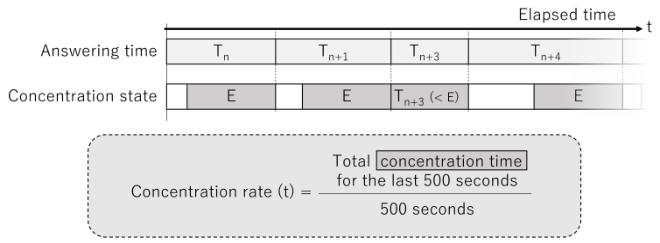
Calculation of Concentration Rate Based on the three-state model during performing cognitive task proposed by Uchiyama et al. (Uchiyama et al. 2013), the answering time data of a cogni- tive task to evaluate intellectual concentration forms a lognormal distribution when answered with concentration, when the task consists of multiple que- stions of constant difficulty. Based on this, the expected answering time E for one question when answering with concentration was calculated by fitting analysis of all sets of answering time data in each participant. Concentra- tion and non-concentration were assigned to each time point in each set as shown in Figure 1 using each participant’s expected answering time E. Answ- ers with an answer time of E or less were assumed to have been answered by continuing to work with concentration, while answers with an answer time longer than E were assumed to have been answered after interrupting work for a while and then concentrating for E. Then, the percentage of time spent concentrating in the last 500 seconds at each time point was used as the concentration rate at that time. In this study, the time window was set to 500 seconds, which is relatively long, to find a rough pattern of change in concentration by clustering based on the long-term trend within each set.
An Analysis of the Effect of Integrated Thermal Control on Cognitive Task Performance 207
Figure 1: Allocation of concentration time and calculation of concentration rate.
Clustering Method In this analysis, correlation value was used as a distance function for clu- stering to find the pattern of time-series change of concentration. The Ward method, which is a hierarchical clustering method that allows us to examine the number of clusters based on the dendrogram was applied.
However, when correlations are used as the distance function, it is difficult to successfully discriminate patterns whose concentration rate is of a con- stant as the same cluster. Therefore, we set a threshold value for the variation of the degree of concentration based on the pre-clustering and separated the data of constant type in advance. In pre-clustering, clustering analysis was conducted with using the all participants data with 8 dummy data represen- ting the major change pattern of concentration rate we found out from our previous data, such as down-constant trend which shows downward trend in the first half and constant trend in the latter half. The threshold value for the variation degree of concentration rate was set based on the variation of the corresponding part of the data classified into the same cluster as the dummy data containing the part of constant trend.
After omitting the data that were defined as constant from the overall data, clustering was applied again to the remaining data. Based on the dendrobium, the number of clusters was set to four in this analysis. Including the constant type that was separated beforehand, the time-series changes in concentration in each task set were classified into a total of five clusters.
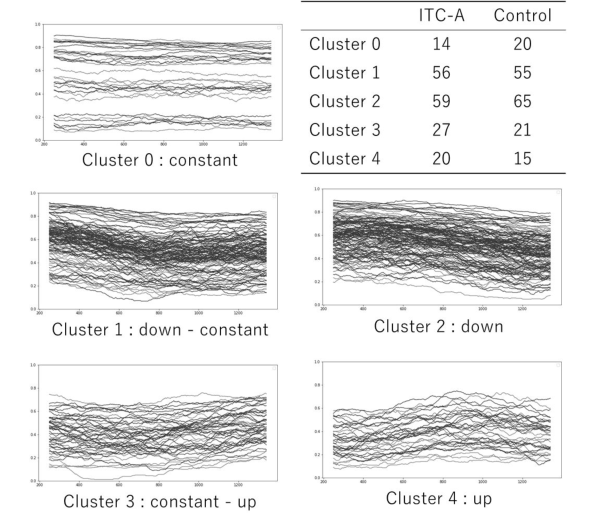
RESULTS AND DISCUSSIONS The results of the clustering are shown in Figure 2. Cluster 0 was a constant type which was separated beforehand, Cluster 1 had a downward trend in the first half and a constant trend in the second half, Cluster 2 had a downward trend throughout the set, Cluster 3 had a constant trend in the first half and an upward trend in the second half, and Cluster 4 had a constant upward trend. In contrast to cluster 3 and 4, which contain patterns of increasing trend of concentration ratio, the numbers of cluster 1 and 2 was larger. Since cluster 1 and 2 contain decreasing trend of concentration rate, this suggests that it would be difficult to maintain a certain level of concentration when working continuously due to fatigue accumulation.
Figure 2: Separated data of each clusters and the list of separated numbers of sets in each cluster.
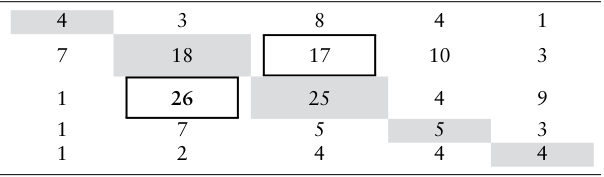
Table 1 shows a summary of which clusters the same set was classified into in the Control and ITC-A conditions. The same set means the set of cognitive tasks performed by each participant during the same time period. While many sets belonged to the same cluster, there was a distinctive difference in the number of sets classified as Cluster2 in the Control condition and Cluster1 in the ITC-A condition, and vice versa. Cluster 1 was the pattern with a down- constant trend, while Cluster 2 is with a continuous downward trend. It was suggested that ITC-A might suppress the decline of concentration rate after the middle part of the set for those whose concentration rate had continuous downward trend.
To examine the difference in the effect of ITC-A for each pattern of change in concentration rate, the average values of concentration rate in the Control and ITC-A conditions for the data classified into each cluster in the Control condition. Table 2 shows the results. The data belonging to most clusters have a higher average of the concentration rate in ITC-A, while only cluster 2 has almost same average values both in ITC-A and Control conditions. Cluster 2 was a group of data that has a continuous downward trend during the 30 minutes task set. The results in Table 1 indicate that the downward trend may have been suppressed, but it may not have led to an improvement in the overall concentration rate of the set based on Table 2. It suggests that for those whose concentration tended to go downward during the task set, it may have suppressed the downward trend but did not lead to an improvement in concentration for the entire set.
An Analysis of the Effect of Integrated Thermal Control on Cognitive Task Performance 209
Table 1. Clustering results of the same set for each condition.
As a result of calculating the time-series change data of intellectual concen- tration from the answering time data and conducting clustering, it was suggested that for the group whose concentration tended to decrease during the 30-minute work period, the ITC-A might suppress the decrease in concen- tration, but it did not lead to an improvement in the average of the overall concentration. In the future, we would like to conduct further studies by com- bining the results with subjective evaluations and by comparing the results with those obtained when the time window for calculating the degree of concentration was changed.
REFERENCES
Kentaro Amano, Hiroki Takahashi, Shinsuke Kato, Hideaki Tani, Takeshi Ishiguro, Masaaki Higuchi, Satoshi Saito, Hiroki Miyata (2012) Indoor odor exposure effe- cts on psycho-physiological states during intellectual tasks and rest, HVAC&R Research, 18:1-2, 217–224. Kimi Ueda, Hiroshi Shimoda, Hirotake Ishii, Fumiaki Obayashi, Kazuhiro Tani-
guchi. (2016) “Development of a new cognitive task to measure intellectual concentration affected by room environment”, The Fifth International The Fifth International Conference on Human-Environment System ICHES2016 Nagoya. Kimi Ueda, Daisuke Kamihigashi, Hiroshi Shimoda, Hirotake Ishii, Fumiaki Obayashi, Kazuhiro Taniguchi. (2017) “A Study of Analysis Framework to Construct Mechanism Model of Intellectual Productivity Changes Affected by Workplace
Environment”, The 8th International Conference on Applied Human Factors and Ergonomics, pp. 121–131. Kimi Ueda, Kosuke Sugita, Hiroshi Shimoda, Hirotake Ishii, Fumiaki Obayashi, Kazuhiro Taniguchi. (2018) “An experimental study on integrated thermal control of office room and break room to improve intellectual concentration”, proceedings of Roomvent & Ventilation 2018 Conference, pp. 43–48. Kosuke Uchiyama, Koutarou Ooishi, Kazune Miyagi, Hirotake Ishii, Hiroshi Shi-
moda (2013) “Process of Evaluation Index of Intellectual Productivity Based on Work Concentration,” proceedings of ICSTE 2013. Soma Kawamoto, Kimi Ueda, Hiroshi Shimoda, Hirotake Ishii, Fumiaki Obayashi, Kazuhiro Taniguchi, Ayaka Suzuki. (2018) “An Experimental Study on Airflow Control to Improve Intellectual Concentration”, proceedings of Roomvent & Ventilation 2018 Conference, pp. 31–36. Nigel Oseland (1999) “Environmental factors affecting office worker performance
a review of evidence” CIBSE Technical Memorandum TM24. Paris: CIBSE. Pawel Wargocki, David P Wyon, and P Ole Fanger (2000) “Productivity is affected by the air quality in offices” Vol. 1, No. 1, pp. 635–40. Saeed Aghabozorgi, Ali Seyed Shirkhorshidi, Teh Ying Wah (2015) “Time-series
clustering - A decade review”, Information System, 53, pp. 16–38. Yousef Al Horr, Mohammed Arif, Amit Kaushik, Ahmed Mazroei, Martha Katafygiotou, and Esam Elsarrag (2016) “Occupant productivity and office indoor environment quality: A review of the literature” Building and Environment, Vol. 105, pp. 369–389.
LISTED IN THE AHFE DIGITAL BOOKSTORE CATALOGUE
Explore the complete digital volume
Human Factors, Business Management and Society
Read this individual research paper free through the original publisher, or explore the full digital proceedings book.
ISBN 978-1-958651-32-2
Explore this ISBN in the AHFE Bookstore ↗Listed in the July 2026 bookstore catalogue; search by ISBN to confirm current availability · Digital book purchase optional