Jun Iio, Atsushi Hasegawa, Shigeyoshi Iizuka, Seiji Hayakawa, Hiroshi Tsujioka (2022). Ethical Guidelines for Human-Centered Design Activities. In: Human Factors, Business Management and Society. AHFE Open Access, vol. 56, pp. 218–222. https://doi.org/10.54941/ahfe1002272
Recently, ethical considerations have become increasingly important in various situations. Human-centered design (HCD) activities are no exceptions. Because there have been no ethical guidelines for HCD-related activities in Japan, the human-centered design organization (HCD-Net) has published specific ethical guidelines for HCD activities. The guidelines provide general rules on ethical considerations for HCD specialists and ethical provisions for investigation, research, and deliverables. The guidelines have been published on the HCD-Net website. All researchers and practitioners engaged in HCD-related activities are expected to adhere to these guidelines when making ethical decisions.
Recently, compliance with laws, social norms, international rules, and corpo- rate ethics has been emphasized globally. In particular, ethical considerations have been considered in all business and research activities. Bioinformatics and biomedical research (Council for International Organizations of Medi- cal Sciences, 2002) face the ethical dilemma of creating artificial life based on genetic engineering (Rollin, 1996, Polkinghorne, 2014), and data analysis involves the handling of sensitive and personal information (Tene and Polo- netsky, 2012, Wu et al. 2013, Xu et al. 2014). Artificial intelligence also requires ethical considerations (Bostrom and Yudkowsky, 2014, Etzioni A. and Etzioni O., 2017); philosophical assessments, such as the trolley problem, are essential in artificial intelligence applications (Renda, 2018, Moolayil, 2018). Research ethics also require careful consideration by researchers in all fields.
The various activities related to human-centered design (HCD) are no exce- ption (Ramírez, 2020). Mulvenna et al. pointed out that design and ethics are closely related (Mulvenna et al. 2017). The experiment subjects in HCD, user- centered design (UCD), and user experience (UX) are human beings; hence, strict ethical considerations are inevitable.
Ethical Guidelines for Human-Centered Design Activities 219
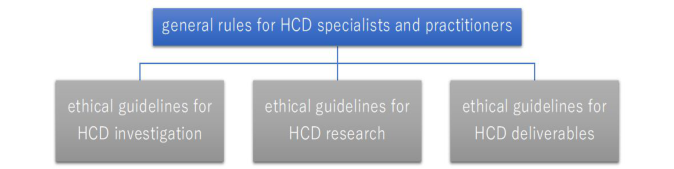
Figure 1: Structure of the proposed HCD ethical guidelines.
Researchers are generally educated on research ethics. Therefore, they are expected to have some knowledge regarding ethical issues. However, some HCD practitioners may not be familiar with ethics. Furthermore, either aca- demic or industrial user research must be conducted in line with HCD-specific research ethics because their research targets are humans as well.
Under such circumstances, to help HCD practitioners and businesspe- ople who are unfamiliar with ethical issues, the Human-Centered Design Organization (hereinafter referred to as HCD-Net) has established specific ethical guidelines for all scientists and practitioners working on HCD-related activities.
This study reports on the ethical guidelines for working in HCD businesses.
PROTOTYPING THE GUIDELINES In May 2020, HCD-Net established a working group (WG) that discussed the ethical guidelines for HCD researchers and practitioners. The main WG activities were virtual meetings owing to the COVID-19 pandemic, and WG online meetings have been held regularly.
In November 2020, at the HCD-Net annual conference (the HCD forum), the WG surveyed the opinions of members on the ethical issues regarding their daily activities. According to the survey results (Iio et al. 2021), many experts who are highly aware of ethical issues considered that the guideline would be helpful and the WG’s activity was meaningful to the members and all stakeholders working in the HCD field.
In Japan, no ethical guidelines have been established for HCD activities. However, we can obtain similar guidelines provided by the Japan Ergono- mics Society (JES), Research Institute of Human Engineering for Quality Life (HQL), and Japanese Psychological Association (JPA). Referring to such documents, the WG created a beta version as an ethical guidelines prototype for HCD activities.
The document comprises four parts: general rules, ethical guidelines for HCD investigation, ethical guidelines for HCD research, and ethical guidelines for deliverables (see Figure 1).
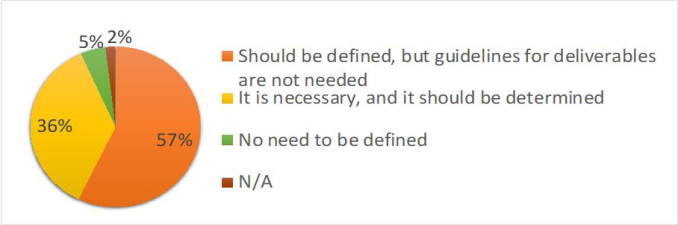
While prototyping the guidelines, it was determined whether the manu- script should include the last part (ethical guidelines for HCD deliverables). In a previous survey (Iio et al. 2021), the answer to whether there was a need for an ethical policy had interesting results; one-third replied that it was necessary and should be determined. However, approximately two-thirds
Figure 2: Percentage of answers to the question “Please give us your opinion about determining a code of ethics in HCD activities for specialists, researchers, and services or products.”
responded that it should be defined but guidelines for deliverables were not required (see Figure 2).
Therefore, the WG considered that it should prepare HCD-specific ethical guidelines in three stages:
1. A fundamental guideline that provides a behavioral criterion that all HCD professionals should have. (This is the first part of the proposed guidelines.) 2. The ethical guidelines for conducting user surveys and tests and existing ethical guidelines in other fields can be used as references. (This is related to the second and third parts of the document.) 3. In the final stage, the ethical standards for services or products created by HCD professionals should be considered. (This is the final part of the guidelines.)
The WG finally determined that it should describe the last part only in the abstract representation.
USE CASES OF THE GUIDELINES The WG discussed several ethical problems in HCD fields, which should be addressed in the guidelines. Although these problems have not been comple- tely solved, they are good examples of the ethical problems regarding HCD activities. This section provides some examples of these problems.
CASE 1: RECORDING A VIDEO IN A PUBLIC AREA For an initial study on transportation service design, the research team would like to record a video of a train station or highway service area and discuss it based on the video. Are there any problems with this action?
This is a case of video recording and analysis of a public space. The possibi- lity of third parties appearing in these videos can be a problem. The research team would not ask every general visitor appearing in the video for informed consent. It is a common practice to blur people’s faces in the video if neces- sary. Alternatively, if the visitors comprise a small enough group that can be part of the scenery, they may be treated as they are.
Ethical Guidelines for Human-Centered Design Activities 221
In this case, one criterion may be whether the research team can obtain personal information data from the video.
CASE 2: A REQUEST FOR REMOVING RECORDS An ethnographic survey was conducted with permission from the interview- ees. However, after the study and analysis, an interviewee requested for their survey record to not be used because it was too detailed. The survey team understood the intentions of the user and would have liked to refrain from using it but a service plan was already underway based on these insights. Does the team need to withdraw from this plan altogether?
This case is relatively complicated. The critical point is to distinguish the interview records from the insights. The interview records should be removed entirely according to the request of the interviewee. However, the service plan is not dependent only on interview records. Therefore, the team does not need to withdraw their plans.
One member who participated in the discussion provided a crucial com- ment on this problem. She advised that the consent form she usually uses mentioned, “You may withdraw your participation in the study, but you may not withdraw your published article.”
CASE 3: ASKING FOR CONTACT INFORMATION The consulting company, for which the inquirer works, asks people to enter their e-mail addresses when downloading materials to obtain e-mail addresses for marketing purposes. Is this unethical?
One WG member mentioned that the Act on the Protection of Personal Information (Ministry of Justice, Japan, 2003) requires that the purpose of use be clearly stated according to the source of information. Another mem- ber pointed out that it was ultimately detrimental because it created a sense of distrust in companies who collected data without fully explaining the reasoning behind.
CONCLUSION
This study describes the process of establishing ethical guidelines for HCD- related activities and its outline.
HCD-Net has many participants, academic researchers, practitioners, and businesspeople. In addition, while many members, such as information engi- neers, have a solid technical background, many non-technical people have a background in design. Therefore, HCD-related activities cover a wide range of topics.
The ethical guidelines developed by the WG are divided into four parts. The general rules are described first, followed by the ethical guidelines for HCD-related investigation, research, and deliverables. One feature of the guidelines is that user investigation is separated from academic research, assuming that research in practice, such as user testing and ethnography, is included. In addition, because many HCD-Net members were reluctant to discuss the ethical responsibilities of their deliverables, the ethical guidelines for deliverables are limited to an abstract guide.
The prototype of the ethical guidelines for HCD activities was first released to the HCD-Net members for comments. The prototype was subsequently improved based on their advice, after which the official version was released. The guidelines have been published on the HCD-Net’s website.
Only the Japanese version is available but translating it into English and providing an English version remains a topic for future studies.
ACKNOWLEDGMENT
The authors would like to thank all HCD-Net members and specialists who participated in the discussions to improve the initial draft of the HCD ethical guidelines.
REFERENCES
Bostrom, N., & Yudkowsky, E. (2014), “The ethics of artificial intelligence.” The Cambridge handbook of artificial intelligence, 1, 316–334. Council for International Organizations of Medical Sciences. (2002) “International
ethical guidelines for biomedical research involving human subjects.” Bulletin of medical ethics, (182), 17–23. Etzioni, A., & Etzioni, O. (2017), “Incorporating ethics into artificial intelligence.”
The Journal of Ethics, 21(4), 403–418. Iio, J., Hasegawa, A., Iizuka, S., Hayakawa, S., and Tsujioka, H. (2021), “Ethics in Human-Centered Design,” In: Kurosu M. (eds) Human-Computer Interaction. Theory, Methods and Tools. HCII 2021. Lecture Notes in Computer Science, vol. 12762. Springer, Cham. pp. 161–170, Online. Ministry of Justice, Japan (2003), “Act on the Protection of Personal Information.”
http://www.japaneselawtranslation.go.jp/law/detail_main?id=130 Moolayil, A. K. (2018), “The modern trolley problem: Ethical and economicallysound liability schemes for autonomous vehicles.” Case W. Res. JL Tech. & Internet, 9, 1. Mulvenna, M., Boger, J., & Bond, R. (2017), “Ethical by design: A manifesto.”
In Proceedings of the European Conference on Cognitive Ergonomics 2017, pp. 51–54. Polkinghorne, J. C. (2014), “The person, the soul, and genetic engineering.” Journal of medical ethics, 30(6), 593–597. Ramírez, R. H. (2020), “The Meaning of ‘Good Design’ in the Age of Smart
Automation.” Journal of Science and Technology of the Arts, 12(3), 100–114. Renda, A. (2018), “Ethics, algorithms and self-driving cars–a CSI of the ‘trolley problem’.” CEPS Policy Insight. Rollin, B. E. (1996), “Bad ethics, good ethics and the genetic engineering of animals
in agriculture.” Journal of animal Science, 74(3), 535–541. Tene, O., & Polonetsky, J. (2012), “Big data for all: Privacy and user control in the age of analytics.” Nw. J. Tech. & Intell. Prop., 11, xxvii. Wu, X., Zhu, X., Wu, G. Q., & Ding, W. (2013), “Data mining with big data.” IEEE
transactions on knowledge and data engineering, 26(1), 97–107. Xu, L., Jiang, C., Wang, J., Yuan, J., & Ren, Y. (2014), “Information security in big data: privacy and data mining.” Ieee Access, 2, 1149–1176.
LISTED IN THE AHFE DIGITAL BOOKSTORE CATALOGUE
Explore the complete digital volume
Human Factors, Business Management and Society
Read this individual research paper free through the original publisher, or explore the full digital proceedings book.
ISBN 978-1-958651-32-2
Explore this ISBN in the AHFE Bookstore ↗Listed in the July 2026 bookstore catalogue; search by ISBN to confirm current availability · Digital book purchase optional