Zaira Tello (2022). The effects of the San Gottardo Base Tunnel System on the transformation of cross-border land and its contribution to a more circular economy. In: Human Factors in Architecture, Sustainable Urban Planning and Infrastructure. AHFE Open Access, vol. 58, pp. 22–28. https://doi.org/10.54941/ahfe1002329
The San Gotthard railway base tunnel, located in Switzerland, connects the cities of Ersfeld with Bodio, has an extension of 57 km, and was inaugurated in June 2016. Its construction has generated an integral system, with the purpose of achieving efficient operation. These types of projects generate permanent transformations in urban environments and landscape. Without long-term articulated policies, directed only at economic competitiveness or national development, and leaving aside policies for protecting the environment and strengthening existing infrastructures and intermodal transport, run the risk of being political instruments that devastate the territories where they are implanted.The first project of the San Gotthard base tunnel dates back to 1961, since that date a number of variants have been made to the project in relation to the financing plan, routes, connections, commercial strategies, capacity for transporting people and merchandise, works compensation, among others. At the time the final project was finalized, the intervention of the confederation at different scales was fundamental, generating a set of actions and international agreements that are part of the so-called "Gothard System", adopting measures with a wide variety of areas and among them reveals that it is possible to execute an adequate policy of managing the waste generated by the construction of the tunnel and of transferring merchandise traffic from road to rail through the Swiss Alps.The Gotthard Base Tunnel is considered the longest in the world; it took 17 years to build and thousands of workers to complete. It is part of the European Rhine-Alps rail freight traffic corridor, which runs from the cities of Rotterdam and Zeebrugge in the Netherlands to the Italian city of Genoa. This transport and logistics infrastructure is essential for the correct development of this commercial and communication corridor, the complexity of its operation reaches different scales: transnational, national, multilateral, regional and subnational.The purpose of this study is to develop an approach that shows the experience in Switzerland and the effects of the construction of the San Gotthard base tunnel in the creation of complementary works, such as agricultural and environmental compensations, projects that enhance the intermodal system. Three levels of analysis were identified that involve the cities located in Switzerland and Italy. At the Milan-Zurich metropolitan level, Mendrisio-Stabio-Arcisate-Varese-Gallarate cross-border level, and at the local level the Swiss cantons of Ticino, Uri and Grigioni. Additionally, a brief comparative analysis is carried out with the future base tunnel that will link the French city of Lyon with the Italian city of Turin, in order to identify some of the effects produced by the construction of the San Gotthard base tunnel on the border between Switzerland and the north of Italy.
The Gotthard Base Tunnel (SG) runs between the Swiss cities of Erstfeld (north) and Bodio (south), it is part of the European Rhine-Alps rail freight traffic corridor, which runs from the cities of Rotterdam and Zeebrugge in the Netherlands, to the Italian city of Genoa, is also part of the New Transalpine Railway approved by popular vote in 1992. The Swiss Confederation opted for a long-term transport policy, together with accompanying policies, which seek to protect alpine environment, transferring freight traffic from road to rail, they have even influenced Italian rail and intermodal transport policies. Switzerland has an exemplary system of financing, public debate and refe- rendum for decision-making, which would be difficult to find another case study with similar conditions worldwide.
The Effects of the Saint Gotthard Base Tunnel System 23
The cost of the work was 15,000 million euros approx. and for the enhance of the Gotthard System it was approximately 624 million euros, financed by the Railway Infrastructure Fund (FIF), which was extended until the year 2035, obtained mainly from heavy vehicles tax according to its performance (TTPCP), VAT, income from federal personal income tax and annual cantonal contributions (UFT, 2020).
To identify the impact of this infrastructure on the cross-border territory between Switzerland and Italy, it is proposed to carry out a comparative analysis with the Lyon-Turin base tunnel (axis 1), which will link the French city of Saint-Jean-de-Maurienne with the Italian Susa (under construction) and will have an extension of 57.5 km (TELT, 2022). France and Italy opted for other supporting policies that were not born of a referendum like the Swiss ones.
To carry out this study, 3 levels of analysis are proposed: at the Milan-Zurich metropolitan level (axis 2), Mendrisio-Stabio-Arcisate-Varese- Gallarate cross-border level, and at the local level, the Swiss cantons of Ticino, Uri and Grigioni. The research hypothesis corresponds to: the com- plementary projects, of compensation and that potentiate axis 2 contribute to a more circular economy and will be significantly superior with respect to axis 1, influenced by the Swiss policies applied in the long term in the construction of the Saint Gotthard base tunnel.
CONTRIBUTION TO THE CIRCULAR ECONOMY IN THE TRANSFORMATION OF THE LAND THROUGH PROJECTS THAT POTENTIALIZE THE “GOTTHARD SYSTEM” Thanks to sustainable circular economy measures, which minimize the gene- ration of excavation material produced by the construction of the SG tunnel, of the 28 million tons extracted, 66.3% was used for filling railway tracks, compensation projects detailed bellow, 33% of this material was destined for the production of concrete, which was used inside the tunnel and only 0.7% ended up in urban dumps. It was an efficient management for the reuse of excavation material, thanks to special machinery and constant controls that made it possible to obtain suitable aggregates for the production of concrete (AlpTransit San Gottardo, 2012).
At the metropolitan level (ML), as a direct consequence of the construction of the SG base tunnel, there is the positioning of the Swiss intermodal com- pany Hupac SpA in Italian territory with the Busto Arsizio/Gallarate terminal (245,000 m2) and the Centro Intermodale Merci Novara, CIM Spa (600,000 m2), located on axis 2 Milan-Zurich (see Figure 2), in Italian territory, are strategic terminals for transalpine traffic, this is how Hupac in 2019 consoli- dates its position in Italy, buying 44% of the shares of the Novara Interport that controls the intermodal rail transport hubs in the north-western area (Trasporto Europa, 2019). Subsequently, since September 2021, the CIM Novara interport is managed by the Combiconnect company, which is also controlled by Hupac (Trasporto Europa, 2021). Hupac is one of the main beneficiaries of Swiss economic subsidies that support intermodal transport
24 Toapanta
Table 1. List of works that enhance the base tunnels of axis 1 and axis 2. Crossborder regional level. Personal elaboration with information obtained from: (OTI nord, 2022) and (TRENORD, 2018).
Table available in the original PDF paper.
Axis 1 Lyon – Turin Axis 2 Milan – Zurich (Gotthard Base Tunnel) Strengthening of the Turin interport S.I.T.O. Spa in rail, logistics and intermodality services. Cost 500 million euros.
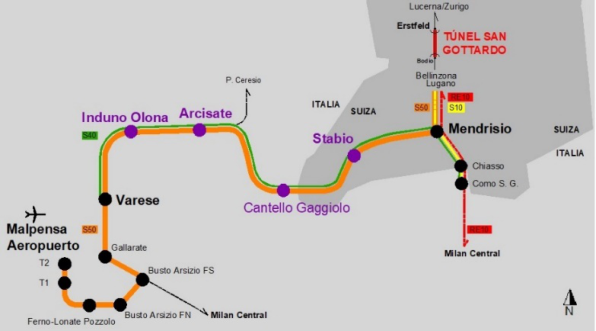
T1. Railway connection Seregno-Bergamo 32 km, cost 1,000 million euros. T2. Terminal intermodal center “Milano Smistamento”. 400,000 m2. Cost 80 million euros. T3. Brescia Terminal “La Piccola Velocita”. Cost 60 million euros. T4. Piacenza Terminal “Le Mose”. Cost 60 million euros. T5. Strengthening of the Rho-Gallarate railway line, 25km and a fourth platform between the stations of the cities of Rho and Parabiago. Cost 723 million euros. T6. Strengthening of the Novara-Malpensa-Seregno 14km railway line. Cost 393 million euros. T7. Public park and the biotope-phytopurification project. Tregarezzo, 8,264 m2. T8. New Arcisate-Stabio railway line and the Como-Mendrisio-Varese-Malpensa Airport connection. Cost 261 million euros (see figure 1)
and seeks to enhance the “Gotthard System” until 2030 (Trasporto Europa, 2019). The works that enhance the Gotthard System consist of increasing the par- king capacity in the stations, with platforms for trains of 740 meters in length (European Court of Accounts, 2020) and the importance of the gauge of the trains, with the possibility of loading semi-trailers (to be transported by road) 4 meters high (Ferrovie Federali Svizzere FFS, 2015) and allow the transit of intermodal freight trains without limitations. The so-called “4 m Corri- dor” (C4m) consists of the expansion of tunnels, adaptation of train shelters, signaling systems, and electric railway traction between Basel and the Italian border at a cost of 947 million euros (Ferrovie Federali Svizzere-FFS, 2016). Also as part of the corridor, the quadrupling of the Chiasso-Monza railway line in Italian territory is considered, with a cost of 1,410 million euros (OTI nord, 2022).
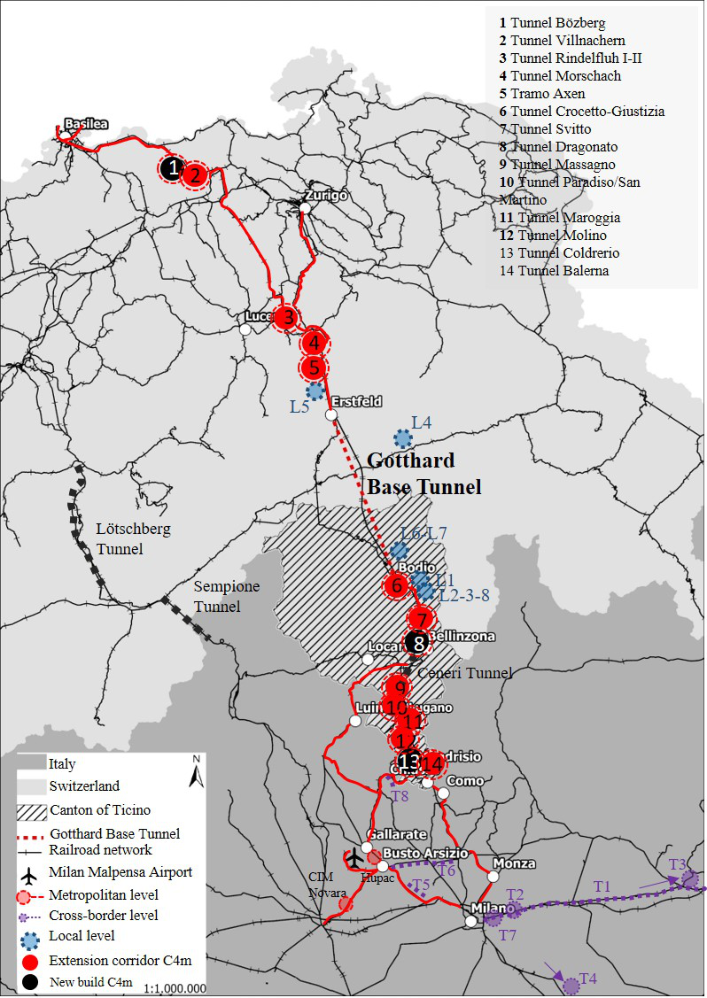
At the cross-border regional level (CRL) in Italian territory, a greater concentration of projects is observed (see Figure 2) in axis 2 compared to axis 1, new infrastructures, expansion and modernization works are iden- tified; On the other hand, in axis 1 this type of project is a minority (see Table 1).
At the local level (LL) in Swiss territory of axis 2, ecological and hydraulic compensation works are identified (see Figure 2) as: L1. Three artificial lakes for cooling drainage water from the mountain where the tunnel passes before directing it to the Ticino River. 7,100 m2, construction period 2014–2015, located in Pollegio, Ticino canton.
The Effects of the Saint Gotthard Base Tunnel System 25
Figure 1: T8 new Arcisate-Stabio railway line and the Como-Mendrisio-Varese- Malpensa airport connection. (Personal elaboration with information obtained from: OTI Nord 2022 and TRENORD 2018).
L2. The artificial green hill in Biasca, as a deposit for excavation mate- rial, was approximately 7 million tons, it was built from 1999 to 2019 (Alpitransit, 2019). L3. Afforestation of the abandoned areas of Santa Petronilla in Biasca, Ticino canton. Year 2005. L4. Lac de Claus artificial lake in Sedrun, 2.9 million tons of excavation material was used, located in Tujetsch, canton Grigioni. (SWIswis- sinfo.ch, 2011). L5. Six artificial Lorelei Islands, made up of 2.6 million tons of excavated material, were built in the period 2000-2005, the cost was 23 million euros, located in Seedorf, canton Uri (SWI swissinfo.ch, 2011). L7. Faido portal square, made with crushed material from the excavation of the tunnel located in Faido, Grigioni canton (Espazium, 2016).
As complementary projects (see Figure 2): L6. El Portal Building, made up of the central ventilation and railway technical area, was built in the period 2012-2014, located in Faido, Grigioni canton. (Space, 2016). L8. Justice Node, made up of the 7 km tunnel on the south side of the SG base tunnel, the bridge with two High Speed railway binaries over the Froda River, a retention chamber (5,500 m3), the embankment of the modified cantonal highway and the new emergency access to the Justicia highway. Built in the periods 2000-2002 and 2011-2015, the approximate cost was 30.8 million euros. (Space, 2016).
At the local level of axis 1, in the Saint Jean de Maurienne-Susa section, the complementary projects where the tunnel is built are limited with respect to axis 2. As in the Gotthard, the residual material from the excavation of the tunnel of base creates a circular economy, which reuses 60% of the mate- rial used to make structural concrete elements. Projects are mainly proposed:
26 Toapanta
Figure 2: Main complementary works, of compensation and that potentiate the Gotthard system according to the three levels of analysis. (Personal elaboration with information obtained from: OTI Nord 2022 and FFS 2015).
urban regeneration in the Maurienne Valley area (France), a 14-hectare tun- nel excavation material deposit, and a concrete ring factory (concio) in the Saint-Martin-La-Porte area, Salbertrand, Turin, the estimated construction period is 2019-2028. Storage tanks for the waste material from the tunnel
The Effects of the Saint Gotthard Base Tunnel System 27
excavation located in Caprie and Torrazza Piemonte, (Italy). External groun- dwater cooling tanks for the excavation of the tunnel, in Chiomonte, Italy (Tunnel Euralpin Lyon Turin - TELT, 2020).
CONCLUSION
The accompanying instruments and policies have favored potentiating the “Gotthard System” to bring it up to European standards, but as the research shows, they have had an impact on the transformation of the land at the three levels of analysis, due to the construction of complementary and ecological works, agricultural and hydraulic compensation, the physical and biological cover have been altered. These measures have undoubtedly contributed to the protection of the alpine environment, but the transformation of the soil has been displaced to transboundary regional levels in northern Italy.
Formally, two types of works are detected, type 1 Metropolitan Level (ML) - Cross-Border Regional Level (CRL) and type 2 Local Level (LL), among the compensation works and complementary projects analysed, the first one has formally linear characteristics of railway connection and intermodal logistics infrastructure, while the second type , formally they are punctual projects, located in the areas adjoining the two tunnels and a few kilometers away, which function as complementary and compensation support buildings. Due to its proximity to the SG base tunnel, the local level (LL) was the one with the greatest contribution to the circular economy compared to the other two levels (ML-CRL), the specific contribution in the reuse of excavation material was 27.8 million tons. The research hypothesis is confirmed, the transforma- tion of the soil by complementary, compensation and potentializing projects of the Gotthard base tunnel of axis 2 is significantly higher than axis 1 of the Lyon-Turin base tunnel.
REFERENCES
Alpitransit. (2019). Ultimati dopo 20 anni i lavori del deposito della Buzza di Biasca.
Retrieved from https://www.alptransit.ch/it/media/comunicato-stampa/dettaglio /news/ultimati-dopo-20-anni-i-lavori-del-deposito-della-buzza-di-biasca-1133/ Alpitransit. (2019). Ultimati dopo 20 anni i lavori del deposito della Buzza di Biasca.
Retrieved from https://www.alptransit.ch/it/media/comunicato-stampa/dettaglio /news/ultimati-dopo-20-anni-i-lavori-del-deposito-della-buzza-di-biasca-1133/ AlpTransit San Gottardo. (2012, abril). AlpTransit Gottahard. Nuove vie di transito attraverso il cuore della Svizzera. Retrieved from http://www.cifi.it/UplDocumen ti/Bologna12022016/05%20Atg_broschuere_2012.pdf Espazium. (2016). Edificio al portale di Faido. Retrieved from https://www.espazium.ch/it/attualita/edificio-al-portale-di-faido Espazium. (2016). No-do del-la Giu-sti-zia, Bia-sca-Oso-gna. Retrieved enero
20, 2020, fromhttps://www.espazium.ch/it/attualita/nodo-della-giustizia-biasca -osogna Ferrovie Federali Svizzere FFS. (2015, diciembre). La Svizzera per eccellenza. L’asse nord-sud del San Gottardo. Retrieved from https://company.sbb.ch/content/dam /internet/corporate/it/medien/dossier-medienschaffende/Basispraesentation-Gott hard.pdf.sbbdownload.pdf
28 Toapanta
Ferrovie Federali Svizzere-FFS. (2016). ≪La Svizzera per eccellenza≫L’asse nordsud del San Gottardo. Retrieved from https://company.sbb.ch/content/dam/inter net/corporate/it/medien/dossier-medienschaffende/Basispraesentation-Gotthard .pdf.sbbdownload.pdf OTI nord. (2022). Ferrovia di connessione al Gottardo: gronda nordest (quadru-
plicamento Chiasso-Monza). Retrieved from https://www.otinord.it/progetti/fe rrovia_di_connessione_al_gottardo__gronda_nordest__quadruplicamento_chia sso_monza_#:~{}:text=Dettaglio%20Costi-,Sono%20in%20corso%20interve nti%20di%3A%20potenziamento%20del%20sistema%20di%20trazione,di %2068%20milioni%20di%2 SWI swissinfo.ch. (2011). Cantiere e natura vanno a braccetto. Retrieved from https: //www.swissinfo.ch/ita/cantiere-e-natura-vanno-a-braccetto/29706048 TELT. (2022). I cantieri. Retrieved from https://www.telt-sas.com/it/tutti-i-cantieri/?
lang=it Trasporto Europa. (2019). Hupac acquisisce il 44% dell’interporto di Novara. Retrieved from https://www.trasportoeuropa.it/notizie/intermodalita/hupac-acquisisc e-il-44-dellinterporto-di-novara/ Trasporto Europa. (2019). Hupac chiede sostegno alla ferrovia in Svizzera. Retrieved
from https://www.trasportoeuropa.it/notizie/ferrovia/hupac-chiede-sostegno-alla -ferrovia-in-svizzera/ Trasporto Europa. (2021). Hupac conquista il controllo del terminal di Novara.
Retrieved from https://www.trasportoeuropa.it/notizie/intermodalita/hupac-con quista-il-controllo-del-terminal-di-novara/ TRENORD. (2018). Carta della mobilità. Retrieved from https://www.trenord.it/fil eadmin/contenuti/TRENORD/4-Info_e_assistenza/Informazioni_utili/Carta_del la_mobilita/Carta_mobilita_2018.pdf Tunnel Euralpin Lyon Turin - TELT. (2020). L’economia circolare dei materiali di
scavo della Torino-Lione. Retrieved enero 7, 2021, from https://www.telt-sas.c om/it/economia-circolare-dei-materiali-di-scavo-della-torino-lione/ UFT. (2020). Programmi di ampliamento dell’infrastruttura ferroviaria. Fondo per l’infrastruttura ferroviaria (FIF). Retrieved from Ufficio federale dei tra- sporti: https://www.bav.admin.ch/bav/it/home/pubblicazioni/rapporti/rapporti-g randi-progetti-ferroviari.html
LISTED IN THE AHFE DIGITAL BOOKSTORE CATALOGUE
Explore the complete digital volume
Human Factors in Architecture, Sustainable Urban Planning and Infrastructure
Read this individual research paper free through the original publisher, or explore the full digital proceedings book.
ISBN 978-1-958651-34-6
Explore this ISBN in the AHFE Bookstore ↗Listed in the July 2026 bookstore catalogue; search by ISBN to confirm current availability · Digital book purchase optional