A. Diogo, Cristina Carvalho, António Morais (2022). Modular fabric tensile structures. In: Human Factors in Architecture, Sustainable Urban Planning and Infrastructure. AHFE Open Access, vol. 58, pp. 71–78. https://doi.org/10.54941/ahfe1002335
The main purpose of this research is the development of a constructive and structural system, which allows a great dimensional flexibility, portability and plastic expression. Able to create multiple uses spaces like temporary architecture, urban infrastructures, environmental moderators against the physical elements, emergency streets; interior design, sound regulators, pavilions for expositions. This system is based on the understanding and manipulation of structural phenomenological behavior that informs the shape design. Its geometric properties provide the induction of several levels of tension into the textile membranes configuring the surface.The generation of form through structural principal - Structural morphogenesis allows an optimization conception of the Shape and construction processes. This design methodology minimizes the impacts of the construction turn it more sustainable
PRINCIPLES AND REFERENCES Nowadays construction processes should be able to respond to various functional and spatial contexts, the constructive system require flexibility, also facility and speed of assembling is a important aspect in the evaluation of the performance and efficiency of a building system.
A literature review allows us to realize current systems presents dimensio- nal rigidity, having difficulties to produces different solutions, denoting some limitations in the constructive solutions and in the relationship between the materials.
The modular rigidity of the tectonic system definitions limits its dimensi- onal variations, making it impossible the exploration of different geometries and different metrics, which limits the generation of different spatialities.
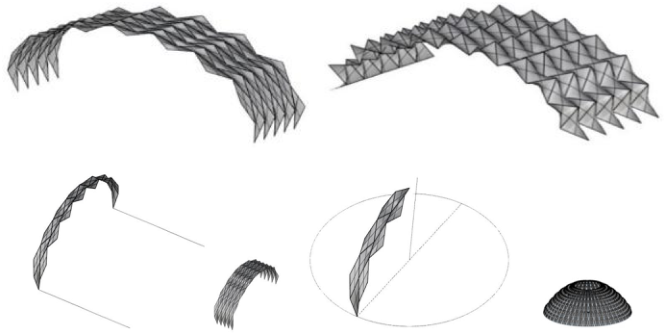
This project has as design references the pavilion IBM in 1984 (Fig. 1) which is a partnership between the architect Renzo Piano and the well-known firm of structural projects Ove Arup and Partners; The investigation produ- ced by Jaap Baselmans (Fig. 2) in the Academy of Architecture and Urban Design of Rotterdam; Emilio Perez Pinero (1935–1972) works, he produ- ces an amazing investigation, through the development of a huge quantity of foldable structures (Figs. 3, 4). The list of his inventions may be very enlighte- ning: “scissors structures” formed by a straight bars modules beam; “scissors
Figure 1,2: Module of the IBM pavilion (on line http://www.rpbw.com/project/22/ibm- travelling-pavillion) Membrane Frame Kinetics (On line http://www.achimmenges.net /?p = 4429).
Figure 3,4: Scissors Kinetics Frames (On line http://3.bp.blogspot.com/-v7-7M-IpBoI/T wbS0-1kwrI/AAAAAAAACV0/8OSS6PABymk/s1600/0\protect$\relax+$star1\protect$\ relax+$00\protect$\relax+$completo_Page_17.jp).
The innovative character of the present system, results of the fusion between articulated structures with tensioned structures; therefore, is not possible to support this research only through a simple literature review. To understand and validate the Flexible Modular System, we need to adopt an interventionist methodology, so, this investigation has to be considered as action research investigation, that mixed moments of theoretical research with an empirical practical work.
The development of this system will be done by mixing digital modeling tools and physical model. With this approach, is possible to understand and evaluate the behavior of the surface, and improve its design.
The physical revelation of curved and double curvature surfaces presents constructive difficulties that the present technological condition does not answer with efficiency. This formal universe has not been able to consistently evolve from the manual technological condition that is in the genesis of its origin to a more advanced condition. The construction systems that reflect a mechanical technological condition were refined to materialize linear and flat formal universes, presenting great difficulty in the materialization of curved architectural artefacts. The advent of a digital technological condition allows to articulate the curved surfaces in their conceptual and constructive
Modular Fabric Tensile Structures 73
moments allowing its materialization, these forms have a high structural potential and lower impacts (Diogo, 2019).
The architectural engineering and construction industry consumes, around 40% of natural resources and 4 0% of the produced energy, emits 40% greenhouse gases and produce 40% of humans wastes (EC, 2018).
Therefore we need to change the structural design paradigm leaving stru- ctural systems that use the strength of materials to obtain equilibrium, in sated of this we should use embracing an equilibrium generated by the shape geometry, unifying Statics, Ethics, Esthetics in the design of shapes and spaces, improving the shape expressivity and the visual freshness of the space.
The development of forms with structural principles - Structural Morpho- genesis presents a tectonic obbise in its physical manifestation which should be filled by the research in new constructive systems able to materialize structural shapes.
SYSTEM GENERIC DESCRIPTION This system aims to be a modular system, fabricated in mass production pro- cess, to reach a scale economy and a production’s rationalization lowers all the production costs. The constructive process is structurally based on active vector system with the active system surface (Engel, 1981). It combines simul- taneously a great adaptability, flexibility and portability, generating different shapes and surfaces.
The system simultaneously explores the concepts of membrane and arti- culated structures, using textile’s elastic properties of the fabric to define the shapes, making possible the generation of a wide range of geometries. Therefore the same basic module is the starting point to achive constructive adaptability and dimensional variation solutions.
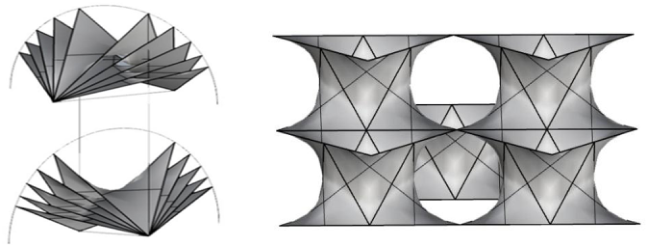
This modular solution is based on an extensible and additive process, crea- ting a tridimensional grid. It is possible to enlarge or reduce the surface, with equal length bars, just by increasing modules’ range. The simple induction of tensions in the membranes generates different angular spacing, resulting in to different curvatures, spams and surface shapes (Fig. 5) .
Reducing the consumption of materials and structures intrinsic to weight, allowed the structure to be re-used also reducing its costs, in a considerable way (Fuller, 1999). System’s reshapebility and portability is a conseque- nce of a significant reduction of its final volume, this result of material lightness used to build it and geometric proprieties that allows mechanical operability, by the articulation of the several parts. This is an advan- tage and a very important feature to consider in this kind of construction process.
The cover element is integrated into the building system since there is no differentiation between the articulated support elements and roof membrane system, that is innovative when compared to some traditional systems, like the geodesic domes designed by Richard Buckminster Fuller or Emilio Perez Pinero a structural reference.
Figure 5: Articulation and expansion of constructive modulo (the author).
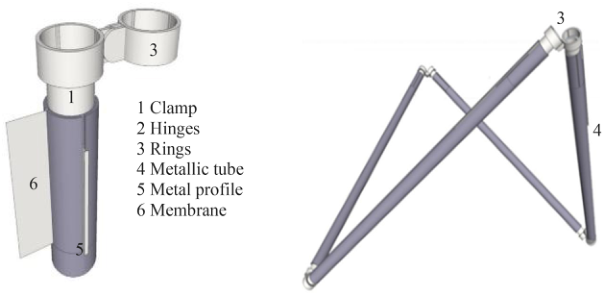
SURFACE AND SUPPORT SYSTEM The system is based on a module of four bars, inter-connected by hin- ges attached to clamps; resulting preferably in identical modular elements (Ferrater, 2006), this way it becomes easier to assemble all the parts of the. Joints brackets not only do the metric regulation of the system, but also are responsible for its structural performance; they rigidify the surface acting as a truss knots. In light steel bars are made several cuts to insert the membrane and also imbibe a metal profile that seal the modules to water.
The geometric properties of the surfaces give an answer to several archite- ctonic aspects, it is possible to avoid sophisticated articulation using simple articulations between 0° and 180° (Fig. 7). Hinges move only in one dire- ction and are responsible for dimensional control of the textile membrane, these membranes are crucial elements for system’s metric. Its formal flexi- bility depends mainly on the elastic properties of the membrane. It is also possible to take advantage of other intrinsic properties of the membrane, such as permeability to light and its acoustics behavior and thermic control.
The domain of geometry is essential to the conception of structural sha- pes; it is the shape control that allows us to obtain structure optimization. Understanding the “path of the forces” from the top the ground to manage the shape, embedding in the design constructive and structural performance of the shapes (Morais, 1997), “geometric energy systems” that actually con- sists in the development of the geometric principles of the physical structures and the flow of the forces that run in to it (Kubo, 2000).
The elements involved in the surface interact to generate an structural equalization (Delanda, 2002). interaction are constants in these shapes, therefore loads are analyzed by which node (Lewis, 2003). Multilayer stru- ctural surface equilibrium could be achieved by a none equalization elements (Ahlquist, 2015).
The structural behavior of these shapes produce important and undesirable horizontal impulse, being a great concern to the designers, in order to avoid its negative consequences this system converts the loads of the self weights
Modular Fabric Tensile Structures 75
Figure 6: Dimensional variation of constructive module, Multi layers surfaces (the author).Figure 7: Articulation and expansion of constructive modulus (the author).
into the need stress to shape the surface. Membranes need normal tension to define their form, so the horizontal impulse which is the result of structural load is converted in this desirable atomic internal work. The membranes will work as elastic band defining the span and avoiding horizontal impulse. The elasticity of the membranes and the tensions induced and transmitted to the frame contribute to shape it. A constant tension is maintained on the surface, during the replacement of the support points; this issue implies the existence of a system of an active full-scale form (Hensel, 2006). These very sophisti- cated and advanced types of structures are designed to be open or closed, working as a closed system defining the wanted shapes.
This structural conception makes this structural and constructive system particular efficient to deal with different spans, with the same number of pieces, it is possible to manage the different curvatures, as well different longitudinal dimension. The tension induced in the membrane generates dif- ferent modules configurations and subsequently the surface gets other formal configuration and plastic expression.
The performance of the surface depends of the module’s configuration, the- refore the module’s geometry should be adapted (Fig. 6), in order to better
obtain the best functional performance of thermic, acoustic efficiency or draining the water issues (Berger, 1996).
Geometric configuration of the module affects the way the surface deals with water, it shouldn’t have great concavities or depression, a very organic surfaces or shapes produce an undesirable accumulation of water, thus risking the production of overloads in the structure.
It is possible to create shape grammars to produce a large range of sur- faces, rotating the modules in torn of an axis or a generatrix is possible to generate domes or vaults surfaces, by the association of hyperbolic parabo- loids formalized by metal bars. This shape universe is particular efficient to build with large spams.
POSSIBLE USES This building system has a high potential in urban context; it may serve as a climate moderator, minimizing environmental impacts of weather conditions and sun exposure, allowing the use of public spaces in a friendlier manner, wind and rain can also be controlled its use.
These surfaces besides the its plastic potentialities, lightness and porta- bility, it is possible use it easily to the creation of pavilion and exhibiti- ons stands, temporary shelters able to respond to calamity or emergencies situation.
The modular system is able to be applied in rehabilitation process interact with preexisting spaces and buildings, answering to a range of needs, main- taining the same geometric principles, minimizing however the structural impacts because the system is a self-support one and its lightness, producing a smaller structural demand.
The geometric principles that inform the generated shapes with the use of membrane as a constitutive element makes it possible its use as acoustic and thermic controller, to achieve that, is overlapping the several components of the flexible modular system, generating multilayered surfaces. These kinds of solution are also able to produce different spans and shapes. Multilayered surface concavities formalize air chambers, its air flux could be controlled to produce convections, controlling the temperature. If the air is enclosed in a chamber, the spatial membrane will produce a thermic cut. Equally it is possible to shape the surface to answer to the acoustic situations.
These geometric constructions are not a simple surface, they could be even be classified as topography, according to Sean Ahlquist. This new geometrical approach allows another kind of solutions, answering to thermic and acoustic requirements. The flexible nature of the modular system can support the creative process of designers.
The development of this system will be done by mixing technological tools and physical model. With this approach, is possible to understand and evaluate the behavior of the surface, and improve its design.
The rigid character of its construction modularity does not limit their space and formal adaptability, through the dimensional variation of con- structive modules. This modular lightweight system can has also responsive capabilities, being able to reshape to answer the above referred requirements.
Modular Fabric Tensile Structures 77
CONCLUSION
This flexible modular system presents a considerable number of advantages, when compared to traditional systems and articulated space trusses.
The proposed system reveals all its originality and efficiency in its stru- ctural conception, converting the horizontal impulses generated by the own weight of the structure into the tension necessary to generate the active tensile structures (Frei, Otto, 1973).
The holistic nature of the system and its operation mode allows the system to generate a formal and functional universe of great diversity. “dynamic” formal character, capable of changing the quantitative and qualitative aspects (Otto, 1995), physical or plastic properties management are done simply by applying tension with different intensities.
The model system proposed has in its generative conception a set of conce- ptual fundamentals intended to respond in a way that is natural dealing with different dimensional requirements.
Either material along with the whole set of geometric principles imbibed in the modular system, present multiple possibilities of application to vari- ous situations and programmatic functions. dimensional flexibility presents a possibility to take advantage of the plasticity of the several elements that integrate the system.
It is possible to generate the adoption of these occlusion surfaces into environmental controllers, and in acoustic and thermic moderators.
This system presents another innovative feature, the imbibed membrane that acts as a waterproofing element, interacts with the several bars that define the constructive module the surface generated and the system itself.
This project consists in an opportunity to mix several fields of knowledge, in order to support the development of the work.
The structural morphogenesis knowledge sustains the approach to the shape behavior: the way of understanding the several structural phenomena that support not only its modulation, optimizing the structural performance, constructive definition and sustainability impacts.
The parametric design and parametric tool could support the development of the shape, by its parametrization we can generate a large range and different kind of solutions.
The modular system can also work as a way to express creativity of the designers, and a way for the analysis and manifestation of values and categories such as harmony and proportion, synthetizing static, ethics, aesthetics.
ACKNOWLEDGMENT
This work is supported by CIAUD Investigation Center of Architecture Urbanism And Design and by FCT. Foundation For Science and Technology.
REFERENCES
Ahlquist, Sean (2015) Membrane Morphologies: Heterogeneous Forces and Articulated Material Form. Architectural Design, Volume 85, pp. 80–85. Berger, H. ( 1996) Light structures structures of light: the art and engineering of
tensile architecture. Birkhäuser, cop, Basel, pp. 40–49. Delanda, Manuel, Intensive Science &Vírtual Philasophy, Continuum, New York, 2002, p. 15. Diogo, A. Basto (2019) Structural Phenomenology Of The Double Curvature In The
Process Of Architectural Ideation - an operational paradigm for the management of structural morphogenesis, Lisbon School Of Architecture of the University of Lisbon. Engel, Heino (1981) Sistemas Estruturais, Hemus Editora Limitada, Brasil, pp. 178–256. Escrig, F., J.P. Valcarcel (1993) Geometry of Expandable Space Structures Website: https://journals.sagepub.com/doi/10.1177/0266351193008001-208. European Commission (2018) Construction and Demolition Waste (CDW) http://ec.europa.eu/environment/waste/construction_demolition.htm Ferrater, Carlos (2006) Sincronizar la Geometría, Actar, Barcelona, p. 28. Fuller, R.Buckminster (1999) The art of designing Science, Lars Muller Publisher,
Zurich, p. 16. Hensel, Michael, Menges, Achim (2006) Morpho-Ecologies, Dexter Graphics, Londres, p. 78. Kubo, Michael e Salazar, Jaime (2000) Una breve historia da era de la informação,
Verb Matters, Actar, Barcelona, p. 6. Lewis, WJ, Ienslo, Sirucfuresi (2003) Form and Behaviaur, Thomas TeÌford, London, pp. 12–15. Morais, António José (1997) A Morfologia Das Estruturas Na concepção Arquite-
ctónica, Edição Ecosoluções, Lda, Lisboa, p. 15–16. Otto, Frei (1973) Estructuras, estudios y trabajos sobre construcción ligera. Gustavo Gili, Barcelona, pp. 138–150. Otto, Frei, Rasch, B.(1995) Finding form: towards an architecture of the minimal,
Edition Axel Menges, Munich: pp. 145–150.
LISTED IN THE AHFE DIGITAL BOOKSTORE CATALOGUE
Explore the complete digital volume
Human Factors in Architecture, Sustainable Urban Planning and Infrastructure
Read this individual research paper free through the original publisher, or explore the full digital proceedings book.
ISBN 978-1-958651-34-6
Explore this ISBN in the AHFE Bookstore ↗Listed in the July 2026 bookstore catalogue; search by ISBN to confirm current availability · Digital book purchase optional