Seung-Kweon Hong (2022). Operator function model to analyze ship accidents related to navigation aids. In: Human Factors in Transportation. AHFE Open Access, vol. 60, pp. 746–751. https://doi.org/10.54941/ahfe1002513
A marine Aids of Navigation (AtoN) is a man-made object in waterways used by mariners to determine their ship's location or a safe route. They act like traffic signs on roads used to reduce the risk of traffic accidents. However, traffic signs can't do their job if you can't recognize them, don't understand their meaning, or violate them. In this study, ship accidents caused by the malfunction of navigation aids were investigated. First, maritime officers’ work in the ship bridge work was analyzed using the Operator Function Model (OFM), and among all the functions derived from the analysis, only the functions related to aids to navigation were selected. Using the selected functions as a classification system for ship accidents, recent ship accidents in the Korean coast were analyzed. The ship accident analysis was conducted using written verdicts of the Korean Maritime Safety Tribunal. Cases of ship accidents were confirmed in most of the selected functions. The results of this study can be used for safety education of maritime officers and the deployment, maintenance, and design of AtoN.
A maritime navigation aid (AtoN) is any device outside a ship specifically designed to assist a navigator in determining their location or safe route, or to warn of hazards or obstacles to navigation. Navigational aids include buoys, data signs, lights, lighthouses, radio beacons, fog signals, indications, and other devices used to provide indications of underwater information. They act like traffic signs on roads used to reduce the risk of traffic accidents.
Traffic signs play a very important role in conveying operational infor- mation to users. Traffic signs are effective only when they are installed in the right places and designed to be easily understood by users (Gholam-ali and Ahmadiyan, 2014). Many studies related to traffic signs on roads have been conducted in various aspects. These studies must have been carried out from various angles, as it can cause traffic accidents if traffic signs are not accurately recognized or incorrectly designed (Ezeibe, et al., 2019, Hussein, 2013). Road traffic sign–related studies includes sign visibility (Kline, et al., 1990), sign luminance (Graham, et al., 1997), sign legibility (Paniati, 1988), sign comprehensibility (Madani, 2000, Al-Madani, and Al-Janahi, 2002),
Operator Function Model to Analyze Ship Accidents Related to Navigation Aids 747
effects of age (Chao, et al., 2013, Dewar, et al., 1994) and drivers’ cognitive workload (Lyu et al., 2017).
On the other hand, a representative the AtoN that has been used at sea for a very long time is a lighthouse. Lighthouses were already systematized at least in ancient Egypt. However, despite such a long history, ergonomic rese- arch on marine traffic signs is lacking compared to research on road traffic signs. This is probably because the functions of land traffic signs and mari- time traffic signs are different. Unlike land traffic signs, modern ships can navigate without the AtoN due to advances in navigation equipment such as ARPA (Automatic Radar Plotting Aid) radar, ECDIS (Electronic Chart Display and Information System) and AIS (Automatic Identification System). The AtoNs have become a means of re-checking navigation routes, hazards, or turning points. Additionally, the AtoNs have limited use, primarily in ports and coastal areas. However, even now, small fishing boats are completely dependent on the aids of navigation. In addition, with the advent of auto- nomous ships, it is expected to expand the existing functions by supporting autonomous ships (Baek et al., 2019).
This study intends to analyze ship accidents related toAtoN. The users of the AtoN are marine officers who operate the ships. There may be various human errors, such as when the officers do not identify the AtoN, misun- derstand one AtoN as another and lack of knowledge about the AtoN. Sometimes AtoNs are misplaced and officers may make mistakes. Mista- kes made by the officers with the AtoN can lead to ship accidents. In this study, the work related to the AtoN performed by marine officers on a bridge is analyzed using operator function model (OFM), and it is intended to investigate whether possible human errors lead to actual ship accidents. By analyzing the cases of ship accidents that appeared in written verdicts of the Korean Maritime Safety Tribunal, ship accidents related to the AtoN were investigated.
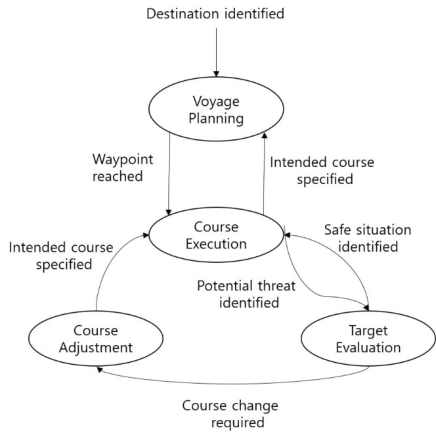
OPERATOR FUNCTION MODEL FOR MARITIME OFFICERS’ TASKS RELATED TO AIDS TO NAVIGATION The operator function model (OFM) describes the role of an operator in a complex system (Thurman, et al., 1998). OFM provides a framework that can give answers to questions such as “what kind of information do wor- kers need?”, “how should the information be combined?”, and “when is the information presented?” (Mitchell, et al., 1986). OFM uses discrete math to characterize worker activity as a network of arcuate nodes. Each node represents an operator activity. Arcs connecting nodes represent triggers or transition conditions that initiate, end, or sequence activities (Mitchell, et al., 1986). These triggers can occur outside the system or represent dynamic relationships between activities. State transitions can be non-deterministic, so they can represent operator choice when choosing an activity to pursue. Figure 1 shows the high-level functions of OFM for ship navigation propo- sed by Lee and Sanquist (2000). In their model, the high-level functions of ship navigation consist of four activities: voyage planning, course execution,
748 Hong
Figure 1: High-level OFM for ship navigation proposed by Lee and Sanquist (2000).Table 1. Failure modes related to AtoN.
Table available in the original PDF paper.
Failure Modes related to AtoN
High-level Functions
Related Low-level Functions Voyage Planning Passage Planning Voyage planning errors because the AtoN cannot be identified or misinterpreted. Target Evaluation
Identify Target Target identification error that does not identify the AtoN related to low-depth areas, rocks, and wrecks. Interpret the Target Errors not knowing its meaning or judging it as another AtoN, after identifying the AtoN. Course Adjustment
Apply Appropriate Rules of the Road
After identifying the AtoN, the error of navigating without properly applying the relevant navigation rules. Course Execution
Determine Position Errors in recognizing the AtoN incorrectly when checking the position of one’s own ship using the AtoN.
target evaluation, and course adjustment. Each activity at a higher level is in turn made up of several sub-functions.
Lee and Sanquist (2000) proposed an OFM of ship navigation to evaluate the cognitive demands of technological innovations in ship navigation. This study proposes an OFM in order to analyze human errors caused by the incorrect use of the AtoN in ship navigation. Table 1 shows the failure modes related to AtoN derived after analyzing the work performed by Maritime Offiers in the navigation process. Each failure mode has the potential to lead to a ship accident.
Operator Function Model to Analyze Ship Accidents Related to Navigation Aids 749
SHIP ACCIDENTS REALTED THE AIDS TO NAVIGATION In order to investigate the cases of ship accidents related to the AtoN, ship accidents that appeared in written verdicts of the Korea Maritime Tribunal for the past 10 years were analyzed. Ship accidents in the written verdicts was about 9.5% of a total of ship accidents that occur in the coast of Korea.
As voyage planning error cases, there were several voyage plans that did not consider the shipwreck and the construction area, and there were also cases where the low depth and reef in the vicinity of AtoN were not properly checked. For an example, the ship accident (Kumho Ferry No. 3) that ran aground at 14:23 on September 23, 2015 occurred due to insufficient infor- mation gathering in advance on the rocky area along the route. Instead of the safe southern route of Seorae-Yeo (south direction sign), the relatively dangerous northern route was selected and operated. There was a southern direction sign, so it was necessary to navigate to the south side, where the navigable water area was wide and safe. Northern side had to be avoided as much as possible.
Secondly, there were cases in which it was not possible to identify the AtoN indicating danger due to officers’ drunkenness, neglect of vigilance, and inter- ference from surrounding lights. In addition, despite the identification of the navigational signs, errors were found in which they could not properly inter- pret or understand the meaning. One example is the ship’s (Bonchallenger) contact accident that occurred at 00:17 on January 27, 2020. The captain of the ship knew that the construction was going on around the port, and the lights were installed at the construction site, and the captain also reco- gnized the lights during the ship navigation. However, he vaguely recognized the light as the light of a fishing net and did not actively take action to avoid contact accidents.
An example of a ship accident related to course adjustment is the collision between a cargo ship (Hyundai Dangjin) and a towed barge (Jinyang No 5) of a tugboat that occurred on March 14, 2012, around 23:14. This is a ship acci- dent caused by not complying with the traffic rules according to the AtoN. Light buoys were installed sequentially along the recommended route. When navigating close to the recommended route, ships must navigate to the right of the recommended route. However, the cargo ship (Hyundai Dangjin) did not comply with this rule and collided with the towed barge.
Fourthly, the stranded accident of the ship (Taeyoung Sky) which occurred at around 08:35 on July 12, 2010, was an accident that was caused by misjud- ging the position of the ship by misrecognizing the AtoN. The waypoint on the navigation map was the second lighted buoy, but the first lighted buoy was recognized as the second lighted buoy. After passing the first light buoy on the port side, the bow course was changed to 326 degrees at a position less than 1.6 miles from the point where it should be changed. This leaded to the ship to run aground.
750 Hong
CONCLUSION
AtoN has been used to improve of maritime navigational safety. However, ergonomic research on marine traffic signs is insufficient compared to resea- rch on road traffic signs. In this study, the tasks related to the AtoN performed by marine officers on a bridge was analyzed using operator function model (OFM) and ship accidents related to the AtoN were investigated. It was con- firmed that all failure modes discovered through OFM lead to actual ship accidents. The OFM presented in this study did not present the low-level functions in detail. A more detailed OFM model is needed in future studies.
ACKNOWLEDGMENT
This research was supported by Basic Science Research Program through the National Research Foundation of Korea (NRF) funded by the Ministry of Education (Grant number #NRF-2018R1D1A1B07048479).
REFERENCES
Al-Madani, H. and Al-Janahi, A.-R. (2002) “Assessment of drivers’ comprehension of traffic signs based on their traffic, personal and social characteristics”, Transportation research part F: Traffic psychology and behaviour, 5(1), pp. 63–76. Baek, Y.S., Kim, G.W., Gang, H.G., Jeong, S.S. and Kim H.G. (2019) ‘The role
and development direction of navigational aids according to technological deve- lopment’, in Proceedings of the Korean Institute of Navigation and Port Research Conference. Korean Institute of Navigation and Port Research, pp. 109–111. Chao, C.-W., Huang, C.H. and Tsai, T. (2013) “The Age Effects of Traffic Signs on Visual Performance”, Life Science Journal, 10(1), pp. 297–302. Dewar, R.E., Kline, D.W. and Swanson, H.A. (1994) “Age differences in comprehen-
sion of traffic sign symbols”, Transportation Research Record, pp. 1–1. Ezeibe, C., Ilob, C., Oguonuc, C., Alid, A., Abadaa, I., Ezeibee, E., Oguonuf, C., Abadag, F., Izuekec, E., and Agboa, H. (2019) “‘he impact of traffic sign deficit on road traffic accidents in Nigeria”, International journal of injury control and safety promotion, 26(1), pp. 3–11. Gholam-ali, B., Ahmadiyan, S. (2014) “Optimal traffic signage can be accessed qui-
ckly by using a demonstration service for drivers”, 13th International Conference on Transport and Traffic Engineering, Tehran, Vice-President and Transport and Traffic Organization. Graham, J. R., Fazal A. and King L. E. (1997) “Minimum luminance of highway signs required by older drivers”, Transportation Research Record 1573: pp. 91–98. Hussein, H.A. (2013) “The role of street traffic signs in reducing road accidents”,
in First International Symposium on Urban Development: Koya as a Case Study. WIT Press. Kline, T. J. B., Ghali, L.M. and Kline, D.W. (1990) “Visibility distance of highway signs among young, middle-aged, and older observers icons are better than text”, Human Factors 32: pp. 609–619. Lee, J.D. and Sanquist, T.F. (2000) ‘Augmenting the operator function model with
cognitive operations: Assessing the cognitive demands of technological innovation in ship navigation’, IEEE Transactions on Systems, Man, and Cybernetics-Part A: Systems and Humans, 30(3), pp. 273–285.
Operator Function Model to Analyze Ship Accidents Related to Navigation Aids 751
Lyu, N., Xie, L., Wu, C., Fu, Q., Deng, C., (2017) “Driver’s cognitive workload and driving performance under traffic sign information exposure in complex envi- ronments: A case study of the highways in China”,. International journal of environmental research and public health 14, 203. Madani, H. AI. (2000) “Influence of drivers’comprehension of posted signs on their
safety related characteristics”, Accident Analysis and Prevention 32: pp. 575–581. Mitchell, C.M. and Miller, R.A. (1986) ‘A discrete control model of operator function: A methodology for information display design’, IEEE Transactions on Systems, Man, and Cybernetics, 16(3), pp. 343–357. Paniati, J.F. (1988) ‘Legibility and comprehension of traffic sign symbols’, in Procee-
dings of the Human Factors Society Annual Meeting. SAGE Publications Sage CA: Los Angeles, CA, pp. 568–572. Thurman, D.A., Chappell, A.R. and Mitchell, C.M. (1998) ‘An enhanced architecture for OFMspert: A domain-independent system for intent inferencing’, in SMC’98 Conference Proceedings. 1998 IEEE International Conference on Systems, Man, and Cybernetics (Cat. No. 98CH36218). IEEE, pp. 955–960.
LISTED IN THE AHFE DIGITAL BOOKSTORE CATALOGUE
Explore the complete digital volume
Human Factors in Transportation
Read this individual research paper free through the original publisher, or explore the full digital proceedings book.
ISBN 978-1-958651-36-0
Explore this ISBN in the AHFE Bookstore ↗Listed in the July 2026 bookstore catalogue; search by ISBN to confirm current availability · Digital book purchase optional