Hiromi Yamaguchi, Yasunobu Ito (2022). Changes in the Relationship between Medical Professionals Mediated by an Information Tool: An Ethnography of Team Medicine in Japan. In: The Human Side of Service Engineering. AHFE Open Access, vol. 62, pp. 126–133. https://doi.org/10.54941/ahfe1002550
Comparing the percentage of the total population aged 65 and over in 2021, Japan (29.1%) is the world's highest super-aged society. It has been predicted for some time that the existing healthcare system would not be able to cope with the increasing demand for healthcare. One of the government's proposals to restructure the healthcare system is to make greater use of team medicine.The purpose of this paper is to clarify what has changed through team medicine mediated by information tools. The study site was a medium-sized hospital in a regional city in Japan. The research method used was ethnography with a focus on participant observation. The study period was eight years, from 2012 to 2020. One of the authors conducted the investigation while working at the hospital as a hospital staff. In the 2012 revision of medical fees, the Ministry of Health, Labor and Welfare (MHLW) added the new item of "guidance and management for prevention of dialysis (through team medicine)" to prevent serious complications in diabetic patients.The new reimbursement system only set out the conditions for calculation and left the operation of the system to the hospitals themselves. Hospitals were initially confused, and medical professionals did not know what to do. However, the introduction of the MAP information tool, which visualizes and lists the patients' treatment status, has made it possible for the health professionals to work proactively. Through the mediation of MAP, inadequate treatment of patients (e.g., lack of necessary tests, inadequate selection of appropriate drugs, etc.) became clear. Under such circumstances, not only nurses and pharmacists but also medical secretaries have been transformed into people who are relied upon by doctors. Such a change was born from their attitude that they did not accept team medicine, which was mainly based on hierarchy and division of labor among medical professionals, and that they were willing to take on the work of other professions. In other words, each specialized profession filled in the gaps in patient care that tended to arise by overlapping their respective duties. In addition, the relationship between doctors and other professionals has changed from a hierarchical relationship to a mutual relationship in which problems are raised.In conclusion, it was found that the mediation of information tools and the overlapping of work with other professions with one's own professional area did not reduce the organizational capacity of the team and promoted positive changes in professional relationships.
The purpose of this paper is to clarify how “team medicine”has changed with the introduction of an information tool through an ethnographic study of medical practice with diabetic patients. In Japan’s medical community, “team medicine” (collaborating with different medical professionals in providing healthcare) had been superficially and optimistically portrayed as “collabo- rative” with emphasis on “equality” by the government publicity. It was followed by deregulation to expand the work scope of each professional. However, the reality r of collaboration in team medicine was not paid much attention (MHLW, 2012). Against this backdrop, team medicine is attracting rising attention due to the shortage of physicians and nurses in the medical field in Japan. In 2021, the ratio between the elderly population of age 65 and above and the total population in Japan holds 29.1%, the highest in the world and Japan has become a super-aging society. It has been long predi- cted that the demand for medical care will increase and the existing medical system will not be able to keep up with it. One of the government’s plans is to rebuild the medical system to further utilize team medicine. However, many
Changes in the Relationship between Medical Professionals Mediated 127
issues have been indicated that need to be solved in order to realize this. In the medical field, it is difficult to say that team medicine as defined by the Ministry of Health, Labor and Welfare is “functioning”. This is because the authority is concentrated in the hands of physicians, and there is a clear hierarchy with physicians at the top (D’Amour, 2005). The Japanese law sti- pulates that all professions other than physicians require a physician’s order to perform their duties. Nevertheless, in the “2012 revision of the medical fee system”, as one of the measures to reduce the burden on hospital physici- ans and other medical professionals, the government introduced the “medical fee calculations for Guidance and Management to Prevent Dialysis in diabe- tes patients (MFPD)” which require multidisciplinary medical professionals to work together. Against this backdrop is the fact that dialysis is taking a toll on medical costs and the biggest factor in the introduction of dialysis was diabetic nephropathy. Therefore, the government hastily institutionali- zed the system with an aim to improve the quality of medical care and control medical costs; still leaving the inherent problems in team medicine “unatten- ded”. The “guidance and management to prevent dialysis in diabetes patients (GMPD)” was introduced under the legal system with an imbalance in the distribution of authority and responsibility between physicians and medical professionals.
By the way, information sharing through electronic medical records is essential to improve the quality of medical care. (Cebul et al., 2011). Accor- ding to Blumenthal, not only is implementation of electronic medical records necessary, it is also vital that physicians and hospital staff use it efficien- tly. In doing so, they face many issues which depend more or less on the pay incentives. However, if the demand level is too high, many physicians and hospital staff may resist and forgo incentives, only to accept the penal- ties (Blumenthal, 2009). In addition, with the goal of improving the quality and efficiency of medical care, the discussion is underway in how healthcare professionals can utilize electronic data in order to integrate patient data for supporting clinical decision-making. (Gagalova et al., 2020, Cho et al., 2010, Frontoni et al., 2020). The authors demonstrated that a medical informa- tion tool would be useful for improving the effectiveness of interprofessional work teams in the treatment of chronic diseases (Yamaguchi and Ito, 2014). The study focuses on the process of medical professional’s proactive invo- lvement in medical treatment through “collaboration1” with an information tool. Through this process, it elaborates on the changes in the relationships among medical professionals. As far as we know, there is hardly any conventi- onal research on the collaborative process of an information tool and medical professionals’ proactive involvement in medical practice, so we believe this study has novelty.
1The idea of collaboration between “humans”and “non-humans”(including tools) was suggested by Actor Network Theory (ANT), which considers humans and non-humans as equivalent actors and analyzes phenomena from their interactions (Latour, 2014).
128 Yamaguchi and Ito
METHOD
The study site was Hospital Y, a medium-sized hospital in a regional city in Japan. The study period was eight years, from 2012 to 2020. The research method used was ethnography with a focus on participant observation. How- ever, it is somewhat different from conventional ethnography conducted by anthropologists. It was an action research type ethnography in which one of the authors conducted the survey while working at hospital Y as a hospi- tal specialist. In 2012, hospital Y implemented the new revision of medical fees for management and prevention of dialysis in diabetes patients and then introduced the information tool for managing diabetes patients, dub- bed the “Disease Management MAP”(hereinafter abbreviated as MAP). One of the authors, a hospital specialist, was involved in introducing the disease management tool and promoted multidisciplinary collaboration in the hospi- tal operations while at the same time observing it, which was an irregular ethnographic method.
RESULTS AND DISCUSSION
The MAP was originally conceived as a medical information tool for regional medical cooperation. It was introduced in Hospital Y to improve the quality of hospital care as a useful tool for “staging activities to take place among multiple professions” and “building a safety net” at the discretion of Vice Director Z. He chanced to hear a lecture given by the City Medical Associa- tion on February 17, 2012. After hearing the lecture, he immediately decided to introduce this MAP. Vice Director Z, a cardiologist, gave the following reasons for his decision. “In the daily practice of physicians, especially in outpatient consultation, there is no mutual consultation, and within the time (constraint) of one-on-one interaction with the person in front of you (pati- ent), there is no one to check what is being done or not being done. The only person who can check what is being done or not is the physician… (From interview transcript, January 8, 2015)”. He was concerned that there were oversights in the outpatient care of diabetic patients. He decided to intro- duce MAP as a solution to this problem. He then took a top-down approach to gather project members from across the organization and launched the Diabetes Disease Management Project in April 2012. The project members ranged from physicians, nurses, registered dieticians, pharmacists, clinical laboratory technicians, radiology technicians, medical affairs section staff, system engineers, and general affairs section staff, with one of the authors participating in the project; the project started with 12 members.
Progress Since the Implementation of MAP When Hospital Y introduced MAP to calculate the new MFPD reimburse- ment, there were many issues to be addressed. They were as follows:
1) At first, there was no diabetologist at Hospital Y. Therefore, the priority was placed on the prevention and early detection of cardiovascular disease as a complication rather than dialysis prevention.
2) The urine albumin quantitative test for the selection of patients for GMPD had not been run and needed to be tested as soon as possible.
Changes in the Relationship between Medical Professionals Mediated 129
3) As MAP was originally a tool for promoting regional collaboration, only the minimum number of test items were set up, which was insufficient for hospital-use and required customizing items.
4) The lack of leadership skills and initiative in approaching the pati- ents was seen in the nurses and registered dietitians in charge of guiding the severely diabetic patients.
At the project meeting, members discussed the new items to be imported from the electronic medical records into MAP. As a result, the following items were added to the MAP: blood test results, names of medications and their types and doses, guidance history, and booking date of the next consultation appointment. The MAP is linked to the electronic medical records used in the hospital and is updated automatically every month. Originally, the MAP was a regional collaboration system, but with this customization, the MAP of Hospital Y has been transformed into a disease management system. In other words, the MAP became a disease management system that encompassed the management of the hospital’s diabetic population and the medical informa- tion of individual patients. Later, one of the authors assumed the managerial role for the MAP at Hospital Y.
New Collaboration Brought About by Information Tool The MAP contains the registry of all diabetes patients the physicians are in charge of, and patient information is updated monthly. The author created a monthly booking list of diabetic patients who are assumed to need guidance support and distributed the list to the project members.
To start the GMPD program, the first step of GMPD is to have the neces- sary blood and urine tests done. The physician will make a judgment based on the result and order “GMPD guidance”, as necessary. The mandatory tests are a quantitative urinary albumin (protein) test and a blood test, HbA1c. A positive urine protein in diabetic patients was not only due to diabetic nephropathy. There are many causes for positive urine protein, including hypertension, infection, and obesity. Therefore, physicians do not immedi- ately order GMPD program even if the stage of nephropathy has worsened based only on the results of these legally required tests. In addition, there are patients unwilling to participate in the program because of the cost bur- den, time constraints or they might just feel troublesome to go through it. The second step of GMPD is when the patient agrees to undergo GMPD program. Patients are not only diabetic, but may also have cancer or demen- tia problems. Then, when the patient’s renal function stabilizes and worsens again, the nurse informs the physician of the need for guidance interventions and resumes GMPD program. The physician is willing to proceed with the medical treatment, and this is the third step of GMPD. The patient accepts the examination and consents to the GMPD program.
Changes in nurses. The nurse identified the relevant patient from the MAP and marked off with a unique marking (■) on the booking list of diabetic patients. In this way, the physician knows which of the patients need guidance and can give orders for “the needed GMPD guidance”.
130 Yamaguchi and Ito
After the introduction of MAP, nurses and registered dietitians began to discuss with physicians, patients, and their families in the consultation room to come up with strategies. The one-way relationship of waiting for the phy- sician’s instructions and then providing guidance has changed to a reciprocal relationship in which the nurses and dietitians refer to the MAP information and proactively approach patients in need of guidance. This clearly shows that the relationship between physicians, nurses, and co-medical staff has changed. The reason why nurses could not actively take the initiative to teach GMPD was that it would increase the burden of medical service fees for patients, and nurses could not determine for themselves whether the gui- dance they were providing was worth reimbursing. It can be said that the introduction of MAP, which encompasses and visualizes medical informa- tion, created the need for guidance. In other words, the introduction of MAP means that nurses are now able to actively provide guidance on GMPD. The nurses had a different way to guide diabetic patients compared with the phy- sicians who altered the prescription medicine based on the test results of the patient. Nurses guided diabetic patients in detail on how patients can recuperate. The guidance of GMPD by nurses was not only about direct neph- ropathy prevention. As nurse A said, “When endocrinology patients come in, all I see is hemoglobin A1c. (omission) There was a part of me that was looking at it from the same perspective as the endocrinologist,”she said, refle- cting on how she was caught up in the numbers of the test results just like the physicians (from the interview article on March 16, 2016). However, once the numbers were visualized by MAP, the nurses began to ask patients speci- fically on the precaution points to help diabetic patients live with controlled blood sugar levels. For example, whether the patients were not injecting in the same body area repeatedly, how they set up a blood glucose self-monitoring device, how to store excess insulin, what to do when patients forgot to take their medication. Occasionally, checking with physicians where needed, the nurses began to think together with the patient. With the introduction of MAP, nurses began to reflect on the guidance they should give as nurses. It is possible to say that the introduction of MAP has allowed them to think proactively about the guidance they should provide.
Changes in pharmacists. Pharmacists have a role to alert physicians when they prescribe inappropriate drugs. However, until now, pharmacists have not been able to alert physicians. This is because the calculation of the cre- atinine clearance, which is an indicator to determine the standard dosage per the package insert, was complicated; The pharmacists could not proa- ctively communicate this situation to the physicians because their traditional way of working for the pharmacists was to wait for the physician’s prescri- ption order to arrive and then start their review. Subsequently, the calculation of creatinine clearance values were added to the MAP. Pharmacists are now able to check on the MAP whether the drugs prescribed to their patients are appropriate, and they begin to alert the physicians to review the prescripti- ons. One pharmacist B said, “The physician may have a logic that compels him to use the drug. However, from the pharmacist’s point of view, the pre- scription of contraindicated drugs according to the drug package insert is a
Changes in the Relationship between Medical Professionals Mediated 131
concern. With the disease management MAP, we can now see the test results and the numbers that are indicators of drug administration without having to calculate them, and we can see immediately the drugs that are curren- tly being prescribed (from an interview on January 13, 2013)”, she told the author. She began to put a statement on her electronic medical record that was directed to physicians, urging them to review the types and dosages of prescription drugs as well as the dosing of antihypertensive drugs, blood lipid metabolism drugs, and anti-anemia drugs to address the patient’s worsening kidney function. This visualization of the patient’s treatment status by MAP has changed the role of pharmacists from dispensing medications to monito- ring physicians’ prescriptions and encouraging busy physicians to reconsider their prescriptions.
Changes in clinical technologists and radiology technicians. Medical tech- nologist C was concerned about a patient whose stage was unknown and thus it was not clear if she was eligible for GMPD. This was because the physician had not ordered urinalysis for some time. Therefore, the column for urinalysis and the stage of nephropathy on the MAP were left blank. To ensure that the physician would not forget to order the complication tests, the technologist reserved the test orders in advance without finalizing the ele- ctronic medical record. All that was left for the physician was to review and confirm the test order. The clinical technologist C said that she was entering the orders for the tests which the physician was not aware of, on behalf of the physician. From the physicians’ perspective, there may have been cases where these tests were considered inappropriate. For example, the physician did not want to run unnecessary tests and considered that there were other factors that were clearly different from diabetic nephropathy. However, with the use of MAP as an intermediary, clinical technologists were able to com- municate with physicians via the electronic medical record system to run the appropriate tests at the appropriate time for the patient.
Radiology technologist M was also concerned about how he/she can con- tribute to the physicians’ medical treatment. The patients who come to the diabetes department are often overlooked on their complications with car- diovascular diseases which are in many cases discovered upon myocardial infarction. Therefore, the radiology technologist examined the ultrasound examination results and urged the physicians to run the necessary tests on patients whose blood vessel wall of carotid artery was thick, as there could be an undetected heart disease. The radiology technologist changed his/her role from waiting on x-ray orders to accessing the list of test status and test result figures in MAP and proactively approaching physicians.
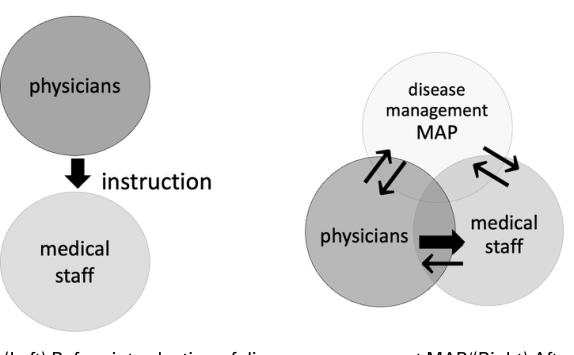
Changes in the Relationship Between Doctors and Medical Staff Conventionally, in the medical field, each medical staff supported patients according to their role, following the physician’s instructions (blindly acce- pting the physician’s instructions) (Fig. 1, left). However, physicians who treat outpatients with multiple complex diseases are at risk of missing out on vari- ous medical fields such as tests, medications, and the precautions surrounding
132 Yamaguchi and Ito
Figure 1: (Left) Before introduction of disease management MAP/(Right) After introdu- ction of disease management MAP.
medical treatment in the patients’ daily lives. The oversight of missed diagno- sis unknowingly leads to the patient becoming seriously ill and affects the patients’ quality of life, not to mention the accumulation of medical costs. Under these circumstances, the introduction of MAP has been significant. The import of medical care information via electronic medical records into MAP allowed visualization of insufficient treatment conditions to other medical professionals other than physicians. Not only nurses and pharmacists, but also clinical laboratory technicians have been able to provide various advice to physicians through the MAP. It can be said that they have changed from simply receiving instructions from physicians to being relied upon by physici- ans (Fig. 1, right). Although the medical staff is still legally obligated to follow the physicians’ orders, the relationship between the medical staff and the phy- sicians is less-hierarchical, as shown in Fig. 1 right. Another way to put it, in Actor Network Theory (ANT) terms, is that the medical professionals chan- ged to be proactively involved in medical treatment through “collaboration” with non-human actors, i.e., the disease management tool MAP.
CONCLUDING REMARKS The introduction of disease management MAP, which imported medical information from electronic medical records, has made the status of ina- dequate treatment of patients visible to medical professionals other than physicians. With the introduction of MAP, the medical staff began to give various advice to physicians. They have changed from merely receiving instructions from physicians to being relied upon by physicians. From ano- ther angle, it means that each professional occupation was filling in the gaps in the patient care by overlapping the domains beyond their own areas of work. In addition, the relationship between physicians and other professio- nals had changed from a hierarchical relationship to a more flat, reciprocal relationship by raising issues and communicating with each other.
Changes in the Relationship between Medical Professionals Mediated 133
The authors believe that the “collaboration” between medical professi- onals and a disease management tool (human and non-human), and the changes in interprofessional dynamics brought about by the information tool presented in this paper will have some implications for other cases beyond the case of the medical institution treated in this paper.
ACKNOWLEDGMENT
The authors would like to express our sincere gratitude to Dr. Tatsuo Katsuki, Director of the Yawata Medical Center in Komatsu, for allowing us to con- duct this study. This work was supported in part by JSPS KAKENHI Grant Numbers JP 18H00782/19H05469.
REFERENCES
Blumenthal, D. (2009). Stimulating the Adoption of Health Information Technology.
New England Journal of Medicine, 360(15), 1477–1479. Cebul, R.D., Love, T.E., Jain, A.K., and Hebert, C.J. (2011). Electronic health records and quality of diabetes care. New England Journal of Medicine, 365(9), 825–833. Cho, I., Kim, J, Kim, J.H. et al. (2010). Design and implementation of a standards-
based interoperable clinical decision support architecture in the context of the Korean EHR. International Journal of Medical Informatics, 79(9), 611–622. D’Amour, D. (2005). The conceptual basis for interprofessional collaboration core concept and theoretical frameworks. Journal of interprofessional care, Suppl1: 116–131. Frontoni, E., Romeo, L., Bernardini, M. et al. (2020). A decision support system for
diabetes chronic care models based on general practitioner engagement and ehr data sharing. IEEE Journal of Translational Engineering in Health and Medicine, 8, 1–12. Gagalova, K.K., Elizalde, M.A.L., Portales-Casamar, E., and Görges, M. (2020).
What you need to know before implementing a clinical research data wareh- ouse: comparative review of integrated data repositories in health care institutions. JMIR formative research, 4(8), e17687. Latour, B. (2007). Reassembling the social: An introduction to actor-network-theory.
Oxford: Oxford University Press. Ministry of Health, Labor and Welfare (MHLW). Health and Medical Services: Annual Health, Labor and Welfare Report 2011-2012 [online]. Available from https://www.mhlw.go.jp/english/wp/wp-hw6/dl/02e.pdf [accessed January 26 2022]. Yamaguchi, H., and Ito, Y. (2014) Improving the Effectiveness of Interprofessio-
nal Work Teams Using EHR-based Data in the Treatment of Chronic Diseases: An Action Research Study. Proceedings of PICMET. Infrastructure and Service Integration, 14, 3492–3497.
LISTED IN THE AHFE DIGITAL BOOKSTORE CATALOGUE
Explore the complete digital volume
The Human Side of Service Engineering
Read this individual research paper free through the original publisher, or explore the full digital proceedings book.
ISBN 978-1-958651-38-4
Explore this ISBN in the AHFE Bookstore ↗Listed in the July 2026 bookstore catalogue; search by ISBN to confirm current availability · Digital book purchase optional