Jesselyn Alcain, Charlie Marquez, Lara Camille Beriña, Luke Samuel Bulaon, Jane Andrea Cheng, Gennes Erika Cruz (2022). Predictive Model Establishment for The Online Shopping Experience Factors Affecting Repurchase Intention Using Stepwise Linear Regression. In: The Human Side of Service Engineering. AHFE Open Access, vol. 62, pp. 152–159. https://doi.org/10.54941/ahfe1002553
The COVID-19 pandemic has brought drastic changes in the way people purchase goods/products. The behavior of people shifted to online shopping and an increase in electronic transactions. In the present, the e-commerce industry in the Philippines continues to grow; however, it is still not as established as developed countries. For online businesses to succeed in the highly competitive online environment, a better understanding of the different factors affecting consumer behavior is vital. This study investigated the e-commerce sector wherein the focus is the online shopping factors that affect the repurchase intention of consumers from multiple generations, namely Baby Boomers, Generation X, Generation Y, and Generation Z. Seven online shopping experience factors were determined in the study affecting consumers' repurchase intention. The study used stepwise linear regression and Cronbach's alpha for data analysis, and the predictive models were validated. The results show that Customer Satisfaction and Perceived Usefulness affect the online repurchase intention for Baby Boomers. At the same time, Perceived Security, Transactionality, and Website Quality are the factors that affect Generation X's repurchase intention. Furthermore, Availability, Perceived Usefulness, and Website Quality affect repurchase intention for Generation Y. Lastly, Perceived Ease of Use, Perceived Security and Customer Satisfaction affects the repurchase intention for Generation Z. Aside from repurchase intention, these factors also significantly affect online store revisit. These results will be helpful for e-commerce company owners in improving the features of their platforms based on consumers' preferences. Recommendations include for e-commerce sites to improve cybersecurity, and user-friendly interface, convenient payment methods, clear refund or return policies, and consistent monitoring and updating of product stocks.
Predictive Model Establishment for the Online Shopping 153
INTRODUCTION
The e-commerce industry in the Philippines continues to grow but it is still not as established as other countries and there is still room for improvement. Despite the advantages of online shopping, there are still errors from online services (Karadeniz and Kocamaz, 2022). In order for online businesses to succeed, having a better understanding of different factors that affect consu- mer behavior is vital in attracting new customers, maintaining and converting online visitors to customers (Vojvodic et al., 2015).
This led the researchers to determine the factors that affect the consumers’ repurchase intentions based on online shopping experiences and established predictive models to improve operations and maximize profit based on online surveys.
This research provides means for e-commerce company owners and sellers to prioritize improving specific features of their business which will grant them customer trust and achieve maximum sales while minimizing costs. It can also assist Micro, Small and Medium Enterprises shifting to e-commerce in determining the essential factors which business owners could utilize to establish customer attraction and retention from the very beginning. Furth- ermore, the results will lead to a more satisfying online shopping experience for Filipino consumers of all ages.
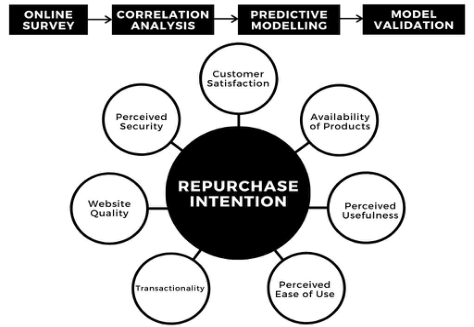
The target respondents of the online survey were online shoppers from the National Capital Region that belong to Baby Boomers, Generations X, Y, and Z in order to fill the research gap and to cater for every generation. Further- more, this study is limited only to the following factors affecting a customer’s repurchase intention: customer satisfaction, availability of products, percei- ved usefulness, perceived ease of use, transactionality, website quality and perceived security. Data gathering was done through online platforms due to quarantine restrictions and the analysis of results was done using the Stati- stical Package for the Social Sciences (SPSS) software. Lastly, the researchers did not focus on any specific e-commerce companies, as every company has a different marketing strategy which can further limit the scope of the research.
REVIEW OF RELATED LITERATURE Repurchase Intention
Repurchase intention exhibits loyalty in consumer behavior wherein there is the urge to rebuy a product or service after a generally favorable experience (Parasuraman, 2006 as cited in Mazza Garcia, 2020).
It is a subjective probability that a consumer will continue to revisit online shops and purchase products from them (Johan, 2020). This indicates that repurchase intention also entails a consumer revisiting an online shop.
Online Shopping Experience Factors As cited in Coker in 2013, Oliver described Customer Satisfaction as the ple- asant sentiments consumers obtain from their interactions with enterprises. When customers are rewarded with a satisfactory purchasing experience in the context of marketing, they are motivated to return to the same seller the
next time a need to purchase the same product or service arises (Andersen & Sullivan, 1993; Kotler, 1999 as cited in Coker, 2013).
Availability refers to how the online store offers a wide variety of abun- dant and affordable products for a specific period of time. It is considered a perceived benefit in online shopping which is proven to increase the inten- tion of consumers to use the internet for shopping (Pandey & Parmar, 2019; Ahmed, et al., 2016).
Perceived Usefulness has a major impact on attitudes regarding online shopping since it refers to how the online store shows the convenience and benefits of online shopping (Juniwati, 2014).
Rose et al. (2012) described perceived ease of use on how consumers can easily shop, function and navigate through the websites of internet shopping.
Transactionality, as described by Pandey & Parmar (2019), is how online retailer shops offer easy refund and return policies regarding defective pro- ducts, as well as how other consumers prefer online shopping if the prices are lower than original price.
Website Quality refers to how the online store provides a secured and aesthetic website interface with clear information and guidelines (Rose et. al., 2012).
Perceived Security refers to the assurance that online retailers will keep all consumer information safe and private. One of the factors associated with it is perceived risk which Ahmed et al. (2016) revealed in their findings as one of the variables that have significant impact and correlated with adoption of online shopping.
Statement of Hypotheses The Researchers Hypothesized the Following:
H1: Customer Satisfaction has a significant influence on determining the repurchase intention of online shoppers. H2: Availability of Products has a significant influence on determining the repurchase intention of online shoppers. H3: Perceived Usefulness has a significant influence on determining the repurchase intention of online shoppers. H4: Perceived Ease of Use has a significant influence on determining the repurchase intention of online shoppers. H5: Transactionality factor has a significant influence on determining the repurchase intention of online shoppers. H6: Website Quality has a significant influence on determining the repu- rchase intention of online shoppers. H7: Perceived Security has a significant influence on determining the repurchase intention of online shoppers. H8: The significance level of the factors affecting repurchase intention varies for every generation.
Research Paradigm The conceptual framework of the present study was based on previous study findings on factors, dimensions, and attributes that positively influence consumer behaviors in the e-commerce context.
Predictive Model Establishment for the Online Shopping 155
Figure 1: Conceptual framework. (Adapted from Pandey, A. & Parmar, J. 2019).Table 1. Cronbach alpha of online shopping factors.
RESEARCH METHODS The researchers used a Correlation-Predictive research design, which includes using more than two variables to test out the relationship between shopping experience variables and consumer repurchase intention. Online shoppers from all generations (Baby Boomers, Gen X, Y & Z) that are residing in National Capital Region cities of the Philippines are the respondents of the study which were approached through online encounters and asked four scre- ener questions. Once satisfied, the respondents proceeded in answering the survey questionnaire in a 5-point likert scale through Google Forms.
RESULTS AND DISCUSSION
Cronbach Alpha was used as a reliability test for the total of 298 respon- dents having a scale of acceptable value above 0.7 and poor value below 0.7. As seen on Table 1, the reliability statistics for all online shopping factor constructs are above 0.7, indicating reliability and validity.
Table 2. Model Summary for baby boomers, generations X, Y, and Z.
Table available in the original PDF paper.
Baby Boomers Generation X Generation Y Generation Z Model 1 2 1 2 3 1 2 3 1 2 3 R .536a .598b .596a .654b .687c .705a .787b .806c .653a .737b .776c
Stepwise Linear Regression Stepwise Regression is a step-by-step iterative process of a regression model (Statology, 2019). All of the model’s r-square values indicate a high linear relationship and its percentage variabilities. In addition, all of the model’s coefficients result in a positive relationship with the dependent variable. Thus, making sure that all models have at least one significant variable. The study results are shown in the tables below with the significant criterion of alpha equal to 0.05.
The following are the predictive models generated from this research: Model 1: Repurchase Intention Model for Baby Boomers γ1 = 1.829 + 0.320χ1 + 0.296χ3 + ε where ε = 0.454 Model 2: Repurchase Intention Model for Generation X γ2 = 0.979 + 0.283χ5 + 0.295χ3 + 0.256χ6 + ε where ε = 0.469
Predictive Model Establishment for the Online Shopping 157
Model 3: Repurchase Intention Model for Generation Y γ3 = 0.212 + 0.420χ3 + 0.304χ2 + 0.256χ6 + ε where ε = 0.371 Model 4: Repurchase Intention Model for Generation Z γ4 = 0.824 + 0.257χ7 + 0.296χ4 + 0.306χ1 + ε where ε = 0.372.
CONCLUSION
The online shopping experience factors that directly affect consumers’ repu- rchase intention differ per generation: for Baby Boomers, Customer Sati- sfaction and Perceived Usefulness; for Generation X, Perceived Security,
Transactionality, and Website Quality; for Generation Y, Availability, Percei- ved Usefulness, and Website Quality; for Generation Z, Perceived Ease of Use, Customer Satisfaction and Perceived Security. These mentioned factors that significantly affect repurchase intentions are also the independent factors that
Predictive Model Establishment for the Online Shopping 159
affect online store revisit. Therefore improving e-commerce sites, its security and having a user-friendly interface, accessible payment options, clear refund or return policies, and regular monitoring and updating of product supplies are the recommendations of the researchers.
ACKNOWLEDGMENT
The researchers would like to render this pursuit to God, to the University of Santo Tomas Faculty of Engineering, and most especially to their families and friends which motivated them to continue pursuing this study.
REFERENCES
Ahmed, R., Vveinhardt, J., Channar, Z., & Feroz, A. (2016). Empirical analysis of factors influencing the online shopping phenomenon: Evidence from Pakistan. 3rd International Multidisciplinary Scientific Conference on Social Sciences & Arts SGEM, ISSN 2367–5659. Coker, B. (2013). ANTECEDENTS TO WEBSITE SATISFACTION, LOYALTY,
AND WORD-OF-MOUTH. Proceedings of 10th CONTECSI International Con- ference on Information Systems and Technology Management. https://doi.org/10. 5748/9788599693094-10contecsi/ps-48. Johan, I. S., Indriyani, R., & Vincevica -Gaile, Z. (2020, April 29). Measuring repurchase intention on fashion online shopping. SHS Web of Conferences. Retrieved November 20, 2021, from https://bit.ly/34OXZ4Y Juniwati. (2014). Influence of Perceived Usefulness, Ease of Use, Risk on Attitude
and Intention to Shop Online. European Journal of Business and Management. https://www.iiste.org/Journals/index.php/EJBM/article/view/15565/15972. Karadeniz, M., Kocamaz, I. (2020). An Investigation of Post-Purchase Cognitive Dissonance and Its Determinants in Online Shopping. Journal of Yasar University, 15 (Special Issue), 307–315. Mazza Garcia, J., De Lamonica Freire, O. B., Almeida Santos, E. B., & Andrade, J. (2020). Factors affecting satisfaction and loyalty to online group buying.REGE
Revista de Gestão, 27(3), 211 228. https://bit.ly/3ozYOFS Pandey, A. & Parmar, J. (2019). Factors Affecting Consumer’s Online Shopping Buying Behavior. Proceedings of 10th International Conference on Digital Strategies for Organizational Success. doi: https://bit.ly/35T1SGo Rose, S. et al. (2012). Online Customer Experience in e-Retailing: An empirical model
of Antecedents and Outcomes. Journal of Retailing, 88(2), 308–322. Statology. (2020, November 6). A Complete Guide to Stepwise Regression in R.
https://www.statology.org/stepwise-regression-r/. Vojvodic, K., Matic, M., & Matusic, D. (2015). Generation y: The importance of socio-psychological variables in an online environment. 2nd International Mul- tidisciplinary Scientific Conference on Social Sciences and Arts SGEM2015. doi: 10.5593/sgemsocial2015/b23/s7.042.
LISTED IN THE AHFE DIGITAL BOOKSTORE CATALOGUE
Explore the complete digital volume
The Human Side of Service Engineering
Read this individual research paper free through the original publisher, or explore the full digital proceedings book.
ISBN 978-1-958651-38-4
Explore this ISBN in the AHFE Bookstore ↗Listed in the July 2026 bookstore catalogue; search by ISBN to confirm current availability · Digital book purchase optional