Praveen Maghelal (2022). Integrating Ergonomics, Biomechanics, and Driving Behavior in a Virtual Environment: Developing a Transactional Framework. In: Physical Ergonomics and Human Factors. AHFE Open Access, vol. 63, pp. 132–140. https://doi.org/10.54941/ahfe1002606
The World Health Organization identifies road traffic injuries are a global health problem. The Global Status Report on Road Safety 2015 (2015) reported that Urgent action is needed to deal with this health epidemic. This is significant because, it is predicted that without addressing this issue head-on, traffic crashes are predicted to become the seventh leading cause of death by 2030. the Sustainable Development Agenda 2030 proposed to reduce the global deaths and injuries occurring from road traffic crashes to half by 2030 (WHO). It in acknowledged that major cause of traffic accidents is a human error related to bad driving behavior or fatigue and drowsiness. Hence, the human factor in transportation design should be a great concern to many transportation researchers (Sanjaya and Sya’bana, 2017). Although human factors have been analyzed through assessment of speed, driving behavior, reaction time, and overall cognitive assessment of environment, transportation research in general has neglected ergonomic study of humans in general (Sanjaya and Sya’bana, 2017) and in particular to understand road traffic crashes. Motion analysis is related to one branch of biomechanics called kinematics, which is the accurate measurement of human motion geometry (Knudson, 2007). Virtual Reality (VR) devices offer the natural solution for inexpensive and compact driving simulation, maintaining a high degree of the immersion feeling.Several studies have evaluated the physiological response to driving using a driving simulator, including measures such as HR variability (HRV), EDA, electromyography (EMG) of the anterior tibialis or trapezius muscle and electroencephalography (EEG). Several driving conditions contribute to differences in signals such as braking, mental workload or physical fatigue (Eudavea and Valencia, 2017). Vehicle operators must rapidly assess changes in vehicle stability and adjust body position in order to maintain vehicle control as they negotiate various road networks and types. Simulation can safely replicate changes in vehicle center of mass, and the operator’s biomechanical responses to these changes can be measured (Jennison et al 2017). However, studies related to human factors and driving have either analyzed the likelihood of traffic injuries (Petridou and Moustaki, 2001) or analyzed the physiological responses to driving behavior independently such as eye tracking (Kasneci, E., et al 2017), ECG and EMG (Eudavea and Valencia, 2017); and postural markers (Jennissen, et al 2017). A comprehensive framework to analyze the driving behavior in virtual simulator and assessing its impact on human physics remains a gap to the best of our knowledge.This research therefore investigates human impact and impact on humans of driving behavior using virtual reality. This study develops a theoretical framework to comprehensively assess the personal, situational and environmental factors that impacts driving behavior and its integration within virtual environment. It furthers this integration by developing a normative framework that uses biomedical and physiological approaches to investigate the impact of driving behavior on human body. Development of such a comprehensive framework will help further the knowledge and understanding of driving safety and human ergonomics and guide further research in this field.
The World Health Organization (WHO, 2017) identifies road traffic injuries as a global health problem. Urgent action is needed to deal with this health and socioeconomic challenge because, it is predicted that without addressing this issue head-on, traffic crashes may become the seventh leading cause of death by 2030 especially, given the fact that the majority of these crashes occur among youth aged between 15-29 years of age. In response, the Sustai- nable Development Agenda 2030 proposes to reduce the global deaths and injuries occurring from road traffic crashes to half by 2030. This is an ambi- tious target considering that every year about 1.25 million individuals are killed as a result of traffic crashes, while 20-50 million suffer non-fatal inju- ries which costs most countries about three percent of their gross domestic product.
Recent studies (RoadSafetyUAE, 2017) report that 41% of people beli- eve that driving has become more dangerous than before exacerbated by the drivers of various cultural background and driving experience. It in acknow- ledged that major cause of traffic accidents is human error related to bad driving behavior or fatigue and drowsiness. Hence, the human factor in transportation design is a critical concern that needs to be addressed by transportation researchers (Sanjaya and Sya’bana, 2017).
Integrating Ergonomics, Biomechanics and Driving Behavior in a Virtual Environment 133
Although human factors have been analyzed through assessment of speed, driving behavior, reaction time, and overall cognitive assessment of environ- ment, transportation research has neglected ergonomic study of humans in general, and particularly towards understanding road traffic crashes (Sanjaya and Sya’bana, 2017). Virtual Reality (VR) devices offer a natural solution for inexpensive and compact driving simulation, maintaining a high degree of the immersive feeling. Also, simulation can safely replicate changes in vehicle center of mass, and the operator’s biomechanical responses to these changes can be measured.
Additionally, studies have evaluated the physiological response to driving using driving simulators. Various driving conditions contribute to variabi- lity of physiological signals, such as braking, mental workload or physical fatigue.
Till date, the majority of studies related to human factors and driving have either analyzed the likelihood of traffic injuries (Petridou and Mou- staki, 2000) or the physiological responses to driving behavior independently, such as eye tracking (Kasneci, E., et al, 2017), ECG and EMG (Eudavea and Valencia, 2017); as well as postural markers (Jennissen, et al, 2017). An inte- grative comprehensive framework to analyze the driving behavior in a virtual simulator while assessing its impact on human biomechanics and physiology remains a gap to the best of the author’s knowledge.
Therefore, this study proposes an approach to comprehensively assess the personal, situational and environmental factors that impact driving behavior and its integration within a virtual environment. This integration is further proposed as a translational model or framework that applies biomedical and physiological approaches to investigate the impact of driving behavior on the human body. Such comprehensive framework will help advance the know- ledge and understanding of driving safety and human ergonomics and guide much needed further research in this field.
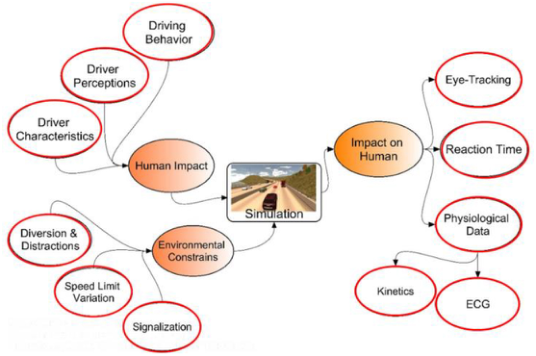
DEVELOPING TRANSACTIONAL FRAMEWORK A model that is influenced by processes in which interactions in two dire- ctions are considered together is defined as a transactional model (Sameroff 2009). This transactional model is proposed to investigate human impact and impact on humans on driving behavior using virtual reality (Fig. 1). Human impact is measured through various markers of driving behavior given their cultural, socio-demographic, experience of driving, method of licensure, and perception of driving conditions and driving regulation. Impact on humans is measures using eye-tracking to observe physiological response, postural markers to observe stress on human ergonomic and brain imaging of their sensory responses, all under varying environmental constrains.
Virtual Reality Systems Virtual environments are used in several areas, like engineering, architecture, design and education as its use plays a leading role on research of spatial processes. This technology allows the simulation of three-dimension environ- ments, that can be explored by humans, in computers. Jansen-Osman (2002) classified VR systems into two systems: desktop and immersive display
134 Maghelal
Figure 1: Transactional framework to analyze human on driving - driving on human interaction.
systems. The first displays the virtual world on a computer screen. In con- trast to this, immersive systems use devices like head mounted displays and tracking systems that create the impression of being completely “immersed”. An intermediate option between these systems are mixed-reality applicati- ons. Examples of this are using of projection-screens and three-dimensional monitors. The performance and behavior of VR systems are, to large extent, determined by the display techniques used to present the computer-generated graphics (Blissing et al., 2019).
Simulators offer an almost completely controlled environment with a high repeatability, reproducibility and flexibility in terms of capability to realize complex and dangerous scenarios, that are hard or impossible to perform in real vehicles even on test tracks (Blissing et al., 2019). Within the virtual driving environment, the framework considers the influence of both human driving behavior and driving on humans in an environmentally constrained test settings.
Human Impact in Driving Environment Human impact in a driving environment can be assessed through their driving behavior, perception and individual characteristics. Driving behavior: Dri- ving behavior is environmentally and culturally mediated. While the physical environment influences the speed of the drivers, studies claim that culture has a significant influence on driving behavior and can play a critical role in general driving safety. For instance, Soliman et al. (2018) conducted a study in Qatar using a Driving Behavior Questionnaire (DQB) which showed that Qatari residents share similarities in their approach to driving even though there is a great diversity among them. Furthermore, the speed of driver is con- sidered as one of the most important factors which influences the accident occurring probability as well as severity, Hence, any relationship in speeding behavior during driving also affects the accident risk involved in driving. It is therefore, argued that a better understanding of individual differences in
Integrating Ergonomics, Biomechanics and Driving Behavior in a Virtual Environment 135
driving behavior will allow more appropriate and effective work on road safety policies and procedures to be developed. Driving behavior appears to be influenced by specific emotional states only. Higher risk taking, aggressive driving and violations of traffic rules seem to be specific for angry drivers (Megías et al., 2011).
Driver Perceptions: Any mode of travel in influenced by the perception of the environment, individual choice and accessibility to the mode of travel. These in turn impacts the behavior of its users, be it walking, biking, dri- ving or using public transportation (Almardood and Maghelal, 2020). Such environment influences individual (Pimenta et al., 2021) and community perception (Al-Ali et al., 2020) on their choice of using a particular mode of travel. Especially for the driving environment, safety of use of road and indi- vidual’s perception of their own driving skills have reported to impact driving of individuals. Measures of self-efficacy of drivers and their perception of the driving environment are some assessments that could be included as part of this factor.
Driver Characteristics: It has been recognized that men and woman exhi- bit different driving behaviors. The evidence of gender differences in driving behavior can be established more on a natural psychological basis than on experience and differences in capabilities and driving skills. Additionally, individual age, education, driving experience, vehicle ownership has reported to influence driving.
Environmental Constraints Distractions and Diversions: Drivers’ attention resources are limited, and if a driver attempts to perform any secondary tasks, the redistribution of attention may lead to deterioration in driving performance. According to the US National Highway Traffic Safety Administration, there are three types of distractions while driving: visual, manual and cognitive. Visual distra- ction occurs when drivers take their eyes off the road to interact with a device; cognitive, when attention is withdrawn from driving and assigned to other tasks; and manual, when drivers take their hands off steering wheel to manipulate a device, leading to action errors. Some distractive beha- vior includes use of cellphones and driving with peers as studies report that accident probabilities increase by 3 and 4 times respectively when dri- vers were conversing or texting on a phone during driving. Also, several studies have dealt with the influence of peers on risky driving and their jud- gmental decision making process by comparing between driving alone and driving with friends in the car, and have consider the factors of age, gen- der, number of passengers, and their connection to the driver (Albert and Steinberg, 2011).
Signage and Speed limits: Roadwork sites have a higher crash rate than the same roads without. A meta-review of accidents in the Netherlands (Martens and Kaptein, 1998) suggest that a failure to miss roadwork signs can result in various accidents such as rear-end collisions and crashing into roadwork safety trailers.
136 Maghelal
Driving Impact on Humans It is clear that the use of a simulated environment involves considerable sim- plifications in the analysis of the situation. However, the determinants of driving behavior and its impact of human health can be much clearly analyzed in a controlled setting of the simulator.
Eye-Tracking: Eye tracking allows to obtain important elements regarding the drivers’ behaviour during their driving activity, by employing a device that monitors the movements of the eye and therefore of the user’s observation point. Meanwhile, visual demand is indicated by number of glances, mean glance duration, single glance duration, percent dwell time, etc. (Hofmann, et al., 2015).
Reaction Time: Objective assessment indicators of driving refers to dri- ving performance and visual demand indicated by longitudinal speed control, headway distance control, brake reaction time, lateral steering error, lane departure, etc. (Ma, et al., 2020).
Physiological Response: The use of physiological indicators to infer men- tal states has a long research tradition (see Table 1). Pupil diameter has been studied largely concerning cognitive workload, stress, fatigue, mental effort, information processing and attention. Eyeblink rate is considered an indica- tor for task demands, mental and visual workload, mood states and fatigue (Cowly et al., 2016). Heart rate is usually used in driving simulation and on- road driving studies as an indicator of stress, workload, mental effort and task demands. Electrodermal Activity (EDA), also known as Galvanic Skin Response (GSR), has long been used in physiological research. Changes in EDA are associated with alertness, emotional load, mental effort and task difficulty (Cowly et al., 2016). Posture, may not have a direct influence on driving, but the discomfort and potential pain from sitting, can influence and affect driving. Reflective markers on anatomical locations together with spe- cialized software will allow us to measure the variations in posture and the amount of fidgeting that takes place, an important correlate of discomfort Electroencephalography (EEG), a physiological signal containing informa- tive brain activities, has presented promising results and findings in a wide range of research fields especially concerning the visual information proces- sing decision-making and action execution (Wijayaratna et al., 2019). It has been found that potentials can be measured via electrodes attached to parti- cipants’ scalp when the participant is exposed to external visual or auditory stimuli. The integration of these physiological measures will allow strong conclusions to be made based on the visual information that is processed or not processed. Such information will give cues as to what type of early warning signals may be required.
TRANSLATIONAL FRAMEWORK TO EXPERIMENTAL SETUP Use of physiological measures to assess responses in virtual environment is encouraged to deepen the understanding of cognitive-emotional state and to overcome the limitation of subjective responses of participants (Higuero- Trujillo et al., 2017, Reinerman-Jones et al., 2010). Although several studies
Integrating Ergonomics, Biomechanics and Driving Behavior in a Virtual Environment 137
Table 1. Domains of physiological indicators and its measures.
Electrophysiological monitoring means that it is used to record an electrical activity associated with cardiac contractions that appears on the paper as a spike and dips in lines due to the muscle squeeze Heart Rate Variability (HRV) Physiological phenomenon on variation within a period of an interval that is between consecutive heartbeats measured in milliseconds and derived from ratio of different low (LF) and high frequency (HF)
Breathing Rate Number of breaths taken per minute measured by counting the chest rises time Heart Rate = 60 R −RInterval
Rhythm Frequency Behavior
Electroence- phalogram (EEG)
State of the person whether (s)he is sleepy, happy or nervous. Each frequency measures the type of rhythm and behavior(s) associated with it measured from various parts of the scalp
Eye Blinking Eye is considered a major factor in determining the attention level of a person towards the surrounding. Eye Aspect Ratio determines when a blink happens EAR = ∥p2 −p6∥+ ∥p3 −p5∥ 2∥p1 −p4∥
have used such physiological measures, recent review of these studies (Hal- big and Latoschik 2021, Wood et al., 2021) report use a combination of ECG, EDA, Skin Temperature (ST), Respiration, EMG, Eye-Tracking and EEG with not a single study using a comprehensive approach of assessing all the physiological measures using virtual simulation. This study, henceforth, proposes a comprehensive normative framework to assess physiological mea- sures and advanced markers in a driving environment. Future studies can empirically test the most significant measures that relate to traffic crashes of all users of the road.
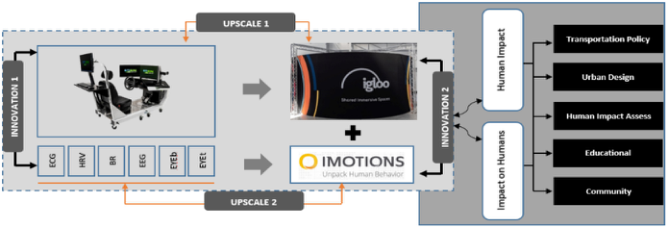
Most virtual reality studies in transportation planning have use desktop or semi-immersive method. Also, the physiological data have been collected independently without clear calibration with driving behavior in the simula- ted test environment. Improvement to such system is recommended using currently available technologies (Fig. 2). For instance, the driving simula- tion can be moved from a semi-immersive to full 270-degree immersive igloo
138 Maghelal
Figure 2: Upscaling and integration of ergonomics and biomechanics in driving environment.
cylindrical setup to give a more realistic projection of the virtual environ- ments. Secondly, the physiological measures can be time-stamped to match the driving behavior and other test events using an advanced iMotion package that integrates the different measures effectively.
The integration of driving simulator data with the physiological data is a recent update in simulation studies. The upscaling of the simulation in the igloo can be integrated with the iMotion package to time-stamp data from both the sources more effectively to assess the human impact and impact of humans. This will aid to determine the fundamental issues related to driving so that remedial measures may be instigated for various stakeholders from the transportation, safety and health agencies.
CONCLUSION
An extensive review of physiological measures and its application in virtual reality by Halbig and Latoschik (2021) reveal that most studies intergrating both these approaches are mostly in the field of medical sciences. Virtual dri- ving environment studies (Maghelal et al., 2011, Naderi et al., 2008) usually assess the driving charactersitics and lack integration of physiological measu- res until its recent development (Beggiato et al., 2019). Even so, none of these studies use a comprehensive approach. This study proposes a transactional framework to integrate these measures using advanced software (iMotion) and hardware (Igloo). Such investigations can also be used to assess crashes of heavy commerical vehicles (Alkhoori and Maghelal, 2021), safe environ- ment for walking and biking (Maghelal et al. 2022) and other perceptions and behavior of road users objectively. Future studies can empirically test these virtual scenarios for effective policy making and road design to reduce crashes and its severity.
REFERENCES
Al-Ali, A., Maghelal, P. and Alawadi, K., 2020. Assessing neighborhood satisfaction and social capital in a multi-cultural setting of an Abu Dhabi neighborhood. Sustainability, 12(8), p.3200. Albert, D., Steinberg, L., 2011. Judgment and decision making in adolescence. J. Res.
Adolesc. 21, 211–224.
Integrating Ergonomics, Biomechanics and Driving Behavior in a Virtual Environment 139
Alkhoori, F.A. and Maghelal, P.K., 2021. Regulating the overloading of heavy commercial Vehicles: Assessment of land transport operators in Abu Dhabi. Transportation Research Part A: Policy and Practice, 154, pp. 287–299. Almardood, M.A. and Maghelal, P., 2020. Enhancing the use of transit in arid regi-
ons: Case of Abu Dhabi. International Journal of Sustainable Transportation, 14(5), pp. 375–388. Beggiato, M., Hartwich, F. and Krems, J., 2019. Physiological correlates of discomfort in automated driving. Transportation research part F: traffic psychology and behaviour, 66, pp. 445–458. Blissing, B., Bruzelius, F. and Eriksson, O., 2019. Driver behavior in mixed and virtual
reality–a comparative study. Transportation research part F: traffic psychology and behaviour, 61, pp. 229–237. Cowley, B.U., Filetti, M., Lukander, K., Torniainen, J., Helenius, A., Ahonen, L., Barral Mery de Bellegarde, O., Kosunen, I.J., Valtonen, T., Huotilainen, M.J. and Ravaja, J.N., 2016. The psychophysiology primer: a guide to methods and a broad review with a focus on human-computer interaction. Foundations and Trends in Human-Computer Interaction. Eudave, L.; Valencia, M. In Wearable and Implantable Body Sensor Networks (BSN),
Proceedings of the IEEE 14th International Conference on IEEE, May 2017, pp 145–148. Halbig, A. and Latoschik, M.E., 2021. A systematic review of physiological measurements, factors, methods, and applications in virtual reality. Frontiers in Virtual Reality, 2. Higuera-Trujillo, J.L., Maldonado, J.L.T. and Millán, C.L., 2017. Psychological and
physiological human responses to simulated and real environments: A comparison between Photographs, 360 Panoramas, and Virtual Reality. Applied ergonomics, 65, pp. 398–409. Hofmann, H., Tobisch, V., Ehrlich, U. and Berton, A., 2015. Evaluation of speechbased HMI concepts for information exchange tasks: a driving simulator study. Computer speech & language, 33(1), pp. 109–135. Jansen-Osmann, P., 2002. Using desktop virtual environments to investigate the role
of landmarks. Computers in Human behavior, 18(4), pp. 427–436. Jennissen, C.; Rahmatalla, S.; Michael, J. S.; DeShaw, J.; Denning, G.; Grant, U.; Losik, K. Identifying Postural Control and Thresholds of Instability Utilizing a Motion-Based ATV Simulator, 2017. Kasneci, E., Black, A.A. and Wood, J.M., 2017. Eye-tracking as a tool to evaluate
functional ability in everyday tasks in glaucoma. Journal of ophthalmology, 2017. Ma, J., Gong, Z., Tan, J., Zhang, Q. and Zuo, Y., 2020. Assessing the driving distraction effect of vehicle HMI displays using data mining techniques. Transportation research part F: traffic psychology and behaviour, 69, pp. 235–250. Maghelal, P., Alawadi, K., Arlikatti, S. and Wahdain, A., 2022. Influence of the Built
Environment on Physical Activity Choices among Emirati Male and Female Ado- lescents: An Examination of Parents’ and Students’ Perceptions. Sustainability, 14(1), p.444. Maghelal, P., Natesan, P., Naderi, J.R. and Kweon, B.S., 2011. Investigating the use of virtual reality for pedestrian environments. Journal of Architectural and Planning Research, pp. 104–117. Martens, M. and Kaptein, N., 1998. Speed Behaviour before and after road design
modifications-A meta review.
140 Maghelal
Megías, A., Maldonado, A., Cándido, A., & Catena, A. (2011). Emotional modulation of urgent and evaluative behaviors in risky driving scenarios. Accident Analysis and Prevention, 43, 813–817. Naderi, J.R., Kweon, B.S. and Maghelal, P., 2008. The street tree effect and driver
safety. ITE Journal on the Web, 78(2), pp. 69–73. Petridou, E. and Moustaki, M., 2000. Human factors in the causation of road traffic crashes. European journal of epidemiology, 16(9), pp. 819–826. Pimenta, A.R., Maghelal, P.K. and Alawadi, K., 2021. Are transit-adjacent deve-
lopments effective neighborhood design models to help meet the recommended weekly physical activity levels? The case of Abu Dhabi. International Journal of Sustainable Transportation, 15(3), pp. 163–174. Reinerman-Jones, L., Cosenzo, K. and Nicholson, D., 2010. Subjective and objective measures of operator state in automated systems. Applied Human Factors and Ergonomics, Miami, FL. RoadSafetyUAE. UAE Road Safety Monitor Commissioned by RoadSafetyUAE and
QIC Insured http://www.roadsafetyuae.com/statistics/ (accessed on February 3, 2022) Sameroff, A. (2009). The transactional model. In A. Sameroff (Ed.), The transactional model of development: How children and contexts shape each other (pp. 3–21). American Psychological Association Sanjaya, K.H. and Sya’bana, Y.M.K., 2017, January. Conceptual framework on the
application of biomechanical measurement methods in driving behavior study. In AIP Conference Proceedings (Vol. 1788, No. 1, p. 040002). AIP Publishing LLC. Soliman, A., Alhajyaseen, W., Alfar, R. and Alkaabi, I., 2018. Changes in driving behavior across age cohorts in an Arab culture: the case of state of Qatar. Procedia computer science, 130, pp. 652–659. Wijayaratna, K.P., Cunningham, M.L., Regan, M.A., Jian, S., Chand, S. and Dixit,
V.V., 2019. Mobile phone conversation distraction: Understanding differences in impact between simulator and naturalistic driving studies. Accident Analysis & Prevention, 129, pp. 108–118. World Health Organization. Road Traffic Injuries. 2017 http://www.who.int/mediac entre/factsheets/fs358/en/ (accessed on January 23, 2022) Wood, K., Uribe Quevedo, A.J., Penuela, L., Perera, S. and Kapralos, B., 2021,
October. Virtual Reality Assessment and Customization Using Physiological Mea- sures: A Literature Analysis. In Symposium on Virtual and Augmented Reality (pp. 64–73).
LISTED IN THE AHFE DIGITAL BOOKSTORE CATALOGUE
Explore the complete digital volume
Physical Ergonomics and Human Factors
Read this individual research paper free through the original publisher, or explore the full digital proceedings book.
ISBN 978-1-958651-39-1
Explore this ISBN in the AHFE Bookstore ↗Listed in the July 2026 bookstore catalogue; search by ISBN to confirm current availability · Digital book purchase optional