Paola Soraya Silva Tobar, Wladimir Chacón Paredes, Cesar Guevara (2022). Continuous improvement as a competitive strategy within organizational quality processes. In: Applied Human Factors Research. AHFE Open Access, vol. 67, pp. 196–201. https://doi.org/10.54941/ahfe1002696
The business environment is constantly changing, due to the different realities and complexities (socioeconomic, political, market, environmental, technological, axiological, among others) that surround them, generated by competitive components that push towards operational excellence. In this context, continuous improvement is understood as a process that helps maintain and improve competitiveness in each business process, with the purpose of providing quality service and consolidating customer satisfaction. The objective of the study is to analyze the methods of continuous improvement for the strengthening of competitiveness related to quality in organizational processes. An investigation is proposed with a mixed non-experimental, field and longitudinal perspective; using hermeneutics as a method of interpretation. Among the results, it stands out that once the value chain and the diagnosis were applied by applying the ISO 9001: 2015 checklist, it was determined that certain non-conformities affected the production, commercial and financial processes. The conclusions denote that using the Kaizen method, results are obtained that allow the consolidation of operational excellence, over all those that have direct inherence with the attention to consumers.
Companies have been evolving and growing rapidly, with a view to facing new disruptions and divergent changes that directly affect their functiona- lity and operability (Gómez et al., 2020). Likewise, the authors emphasize that businesses generally go through phases (operational, structural, human talent, technological, sustainability, social responsibility, globalization) that are quite distinctive, whose characterizations are framed within processes related to managerial and organizational management, where each one of them emphasizes a relevant aspect of administrative science that is in the constant search for continuous improvement, quality and excellence.
In this sense, continuous improvement can be understood as a philosophy or way of life (culture) that focuses on the development of operational and
Continuous Improvement as a Competitive Strategy within Organizational Quality 197
functional adversities that organizations suffer, with the intention of bala- ncing activities, turning them into an organizational competitive advantage (Alaña et al., 2018). Another way to describe it is to take it as an organized sequence of activities that allows solving problems or managing projects in any area of the company and that must produce added value for the custo- mer. Value means the total satisfaction of the needs and expectations of the consumer in terms of price, performance, term, production, environmental impact and ethical principles. It is an organized systematic process of continu- ous improvement used to guarantee the fulfillment of objectives, undertaking processes under teamwork for which a common purpose and a single process are required.
The search for operational excellence is a differentiating element with which organizations focus to face the volatility of the economy, intense competition and market uncertainties. Keeping abreast of the company’s kno- wledge and behavior (internal and external) plays an important role when undertaking new business models and strengthening operating procedures with a view to achieving an intelligent business level and a systemic and innovative vision, especially all in processes framed towards quality and organizational profitability (Garbanzo-Vargas, 2015).
In Ecuador there is a trend on the part of companies that are concer- ned with being pioneers in terms of quality and operational productivity (Guaipatin and Schwartz, 2014). The initiatives are framed towards the deve- lopment of procedural policies that guide and support the processes that make up the organization. Contreras et al. (2017) that in order to make progress in this aspect, it is necessary to establish management levels or indicators that allow the introduction of a philosophy of continuous impro- vement and to be able to evaluate the results of the operations, especially those that are framed in customer satisfaction. These indicators can generally be concentrated through a Quality Management System (QMS) that serves as a tool that merges a series of activities to control tasks effectively and efficiently.
The management system must contain conformity characteristics adhered to continuous improvement and, in this way, avoid distortions that could be reflected in the marketing and positioning of the product/service. This appro- ach must be designed from the perspective of quality, in fact, González et al. (2016) state that it emerges as a competitive source that addresses internal and external processes that in many cases adapts to models (Deming, Quality Management model based on ISO 9001 processes, Kaizen model, Euro- pean Excellence, Lean Manufacturing, Six Sigma, Just in Time, Porter’s five forces, continuous improvement), which seek to strengthen organizational operations.
This research is carried out in the family business known as “Importa- dora Altamirano e Hijos” IMPALDIESEL Cía. Ltda., located in the city of Ambato, Tungurahua Province-Ecuador; which has been in the market for 26 years dedicated to the importation and merchandising of spare parts for diesel automobiles, in which it is intended to analyze the methods of continu- ous improvement for the strengthening of competitiveness related to quality in organizational processes.
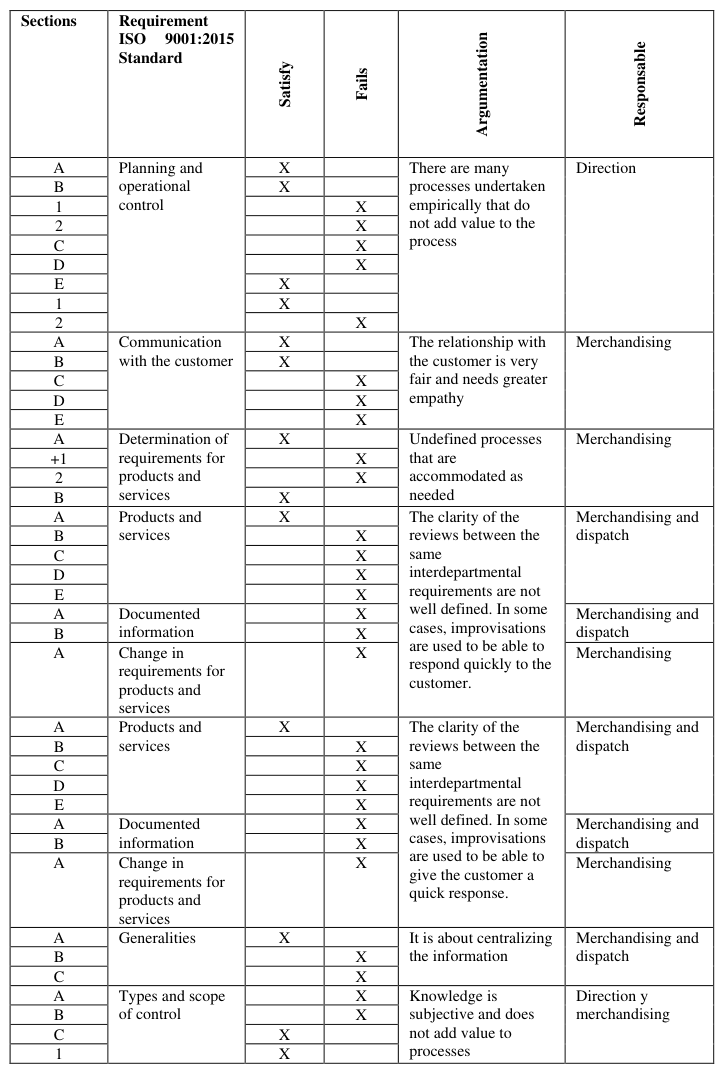
An investigation with a mixed non-experimental, field and longitudinal perspective is proposed; using hermeneutics as a method of interpretation. It is based on the following study variables: continuous improvement as a dependent variable (mixed) and the merchandising and dispatch pro- cess as independent (quantitative) in accordance with the collection and descriptive analysis related to the information extracted from the company “Importadora Altamirano e Hijos” IMPALDIESEL Cía. Ltda (Table 1).
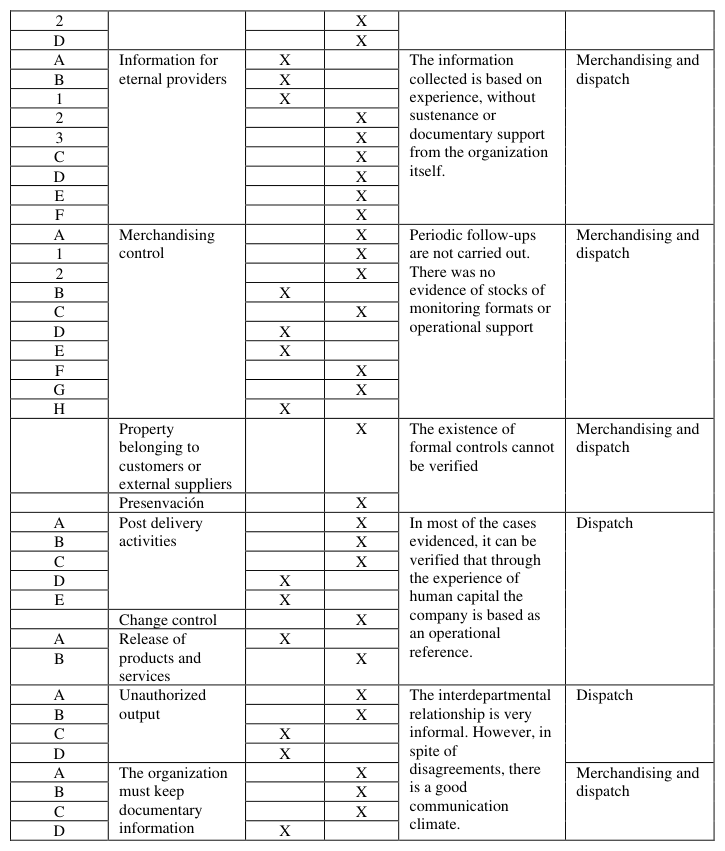
The checklist determined by the ISO 9001: 2015 standard was applied, which allowed knowing the conformities and non-conformities that support changes and weaknesses and strengthening that must be covered in the design of the continuous improvement model based on the quality of the processes in the merchandising and clearance departments of the company “Importador Altamirano e Hijos” IPALDIESEL Cía. Ltda.
It is precisely in the merchandising and dispatch departments that a series of setbacks have been occurring at the level of their activities, originated by the way the functions are structured at the organizational level, supported by the experience and empirical dedication of those involved in the process, bringing as its main problem the dissatisfaction in terms of customer service, whose consequences lie in the delays (time) for the delivery of the products between marketing and the customer, Inconsistencies in the quantities betw- een the physical inventory and what the invoicing system shows, errors in the delivery of products (wrong brands or measurements), disorientation when selecting or locating the products to be shipped, inappropriate physical orga- nization of products in the warehouse and poor use of storage space, and inadequate management of inventory management policies due to the use of ineffective methods for projecting demand and the sales plan, generating stock-outs and back orders.
If the aforementioned continues, the company IMPALDIESEL could pre- sent collapses between these dependencies (merchandising and dispatch), which would cause both tangible (monetary mass) and intangible losses (prestige, loyalty, fidelity) as well as problems of effectiveness, producti- vity, efficiency and competitiveness when delivering the product(s) (spare parts). It is important that the Importer internalizes these situations and finds the roots that originate it, which can become a product of ignorance of production processes, little training of the personnel involved, outdated or unequivocal use in terms of handling equipment, non-existence of measu- rement indicators of quality for continuous improvement and to be able to evaluate if the activities tied to the processes are directed towards quality and excellence.
On average only 25% is the percentage that is determined derived from the procedural compliance that the company “Importadora Altamirano e Hijos”IMPALDIESEL Cía. Ltda., presents in the merchandising and dispatch departments. It is important to determine and implement a system based on continuous quality improvement, which strengthens these non-conformities with a view to systematically strengthening the activities and operations in these vital dependencies for the growth and commercial development of the organization, taking into consideration the own resources which the company has.
Continuous Improvement as a Competitive Strategy within Organizational Quality 199
Table 1. ISO 9001:2015 standard requirement.Table 1. Continued.
Excess inventory (items projected into the future that cause loss of space and cost);
Waiting times (ratio of time lost between operators and customers waiting for information);
Inappropriate processes (activities that do not add value to productivity or planning) and
Defects in the final product-deliveries (details failures in the product tracking process in the merchandising and dispatch departments).
CONCLUSION
Markets are becoming more global, complex and changing, which is why it is not always possible to foresee crises. The coronavirus pandemic has made
Continuous Improvement as a Competitive Strategy within Organizational Quality 201
this very clear. Therefore, in the face of the great uncertainty that affects the international and national markets, the importer has made the decision to focus on those small short-term goals that could be key and strategic to sustain itself over time and be able to withstand the onslaught of current economic situation and; even lay solid foundations for the future growth of the organization.
The merchandising and dispatch departments presented among their dia- gnoses what are known as changes, which are indicators of errors or noncon- formities that must be resolved and separated from the processes, with a view to strengthening the activities that really add value to the company. Commu- nication and empathy on the part of the workers is essential to consolidate the new steps to follow at the level of quality activities, as well as to lay the foundations of a new quality philosophy or culture to integrate continuous improvements into activities that serve as a boost to cover the goals and obje- ctives set by the shareholders. The purpose of the Kaizen methodology is to achieve goals and objectives gradually and continuously, eliminating activities that only add losses caused by unequivocal activity management. Of course, in addition to the benefits provided by the Kaizen method, it is also impor- tant to incorporate good software that serves as an ally to the continuous improvement system.
REFERENCES
Alaña, T., Crespo, M., y Gonzaga, S. (2018) Cómo las estrategias empresariales permiten una ventaja competitiva en las micro, pequeñas y medianas empre- sas de la provincia de El Oro? Universidad y Sociedad, 10(2), 251–256. http: //scielo.sld.cu/pdf/rus/v10n2/2218-3620-rus-10-02-257.pdf Contreras, F., Olaya, J., y Matos, F. (2017). Gestión por procesos, indi- cadores y estándares para unidades de información. Biblioteca Nacional del Perú. http://eprints.rclis.org/31012/1/Gesti%C3%B3n%20por%20proceso s%2C%20indicadores%20estandares.pdf Guaipatin, C., y Schwartz, L. (2014). Ecuador. Análisis del Sistema Naci- onal de Innovación. Hacia la consolidación de una cultura innovadora. BID. https://www.epn.edu.ec/wp-content/up loads/2017/03/CTI-MON-Ecuador- An%C3%A1lisis-del-Sistema-Nacional-de-Innovaci %C3%B3n.pdf Garbanzo-Vargas, G. (2015). Desarrollo organizacional y los procesos de cambio
en las instituciones educativas, un reto de la gestión de la educación. Revista Educación, 40(1), 67–87. DOI: 10.15517/revedu.v40i1.22534 Gómez, J., Rodríguez, E., Salas, J. y Acevedo, E. (2020). Análisis comparativo de la pequeña y mediana empresa en América Latina. Visión Gerencial, 19(2), 254–271. González, L., Tapia, M., Hernández, D., y Luna, A. (2016). Factores críticos de éxito
en la mejora de la calidad de la industria manufacturera en el Municipio de Celaya. Pistas Educativas, 38(121), 99–116. http://www.itcelaya.edu.mx/ojs/index.php/pi stas/article/viewFile/506/581
LISTED IN THE AHFE DIGITAL BOOKSTORE CATALOGUE
Explore the complete digital volume
Applied Human Factors Research
Read this individual research paper free through the original publisher, or explore the full digital proceedings book.
ISBN 978-1-958651-43-8
Explore this ISBN in the AHFE Bookstore ↗Listed in the July 2026 bookstore catalogue; search by ISBN to confirm current availability · Digital book purchase optional